Keeping a trading journal is the most recommended and least practiced habit in the business. Everyone knows they should do it, almost nobody really does, and those who stick with it make up a disproportionate share of profitable traders. Journaling is an invisible discipline: its effects don't show trade by trade, but they transform your progress over time.
- Journaling makes your patterns visible: you can only correct what you see.
- It turns experience into learning: without it, you repeat your mistakes without seeing them.
- Its regularity matters more than its perfection: a simple journal kept daily beats a perfect one abandoned.
- It's an invisible discipline: its effects accumulate slowly but transform your progress.
Ask profitable traders what made them improve, and one answer keeps coming back: their journal. Yet when you suggest a struggling trader keep a journal, they drag their feet. It seems tedious, without immediate effect, one more administrative chore. That's the whole paradox of journaling: it's one of the most profitable habits in trading, and one of the most neglected, precisely because its effects aren't immediate.
The journal doesn't make you win on the trade you just logged. It makes you win three months from now, when the patterns it made visible will have let you correct what you couldn't see. It's an invisible discipline, whose value reveals itself through accumulation. This guide explains why journaling is so powerful, what it makes possible, and how to keep it sustainably instead of abandoning it after a week. A journal does more than record: it makes discipline measurable, and measuring your discipline trade after trade turns an intention into a number you can follow over time.
Why journaling is so powerful
The journal's power rests on a simple truth: you can only correct what you see. As long as your mistakes stay vague impressions ('I think I overtrade', 'I feel like I manage my losses badly'), you can't do anything with them. The journal turns those impressions into visible, recurring facts, and a visible fact you can correct. It's the shift from intuition to data that makes progress possible.
Without a journal, you don't trade a hundred times: you trade once, a hundred times. You repeat the same mistakes on loop without ever identifying them, because nothing makes them visible. Each trade is lived in isolation, forgotten at once, and the destructive patterns running through your trading stay invisible. The journal breaks that amnesia by keeping a record that, reread, reveals what experience alone never shows.
What the journal makes possible
A well-kept journal reveals things no trader can see by eye, because they only appear when crossing many trades. Here are some of the discoveries journaling makes possible:
| What the journal reveals | What it changes |
|---|---|
| Your losses explode after 2pm | You stop trading in the afternoon |
| You lose on stressed days | You don't trade in that state |
| A given setup makes you lose | You abandon it |
| You cut your gains too early | You work on your exits |
| Your gains come from one setup | You focus on it |
None of these discoveries is visible on an isolated trade. They only emerge from an accumulation of data, revealed by the journal. That's its whole value: it shows you the patterns running through your trading, those costing you money session after session without you spotting them, and those making you win that you could reinforce. The journal is the microscope that makes your invisible patterns visible.
The numbers journal and the emotions journal
A complete journal has two dimensions, and both matter. The first is objective: each trade's data (instrument, entry, exit, stop, size, result, R). These numbers, aggregated, give you your statistics and reveal your performance patterns. The second is subjective: your emotional state, what you felt, why you took or cut the trade. This dimension reveals the psychological patterns the numbers alone don't show.
The numbers journal tells you what you did. The emotions journal tells you why. You need both to truly understand yourself.
It's by crossing the two that the journal becomes truly powerful. When you can link your emotional state to your performance, you discover in black and white that certain states cost you money: that your stressed or euphoric days are statistically your worst. This awareness, impossible without a journal that captures emotion, is often the trigger that transforms a trader.
Regularity before perfection
The number-one reason traders abandon their journal is that they want it too perfect. They create an elaborate system, with dozens of fields to fill, screenshots, detailed analyses, and they last a week before giving up, crushed by the load. A perfect abandoned journal is worthless; a simple journal kept daily is gold.
The golden rule of journaling is regularity before perfection. Better to note three essential lines after each session, for months, than to fill an exhaustive journal for a week. Start minimalist: the result, your emotional state, a lesson. You can enrich it later, once the habit is anchored. It's consistency, not exhaustiveness, that produces exploitable patterns.
How to keep a sustainable journal
- Start minimalist: result, emotional state, one lesson. Nothing more at first.
- Note after each session, while it's fresh, including (especially) the bad days.
- Automate everything that can be (trade data) to keep by hand only what has value.
- Reread your journal regularly: a journal never reread is useless, rereading is where lessons are born.
- Enrich progressively once the habit is anchored, never before.
The journal as a mirror of your progress
Beyond revealing your leaks, a journal kept over time becomes the mirror of your progress. By rereading your entries from six months ago, you concretely measure the ground covered: errors you made systematically and no longer make, emotional states you managed badly and now master, a discipline that has firmed up. This tangible proof of progress is precious, especially in periods of doubt when you feel like you're stagnating.
This perspective is especially useful during drawdowns, where emotion makes you believe you're not progressing. Rereading your journal reminds you where you came from and shows you that your long-term trajectory is positive, even if the present moment is hard. The journal thus becomes an anchor that keeps you in the right direction when short-term variance would make you doubt everything. Few tools provide this perspective on your own evolution, and it's one of the least visible but most profound benefits of journaling.
What distinguishes a good journal from a mere record
Many confuse keeping a journal with keeping the history of their trades. They're two different things. A trade record logs the raw facts (entries, exits, results), but a real journal adds the interpretation layer that gives meaning to these facts: why you took the trade, what you felt, what you should have done differently, the lesson you draw. It's that subjective layer that turns data into learning.
A journal without reflection is just accounting, and accounting alone teaches you nothing about your behavior. Conversely, a few lines of honest reflection after each session are worth more than pages of raw numbers. The essence of a good journal isn't in the data, which technology can automate, but in your personal reflection, which nobody can write for you. That's why a useful journal reserves its effort for the interpretive part, the only one that truly requires your involvement and produces the real lessons.
The audio journal and other formats
A journal doesn't need to be written to be useful. Some traders find it more natural and faster to keep an audio journal, recording themselves for a few minutes after each session to verbalize what they did and felt. This format often captures emotion better and is easier to keep, because speaking takes less effort than writing, which helps maintain the regularity that gives journaling all its value.
The point isn't the format but the regularity and sincerity. Written, audio, with screenshots or minimalist: the best journal is the one you actually keep, every day, with honesty. Experiment with formats until you find the one that reduces friction enough that you never skip a session. An audio journal kept faithfully is infinitely better than a perfect written journal abandoned after a week. Form is secondary; consistency and honesty are everything.
The trap of a journal that only reassures you
There's a way of keeping a journal that gives the illusion of rigor without producing its benefits: the journal that only serves to justify. Some traders scrupulously log every trade, but systematically write explanations that absolve them ('the market did something crazy', 'it wasn't foreseeable') rather than honestly examining their own role in the outcome. That journal looks like rigor, but produces no learning, because it never questions the trader's own behavior.
The mirror image exists too: the journal that only serves to self-flagellate, where every loss becomes proof of incompetence and every lesson turns into harsh judgment rather than useful observation. That tone, just as counterproductive, discourages keeping the journal in the medium term, because nobody wants to face a guilt exercise every day.
A good journal strikes a balance: it factually describes what happened, distinguishes what was within your control (following the plan, managing risk) from what wasn't (market movement), and draws an actionable lesson rather than an emotional verdict. The question to ask yourself is never 'am I good or bad' but 'what do I do differently next time'.
A worked example: from detected pattern to behavior change
To make the process concrete, imagine a trader who logs, over three months, each of their last fifty trades with its result and their emotional state. Rereading the whole, they notice that their fifteen trades taken in a state they logged as 'impatient' show a 20% win rate, versus 55% for trades taken in a 'composed' state. Without a journal, this difference doesn't exist: it's drowned in the flow of sessions and never connected.
Once this pattern is identified, the behavior change becomes almost mechanical: the trader adds a simple rule to their ritual, not trading or reducing size as soon as they log a state of impatience. Three months later, rereading their journal again, they find that trades taken in an impatient state have nearly disappeared, and their overall win rate has improved as a result.
This example, built to illustrate the mechanism rather than report a specific real case, shows the essential point: the journal doesn't change anything on its own, it's the complete loop (log, reread, identify, adjust, recheck) that produces progress. Skipping a single one of these steps, especially rereading, cancels out nearly all the benefit of the logging work.
Memory bias, or why your recollection lies
One of the most underrated reasons the journal is indispensable is that your memory isn't a faithful record of what happened, it's a reconstruction, redone every time you recall it, and distorted by your emotions in the moment. A trader trying to judge their performance 'from memory' disproportionately remembers their most striking trades, often their biggest losses or their best wins, and massively underweights the mass of ordinary trades that make up most of their activity.
This distortion explains why so many traders have a completely wrong picture of their own performance: they remember 'always' having a problem with a certain type of trade when the numbers show the opposite, or conversely believe they're good on a setup that, in reality, costs them money on average. The journal is the only reliable safeguard against this distortion, because it records the facts the moment they happen, before your memory has had a chance to rewrite them its own way.
How Tradoshi makes journaling easy
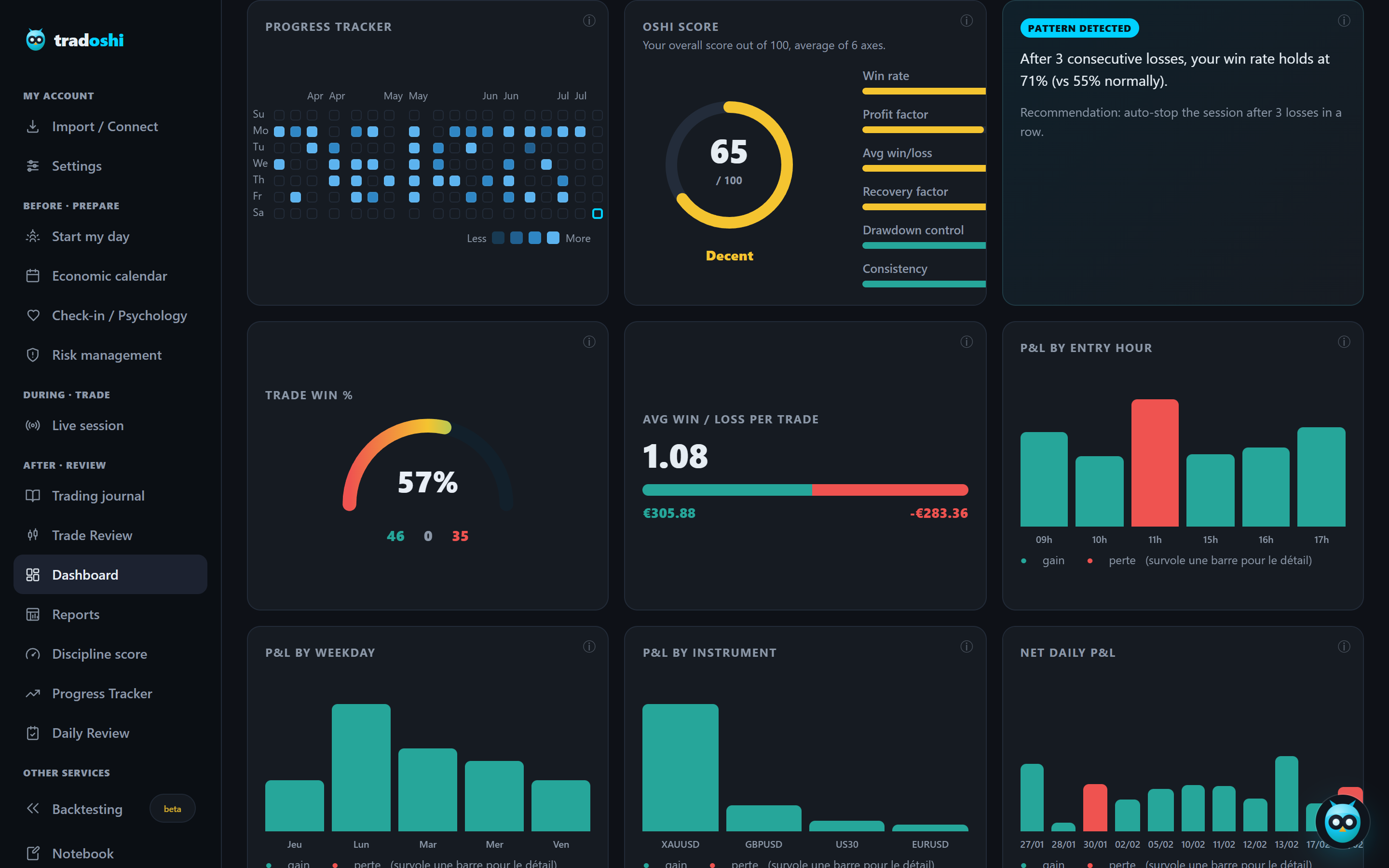
Tradoshi removes from journaling the chore that makes you abandon it: it automates your trade data and lets you focus on what truly has value, your feeling and your lessons, then it reveals the patterns for you.
- Automatic data: your trades are imported from your broker, no more tedious entry.
- Notebook and emotion: you note your state and lessons, the subjective dimension that truly matters.
- Patterns revealed: the app crosses emotion and performance and surfaces your destructive patterns.
- Daily synthesis: each day is summarized to turn experience into learning effortlessly.
Frequently asked questions
Why keep a trading journal?
Because you can only correct what you see. As long as your mistakes stay vague impressions, you can't do anything with them; the journal turns them into visible, recurring facts you can correct. Without a journal, you repeat the same mistakes on loop without identifying them. Journaling turns raw experience into learning, which is why traders who keep one are overrepresented among the profitable.
What does a trading journal reveal?
Patterns invisible on an isolated trade, that only emerge from crossing many trades: that your losses explode at certain hours, that you lose on stressed days, that a given setup costs you money, that you cut your gains too early, or that your gains come from one type of setup. These discoveries let you correct what costs you and reinforce what makes you win.
Should I note my emotions in a journal?
Yes, it's even essential. A complete journal has two dimensions: the numbers (what you did) and the emotions (why). By crossing your emotional state and your performance, you discover that certain states cost you money, that your stressed or euphoric days are statistically your worst. This awareness, impossible without capturing emotion, is often the trigger that transforms a trader.
Why do I always abandon my journal?
Because you want it too perfect. An elaborate system with dozens of fields to fill lasts a week before being abandoned, crushed by the load. The golden rule is regularity before perfection: better to note three essential lines each day for months than an exhaustive journal for a week. Start minimalist and enrich once the habit is anchored.
What should I note in a trading journal?
At minimum: the result, your emotional state, and one lesson. That's enough to start and surface the first patterns. You can enrich later (setup, screenshots, detailed analysis) once the habit is formed, but never before, on pain of abandoning it. Automate the objective trade data to keep by hand only the feeling and lessons, the truly valuable part.
How often should I keep my journal?
After each session, while it's fresh, including and especially the bad days (they teach the most). Regularity matters above all: a simple journal kept daily beats a perfect one filled once a month. And reread it regularly: a journal never reread is useless, it's in the rereading that exploitable lessons are born.
How do I stop my journal from just serving to justify myself?
By systematically distinguishing what was within your control (following the plan, managing risk) from what wasn't (market movement). A journal that explains every loss with 'the market did something crazy' looks like rigor but produces no learning. The question to ask yourself is never 'am I good or bad' but 'what do I do differently next time'.
Why can't I trust my memory to judge my performance?
Because your memory isn't a faithful record, it's a reconstruction distorted by your emotions in the moment. You disproportionately remember your most striking trades (big losses, great wins) and underweight the mass of ordinary trades. The journal records the facts the moment they happen, before your memory has had a chance to rewrite them its own way.