 By Benjamin Roure L'Hermitte
Gap and go trades the continuation of a stock that opens with a sharp gap from the previous close, driven by news, an earnings release or another catalyst. The idea is to ride the initial momentum created by that gap, without trying to guess its deeper cause. It's a method centered on US equities, fast to execute, and full of classic traps for anyone discovering it without knowing the mechanics.
- Gap and go trades the continuation of a stock that opens with a strong gap, up or down, on an identifiable catalyst.
- Typical filters include relative volume, float size, and the perceived quality of the catalyst.
- Common traps are chasing an already extended move, and reversal driven by the gap filling.
- It's a US-equities-centric method, driven by news, that demands fast execution right at the open.
Some stocks, at the open, sharply diverge from their previous close: a gap. That gap often reflects new information, released after the close or before the open: the SEC, the US securities regulator, notes in its investor bulletin on extended-hours trading that companies may announce important news or financial information outside regular trading hours, which may lead to significant price changes. When the news is big enough to change the story of the company rather than just its price for a session, the same setup is known as an episodic pivot, and it is played over days rather than minutes. Gap and go is a method that tries to exploit the momentum of this kind of shifted opening, a momentum that does not always carry on.
This guide explains the mechanics of the setup, the filtering criteria typically used to spot the most interesting stocks, the classic traps that catch inexperienced traders, and why this method stays centered on a very specific market and execution context.
The mechanics of the setup
A gap occurs when a stock's opening price diverges sharply from its previous session's closing price, with no trading between the two levels during the regular session. In New York that session runs from 9:30 a.m. to 4:00 p.m. Eastern Time and starts with an auction (NYSE trading hours). The stock can still trade before it: Nasdaq's pre-market session runs from 4:00 a.m. to 9:30 a.m. (Nasdaq trading hours page), with fewer buyers and sellers and wider quote spreads, the SEC warns. The gap typically follows significant news released while the market is closed: quarterly earnings, a regulatory announcement, a takeover rumor, or any other catalyst likely to sharply shift perception of the stock's value.
The idea behind gap and go is simple in principle: rather than guessing whether the gap will fill or continue, the method looks to trade in the direction of the gap, betting that the initial momentum created by the catalyst will continue into the first minutes or hours of the session, before the market fully digests the news. It's a continuation strategy, not a counter-trend one.
The typical filtering criteria
Not all gaps are equal, and traders who practice this method generally rely on several criteria to filter which stocks to watch in the morning. Relative volume compares the volume traded with its usual average, and the calculation depends on the tool: in TradingView it divides volume by its average over the previous 10 periods, while 'relative volume at time' compares it with the same time slot over the last 10 days (TradingView help page on how relative volume is calculated). Traders read it as a proxy for interest: a gap accompanied by abnormally high volume in the first minutes is held to be sturdier than a gap on thin volume, which could fizzle out quickly. That is a working convention, not a measured law.
Float is the part of a company's shares that the public can actually buy and sell, as FINRA, the US brokerage regulator, defines it in its page on pump-and-dump scams. A small float can amplify moves in either direction: in the model of Hong, Scheinkman and Xiong, published in The Journal of Finance in 2006, a stock's volatility and turnover decrease as its float grows. It cuts both ways: the same FINRA page describes fraudsters buying up a large portion of the float so that they can manipulate the price more easily.
Catalyst quality also matters: news judged structural (earnings well above expectations, a confirmed takeover) is generally seen as more likely to support a sustained move than an unconfirmed rumor or minor news. The idea echoes what research calls post-earnings announcement drift, the tendency of stock prices to incorporate an earnings surprise only slowly, over several days or months. It has lost much of its force: on US earnings announcements from 1984 to 2019, Charles Martineau's study finds no drift since 2006 outside microcap stocks, and none since 2016 for microcaps.
| Criterion | What it generally indicates |
|---|---|
| High relative volume | Real, broad interest from market participants |
| Small float | Amplified move potential, in both directions |
| Clear, significant catalyst | Fundamental justification perceived as more durable |
| Gap already very extended at the open | Higher risk the move has already played out |
These criteria remain general markers, described here without universal numerical thresholds, since every trader adjusts their own filters based on experience, style and current market conditions. There's no fixed magic combination that guarantees an outcome.
An illustrative example
Imagine a stock that closes at 20 the day before, then releases quarterly earnings well above market expectations after the close. The next day, the stock opens at 24, a 20% gap, with volume in the first minutes far above its usual average. In this illustrative setup, a trader practicing gap and go might look to enter on a continuation of the move up in the first minutes, for instance after a first pause that forms a flag, using that volume and catalyst as confirmation, with a stop placed below a short-term structure level identified on the intraday chart.
This scenario is purely illustrative: it doesn't claim to describe real performance nor guarantee a similar setup would unfold the same way in the future. It only serves to show the logic of the setup, not to vouch for its statistical reliability, which stays specific to each trader and each market context.
The classic traps
The first trap is chasing an already largely extended move, entering late on a stock that has already traveled most of its way. This trap, often called 'chasing' the stock, exposes to disproportionate risk: the trader enters high, with reduced continuation potential. Research describes it right at the open: Berkman, Koch, Tuttle and Zhang find a strong tendency for positive overnight returns followed by reversals during the trading day, driven by an opening price that is high relative to intraday prices, concentrated among stocks that have recently attracted the attention of retail investors.
The second classic trap is gap filling, a phenomenon where price partially or fully returns toward its previous close, erasing all or part of the initial gap. Thomas Bulkowski measured it on 520 stocks, for upward gaps of 3% or more (opening gap study on thepatternsite.com, updated in late 2016): in the 1990s, 48% of those gaps closed completely during the same session; in the 2010s, only 23% did, and price came back to mid-gap 51% of the time. On that data, one upward gap in two still gave back half its distance: a continuation trade turns into a losing one if the stop isn't positioned for that possibility, which should never be ruled out even on a gap that looks solidly supported. Some traders trade that return as a setup of its own, the mirror image of gap and go: our lesson on the gap fill covers which gaps actually close, and how fast.
A method centered on US equities
Gap and go is mostly practised on US equities, and three features of that market lend themselves to it. Earnings arrive every quarter: US reporting companies file a Form 10-Q for each of the first three quarters of their fiscal year, then an annual report (Investor.gov page on Form 10-Q). Market hours are clearly defined (overnight close, pre-market session), which lets news trade before the open. And that market includes low-priced stocks, often very small companies, which FINRA describes as volatile and thinly traded, hence sensitive to even relatively small trades (FINRA page on low-priced stocks).
It's also a strongly news-driven method: a gap and go trader spends a significant part of their preparation time identifying, before the open, stocks carrying a catalyst strong enough to justify watching. This dependence on news demands fast execution right from the session's first minutes, since the opportunity window can close very quickly once the initial move has been fully exploited by all participants.
Risk management specific to this style
The volatility of gap and go stocks, especially low-float ones, requires particularly strict risk management. Price moves can be very fast in the first minutes of the session, with slippage risk on market orders, and a stop is no exception: once its stop price is reached it becomes a market order, whose execution price can deviate significantly from the stop price, the SEC notes in its investor bulletin on stop orders. A runaway stock can also see its trading paused for five minutes under the US markets' Limit Up/Limit Down mechanism (FINRA page on market volatility guardrails). Precise position sizing and strict stop discipline therefore matter even more than on calmer instruments.
A trader practicing this method must accept that a significant share of their trades will fail, precisely because the unpredictable nature of a news-driven move makes every setup unique, with no perfectly reproducible pattern from one session to the next. It's a style where discipline around position size matters at least as much as the quality of the catalyst reading itself.
Pre-market preparation
Unlike a method practiced continuously throughout the session, gap and go is largely prepared before the market opens. A trader practicing this method typically spends a good part of the morning, before trading even begins, reviewing stocks that released news overnight or the evening before, assessing the quality of their catalyst, and noting key technical levels (previous high, round numbers, structure zones) that will serve as reference points once the session opens.
This upfront preparation reduces the decision load at the most critical moment, the open itself, where price can move extremely fast. A trader who arrives at the open without having already shortlisted candidates and defined levels in advance ends up having to analyze and decide at the same time, in a window where every second of hesitation can be costly on stocks as volatile as those typically targeted by this method.
How Tradoshi helps
Whatever your strategy, gap and go, swing trading or any other method, the question that matters stays the same: does this setup give you a real edge once measured over time? Tradoshi doesn't tell you which stocks to watch in the morning, that's not its role, but it lets you measure what your gap continuation trades have actually produced.
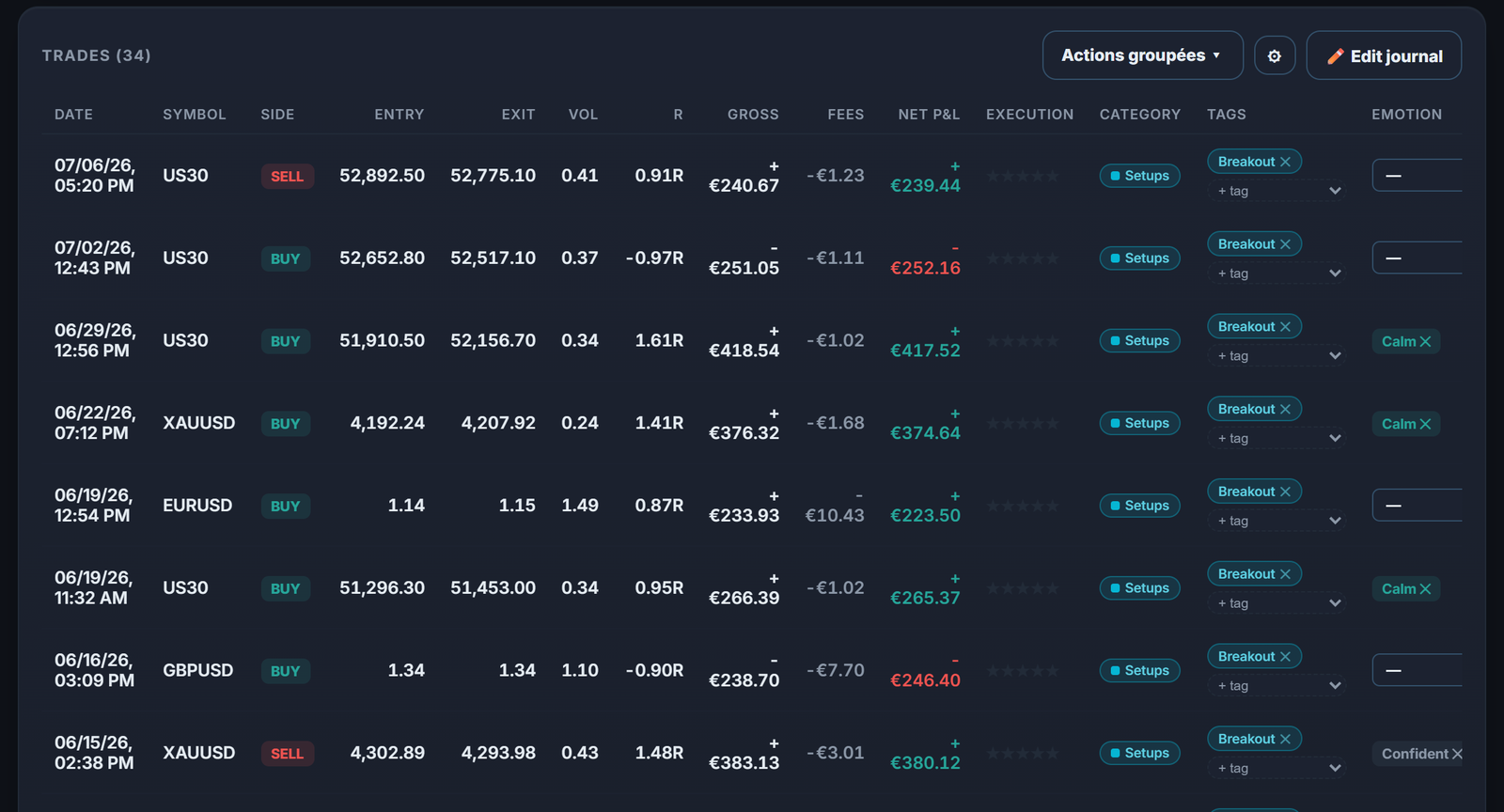
By tagging every gap and go trade with its context (gap size, catalyst category), you build a history that lets you compare your performance by setup type, instead of relying on a general impression about 'this trade style working well' or not.
- Per-trade setup tags: categorize your gap and go trades by gap size or catalyst type.
- Stats by tag: win rate and average R-multiple computed for each setup category.
- Real risk per trade: check your position size stays consistent despite the volatility of these stocks.
- Detailed journal: document your entry reasoning to review yourself later, away from the excitement of the open.
Frequently asked questions
What is the gap and go strategy?
It's a method that trades the continuation of a stock opening with a strong gap, up or down, often driven by news or an earnings release. The idea is to ride the initial momentum of the gap rather than guessing whether it will fill.
What is an episodic pivot?
An episodic pivot is the same opening gap played on a longer clock: the news is big enough to change the story of the company rather than its price for one session, and the move is traded over days rather than minutes. Episodic pivots are recognised by volume rather than by shape, which is what separates them from ordinary breakouts.
What criteria filter which stocks to watch?
Relative volume (compared to the stock's usual average), float size (number of shares actually available to trade), and the perceived quality of the catalyst (earnings, takeover, regulatory announcement). These criteria stay general and are adjusted by trader and market conditions.
What are the classic traps in gap and go?
Chasing an already largely extended move by entering late with elevated reversal risk, and gap filling, where price partially or fully returns toward its previous close, sometimes within the same session.
Why is gap and go centered on US equities?
Because US reporting companies publish their accounts every quarter, because market hours (overnight close, pre-market) let news trade before the open, and because that market includes low-priced stocks that are volatile and thinly traded.
What risk management fits gap and go?
Particularly strict management, due to the high volatility of gapping stocks and the slippage risk on market orders in the session's first minutes. Discipline around position size matters as much as the quality of the catalyst reading.
Does gap and go suit a beginner?
It's a method demanding fast execution and strict risk management, on often highly volatile stocks. It requires serious preparation before the open and strict discipline, which makes it better suited to a trader with an already solid risk management base than to a pure beginner.
How do you prepare before the open for gap and go?
By reviewing stocks that released news overnight, assessing the quality of their catalyst, and noting key technical levels in advance. This preparation reduces the decision load at the critical moment of the open, where price can move very fast.
Does a gap and go trade only play out at the open?
The method targets the very first minutes or hours of the session, right after the news. Some stocks continue their move later in the day, but nothing guarantees continuation, at the open or afterwards.
Does gap and go work across all market cap sizes?
It's more often associated with small, low-float stocks, which are more volatile and more thinly traded, hence riskier. Large caps can also gap on major news.
Should you always trade in the direction of the gap?
That's the method's basic logic, but some experienced traders also watch the opposite scenario, a gap that fails to hold and fills quickly, as a distinct opportunity. That's a more advanced variant, not to be confused with the classic continuation setup.