Scalping has a reputation as an easy way into trading: positions held for a few seconds to a few minutes, small repeated gains, the impression of being able to build experience quickly. The reality is harsher. It's a demanding execution style, where transaction costs weigh proportionally far heavier than on other horizons, and where the mental load of near-constant decision-making wears down judgment fast. Here's what scalping actually requires.
- Scalping targets small, repeated gains on positions held from a few seconds to a few minutes.
- It demands execution speed, liquid low-spread instruments and near-uninterrupted focus.
- Spread, commission and slippage weigh proportionally far more here than in swing or position trading.
- It's not a beginner shortcut: it's one of the most demanding styles, both technically and psychologically.
Scalping is intriguing because it promises something tempting: dozens of small wins a day, very short market exposure, and the feeling of staying in control at all times since nothing is ever held for long. That promise is especially appealing to beginners, who wrongly see it as a way to learn faster by racking up more trades.
This guide explains what scalping actually is, what it demands technically and mentally, why its hidden costs erode the edge far faster than at other horizons, and why it's neither a shortcut to profitability nor a recommended starting point for a beginning trader.
What scalping is
Scalping is a trading style aimed at capturing very small price moves, often a few points or a few pips, on positions held for just a few seconds to a few minutes. A scalper isn't trying to catch a large directional move, they're trying to repeat a very high number of small wins over a session, entering and exiting the market quickly.
This high frequency clearly sets scalping apart from classic day trading, which can hold positions for several hours during the day, and even more so from swing trading, which holds positions for several days. An active scalper can make dozens, even hundreds of trades in a single session, which radically changes the nature of the skills and resources needed compared to other time horizons.
What scalping demands technically
Execution speed is central: a scalper must be able to enter and exit the market almost instantly, which requires a responsive platform, a stable connection, and often keyboard shortcuts or one-click execution tools. A latency of a few dozen milliseconds, negligible for a swing trader, can make the entire difference between a winning scalp and a losing one.
The choice of instrument matters just as much. Scalping works best on highly liquid markets, with a tight spread and enough order book depth to absorb entries and exits without moving the price against the trader. That depth is exactly what reading order flow makes visible. Scalping an illiquid instrument or one with a wide spread means starting every trade with a cost disadvantage that's hard to make up on an already tiny profit target.
Why costs weigh more here
This is the most underestimated aspect of scalping: at this frequency, transaction costs stop being a detail and become a major component of the outcome. The spread (the gap between bid and ask) is paid on every entry. The commission, if any, adds up on both entry and exit. Slippage, the gap between the intended price and the price actually obtained at execution, adds up further, especially during volatility or thin liquidity.
| Cost | Impact in scalping vs swing |
|---|---|
| Spread | Paid on every trade; against a target of a few pips it eats a huge share of the intended gain |
| Commission | Fixed per trade; its relative weight grows when the target gain is small |
| Slippage | More frequent on short horizons, where executions are more timing-sensitive |
| Cumulative frequency | Dozens of trades a day multiply the effect of each individual cost |
Take an illustrative example: a scalper targets an average gain of 5 points on an instrument where the spread represents 1 point and the commission the equivalent of 0.5 point round trip. Just to reach breakeven, this trader already needs to generate 1.5 points of favorable movement before earning a single cent of real profit, or 30% of the target gain swallowed before any actual profit begins. That same cost ratio, applied to a swing trader targeting 200 points, would be almost insignificant.
Who it suits, who it doesn't
In theory, scalping suits a very specific profile: a trader able to stay relentlessly focused through long sessions, with reliable and fast technical execution, and above all, able to absorb frequent losses (the losing trade rate can be high even for a profitable scalper) without it affecting their discipline. It's a methodical executor's profile far more than a patient analyst's.
Contrary to popular belief, it isn't a style suited to beginners. A trader who doesn't yet have solid experience reading the market, managing emotions, or quickly calculating risk finds themselves, in scalping, exposed to a decision pace that leaves no room for gradual learning. Mistakes pile up too fast to be corrected along the way, and the account can take serious damage before the lessons have had time to sink in.
The psychological toll
Scalping imposes a particular mental load: near-continuous decision-making, without the natural pauses that other time horizons offer. Every trade must be evaluated, executed and closed within moments, leaving little room for careful reflection and a lot of room for decision fatigue, that well-documented phenomenon where judgment quality degrades after a large number of closely packed decisions.
This fatigue is all the more dangerous in scalping because it sets in within the session itself, often without the trader noticing. A scalper worn out after two hours of back-to-back trades typically keeps trading at the same pace, even as their judgment has already eroded, opening the door to execution mistakes and discipline drift that are hard to spot in the moment.
Common mistakes among scalpers
The first classic mistake is underestimating costs when setting a profit target. A scalper aiming for a move barely wider than the instrument's spread works with almost no margin: the slightest execution gap, the slightest tenth-of-a-second hesitation, is enough to turn a planned winner into a loser. Setting a target that leaves real room above known costs is a baseline condition, not a minor detail.
The second mistake, very common, is overtrading: piling on entries out of boredom or a need to 'stay active', without every trade answering a setup clearly defined in advance. At scalping frequency, this drift often goes unnoticed in the moment, buried in the flow of dozens of trades in the session, and only becomes visible once statistics are aggregated over several days. The third mistake is neglecting the cumulative impact of commissions on real profitability: a scalper who never recalculates their net edge, commissions and spreads included, may believe they're profitable based on gross balance while the net result tells a very different story.
Partial automation, a double-edged path
Faced with the execution speed and decision fatigue inherent to scalping, some traders turn to partial automation: pre-programmed orders, technical alerts, or scripts that execute part of the entry and exit logic based on rules decided cold. This approach can reduce the gap between intention and execution, particularly around strict exit management, an area where human hesitation is costly at this frequency.
But partial automation doesn't eliminate the need for market understanding, it simply moves where the mistake can happen: from a real-time hesitation to a poorly calibrated rule set upstream. A scalper who automates part of their execution without first validating the logic manually, trade after trade, risks industrializing a systematic mistake rather than fixing it. Automation serves discipline, it doesn't replace it.
How Tradoshi helps
Whatever your trading horizon, scalping, day trading or swing, the question that matters stays the same: is your net edge, after costs, actually positive over time? Tradoshi doesn't tell you whether to scalp, that choice is entirely yours, but it gives you the means to objectively check whether this style genuinely pays off once all costs are accounted for.
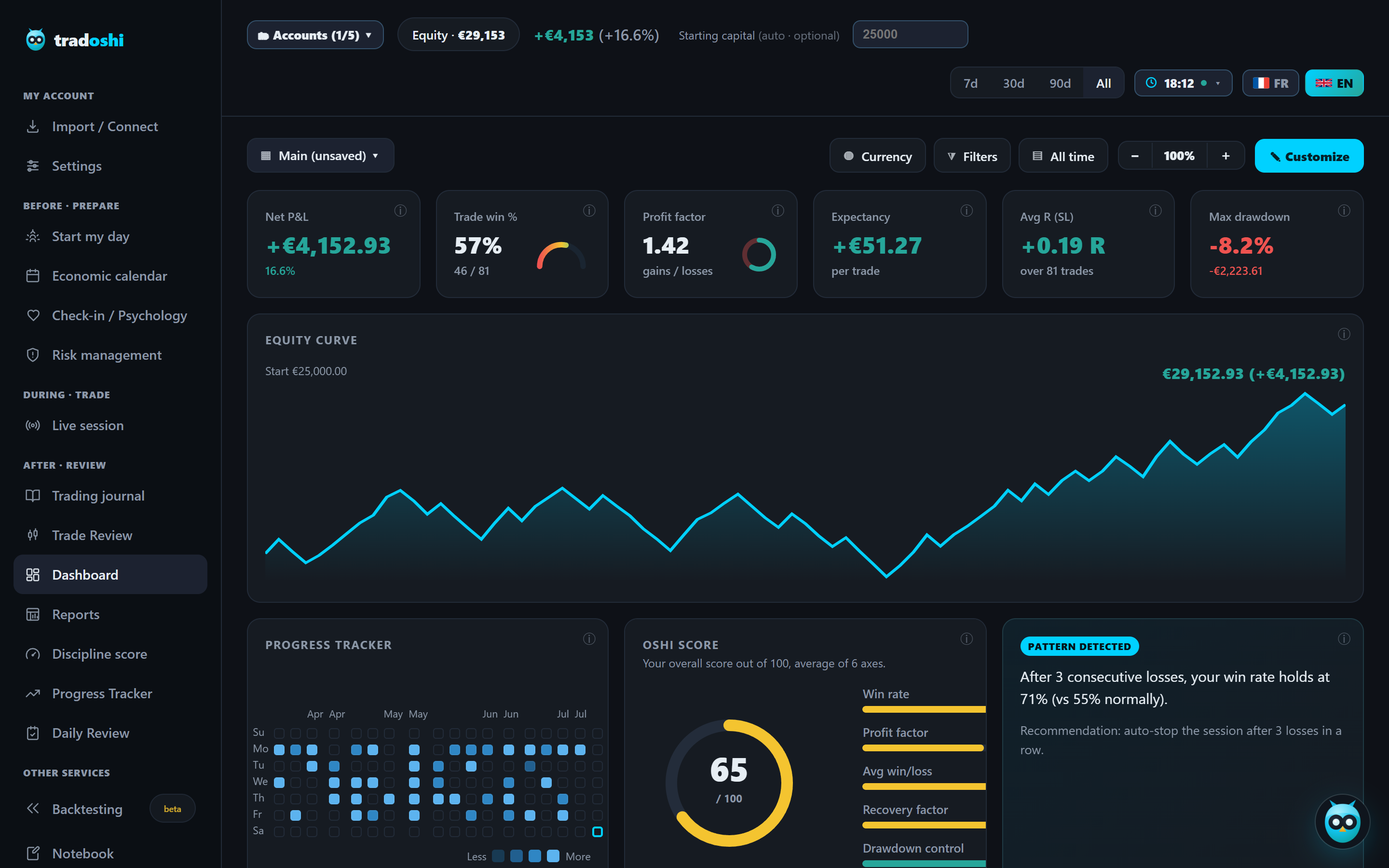
By tracking every trade with its real R-multiple and aggregating stats across a high trade count, you can see in black and white whether your high trade frequency produces a positive net edge, or whether cumulative costs are quietly eating what your good trades earn you.
- High-frequency journal: log every trade quickly, even while actively scalping.
- Aggregated stats by tag: profit factor and average R-multiple computed across all your trades, costs included.
- Discipline score: spot behavior drift late in a session, when decision fatigue sets in.
- Real risk per trade: check your size stays consistent despite the fast pace of decisions.
Frequently asked questions
What is scalping in trading?
Scalping targets small, repeated gains on positions held from a few seconds to a few minutes, with a high number of trades in a single session. It's set apart from classic day trading, and even more from swing trading, by the extreme brevity of each position.
What instruments suit scalping?
Highly liquid instruments with a tight spread and enough order book depth to absorb entries and exits without moving the price against the trader. An illiquid or wide-spread instrument imposes a cost disadvantage that's hard to make up on an already tiny profit target.
Why do transaction costs weigh more in scalping?
Because the spread, commission and slippage are paid on every trade, and a profit target of a few points leaves almost no margin once those costs are deducted. Across dozens of trades a day, this effect compounds and can represent a huge share of the net result.
Is scalping suited to beginners?
No, despite a misleading reputation. A beginner who doesn't yet have solid experience reading the market, managing emotions, and quickly calculating risk ends up exposed to a decision pace that leaves no room for gradual learning, with mistakes piling up too fast to correct.
What's the main psychological challenge of scalping?
Decision fatigue from near-continuous decision-making, without the natural pauses of other trading horizons. This fatigue often sets in without the trader noticing, and degrades judgment quality as the session goes on.
Does scalping guarantee faster profitability?
No. Taking more trades only speeds up exposure, in either direction, to transaction costs and execution mistakes. Nothing guarantees an edge exists at this frequency, and the proportionally higher costs raise the bar compared to other horizons.
Can automation solve scalping's challenges?
It can reduce the gap between intention and execution, particularly around strict exit management, but it doesn't replace market understanding. A poorly calibrated automated rule simply industrializes the mistake instead of fixing it: automation serves discipline, it doesn't create it.
How much capital do you need to scalp seriously?
There's no universal figure, but too small a capital makes the relative weight of fixed costs (minimum commission, spread) even more crushing on each small targeted gain, which can push the net edge negative before even accounting for the quality of the trades themselves.
Does scalping require particular equipment?
A stable connection and a responsive platform matter more than in classic day trading or swing trading, since a few dozen milliseconds of latency can be enough to turn a winning scalp into a losing one on an already tiny profit target.
Does scalping work on every market?
No. It mostly suits highly liquid markets with a tight spread. On a thinly traded or wide-spread instrument, the starting cost disadvantage is often too large for such a small profit target to stay realistic, whatever the quality of execution.
Is scalping compatible with a written trading plan?
Yes, and it's actually essential. Scalping's fast pace makes the temptation to improvise stronger than at any other horizon, which makes a plan written cold, with clear entry, exit and stop rules, even more necessary here than elsewhere to avoid drift.