Day trading attracts people for the wrong reasons: the promise of fast income, the image of the trader who clicks twice and pockets the month's rent. The reality is both starker and more interesting. Day trading is a craft of execution, risk management and repetition, requiring time, capital and a discipline that few beginners anticipate before jumping in. This guide tells you what it actually takes to start, without the filter.
- Day trading requires real screen time during market hours, not 20 minutes stolen between tasks.
- The difference with swing trading comes down to position horizon, not how serious the approach is.
- Undercapitalization, missing risk management and no journal sink the majority of beginners.
- The first 90 days are built on demo then minimum size, never on going big from day one.
Day trading means opening and closing a position within the same session, never carrying overnight risk. That's a simple definition, but it hides a heavy requirement: following the market live, reacting fast, absorbing several decisions per day without fatigue or emotion taking over. It's not a trading style you pick by default among others, it's a distinct mode of practice, with its own constraints on time, capital and temperament.
This guide breaks down what day trading concretely demands: real screen time, a reasonable starting capital, the essential tools, and above all the reasons why most beginners fail before they've even had time to improve. The goal isn't to discourage you, it's to replace the fantasy with a realistic roadmap.
What day trading actually requires
Day trading isn't a 'faster' or 'easier' category of trading than others, it's a time constraint that changes the entire mechanics of decision-making. Because you close your positions within the day, you must follow the market live during the windows you trade, react to moves counted in minutes, and absorb a much denser flow of decisions than a trader holding positions for several days. That density of decisions is exactly what makes day trading demanding: every poorly made decision repeats faster than elsewhere.
Concretely, that means being available, focused and undisturbed during the time windows where you hunt your setups, whether that's the London open, the New York open, or another window depending on the instrument you follow. A day trader monitoring their screen between two meetings, distracted by notifications, isn't day trading under good conditions: they're making degraded decisions on a market that doesn't forgive inattention.
Day trading, swing trading, position trading: the real difference
Day trading differs from swing trading (positions held a few days to a few weeks) and position trading (positions held several weeks to several months) by a single criterion: position horizon, never overnight in day trading. It's not a difference in rigor or seriousness, a diligent swing trader can be far more disciplined than a chaotic day trader. It's a difference in rhythm and mental load: the day trader compresses into a few hours what the swing trader spreads over several days.
| Style | Position horizon | Screen time required |
|---|---|---|
| Day trading | Intraday, never overnight | High, during active windows |
| Swing trading | A few days to weeks | Moderate, daily follow-up |
| Position trading | Weeks to months | Low, periodic follow-up |
This difference in rhythm has a direct consequence on who should choose what. A beginner with little time available during the day, due to a job or a family, risks executing day trading in a fragmented, sloppy way, which is worse than not trading at all. The trading style should be chosen based on time actually available, not on what looks most exciting on social media.
The capital you actually need
There's no universal magic number, but there's one non-negotiable principle: starting capital has to be money you can afford to lose, not savings that cover your rent or bills. Trading with capital you need elsewhere changes your psychology entirely: every loss becomes an existential threat, which mechanically pushes you to over-risk to compensate, or to freeze on a simple decision out of fear of losing.
Beyond that principle, capital size mainly determines the size of your room to maneuver. With a small account, the risk per trade in absolute terms is low, which is healthy for learning, but it also means the potential income is just as low, regardless of your skill. That's one reason many serious traders, once their skills are proven, turn to prop firm funded accounts: personal starting capital is there to learn, not necessarily to generate income right away.
The essential tools before you start
The bare minimum to day trade properly is short but each item matters: a reliable platform with fast execution and no excessive latency, real-time market data access for the instrument you follow, and a stable internet connection, because a disconnect mid-position can cost dearly. Many beginners neglect these technical basics by focusing only on strategy, when a platform that crashes at the wrong moment ruins any strategy.
The second essential tool, less obvious, is a tracking system: a trading journal that records every position, the context, the result, and your state at the moment of the trade. Without this tracking, you can't tell a bad month caused by bad luck apart from a bad month caused by a systematic execution error. The journal isn't a comfort accessory, it's the instrument that turns trading experience into real learning.
Why most beginners fail
The reasons for failure in day trading repeat from one beginner to the next with striking regularity. Undercapitalization tops the list: trading with an account too small to absorb a normal losing streak pushes traders to take a disproportionate risk per trade, just so the potential gain 'feels worth it'. Missing risk management follows closely: without a clear rule for position size and maximum loss per trade, a beginner navigates blind and a single bad day can wipe out weeks of gains.
- Undercapitalization: an account too small pushes you to take a disproportionate risk to hope for a meaningful gain.
- Missing risk management: no defined position size, no maximum loss per trade or per day.
- No journal: impossible to distinguish a recurring mistake from simple bad luck.
- Revenge trading: trying to win back a loss immediately, with bigger size, without a clear setup.
The third factor, no journal, is quieter but just as destructive: without data to back decisions, a beginner repeats the same mistakes for months while believing they simply have 'bad luck'. Finally, revenge trading closes the loop: after a loss, the temptation to re-enter immediately, bigger, to win it back, turns a normal loss into disproportionate damage. These four factors often combine, and it's their accumulation, more than any single one, that blows up a beginner's account.
A realistic timeline for your first 90 days
A well-built first quarter follows a progression, not a direct leap into live trading at normal size. The first weeks are spent on demo, not to 'play around' risk-free, but to validate that your understanding of order mechanics and your strategy holds up against the real market, without the stress of money on the line. This phase serves to identify your execution errors before they cost anything.
Next comes a phase of live trading at minimum size, often much longer than beginners imagine, where the goal isn't to make money but to prove you can execute your plan with real money on the line, which changes everything psychologically compared to demo. Only after demonstrating consistent execution over several weeks, with a journal to prove it in black and white, should size increase gradually. Wanting to skip these steps to go faster is exactly what pushes a beginner to lose faster.
Day trading isn't a 20-minute side hustle
One of the most costly misconceptions is believing day trading can fit into the margins of your day, between two meetings or during a lunch break. The market doesn't pause to wait for you to be available, and a position left open while you're distracted by something else is a poorly managed position, whether it ends up winning or losing. Day trading demands real presence, not fragmented attention.
That doesn't mean you need to trade full time to succeed, many serious day traders focus on a single time window per day, short but fully dedicated. What matters is the quality of presence during that window, not its absolute length. A day trader who blocks off 45 focused minutes each day, with no other distraction, is better equipped than a beginner keeping half an eye on their screen all day between tasks.
How Tradoshi helps you start on the right foot
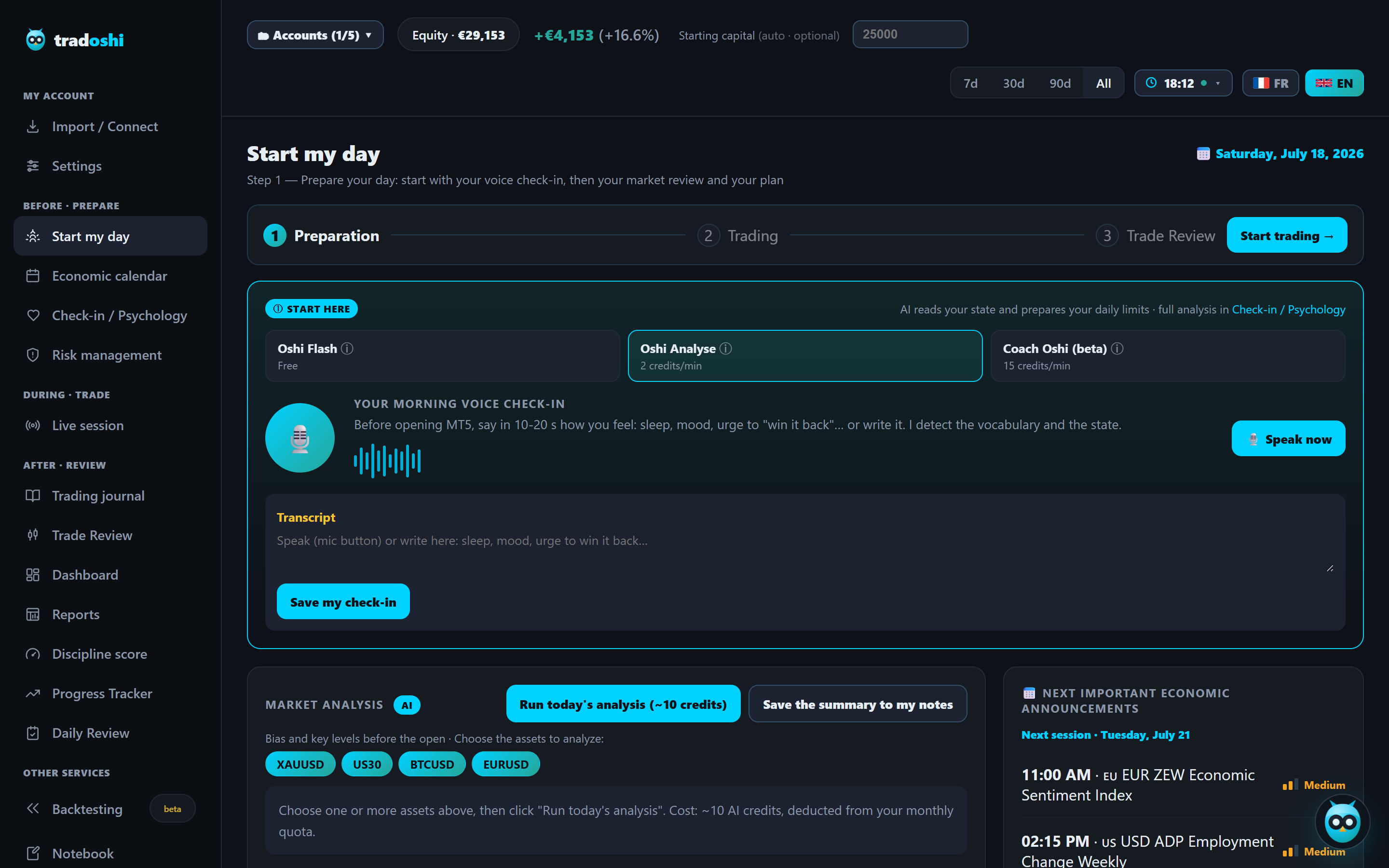
Tradoshi is built to support a beginner from their very first trade, making visible the habits that sink the majority of day traders before they turn into real damage. The journal captures every trade automatically from your broker or platform, the risk calculator suggests a position size consistent with your actual capital, and the emotional check-in makes you name your state before the market does it for you.
- Automatic sync with your broker (MT4/MT5) or CSV import: every trade is journaled effortlessly.
- Position size calculator that aligns your risk per trade with your actual capital.
- Emotional check-in before each session to spot days at risk of revenge trading.
- Progress statistics (win rate, R-multiple, expectancy) to see objectively where you stand.
Frequently asked questions
How much time per day does day trading take?
You need real, focused presence during the time windows where you hunt your setups, not necessarily the whole day. A short but fully dedicated window, with no distraction, beats fragmented monitoring all day long. What matters is the quality of attention, not the number of hours logged.
What's the difference between day trading and swing trading?
Day trading closes all positions within the same session, never overnight. Swing trading holds positions from a few days to a few weeks. It's not a difference in seriousness, but in rhythm and mental load: day trading compresses into a few hours what swing trading spreads over several days.
What's the minimum capital to start day trading?
There's no universal magic number, but the principle is non-negotiable: it has to be money you can afford to lose, never savings covering your rent. Capital size mainly determines your room to maneuver, not guaranteed success.
Why do most beginners fail at day trading?
Four factors come up most often: undercapitalization pushing you to over-risk, missing risk management, no journal preventing you from spotting recurring mistakes, and revenge trading after a loss. These factors often combine, and it's their accumulation that blows up a beginner's account.
Can you day trade part-time?
Yes, provided you block off a short but fully dedicated time window, with no other task in parallel. What sinks beginners isn't part-time trading itself, but fragmented attention: monitoring your screen between two meetings produces degraded decisions, whatever the strategy behind it.
How long before you're competent at day trading?
There's no guaranteed timeline, every path differs depending on time invested and quality of practice. A realistic progression goes through a demo phase, then an extended phase at minimum size, before gradually increasing size once execution is proven by the journal. Wanting to skip these steps is what causes the fastest losses.
Is day trading right for everyone?
No. It demands real availability during precise time windows, capital you can afford to lose, and a tolerance for repeating decisions under pressure. A profile that can offer neither the time nor the mental availability required will get more out of a style like swing trading, which imposes a less intense rhythm.