The profit factor is one of the few numbers that can tell you, at a glance, whether your strategy makes or loses money. It fits in one simple division: everything you gained, divided by everything you lost. Yet most traders never look at it, or misread it. This guide explains what the profit factor is, how to read it, its traps, and how to improve it.
- Profit factor = total gains ÷ total losses. Above 1, you win; below, you lose.
- It sums up your system in one number more honest than the win rate alone.
- 1.5 is a good benchmark: for every unit lost, you gain one and a half.
- It can lie on a small sample or when a single trade dominates your gains.
Many traders judge their performance by their win rate, the percentage of winning trades. That's a mistake: a high win rate can hide a losing system, and a low win rate can hide an excellent one. The profit factor corrects this bias by weighing your gains against your losses, which makes it one of the most reliable indicators for judging an edge.
This guide breaks down the profit factor: its formula, what it reveals, the thresholds that matter, the traps that make it misleading, and above all how to use it to concretely improve the way you trade.
The profit factor formula
The profit factor is computed by dividing the sum of all your winning trades by the absolute value of the sum of all your losing trades. If you gained 3,000 in total and lost 2,000, your profit factor is 1.5. It's a unitless ratio, which makes it comparable from one account to another, whatever the position size or starting capital.
The interpretation is immediate: a profit factor above 1 means you win more than you lose, so your system is profitable over the measured period. A profit factor below 1 means the opposite. Exactly at 1, you break even: your gains and losses cancel out. This simplicity is its strength.
The thresholds that matter
Not all profit factors above 1 are equal. A profit factor of 1.05 is technically a winner but dangerously fragile: the slightest degradation, a losing streak or rising fees can push it below 1. A higher profit factor gives you a safety margin that absorbs surprises and market noise.
| Profit factor | Reading |
|---|---|
| Below 1.0 | Losing system: your losses exceed your gains |
| 1.0 to 1.2 | Barely profitable, very fragile |
| 1.3 to 1.6 | Solid, exploitable edge |
| 1.7 to 2.5 | Excellent, comfortable margin |
| Above 3 | Rare: check the sample size |
Beware of the opposite excess: an abnormally high profit factor, above 3 or 4, should trigger suspicion rather than enthusiasm. It often comes from too small a sample, an exceptional period, or one or two huge trades that won't repeat. A durable edge looks more like a stable 1.5 than a 4 over twenty trades.
Profit factor vs win rate
The great strength of the profit factor is that it captures what the win rate ignores: the size of your gains and losses. Two traders can have exactly the same 50% win rate and opposite results, one profitable, one wiped out, depending on whether their gains are bigger or smaller than their losses. The win rate counts trades, the profit factor weighs money.
That's why the profit factor is a more reliable judge of your edge. A low-win-rate system can show an excellent profit factor if its rare winners pay big, and a high-win-rate system can have a mediocre profit factor if its rare losses are huge. Looking at both together gives the full picture, but if you had to keep only one, it would be the profit factor.
The traps of the profit factor
The profit factor is only reliable over a sufficient sample. Over ten trades, it's dominated by chance and says nothing about your real edge. The first trap is thus concluding too fast: a profit factor of 2 over fifteen trades proves nothing, you need dozens or even hundreds of trades for it to become meaningful.
The second trap is concentration. If a single exceptional trade represents half your gains, your profit factor is artificially inflated and doesn't reflect your usual edge. A good reflex is to recompute your profit factor removing your biggest gain: if it collapses, your profitability rests on a lucky shot, not a repeatable process.
How to improve your profit factor
There are only two levers to raise your profit factor: win more on your winning trades, or lose less on your losing ones. The second is almost always the most effective, because it depends mainly on your discipline. Cutting your losses fast, respecting your stops and avoiding letting a losing trade run reduces your denominator and lifts your profit factor without changing your strategy.
The first lever, letting your winners run, is harder psychologically but just as powerful. Cutting a winning trade too early out of fear of giving back the gain drags down your numerator. Many traders have a mediocre profit factor not because their strategy is bad, but because they bank too fast and let their losses drift: exactly the opposite of what they should do.
Profit factor by setup
Your overall profit factor is an average that can hide big disparities. By breaking it down by setup, by instrument or by time of day, you often discover that your edge comes from a few precise situations, while others lose you money without you knowing. This segmentation is one of the most profitable uses of the profit factor.
Imagine your overall profit factor is 1.3, decent but not spectacular. By segmenting, you might discover that one of your setups shows 2.2 while another is below 1. The conclusion is obvious: focus on the first, drop or fix the second, and your overall profit factor rises mechanically. Without this breakdown, you'd stay blind to this simple arbitrage.
Profit factor and expectancy, the hidden relationship
The profit factor and expectancy tell the same story from two different angles. Expectancy gives you the average expected gain per trade, factoring in your win rate and average win/loss ratio; the profit factor weighs the same information but at the scale of all your gains against all your losses. The two indicators are mathematically linked: a positive expectancy almost always implies a profit factor above 1, and vice versa.
The practical difference is in the reading. Expectancy tells you how much you can expect to earn on average on your next trade, useful for sizing your position. The profit factor tells you the overall solidity of your edge over a period, useful for judging your system as a whole. Using both together, rather than just one, gives you a complete picture: one for the immediate decision, the other for the underlying diagnosis.
A full worked example
Take ten trades to illustrate the calculation. Six are winners, at 80, 120, 60, 200, 90 and 150 respectively, for total gains of 700. Four are losers, at -100, -80, -150 and -70, for total losses of 400. This series' profit factor is therefore 700 divided by 400, or 1.75, a solid number despite a win rate of only 60%.
This example illustrates well why the profit factor and win rate tell different stories: this trader wins six times out of ten, but their winners (117 on average) are noticeably bigger than their losers (100 on average), which is enough to create a comfortable edge. A trader with the same win rate but average gains closer to their losses would get a far more fragile profit factor, around 1.1 or 1.2, despite an identical number of winning trades.
Rolling profit factor: tracking its evolution over time
The profit factor computed over an account's entire lifetime hides an essential piece of information: is your edge strengthening or degrading recently? An overall profit factor of 1.4 can mask a start of the year at 1.8 followed by continuous degradation toward 1.0, or the opposite, steady progress from a difficult start. Without looking at it over time, you only see the average, not the trend.
Computing your profit factor on a rolling basis, for example over the last fifty trades at every new trade, lets you spot degradation before it becomes critical. If your rolling profit factor has been declining steadily for several weeks, that's a far earlier warning signal than waiting for month-end to notice. It's the equivalent, for your profitability, of what a trend line does for a technical indicator.
Profit factor and trading costs
The profit factor computed on gross P&L can give a misleading picture if you ignore transaction fees, spreads and commissions. On an account that trades frequently, these costs pile up and silently eat into every trade, winner and loser alike. A gross profit factor of 1.3 can fall to 1.1 once fees are actually deducted, which completely changes the assessment of the system's viability.
This is a common trap for traders who scalp or stack many small trades, where fees represent a proportionally bigger share of each trade. Always computing your profit factor on your net P&L, after all costs, is the only way to get an honest picture. A system that looks profitable gross but collapses net isn't an edge, it's an accounting illusion.
Profit factor on a prop firm account
On a prop-firm-funded account, the profit factor takes on particular importance, because many firms monitor this ratio in addition to plain P&L to judge the quality of your trading, sometimes with an explicit minimum threshold to meet. A trader who hits their gain target only thanks to one or two lucky trades, with a fragile underlying profit factor, can be seen as a risky profile even if their final result looks good.
Tracking your profit factor continuously on this type of account isn't just a personal analysis exercise, it's also a way to secure your funding by showing, with numbers, that your profitability rests on a repeatable edge rather than luck. A stable profit factor around 1.5 over several hundred trades is often a stronger argument than a gain target hit in a handful of exceptional trades.
Profit factor and partial exits
Many traders split their exits: part of the position is closed at a first target, the rest is left running with the stop moved to breakeven. This practice, healthy for risk management, slightly complicates the profit factor calculation if you don't correctly count each partial exit as a distinct result tied to the same overall trade.
The classic mistake is only recording the result of the last exit, forgetting the gain already banked on the first portion. A trade that takes a small profit on fifty percent of the position then gets stopped at breakeven on the rest wrongly shows up as neutral or even slightly negative if you don't track both legs separately, when it actually generated a net gain. A journal that handles each execution correctly avoids this silent distortion of the profit factor.
Target profit factor depending on your trading style
The profit factor to aim for isn't the same across styles. A scalper taking a huge number of small trades with a win/loss ratio close to 1 can target a more modest profit factor, around 1.2 to 1.4, compensated by a high trade volume. A swing trader taking few trades but with win/loss ratios of 3 or 4 to 1 can aim for a much higher profit factor, above 2, sometimes with a win rate under 40%.
Comparing your profit factor to an absolute number, without accounting for your style, doesn't make much sense then. The right question isn't 'is my profit factor good in absolute terms', but 'is my profit factor consistent with the structure of my system and stable over time'. It's this internal consistency, more than a universal threshold, that signals a healthy edge.
How Tradoshi computes your profit factor
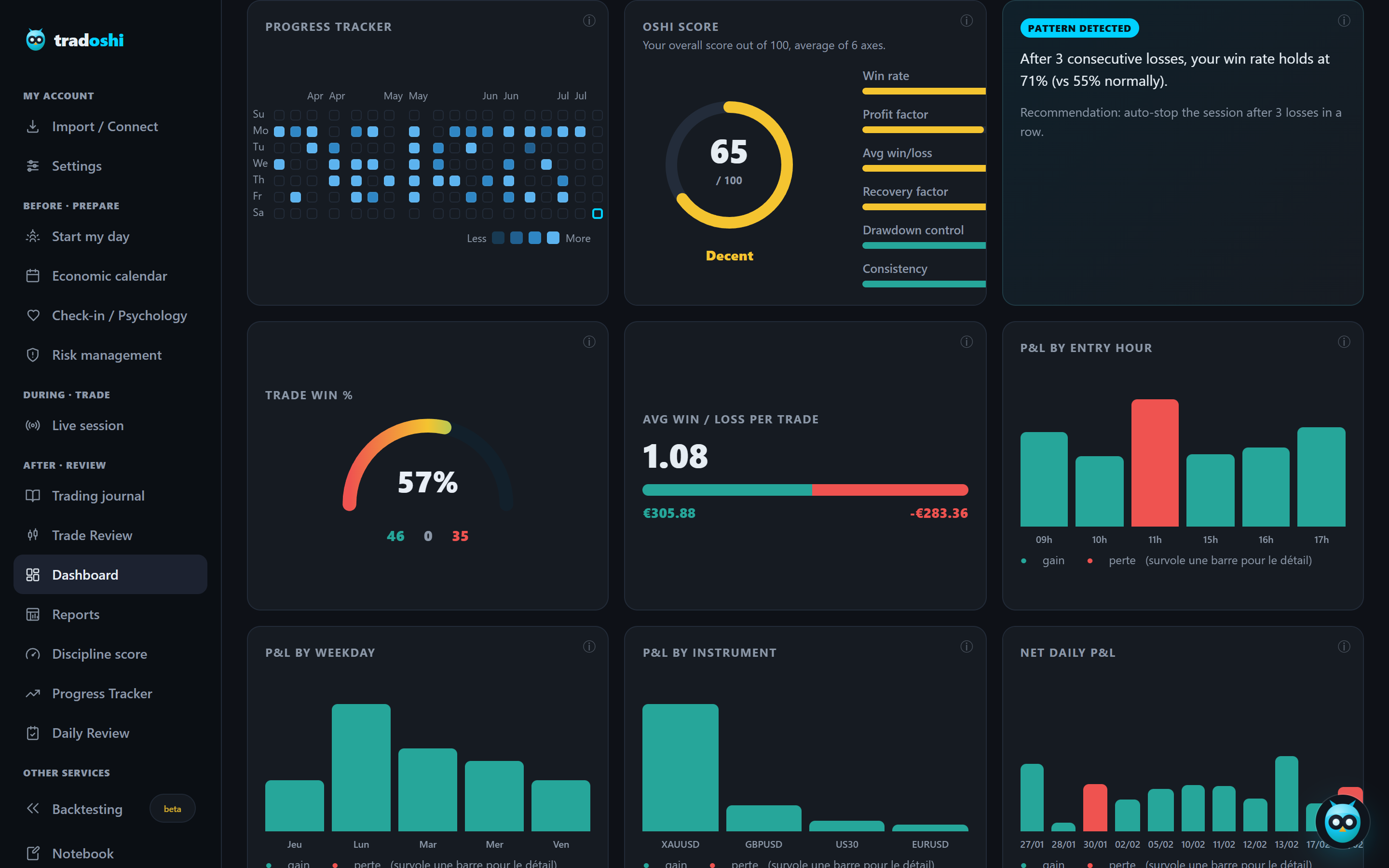
Tradoshi computes your profit factor automatically over all your trades, and breaks it down by instrument, setup and over time. You see at a glance whether your system is profitable, by how much, and where your edge truly hides.
- Overall profit factor computed over all your trades, updated on every sync.
- Breakdown by instrument and hour to spot your most profitable situations.
- Tracking over time to see whether your edge is strengthening or degrading.
- Crossed with your expectancy in the Oshi Score, your overall trader rating.
Frequently asked questions
What is the profit factor in trading?
It's the ratio between the sum of all your gains and the sum of all your losses. Above 1, you win more than you lose; below, the opposite. A profit factor of 1.5 means that for every unit lost, you win one and a half. It's one of the most reliable indicators for judging whether a strategy is profitable.
What is a good profit factor?
A profit factor between 1.3 and 1.6 indicates a solid, exploitable edge; between 1.7 and 2.5, it's excellent. Below 1.2, your system is barely profitable and very fragile. Above 3, be wary: it often signals too small a sample or one or two exceptional trades inflating the number.
Profit factor or win rate, which should I watch?
The profit factor is more reliable, because it weighs the amounts of your gains and losses, whereas the win rate only counts the number of winning trades. Two systems with the same win rate can be one profitable and one wiped out depending on the size of their gains and losses. Watch both, but if you keep only one, keep the profit factor.
How many trades for a reliable profit factor?
Over ten trades, the profit factor is dominated by chance and means nothing. You need several dozen, ideally hundreds of trades, for it to become meaningful. A profit factor of 2 over fifteen trades proves nothing; the same over three hundred trades is a real edge.
How do I improve my profit factor?
Two levers: lose less on your losers (cut fast, respect your stops) or win more on your winners (let them run). The first is often the most effective because it depends on your discipline. Many traders have a mediocre profit factor because they bank too fast and let their losses run.
Why is a very high profit factor suspicious?
Because a durable edge looks more like a stable 1.5 than a 4 over twenty trades. An abnormally high profit factor often comes from too small a sample, an exceptional period, or one or two huge trades that won't repeat. Recompute it removing your biggest gain: if it collapses, your profitability rested on luck.
What's the difference between profit factor and expectancy?
The two are mathematically linked: a positive expectancy almost always implies a profit factor above 1. Expectancy tells you how much you can expect to earn on average on your next trade; the profit factor weighs all your gains against all your losses over a period, to judge the overall solidity of your edge.
Should I compute my profit factor on gross or net P&L?
Always on net, after fees, spreads and commissions. A profit factor computed gross can give a misleading picture, especially if you trade frequently: a gross profit factor of 1.3 can fall to 1.1 once fees are deducted. A system profitable gross but that collapses net isn't a real edge.