Swing trading holds positions for several days to several weeks, aiming to capture a larger underlying move rather than a quick back-and-forth within the day. It's a style that especially appeals to those who can't stay in front of a screen all day, but it carries a very real risk in exchange: holding a position while the market is closed, unable to react before it reopens.
- Swing trading holds positions for several days to several weeks to capture a larger move.
- It suits a busy schedule well, since it doesn't require watching the screen continuously.
- Overnight and weekend gap risk is structural and must be managed, not ignored.
- Position size and stops differ notably from a day trader's, with wider stops and smaller size.
Not every trader has the ability, or the desire, to stay glued to a screen during market hours. Swing trading answers that constraint by shifting the decision horizon: instead of looking for several trades a day, a swing trader looks for a handful of well-chosen positions to hold for several days, sometimes several weeks, giving an underlying move time to fully develop.
This guide explains how swing trading works, why it particularly suits a profile with a busy schedule, what structural risks it involves and how to manage them, and the concrete differences in position management and journaling compared to day trading.
What swing trading is
Swing trading refers to a trading style that holds positions over a horizon of a few days to a few weeks, aiming to capture a meaningful portion of a directional move larger than a simple intraday fluctuation. Unlike a day trader, who systematically closes positions before the session ends, a swing trader accepts carrying a position across several sessions, betting on the continuation of an identified trend or move.
This wider horizon changes the nature of the trading: a swing trader generally spends less time continuously watching the screen, and more time analyzing context before entering a position. In its pace, it's a style closer to active portfolio management than to the fast execution trading typical of day trading or scalping.
Why it suits a busy schedule
One of the great advantages of swing trading, and likely the main reason for its popularity among traders who keep a job on the side, is that it doesn't require following the market continuously. Once a position is opened with a stop and often a target defined, a swing trader can go about their day and only check the market at a few chosen moments, without needing to be at the screen at the exact moment of a price move.
This flexibility makes it a style accessible to profiles very different from the classic day trader: someone with a salaried job, family responsibilities, or simply a preference for not spending hours in front of charts can absolutely practice swing trading seriously, provided they accept the specific constraints this style imposes in exchange for that freedom of time.
Gap risk, a structural constraint
The honest trade-off for that freedom of time is a very real risk: the gap. When a position is held while the market is closed (overnight in some markets, or over the weekend in nearly all markets outside crypto), price can reopen very differently from its closing level, driven by news released during the closure. A stop placed the day before no longer protects at its intended level: it fills at the first available price on reopening, which can be significantly worse.
This gap risk isn't hypothetical, it's a structural reality of swing trading that must be built into the trading plan from the start, not discovered after the fact. A serious swing trader consistently sizes their position accounting for the fact that the real loss could, in some scenarios, exceed the theoretical loss calculated from the stop distance, precisely because of this opening-gap risk.
Timeframes used in swing trading
The typical swing trading approach follows a top-down logic across timeframes. Higher timeframes, daily or weekly, establish the underlying directional bias: does the broader context favor a long or short position on the instrument in question. Shorter timeframes, often 4-hour or 1-hour, then refine the precise entry point, once that underlying bias is established.
| Timeframe | Typical role in swing trading |
|---|---|
| Weekly / daily | Establish the context and underlying directional bias |
| 4-hour | Identify a more precise entry structure within that bias |
| 1-hour | Refine entry timing without changing the underlying bias |
| Very short timeframes | Generally of little use in swing trading, better suited to day trading |
This top-down reading, from large to small, aligns the entry with the underlying move the swing trader is actually trying to capture, rather than trading a micro-fluctuation unrelated to the position's actual horizon.
Position size and stops: what changes
Position management in swing trading differs notably from day trading, for a simple mechanical reason: over a wider horizon, price moves are proportionally larger, which requires wider stops to give the position room to breathe without being knocked out by normal market noise. A stop sized for a day trade's range would be triggered constantly by the normal volatility of a position held for several days.
This wider stop distance has a direct consequence for position size: at an equal percentage of risk, a wider stop mechanically forces a smaller position size in units or contracts. It's a direct application of standard risk calculation, but the result sometimes surprises traders moving from day trading to swing trading without mentally adjusting their sizing habits.
An illustrative example
Imagine two traders each with 20,000 in capital, risking 1% (200) per trade. The day trader uses a 20-point stop on their instrument, allowing a position size matching that 200 risk over that distance. The swing trader, on the same instrument but with a multi-week view, uses a 150-point stop to let the position breathe through the normal fluctuations of that wider horizon. At equal percentage risk, their position size will be roughly seven times smaller in units than the day trader's.
This contrast illustrates well why a swing trader who kept the sizing habits of day trading, without adjusting them to a wider stop distance, would actually be taking far more risk than intended. Consistency between stop distance and position size is a pillar of risk management regardless of horizon, but its concrete application changes significantly from one style to another.
A journal that differs from day trading
A swing trader's journal looks little like that of an active day trader. Where a day trader or scalper can rack up dozens of trades a week, hard to document one by one in detail, a swing trader generally manages a far smaller number of positions, which leaves room for a much fuller narrative for each trade: the underlying context identified, the reasoning behind the entry, how the thesis evolved during the position, and any adjustments made along the way.
This documentary depth has real value for improving: in swing trading, each trade is a more significant decision, made with more perspective, and documenting the initial reasoning in detail allows, once the position is closed, an objective comparison between what was anticipated and what actually happened, a valuable discipline for refining a method from one swing trade to the next.
Financing fees and carrying costs
Holding a position for several days often involves, depending on the instrument traded, financing fees (sometimes called swap or rollover fees) that apply every night the position stays open. These fees, generally small over a single night, can end up representing a meaningful cost on a position held for several weeks, particularly on leveraged instruments where this carrying cost is directly tied to the rate difference between the two currencies or assets involved.
A serious swing trader factors this carrying cost into their expected profitability calculation before opening a position, especially on trades with an intended horizon beyond a week or two. Ignoring this cost, small trade by trade but cumulative, can distort the calculation of a strategy's real breakeven point, an invisible trap that day trading, through its systematic end-of-session closing, doesn't face in the same way.
How Tradoshi helps
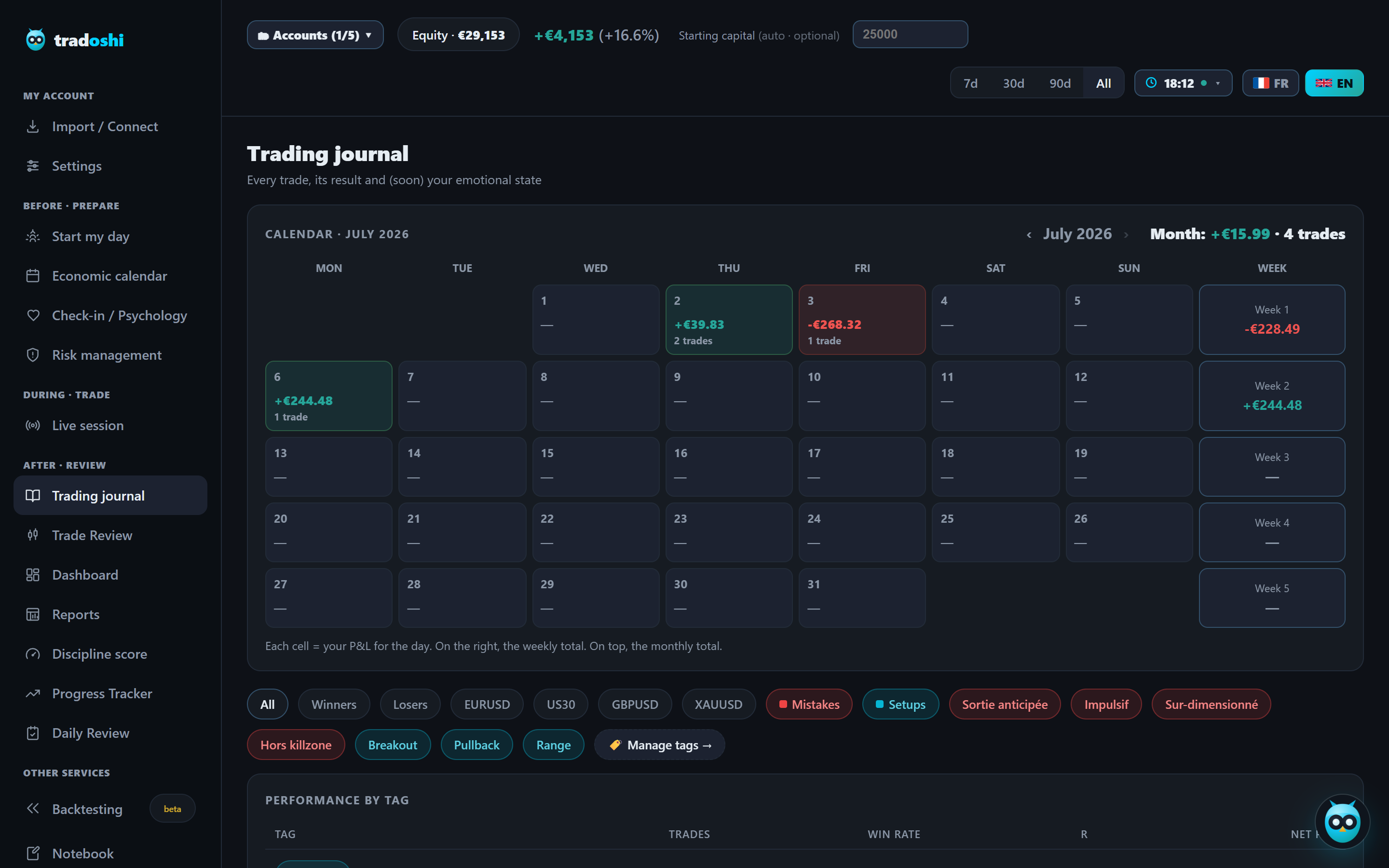
Whatever your trading horizon, day trading, swing or position, the question that matters stays the same: does your method produce a measurable result over time? Tradoshi adapts to the pace of swing trading, with a journal designed to document a full line of reasoning across a smaller number of trades, rather than optimizing only for fast entry of a high-frequency trade flow.
By tracking your real risk per trade on wider-stop positions, and documenting your initial thesis for every swing, you build a history that lets you know, with numbers, whether your approach to the underlying move gives you a real edge.
- Narrative journal: document the context and thesis of every swing, to compare anticipation against reality afterward.
- Real risk per trade: check your size stays consistent with wider stops, without risk drift.
- Stats by setup tag: compare your swings by underlying context identified (trend, range, reversal).
- Built-in calculator: determine the right position size from your real capital and your wider stop distance.
Frequently asked questions
What is swing trading?
Swing trading holds positions for several days to several weeks, aiming to capture a meaningful portion of a directional move larger than a simple intraday fluctuation. Unlike a day trader, a swing trader accepts carrying a position across several sessions.
Why does swing trading suit a busy schedule?
Because it doesn't require following the market continuously. Once a position is opened with a stop and often a target defined, the trader can check the market at a few chosen moments during the day, without being at the screen at the exact moment of a price move.
What is gap risk in swing trading?
It's the risk that price reopens very differently from its closing level, driven by news released while the market was closed (overnight or weekend). A stop placed the day before no longer protects at its intended level: it fills at the first available price, potentially far worse.
What timeframes are used in swing trading?
Higher timeframes (weekly, daily) establish the underlying directional bias, and shorter timeframes (4-hour, 1-hour) then refine the precise entry point within that bias, following a top-down reading logic.
How does position size differ from day trading?
A swing trader uses wider stops to let the position breathe through the normal fluctuations of a longer horizon. At an equal percentage of risk, that wider stop mechanically forces a smaller position size in units or contracts.
How do you journal in swing trading?
With fewer trades but a fuller narrative for each: the underlying context identified, the entry reasoning, how the thesis evolved during the position, and any adjustments made. This documentary depth allows an objective comparison between anticipation and reality once the trade closes.
Does swing trading involve extra fees?
Often yes, in the form of financing fees (swap or rollover) that apply every night the position stays open, depending on the instrument. Small over one night, they can become a meaningful cost on a position held for several weeks and should be factored into expected profitability.
How many positions does a swing trader typically manage?
Generally few at a time, often just a handful, since each trade requires tracking its underlying context over several days to several weeks. Managing too many simultaneous positions spreads thin the attention needed to properly follow each thesis.
Does swing trading require following macroeconomic news?
To some extent, yes, since a position held for several days or weeks is more likely to cross a major economic announcement or an earnings release than an intraday position. Knowing that calendar is part of honest risk management in swing trading.