Beginner traders often think their mistakes are unique, personal, tied to their situation. The reality is quite different: the vast majority of losing traders make the same mistakes, in the same order, for the same reasons. Knowing these classic mistakes gives you a huge head start. This guide reviews the faults that recur most often and how to avoid them.
- Trading mistakes are universal: almost all losers make the same ones.
- They're mostly behavioral, not technical: risk, discipline, emotion.
- Knowing them in advance lets you spot them in yourself before they get expensive.
- A journal makes them visible and quantifies their real cost, which speeds up correction.
There's something comforting and slightly annoying about discovering that your trading mistakes aren't original. Comforting, because if everyone makes them, they're surmountable and documented. Annoying, because we'd like to believe we're different. But accepting this universality is the first step to progressing faster than average.
Most of these classic mistakes aren't technical but behavioral: they touch risk management, discipline and emotions. That's good news, because it means avoiding them doesn't require secret knowledge, but awareness and guardrails. This guide reviews the most frequent mistakes to help you recognize and correct them before they drain your account.
Risking too much and trading without a stop
The most fundamental mistake, the one that kills the most accounts, is risking too much per trade. The beginner, eager to win, bets big, and a few consecutive losses are enough to devastate their capital. This mistake is often doubled by another, just as deadly: trading without a stop loss, telling yourself you'll cut by hand if it goes wrong, which almost never happens in the heat of the action.
These two mistakes combine into an account-ruining machine. Without a stop, a loss can grow without limit; with an already-too-high risk, a single bad position can do irreparable damage. The correction is simple to state: risk a small fixed percentage per trade and systematically place a stop at entry. Simple to say, hard to hold under emotion, but it's the non-negotiable foundation of survival.
Cutting gains, letting losses run
The most universal behavioral mistake is doing exactly the opposite of what you should: cutting your winning trades too early, and letting your losing trades run. The trader quickly secures a small gain out of fear of giving it back, and refuses to realize a loss out of hope it turns around. The result: small gains and big losses, the perfect recipe for losing despite a good win rate.
Most traders cut their flowers and water their weeds. They bank their good trades too early and keep their bad ones too long.
This mistake comes directly from our psychological wiring: loss aversion makes us flee the pain of realizing a loss and secure too quickly the pleasure of a gain. Correcting it requires going against your instinct, letting your winners reach their target and cutting your losers without hesitation. It's one of the hardest psychological projects, but also one of the most profitable in trading.
Revenge trading
Revenge trading is the mistake that turns a bad day into a catastrophe. After a loss, part of you wants to immediately recover the money: you take a trade you'd never have taken cold, often with a bigger size, to win it back. It's the most destructive behavior of all, because it concentrates risk exactly when your judgment is most degraded.
Revenge trading is particularly pernicious because it self-feeds: a loss spawns a revenge trade that often spawns a new, bigger loss, which calls for even stronger revenge. The only reliable counter is stopping: a rule that makes you cut the session after a certain number of losses, decided cold and applied mechanically, before the spiral accelerates.
Overtrading
Overtrading is taking too many trades, often out of boredom, FOMO or a need for action. The trader who overtrades forces mediocre entries they wouldn't have taken if selective, which degrades the average quality of their trades. Worse, they thus multiply their exposure to fees and their total risk, while diluting their edge in a mass of conviction-less trades.
| Mistake | Consequence |
|---|---|
| Risking too much | A losing streak ruins the account |
| No stop | A loss grows without limit |
| Cutting gains early | Small gains, big losses |
| Revenge trading | A bad day becomes a disaster |
| Overtrading | Diluted edge, higher fees and risk |
Overtrading is often the symptom of a lack of clear criteria: without a precise definition of what a good trade is, everything becomes a potential trade. The correction goes through selectivity: strict entry criteria, a limit of trades per day, and accepting that doing nothing is often the best decision. Fewer trades, but better quality, almost always beats many mediocre ones.
Constantly changing systems
A more subtle but equally crippling mistake is system-zapping: changing strategy at the slightest drawdown. The trader who zaps never accumulates enough trades on a single method to know whether it has an edge, and often abandons a profitable strategy just as a normal losing streak makes them doubt it.
This instability makes any progress impossible, because you can't improve what you never let settle. The correction is patience: choose a system, let it produce enough trades to be judged honestly, then refine it through small adjustments rather than replacing it. Mastery comes from depth on one method, not from collecting methods tried then abandoned.
Not keeping a journal
The mistake that worsens all the others is not keeping a journal. Without a journal, your mistakes stay invisible: you repeat them without realizing, you never measure their real cost, and you can't know whether you're improving. It's the most costly mistake long-term, because it condemns you to endlessly relearn the same lessons.
Keeping a journal turns each mistake into usable data. By recording your trades and their context, you see your recurring patterns emerge, you quantify what each bad habit costs you, and you track your progress. The journal is the tool that makes all other corrections possible, because it replaces impression with measurement. That's why not keeping one is, indirectly, the gravest of the classic mistakes.
Trading without a written plan
A mistake upstream of all the others is trading without a written plan, improvising every decision as the market moves. Without rules put on paper, every trade becomes a negotiation with yourself, where the emotion of the moment always has the final word. The trader with no plan can't even know whether they executed well, since there's no reference to compare their actual behavior against.
This lack of a plan mechanically worsens every other mistake on this list: without written selection criteria, overtrading becomes almost inevitable; without an exit rule defined in advance, cutting gains too early becomes the default reflex. Writing your plan, even a simple one, before refining it with experience, is the prerequisite that makes correcting all the other classic mistakes possible.
Ignoring correlation between your positions
A lesser-known but equally costly mistake is opening several positions that look diversified but actually respond to the same underlying factor. A trader who thinks they've spread their risk across three different positions may have in fact tripled their exposure to a single market move, if those three instruments are highly correlated. This illusion of diversification is particularly dangerous because it gives a false sense of security exactly when real risk is concentrated.
Imagine a trader who risks 1% of their capital on each of three currency pairs that almost always move together: in an adverse common move, they don't lose 1% but the equivalent of 3% at once, without ever exceeding their per-position limit. Checking the real correlation between your open positions, not just their name or apparent sector, is a risk-management step many traders skip, to their cost.
Neglecting market context
One last classic mistake is applying a strategy identically regardless of market context, ignoring whether you're in a strong trend, a tight range, or a high-volatility phase. A setup that excels in trend can generate a string of false signals in a range, and vice versa. The trader who doesn't distinguish between these market regimes is puzzled by inconsistent results, without realizing the problem isn't their setup but the context in which they apply it without discernment.
Correcting this mistake doesn't require predicting the market, only recognizing which regime you're currently in and adjusting your selectivity accordingly: staying more cautious or standing aside outside the conditions where your edge has proven itself. This context awareness, combined with a journal that breaks down your results by market regime, turns an invisible mistake into an extra filter that mechanically improves your selectivity.
Trading with money you need
A fundamental mistake, often left unsaid, is trading with money you need in the short term, next month's rent, your emergency savings, a budget already earmarked elsewhere. This mistake isn't primarily financial, it's psychological: when every loss threatens your ability to pay your bills, your brain can no longer treat trading as a normal probabilistic activity. Every trade becomes existential, which triggers exactly the stress reactions that degrade judgment.
A trader who plays with money they genuinely need can't calmly apply their risk management, because emotional pressure makes every loss unbearable, even one that stays within their rule. This financial context explains a large part of the destructive behaviors already covered: overtrading to make up a shortfall, revenge trading to avoid a personal catastrophe. The rule is simple to state and hard to follow: only trade with capital whose loss, even total, wouldn't change your daily life.
Underestimating fees and transaction costs
A discreet mistake that weighs heavily over time is underestimating the impact of transaction fees, spread and overnight financing on real profitability. A trader who racks up round trips without counting these costs may believe they're profitable on paper while cumulative fees eat a significant share, sometimes all, of their theoretical edge. The higher the trading frequency, the heavier this erosion, and the more it goes unnoticed unless you isolate it explicitly in your tracking.
Correcting this mistake simply requires folding these costs into your real performance calculation, not just your gross P&L, and honestly asking whether your trading frequency is justified by an edge strong enough to absorb these fees. A setup that looks slightly profitable excluding costs can turn out clearly unprofitable once fees are included, which radically changes the decision to keep it or drop it.
Copying other traders' trades without your own judgment
One last classic mistake, amplified by social media, is copying other traders' trades or ideas without running them through your own risk and understanding filter. Following an outside signal can feel like a shortcut, but you lose what matters most: the conviction and understanding needed to hold the position when it moves against you, and the ability to judge whether this trade actually fits your system and your account size.
A trader who copies without understanding almost always ends up panicking at the wrong moment, because they lack the underlying reasons that justified the original idea, only the hoped-for result. Good practice isn't to ignore other people's ideas, they can be a legitimate source of inspiration, but to always run them through your own entry criteria, your own risk management and your own validation before executing them as if they were yours.
How Tradoshi helps you avoid these mistakes
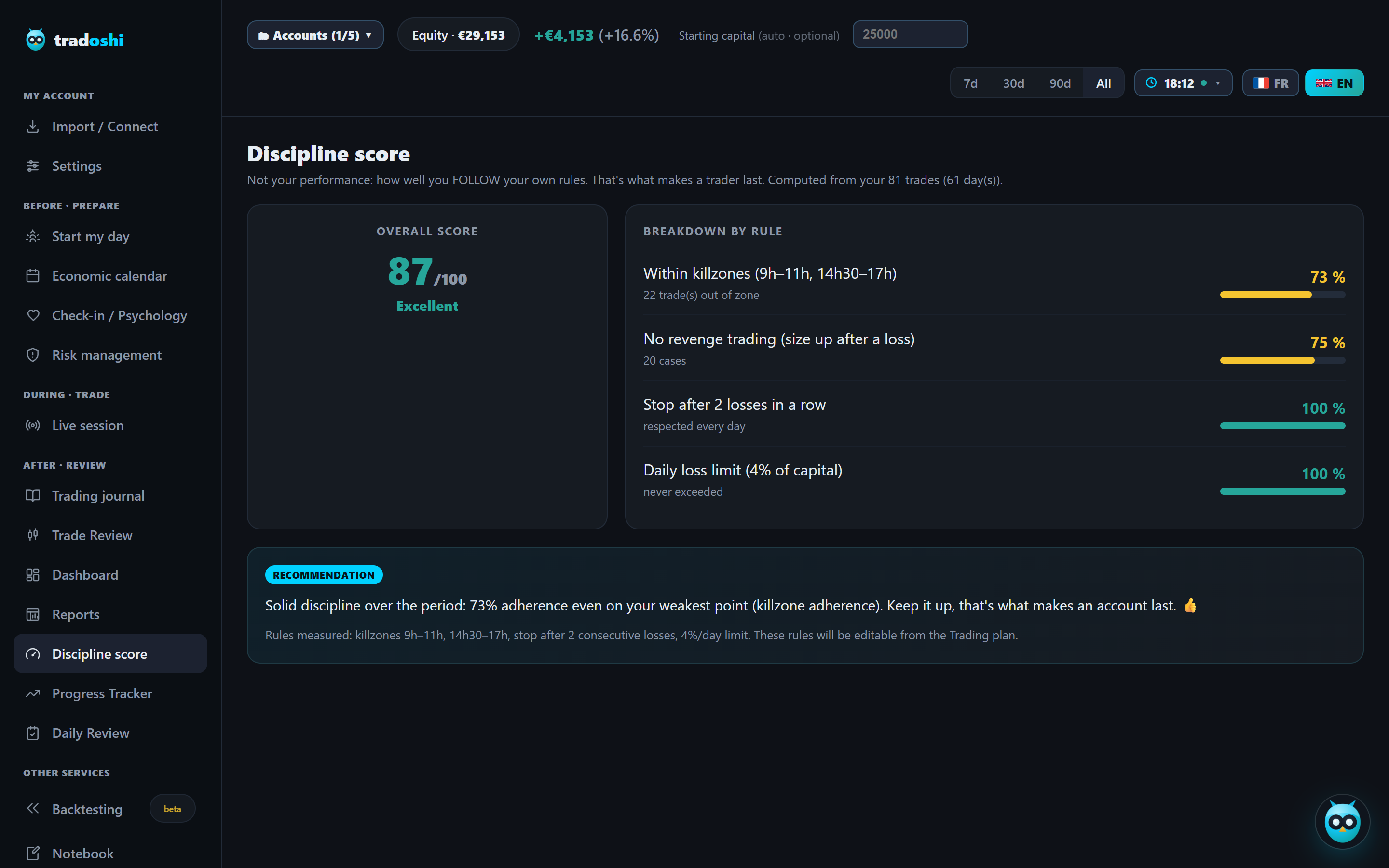
Tradoshi makes classic mistakes visible in your real trades and quantifies their cost. It detects revenge trading, overtrading, the absence of a stop, and measures what these behaviors really cost you.
- Discipline score that spots revenge trading, overtrading, out-of-zone trades and missing stops.
- Underlying statistics to distinguish a normal losing streak from a real problem, and avoid zapping.
- % of capital risked and risk calendar to spot too-high risk.
- Automatic journal from your synced trades, so mistake number one (no journal) no longer exists.
Frequently asked questions
What are the most common trading mistakes?
Risking too much per trade, trading without a stop loss, cutting gains too early and letting losses run, revenge trading, overtrading, constantly changing systems, and not keeping a journal. These mistakes are universal and mostly behavioral: almost all losing traders make them, in the same order.
Why do I cut my gains early and keep my losses?
Because of loss aversion, a universal psychological bias: your brain makes you flee the pain of realizing a loss (so you keep losers) and secure too quickly the pleasure of a gain (so you cut winners). The result: small gains, big losses. Correcting this requires going against instinct, which is one of the most profitable projects in trading.
What is revenge trading?
It's taking, after a loss, a trade you'd never have taken cold, often with a bigger size, to recover the money immediately. It's the most destructive behavior because it concentrates risk when your judgment is most degraded, and it self-feeds. The counter is a stop rule after N losses, decided cold.
Should I change strategy after a losing streak?
No, it's a classic mistake. A losing streak can be perfectly normal. Changing system at the slightest drawdown prevents you from accumulating enough trades to know whether your method has an edge, and often makes you abandon a profitable strategy at the worst moment. Mastery comes from depth on one method, not from collecting methods.
What's the mistake that worsens all the others?
Not keeping a journal. Without one, your mistakes stay invisible: you repeat them without realizing, never quantify their cost, and don't know whether you're improving. The journal turns each mistake into usable data and makes all other corrections possible by replacing impression with measurement.
Why is trading without a written plan such a serious mistake?
Because without rules put on paper, every trade becomes a negotiation with yourself where emotion always has the final word, and you can't even know whether you executed well. This lack of a plan mechanically worsens every other mistake: without written criteria, overtrading becomes almost inevitable.
Why is correlation between my positions a hidden risk?
Because several positions that look diversified may actually respond to the same underlying factor. If you risk 1% on each of three highly correlated positions, an adverse common move makes you lose the equivalent of 3% at once, without ever exceeding your per-position limit. Checking real correlation, not just instrument names, is a step often skipped.