Every trader has patterns: recurring schemas in how they trade that, without them being aware, determine a large part of their results. Some patterns make you win, others make you lose, and most stay invisible until you look for them. This guide explains which patterns to spot in your own trading, how to identify them, and how to use them to improve.
- Your patterns decide your results often more than your stated strategy.
- They're invisible without analysis: you suffer them until you look for them.
- There are winning patterns to repeat and losing patterns to cut.
- They appear in breakdowns by time, instrument, day and emotion.
When we talk about patterns in trading, we often think of chart patterns. But the most important patterns for your performance aren't on the chart, they're in your behavior: the moments you win most, the situations where you systematically lose, the emotions that coincide with your best and worst days. These behavioral patterns are your real ground for progress.
The problem is that these patterns are invisible to the naked eye. Lost in the flow of your trades, you can't see that you always lose on Friday afternoon, or that your best setup hides in a specific time window. This guide shows you which patterns to look for, how to surface them from your data, and how to turn this knowledge into a concrete advantage, from the initial spotting all the way to the written rule you apply day to day.
The patterns that really matter
The most decisive patterns for your performance are behavioral, not chart-based. They're the regularities in how you trade: the setups where you excel, the moments you derail, the emotional states that precede your best and worst decisions. These patterns are unique to you, they reflect who you are as a trader, and that's precisely why they're so valuable to know.
Unlike chart patterns, available to everyone, your behavioral patterns are your private information. No one but you can discover them, because they're in your own data. Identifying them gives you an advantage no one can copy: the intimate knowledge of what makes you win and lose, which lets you adjust your behavior where it truly counts, rather than following generic advice that ignores who you actually are.
The winning patterns to repeat
The first family of patterns to look for is your winning patterns: the situations where you win most often and biggest. Maybe a specific setup shows an excellent win rate, a certain time window concentrates your best trades, or a particular instrument suits you far better than others. These positive regularities are gold mines, because they tell you where to concentrate your energy.
Most traders seek to correct their weaknesses. The best first identify their strengths, and simply do more of what already works.
Identifying your winning patterns enables an often-neglected optimization: instead of correcting weaknesses, you amplify strengths. Discovering that a single setup produces a large share of your gains pushes you to play it more, prepare it better, not miss it. Doing more of what already works is one of the simplest and most effective ways to improve your performance, and it starts with recognizing your winning patterns.
The losing patterns to cut
The second family is your losing patterns: the situations that systematically cost you money. A weekday where you always lose, an hour when your trades go wrong, a type of market that doesn't suit you, or an emotional state that coincides with your worst days. These negative patterns are leaks you can often plug simply by stopping the activity that produces them.
Optimization by removal, stopping what makes you lose, is one of the easiest gains in trading. If your data shows a certain situation has a clearly negative expectancy, the decision is obvious: avoid that situation. Many traders clearly improve their performance simply by removing their worst patterns, without changing anything else. But to cut them, you first have to see them, and that's where analysis becomes indispensable. It's also psychologically easier than fixing a technical weakness: it's not about learning to trade a situation better, just about no longer exposing yourself to it at all.
Surfacing patterns through breakdowns
Patterns don't appear in a raw list of trades, they emerge when you break down performance along different dimensions. By grouping your trades by time of day, day of week, instrument, setup or emotional state, you surface performance differences that were drowned in the mass.
| Breakdown | Pattern it reveals |
|---|---|
| By hour | Your winning and losing windows |
| By day | The days you derail |
| By instrument | What suits you or not |
| By setup | Your profitable configurations |
| By emotion | The state that coincides with losses |
Each of these breakdowns is a lens that reveals a different type of pattern, and none of them is optional if you want the full picture rather than a partial, potentially misleading one. It's by crossing these dimensions that you get the finest information: not just that you lose on Friday, but that you lose on Friday afternoon on a specific instrument when you're in a degraded emotional state. The more precise the breakdown, the more actionable the pattern, and the more targeted and effective the correction.
Beware of false patterns
Searching for patterns is worth doing seriously, not as a one-off exercise but as a recurring habit, because your patterns shift as you gain experience, as market conditions change, and as your life circumstances evolve. A review that made sense six months ago can be stale today. An important trap awaits the pattern-seeker: the false pattern, an apparent regularity that's actually just chance. On a small sample, you can always find a motif, like three consecutive losses on a Tuesday, that seems significant but isn't at all. Acting on a false pattern means mistaking noise for signal, and complicating your life for nothing.
To distinguish a real pattern from a false one, you need a sufficient sample size and a marked, consistently repeated difference, not a one-off streak that could just as easily have gone the other way. A pattern based on five trades is worthless; the same based on dozens of trades, with a clear performance gap, deserves attention. Statistical caution is essential: better to act on a few solid, well-established patterns than on a multitude of fragile motifs that are just disguised chance.
Time-based patterns: hour, day, session
Time is one of the richest dimensions for patterns, and yet one of the most overlooked. Every trader has hours when their focus, market reading and discipline are better, and hours when they degrade, often without realizing it. A trader might excel at the London session open, for instance, and perform noticeably worse late in the day, when fatigue builds up and patience runs out.
The day of the week adds another layer: some traders perform much better mid-week, when their rhythm is stable, and noticeably worse on Fridays, caught between wanting to close the week on a win and accumulated fatigue. Crossing hour and day refines the pattern further: a trader might discover they almost systematically lose on Friday after 4pm, a very specific window they can simply decide to avoid, without changing anything else about their strategy.
Patterns tied to instrument and setup
Not all instruments are equal for a given trader, even within the same asset class. A trader might have a real edge on one index but be structurally unprofitable on another, simply because their reading of context, execution speed or tolerance for volatility fits one better than the other. This pattern is easy to miss if you trade several instruments without ever comparing them separately.
Setup adds an even finer layer of granularity. Two setups that look similar in theory, a range breakout and a trend breakout for example, can have radically different performance profiles for the same trader. One might show a solid edge, the other a slightly negative expectancy, even though they belong to the same family of chart patterns. Without a per-setup breakdown, these two opposite realities stay drowned in a single, misleading average statistic.
Emotional and physiological patterns
Some of the most powerful patterns are neither time-based nor tied to an instrument, but purely internal. Fatigue, lack of sleep, stress accumulated outside trading, or even hunger, measurably influence decision quality, even when you're not aware of it in the moment. A trader might, for instance, find that trades taken after a night with less than six hours of sleep have a noticeably lower win rate than those taken after a full night's rest.
These physiological and emotional patterns are often the most profitable to fix, because they touch root causes rather than surface symptoms, and because fixing them tends to improve every other pattern at once, rather than just one narrow slice of your trading. Spotting that a degraded emotional state systematically precedes a losing streak doesn't just say what to avoid, it also reveals an early warning signal: the next time that state appears, the trader knows to cut size, or even stop, before the losses pile up.
From discovery to action
Discovering a pattern is useless if you don't turn it into a concrete rule. Once a pattern is confirmed on a sufficient sample, good practice is to write it down as a rule in your trading plan: 'I don't trade after 4pm on Fridays,' or 'I cut my size in half if I slept less than six hours.' A written rule is infinitely easier to respect than a vague intuition about what works or doesn't.
This transformation also requires ongoing tracking: a pattern identified today can evolve with your experience, your life circumstances or market conditions. Regularly reviewing your patterns, rather than treating them as fixed once and for all, ensures your trading plan stays aligned with who you actually are as a trader, not who you were six months ago.
A worked example: uncovering a hidden pattern
Let's take a concrete example. A trader who takes an average of 200 trades over a quarter has an overall win rate of 48% and a profit factor of 1.1, decent but nothing special. Breaking these same trades down by hour, they discover their 40 trades taken between 2pm and 4pm show a 61% win rate and a 1.9 profit factor, well above their overall average. Conversely, their 35 trades taken after 7pm show a 34% win rate and a 0.6 profit factor, clearly losing.
This pattern, invisible in the overall statistic, changes everything once isolated. By choosing to concentrate their activity on the 2pm to 4pm window and stopping trading entirely after 7pm, this same trader, without changing a single rule of their strategy, could see their overall profit factor climb significantly, simply by playing their best pattern more often and cutting their worst one. It's the perfect example of the value of breakdowns: the same strategy, the same trader, but a radically more efficient allocation of time.
How Tradoshi reveals your patterns
Tradoshi automatically does the breakdowns that reveal your patterns, on your real trades. You see where and when you win or lose, which setups suit you, and which emotional state coincides with your worst days.
- Breakdowns by hour, day and instrument to spot your winning and losing windows.
- Per-setup statistics to identify your most profitable configurations to repeat.
- Emotion crossed with performance to reveal the state that coincides with your losses.
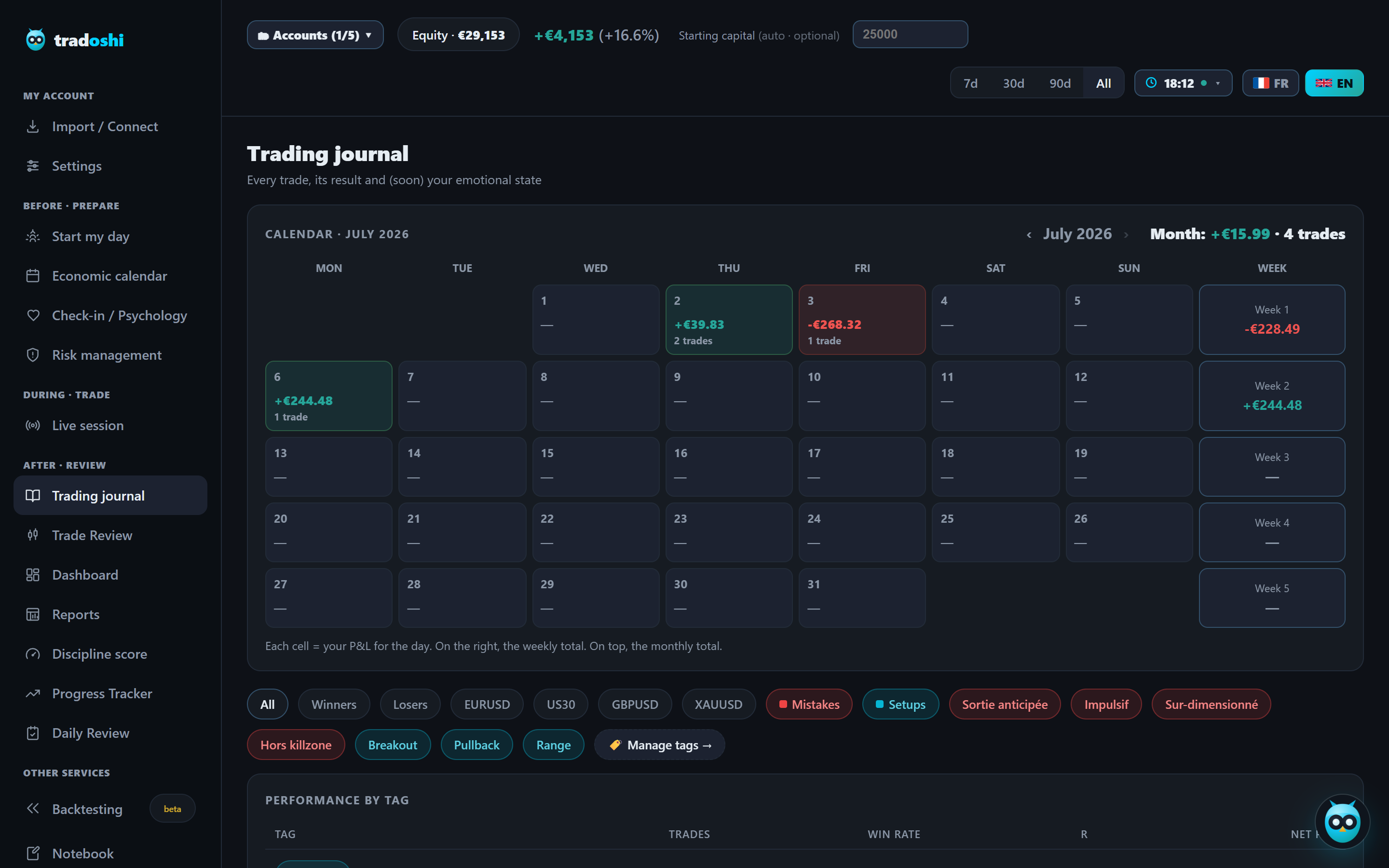
- P&L calendar to see at a glance your patterns by day and week.
- Pre-session check-in to connect today's state to the emotional patterns you've identified.
Frequently asked questions
What is a trading pattern?
Beyond chart patterns, they're mainly recurring schemas in your own behavior: the moments you win most, the situations where you systematically lose, the emotions that coincide with your best and worst days. These behavioral patterns, unique to you, determine a large part of your results and stay invisible until you look for them.
How do I identify my trading patterns?
By breaking down your performance along different dimensions: by hour, day of week, instrument, setup and emotional state. These breakdowns surface performance differences drowned in the raw list of your trades. The more you cross these dimensions, the more precise and actionable the pattern.
What do I do with a winning pattern?
Repeat it. Identifying your winning patterns (your best setup, best window, best instrument) enables an often-neglected optimization: instead of correcting weaknesses, you amplify strengths. Doing more of what already works is one of the simplest and most effective ways to improve your performance.
How do I cut a losing pattern?
Simply by stopping the activity that produces it. If your data shows a situation has a clearly negative expectancy (a day, hour, type of market), avoid it. Optimization by removal is one of the easiest gains in trading: many traders clearly improve their performance just by removing their worst patterns.
How do I avoid false patterns?
By requiring a sufficient sample and a marked difference. On a small number of trades, you always find apparent regularities that are just chance. A pattern based on five trades is worthless; the same on dozens of trades with a clear gap deserves attention. Better to act on a few solid patterns than a multitude of fragile motifs.
Are time-based patterns really reliable?
Yes, provided you have a sufficient sample. Many traders have hours or days when their focus and discipline are noticeably better, often without realizing it. Crossing hour and day refines the pattern further, for example discovering you systematically lose on Friday afternoons, a specific window you can simply decide to avoid.
How do I turn a pattern into a concrete change?
By writing it down as an explicit rule in your trading plan, not as a vague intuition. Once the pattern is confirmed on a sufficient sample, a written rule like 'I don't trade after 4pm on Fridays' is infinitely easier to respect. You then need to review this pattern regularly, since it can evolve with your experience and market conditions.
Should I track physiological factors like sleep alongside my trades?
It's worth trying if you suspect fatigue or stress affects your results, which is common. Even a simple note on hours slept or stress level, logged alongside each session, can surface a pattern within a few weeks. If trades taken on little sleep show a clearly worse win rate, that single insight can be more valuable than months of tweaking entry rules, since it costs nothing to apply once you know it.
Do patterns matter more than my overall strategy?
Not more, but they often explain more of the gap between a mediocre result and a good one. Two traders can run the exact same strategy on paper and end up with very different results, purely because of how consistently one of them plays their best patterns and avoids their worst ones. The strategy sets the ceiling, your patterns decide how close you get to it, which is exactly why two people running the same playbook can post very different results a year later.