Order book scalping is the kind of subject that hypnotizes traders and wrecks about nine out of ten who touch it without a method. You stare at numbers flickering, green and red columns pulsing, and you tell yourself the truth of the market is right there, hidden in that flow. It is, partly. But reading a book gets you nowhere if you do not know what to do with the information in the three seconds it is still valid.
- The order book shows supply and demand in real time, not a prediction of what comes next.
- Big visible orders are not always honest: spoofing and layering are real and common.
- Execution speed matters as much as reading skill. A well read book badly executed is worthless.
- Without a journal or discipline, order book scalping quickly turns into a capital vacuum.
What order book scalping actually is
The order book, or the book, is the real time list of every pending order on an instrument: buyers waiting to get in at a given price, sellers waiting to get out at another. On one side the bid, on the other the ask. Between the two, a spread that breathes with the liquidity of the moment. A trader working the order book does not just look at where price sits, he looks at where price wants to go by watching who is pushing and who is holding the line.
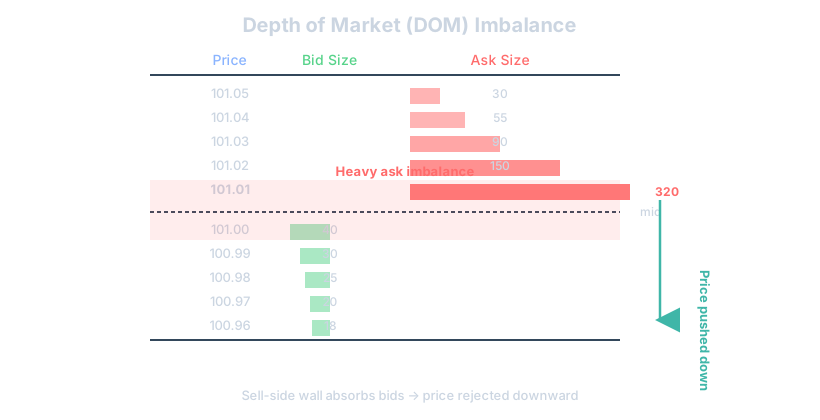
In practice, you open a depth of market window, the famous DOM, and you watch quantities stack up at every price level. Trading index futures, for example, you might see 400 contracts stacked on the bid and only 50 on the ask just above. That raw visual imbalance is the scalper's raw material. There is little to no classic technical analysis here. The trader is reading the mechanics of supply and demand at this exact instant.
This differs from order flow in the broader sense, which also includes time and sales, volume imprints, and delta. The order book is one brick of order flow, the one that shows displayed intentions (resting limit orders), while time and sales shows what actually got filled. A good scalper cross references both constantly, because the book alone can lie to you.
Why this style attracts so many traders (and disappoints just as many)
There is something mesmerizing about watching a book move. You feel like you are seeing the market's naked truth, without the lag of indicators. No moving average dragging behind, no RSI confirming three candles too late. Just supply and demand, live. For a trader who loves action and hates waiting, that is a soft drug.
The problem is that this apparent truth is also the easiest thing to over interpret. A wall of 500 lots on the bid can vanish in one second, because an algorithm placed it and pulled it just to create an impression. You think you are reading real demand. You are actually reading a decoy. And since scalping plays out on tiny moves, a bad read costs you immediately, with none of the recovery time you would get on a swing trade that leaves you hours to adjust.
This style also demands total mental commitment during the session. No multitasking, no scrolling between trades. You are glued to the screen, tense, for blocks of twenty to forty minutes. Many traders underestimate that cognitive cost and burn out after two hours, exactly when fatigue makes them miss the real signal of the day.
The elements you need to learn to read in the book
The order book is not just a column of numbers. There are several distinct signals in there, and confusing them is beginner mistake number one.
- The bid/ask spread: the wider it suddenly gets, the more liquidity is pulling out, often right before or during a news release.
- The depth at each level: a large size that holds its position for several seconds carries more weight than size that flickers in and out.
- Absorption: when a large resting order absorbs aggressive selling without price moving, it often signals someone defending a level.
- Time and sales: the speed and size of executed trades, always to be checked against what the book is showing.
- Iceberg orders: hidden orders that reveal only a fraction of their real size, exposed only by repeated fills at the same price.
An illustrative example to make this concrete: imagine you are watching a book on a futures contract and you see 300 contracts on the best bid. Price hits that level three times in a row, and each time the size refills almost instantly. That is the classic sign of an iceberg. An experienced scalper reads that as a defended zone and looks for a bounce, rather than blindly shorting just because price tested the level three times.
The trap of spoofing and fake walls
Let's be blunt about this, because it is what wrecks the most beginner accounts in order book scalping. Spoofing means placing a large visible order in the book with no intention of executing it, purely to influence how other traders perceive the market and push them to act a certain way. The order gets pulled a split second before it would be hit.
Layering works on a similar logic: stacking several orders at different price levels to create the illusion of a solid wall, when the whole structure can be pulled in a cascade. On heavily regulated markets these practices are banned and punished, but that does not stop them from happening, especially on less regulated markets or during thin liquidity hours.
How do you protect yourself without playing financial detective? By watching for persistence. A wall that stays stable for several seconds, that genuinely absorbs fills, carries far more credibility than a wall that appears right before price approaches and disappears at the last moment. This is a skill built over hundreds of hours of observation, not a weekend of YouTube tutorials. And honestly, if you are just starting out, it makes more sense to first understand scalping in its broad strokes before diving into fine grained book reading.
Execution: the part everyone underestimates
Reading the book is one thing. Pressing the button at the right moment, with the right size, with zero lag, is another. In order book scalping you are playing on moves of a few ticks. A latency spike, a sluggish platform, a misplaced click, and your theoretical edge evaporates before it ever existed.
This is why this style structurally favors certain account types and brokers over others. Direct market access with minimal latency changes everything compared to a standard retail account where the order passes through several layers before reaching the market. That is not a minor technical detail, it is a component of the edge itself. You can have the best read in the world, but if your execution lags by 200 milliseconds on a market moving in 50, you are structurally at a loss.
The same logic applies to position risk management. Mental stops do not exist in order book scalping, there is no time to think. You need an automatic stop, often very tight, defined before you even enter. This is where calculating your position size correctly becomes vital: on a scalp with almost no margin for error, an oversized position turns a small execution slip into serious account damage.
The specific psychological cost of this style
Trading psychology gets discussed in general terms all the time, but order book scalping has its own sharper mental traps, more acute than on longer timeframes. The frequency of decisions is enormous. You might take fifteen, twenty, sometimes thirty trades in one session. Each small loss, on its own, means nothing. But the accumulation over a rough morning can push you toward tilt without you even noticing it happening.
This is the perfect playground for revenge trading, because the speed of the loss-then-retry cycle leaves you no room to step back. On a swing trade, you lose, you close the screen, you come back tomorrow with a clear head. On a scalp, you lose, and five seconds later the book is already flashing a new opportunity screaming 'get in now'. That compression of time between failure and the temptation to jump back in is what makes this style so psychologically dangerous.
FOMO also takes a particular shape here: watching a move unfold while you hesitate a split second too long, then wanting to 'make up for it' on the next trade with a bigger size. That is exactly the mechanism described in the piece on FOMO in trading, except here everything happens at a speed that gives you almost no chance to catch yourself before your finger hits the button.
Building a realistic routine for this trading style
Order book scalping is not compatible with improvisation. It needs a structured session, rules written down in advance, and the ability to stop cold the moment something feels off. Here are the pillars that show up again and again among traders who actually last with this style.
- Decide in advance which instruments you follow (one or two, never more) and know their liquidity behavior at different hours of the day.
- Set a fixed position size for the whole session, not one that grows after every win.
- Set a hard limit on consecutive losses before you stop, because the fast pace hides the decline in your mental state.
- Log each trade right after taking it, even one line, so you don't lose track of what worked and what failed.
- Build in mandatory breaks every 20 to 30 minutes. Focus on a DOM degrades fast with fatigue.
On that last point, plenty of traders believe they can stay sharp for two straight hours on a DOM. In practice, read quality drops noticeably after roughly 45 minutes of continuous focus, and that drop is exactly when small, avoidable mistakes start creeping into the session. A short break, even five minutes away from the screen, resets attention enough to matter.
Why most traders never make this style work
Here's an uncomfortable truth: most retail traders who try order book scalping are undercapitalized, under equipped on execution, and mentally unprepared for the pace. They watch a few videos of an experienced trader calling moves with apparent ease, and they assume the skill transfers instantly. It doesn't. What you're watching is thousands of hours of pattern recognition compressed into a five minute clip.
There is also a structural mismatch between order book scalping and the retail trading psychology most people bring to the market. This style rewards patience within speed, a strange combination: you need to wait for the right imbalance, but once it appears you have almost no time to act. Most beginners either force trades out of boredom, which is a textbook case of overtrading, or freeze at the critical moment and miss the window entirely.
Add to that the fee structure. Scalping generates a high volume of trades, and each one carries a cost, whether it's commission, spread, or slippage. A strategy that looks profitable on paper can bleed out once real transaction costs get factored in. This is precisely why tracking your profit factor matters more here than almost anywhere else: a high win rate built on tiny wins can still be a net loser once costs eat the margin.
Risk rules that actually fit this pace
Generic risk management advice does not always translate cleanly to order book scalping, because the time horizon is so compressed. Still, the core principle holds: you should know, before you click, exactly how much you stand to lose if the read is wrong. Risking a small, fixed percentage of capital per trade, the logic explained in why risking 1 percent changes everything, applies just as much here, maybe more, because the sheer number of trades multiplies any sizing mistake many times over in a single session.
A daily loss limit is not optional in this style, it is survival gear. Given the frequency of trades, a bad morning can spiral into a catastrophic day within twenty minutes if there is no hard stop. Traders working under funded account rules know this instinctively, because breaching a daily loss limit ends the account outright. Retail traders without that external constraint often lack the same discipline, and that gap is exactly where order book scalping quietly destroys capital.
There is also the question of correlated exposure. If you scalp two instruments that tend to move together, say two index futures, a bad read on one often means a bad read on both at the same time. That hidden overlap is worth understanding through the lens of position correlation, because what looks like diversification across two charts can actually be one single, doubled bet.
How Tradoshi helps you
Order book scalping produces a lot of trades, fast, and that volume is exactly what makes honest self assessment hard without a proper record. Tradoshi's trading journal lets you import trades automatically from MT5, MT4, cTrader or crypto exchanges, or log them manually, so a 30 trade session does not vanish into a blur of half remembered clicks and gut feelings by the end of the day.
The statistics module gives you your win rate, profit factor, expectancy, average win/loss ratio and R-multiple, all useful to check whether your book reading edge is real or just noise dressed up as skill over a small sample. The position size calculator and customizable risk rules help you keep sizing consistent trade after trade, which matters enormously in a style where one oversized click can undo a week of small, disciplined gains.
Because this style is mentally taxing, the emotional check-in before a session and the emotion and performance link analysis can help you notice, over time, whether your worst trades cluster around fatigue, frustration after a loss, or a specific hour of the day. Trade Review lets you replay a session, tag trades with labels you choose yourself, and check plan adherence, so you can see clearly whether a losing streak came from bad reads or from abandoning your own rules under pressure. None of this replaces screen time on the book itself, but it gives you the record to learn from that screen time honestly.
A realistic path if you want to try this style
Nobody should start live trading real capital on the order book on day one. The realistic path looks more like this: spend weeks just watching the DOM without trading, narrating out loud what you expect price to do next, and checking yourself against what actually happens. It feels slow. It is slow. It is also how the traders who last actually built their reads, one boring, uneventful session at a time.
Once you start trading small size, keep the size genuinely small, small enough that a string of losses does not touch your confidence or your account meaningfully. Scale up only when your statistics, not your gut feeling, tell you the edge holds across dozens of sessions and different market conditions. Fast markets forgive almost nothing. Slow, deliberate progress is the only sane way in.
null
Frequently asked questions
Is order book scalping suitable for beginners?
Generally no. It demands fast pattern recognition, low latency execution and strong emotional control under pressure, all things that take time to build. Beginners are usually better served starting with slower, more forgiving styles before attempting this one.
What is spoofing in the order book?
Spoofing is placing a large order with no intention of executing it, purely to influence other traders' perception of supply or demand. The order is pulled before it would be filled. It is illegal on many regulated markets but still occurs, particularly in less regulated venues.
How is order book scalping different from order flow trading?
The order book shows resting, displayed orders (intentions), while broader order flow analysis also includes time and sales, executed volume and delta, meaning what actually traded. Order book reading is one component of the wider order flow approach.
Do I need a special broker for this style?
Execution speed matters enormously here. Many traders who scalp the book use direct market access setups with minimal latency, since a slow order routing path can erase a theoretical edge entirely.
How many instruments should I follow at once?
Most experienced practitioners stick to one or two instruments they know intimately, including how their liquidity behaves at different times of day. Watching too many books at once splits attention and degrades reading quality.
What is an iceberg order?
It is a large order that only displays a small portion of its true size in the book. It reveals itself through repeated fills at the same price level without the visible size ever seeming to shrink.
How long can I realistically stay focused on a DOM?
Read quality tends to drop noticeably after around 45 minutes of continuous focus, illustratively speaking. Building short breaks into the session protects against fatigue driven mistakes.
Is order book scalping profitable long term?
It can be for traders with the right infrastructure, discipline and enough screen time to build a genuine read. For most retail traders, transaction costs and execution lag make it a much harder edge to sustain than it looks from the outside.
How do transaction costs affect this style?
Because scalping generates a high number of trades, commissions, spread and slippage accumulate fast. A strategy that appears profitable in theory can turn into a net loser once real costs are factored in.
Should I track every single scalp trade in a journal?
Yes, even briefly. With the trade frequency involved, memory alone cannot tell you honestly whether your edge is real. A logged record, even one line per trade, is the only reliable way to review performance later.