 By Benjamin Roure L'Hermitte
Trading is the act of buying and selling financial assets with the goal of benefiting from price movements. Beyond the definition, this guide shows how people actually participate in markets, and explains the basics in plain English.
The most important starting point is simple: trading is accessible, but it is not easy. Online platforms have made it possible for almost anyone to open an account, view prices, and place orders, yet the real challenge is learning how markets behave, how risk works, and how to make decisions without being controlled by emotion.
What does trading mean in Spanish?
Spanish speakers who ask “¿qué significa trading?” usually get the answer “compraventa de activos financieros,” the buying and selling of financial assets. Spanish keeps the English word, and in everyday language it refers to the activity of entering and exiting market positions in assets such as stocks, currencies, cryptocurrencies, commodities, indices, bonds, or derivatives, normally with a shorter-term objective than traditional investing.
In Spanish, “un trade” is one operation and “el trading” the activity as a whole, so a beginner asking “¿qué es un trading?” wants the same answer as “¿qué es trading?”: what the activity consists of. In practice, “hacer trading” means analyzing an asset, deciding whether its price may rise or fall, opening a position through a broker or platform, and later closing that position. The difference between the buying price and selling price, after costs, determines whether the trade ends in profit or loss.
The word “trade” refers to one individual transaction, and its plural, “trades,” names the individual buying or selling operations made in a market. A trader may place one trade in a week or many trades in a single day, depending on their style, strategy, and risk tolerance.
The basic mechanics of online trading
To understand how trading works, imagine a marketplace where prices move constantly because buyers and sellers disagree about value. When demand is stronger than supply, prices tend to rise. When sellers dominate, prices tend to fall. Traders try to identify these movements early enough to act, but no one can predict the market with certainty. The glossary of the CFTC, the US derivatives regulator, defines a speculator along the same lines: a trader who aims to profit by successfully anticipating price movements.
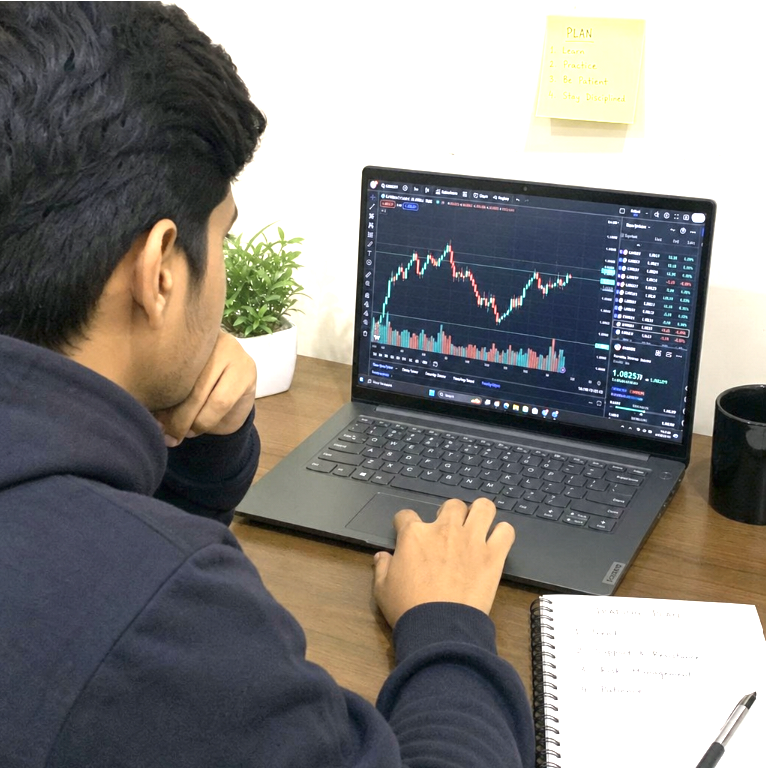
Modern trading usually happens through an online broker or trading platform. The platform displays live or delayed market prices, charts, order buttons, account balance, open positions, and risk management tools. A trader chooses an asset, decides the size of the position, selects the type of order, and sends the instruction to the market or broker.
A simple example looks like this:
- You study the price chart of a stock.
- You believe the price may rise from its current level.
- You buy a small position through your platform.
- You set a stop-loss to limit potential damage if the trade moves against you.
- You close the trade later, either with a profit or a loss.
- You review what happened and record the result in a trading journal.
That is the foundation of how trading works. The process is easy to describe, but hard to perform consistently because every decision involves uncertainty, cost, timing, and psychology.
The main participants and tools
Trading connects many types of participants. Retail traders are individuals using personal accounts. Institutional traders may work for banks, funds, or financial firms. Market makers, brokers, exchanges, liquidity providers, and technology platforms all help create the environment where orders are placed and executed.
The tools are also important. Charts help traders visualize price movements. Technical indicators may help identify trends, momentum, volatility, or possible reversals. Fundamental information, such as earnings, economic data, or industry news, may influence longer-term expectations. Risk tools, especially stop-loss and take-profit orders, help define the possible outcome before entering a trade.
Still, tools do not remove risk. A chart can look clear after the fact and confusing in real time. A stop-loss can reduce damage, but it cannot guarantee that every loss will be small in every market condition. As Investor.gov, the SEC's investor site, explains on its order types page, a stop order becomes a market order once the stop price is reached, so the execution price is not guaranteed. A good platform helps, but it does not replace knowledge.
Trading versus investing
Many beginners treat trading and investing as the same thing, but they are not. Investing usually focuses on building wealth over a longer period by buying assets believed to have durable value. Trading focuses more on price movement, timing, and active decisions.
An investor might buy shares of a company because they believe the business can grow over many years. They may study financial statements, competitive advantages, management quality, and long-term economic trends. A trader might buy the same stock because the chart shows short-term momentum, the price has broken through a key level, or volatility creates an opportunity. The SEC's guide to stocks notes that stocks offer the greatest potential for growth over the long haul, but that prices move down as well as up and that you can lose the money you invest.
The difference is not about intelligence or seriousness. It is about method, timeframe, and risk profile. Trading often requires more frequent monitoring, faster decisions, and stricter position sizing. Investing usually requires patience, diversification, and the ability to tolerate market cycles without overreacting.
A practical way to separate them:
- Trading is more active, shorter-term, and focused on entries, exits, price behavior, and risk per trade.
- Investing is usually longer-term, less frequent, and focused on asset quality, valuation, and compounding over time.
- Speculation may appear in both, but becomes dangerous when decisions are based only on excitement, rumors, or fear of missing out.
If you are deciding between the two, ask yourself how much time you can dedicate, how you react to losses, whether you enjoy analysis, and whether your financial goals require active risk or long-term planning.
How can a beginner start trading safely?
The safest way to start is to learn first, practice second, and risk real money only when you have a written plan. Beginners should avoid starting with large amounts, borrowed money, or the belief that trading will quickly replace a salary. A careful start protects both your capital and your confidence.
Here is a practical beginner roadmap:
- Learn the basic vocabulary. Understand assets, brokers, spreads, commissions, leverage, margin, stop-loss orders, take-profit orders, liquidity, volatility, and position size.
- Choose one market at first. Do not try to trade stocks, forex, crypto, commodities, and indices all at once. Each market has its own rhythm and risks.
- Use a demo account. Practice placing orders, reading charts, and managing trades without real money. Treat the demo account seriously, not like a game.
- Create a written trading plan. Define what you trade, when you trade, why you enter, where you exit, and how much you are willing to lose.
- Start small if you go live. Use money you can afford to lose. The goal at the beginning is survival and learning, not dramatic profit.
- Keep a trading journal. Record entries, exits, reasons, emotions, screenshots, and lessons. Patterns in your behavior often matter as much as patterns on the chart.
- Review before increasing risk. Do not scale up because of one lucky win. Increase only after consistent process, disciplined risk control, and enough experience.
Two measured facts help place these markets. According to the Bank for International Settlements' 2025 Triennial Survey, foreign exchange turnover averaged $9.6 trillion per day in April 2025, all instruments combined. On CFDs, ESMA, the European markets regulator, found that 74 to 89% of retail accounts lose money, and in 2018 it announced leverage limits for retail clients ranging from 30:1 on major currency pairs to 2:1 on cryptocurrencies.
This is also the most realistic way to start trading from zero. Starting from zero does not mean starting blindly. It means building a base before exposing yourself to the emotional pressure of real money.
Choosing a broker or platform
A broker is the company that gives you access to markets or trading products. Choosing one should never be based only on advertising, bonuses, or social media popularity. Regulation, transparency, available assets, costs, educational support, platform stability, order types, and customer service all matter.
Before opening an account, check whether the broker is regulated in a serious jurisdiction, whether fees are easy to understand, and whether the platform offers the tools you need. Look at spreads, commissions, withdrawal conditions, minimum deposit requirements, margin rules, and risk warnings. If a platform promises guaranteed profits or pressures you to deposit quickly, treat that as a red flag. In France, for example, the AMF's page on checking an authorisation explains how to confirm that a firm is listed in the official Regafi register and absent from its blacklists, and adds that this check does not replace finding out about the firm and its products.
Common trading styles
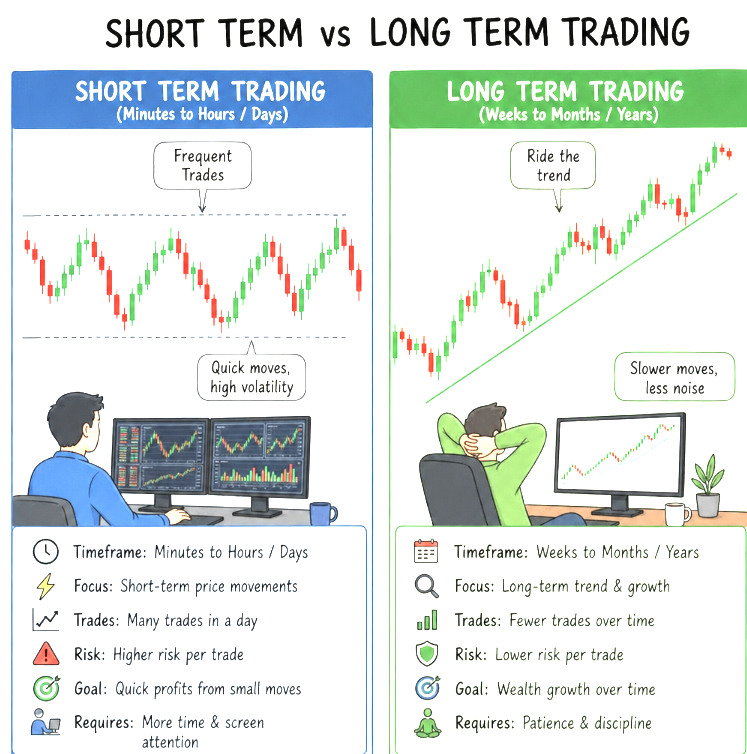
There is no single way to trade. Traders often choose a style based on available time, personality, capital, and tolerance for stress. The shorter the timeframe, the more intense the decision-making usually becomes.
Common styles include:
- Scalping: Very short-term trades that may last seconds or minutes. Scalpers look for small price movements, often using high focus and fast execution.
- Day trading: Positions are opened and closed within the same trading day. The trader avoids holding overnight risk but must monitor the market actively.
- Swing trading: Trades may last several days or weeks. This style gives more time for analysis and may suit people who cannot watch charts all day.
- Position trading: Positions may last months or longer. It is closer to active investing but still uses planned entries, exits, and risk controls.
Each style has trade-offs. Scalping and day trading can feel exciting, but transaction costs, speed, and emotional pressure can be demanding. Swing trading and position trading may be less intense day to day, but they require patience and the ability to tolerate wider price swings. Costs are not a detail: among 66,465 households at a large US discount broker from 1991 to 1996, Barber and Odean's study, 'Trading Is Hazardous to Your Wealth', found that those who traded stocks the most earned 11.4% a year while the market returned 17.9%.
Can you make money with trading?
The honest answer is yes, some traders can make money, but many beginners lose money, especially when they start without preparation. Trading is not a guaranteed income system, and it should not be treated as a shortcut to financial freedom. The possibility of profit exists because risk exists.
The available measurements point the same way, each on its own population. On the Taiwan Stock Exchange, from 1992 to 2006, about 360,000 individuals day traded stocks in an average year, and the study by Barber, Lee, Liu and Odean concludes that fewer than 1% of them were still able to earn predictable profits net of fees the following year. In France, on CFDs and forex, the AMF's study of 14,799 active clients, observed over four years between 2009 and 2013, counts more than 89% of clients losing money. Neither figure says anything about other markets or other ways of trading, but both show that steady short-term profits are rare.
Profitable trading usually depends on several factors working together: a tested strategy, strict risk management, emotional discipline, realistic expectations, and enough capital to survive losing periods. Even strong setups can fail. A trader can make the “right” decision according to their plan and still lose because markets are uncertain.
New traders often focus only on how much they could gain. Experienced traders focus first on how much they could lose. That difference in mindset is crucial. Protecting capital gives you the chance to keep learning, while one reckless decision can erase months of progress.
Myths that create bad decisions
Trading attracts myths because it combines money, independence, technology, and dramatic screenshots. Beginners should be especially careful with content that shows luxury lifestyles but hides losses, leverage, or risk.
Watch out for these common myths:
- “You can get rich quickly.” Fast gains can happen, but they are not a reliable plan. Chasing them often leads to oversized positions.
- “A secret indicator is enough.” Indicators can help organize information, but no tool predicts the future perfectly.
- “More trades mean more money.” More activity can also mean more costs, more mistakes, and more emotional fatigue.
- “A winning streak proves mastery.” Short-term results can be luck. Process matters more than one good week.
- “Losses mean failure.” Losses are part of trading. The real issue is whether they are planned, controlled, and reviewed.
Risk management is the center of trading
Risk management is not an optional extra. It is the foundation that keeps one bad trade from becoming a financial disaster. A trader can be wrong often and still survive if losses are small, but even a high win rate can fail if losing trades are too large.
The first rule is to define risk before entering. Decide where the trade idea becomes invalid, how much money you are willing to lose, and what position size matches that limit. Do not move a stop-loss farther away simply because you do not want to accept the loss.
Useful risk habits include:
- Risk only a small percentage of your account on each trade.
- Avoid leverage until you fully understand how it magnifies both gains and losses.
- Set stop-loss levels based on analysis, not emotion.
- Do not add to losing positions without a clear, tested rule.
- Take breaks after a series of losses or emotional decisions.
- Never trade with rent money, emergency savings, or borrowed funds.
Risk management also includes psychological risk. Fear can make you exit good trades too early. That reflex has been measured: across 10,000 accounts at a US discount broker from 1987 to 1993, Terrance Odean's study on the reluctance to realize losses shows investors selling their winners more readily than their losers. Greed can make you ignore your target. Revenge trading can push you to enter low-quality setups after a loss. A written plan helps, but discipline is what makes the plan useful.
A simple checklist before your first real trade
Before risking real money, use this checklist to slow down and confirm that you are not acting impulsively:
- I understand the asset I am trading and why its price may move.
- I know whether my approach is scalping, day trading, swing trading, or position trading.
- I have chosen a regulated broker and understand the main fees.
- I know the exact entry, stop-loss, and potential exit area.
- I have calculated my position size before placing the order.
- I am not trading because of boredom, panic, anger, or social media hype.
- I accept that this trade can lose money.
- I will record the result and review it later.
This checklist will not guarantee a profitable trade, but it can prevent many beginner mistakes. Good trading is often less about dramatic predictions and more about repeating sensible decisions under uncertain conditions.
Building a sustainable learning path
If you want to understand what trading is and how to start, think in stages. First, learn the language of markets. Then learn how orders work. After that, study risk, psychology, and one simple strategy. Only then should real-money trading become part of the process.
A sustainable path might begin with reading educational material, watching platform tutorials, and practicing in a demo account. From there, choose one strategy and define exact rules. Test it across many examples before trusting it. When you move to real money, use the smallest practical size so your emotions do not overwhelm your learning.
Avoid jumping from strategy to strategy after every loss. No method wins all the time. Instead, ask whether you followed your rules, whether the setup was valid, whether the risk was acceptable, and whether the result teaches you something useful.
Final takeaway
Trading means buying and selling financial assets in an attempt to benefit from price changes. The core ideas are simple, but consistent execution takes education, practice, discipline, and respect for risk.
If you are just beginning, your first goal should not be to make quick money. Your first goal should be to understand the market, protect your capital, and build habits that can survive both wins and losses. Start slowly, stay skeptical of easy promises, and treat trading as a skill to develop rather than a gamble to rush into.