Scalping sells a dream: get in, get out, bank a little profit, repeat until the day is done. The reality behind that image of a wired trader glued to five monitors is a lot less glamorous. It's a precise, demanding, often misunderstood discipline. If you want an actual scalping strategy and not just rapid-fire clicking dressed up as a plan, this is where you start.
- Scalping is not the easy shortcut it looks like, it's one of the most technically and mentally demanding styles out there.
- Without tight risk control, the sheer number of trades turns small mistakes into fast disasters.
- Discipline matters more than technical analysis: a good scalper follows a plan, a bad one improvises on every candle.
- A trading journal isn't optional here, it's the only way to know if your edge actually survives this pace.
What a scalping strategy actually is
Scalping means holding positions from a few seconds to a few minutes, rarely longer. You're not hunting a big trend, you're scraping small price moves, often a handful of pips in forex or a few ticks in futures, repeated many times over a session. A scalper might place twenty, fifty, sometimes over a hundred trades in a single day. Compare that to swing trading, where a position sits for days, and you're basically looking at a different sport.
What separates a real strategy from nervous clicking is structure. A serious scalper has defined entry criteria, a mechanical stop, an exit target set before the click even happens. This isn't improvisation at high speed. It's the same setup executed over and over, with metronome-like discipline. If you've read our piece on scalping explained, you know the base mechanics look like extreme day trading, but the rhythm and tolerance for market noise are on a whole different level.
Plenty of beginners mix up scalping with regular day trading. Day trading can include positions held for hours. Scalping lives in the moment. A single one-minute candle can spit out several entry signals. It's a game of precision and speed, not a patient stare-down of an H4 chart.
Why so many traders fail at scalping
Here's the part nobody tells you enough: scalping amplifies your flaws instead of hiding them. If you have a discipline problem on swing trades, maybe you make three mistakes a week. In scalping, with fifty trades a day, that same flaw can cost you dearly in a matter of hours. Volume forgives nothing.
Problem number one is fees and spread. On a trade targeting ten pips, if the spread eats two or three of them, your edge evaporates before the market even moves. Plenty of beginner scalpers never calculate this real cost, then wonder why the account stalls despite a decent win rate. That's usually the moment to look past the raw percentage of winning trades and compare win rate against profit factor to see if the strategy actually produces a net positive result once costs are baked in.
The other classic trap is overtrading. Scalping creates the illusion that you always need to be in the market. A mediocre signal shows up? You take it anyway, because you're already at the screen, adrenaline running. The result: you stack trades outside your plan and dilute whatever edge you had in pure noise. If that sounds familiar, it's not a coincidence, it's a documented pattern covered in our article on overtrading and why you take too many positions.
The technical foundations of a scalping strategy
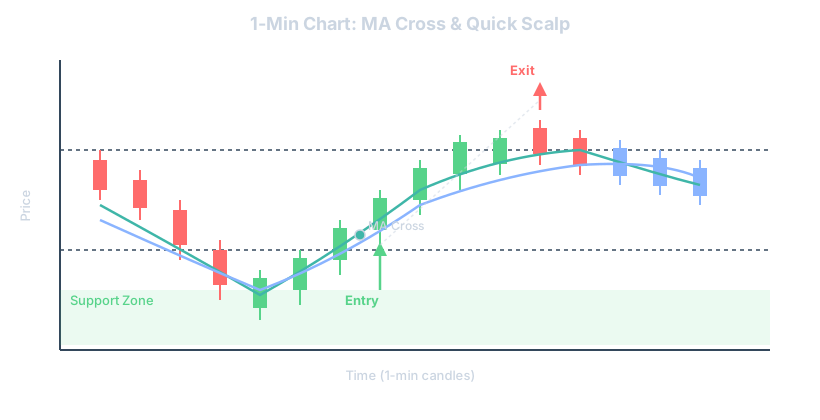
A serious scalping strategy leans on simple, fast-to-read markers. Traders often use short moving averages to judge immediate momentum, very short-term support and resistance levels, or a read of the order book and flow when it's available. Complexity is not the scalper's friend: the faster the analysis, the better, because the market isn't going to wait for you.
Some combine a slightly wider timeframe read (5 or 15 minutes) with execution on the 1-minute chart. The idea: only scalp with the dominant move, never against it. This simple filter cuts down on the counter-trend trades that tend to be the biggest losers. If you want to sharpen your read on crossovers, check our article on moving averages for entries and exits, the principles hold whether you're scalping or swinging, just zoomed in differently.
Another point that gets ignored too often: liquidity. Scalping an illiquid instrument means condemning yourself to constant slippage that chews through your edge. Serious scalpers pick pairs or instruments with heavy volume and tight spreads, during the hours the market is most active. Trading an exotic pair at 3am with this approach is basically fighting yourself.
Risk management is non-negotiable in scalping
With this many trades stacked up, your risk management needs to be near mechanical. No room for approximation. If you risk 2% per trade while scalping fifty times a day, one bad stretch can wreck you in a single session. That's why most serious scalpers cut their per-trade risk well below swing trading standards. The principle stays the same as what's detailed in our article on why risking 1% changes everything, but in scalping, some go even lower, around 0.25% to 0.5% per position, precisely because of the frequency.
Position sizing becomes even more critical here because you don't have time to think between trades. You need a fixed rule, applied every single time, no exceptions, no adjusting based on the mood of the moment. Our article on calculating position size breaks down the mechanics, but in scalping the ideal is having that math nearly automated before the session even opens, not recalculated trade by trade under stress.
You also need a strict daily loss limit, and you need to actually respect it. Scalping creates a specific trap: because individual losses are small, you tend to downplay them mentally. 'It's only ten pips.' Except ten pips times fifteen losing trades on the same bad day starts looking like a disaster. That's why a clear daily loss limit, set before the session and never renegotiated mid-stream, matters so much.
- Set your per-trade risk noticeably lower than swing trading, often under 0.5%.
- Define an absolute daily loss limit and cut the session the moment you hit it.
- Calculate your position size ahead of time using a fixed amount, never by gut feeling mid-session.
- Factor spread and fees into every target calculation, otherwise your real edge disappears.
The scalper's mindset: a different animal
Trading psychology gets discussed in general terms all the time, but scalping demands specific mental discipline. You make decisions in seconds, absorb a loss, and immediately move to the next trade without letting emotion pollute your read. It's close to what a fast cash game poker player does: each individual hand matters little, but the accumulation of consistent decisions is what separates winners from losers over time.
Tilt is a real threat for scalpers specifically. One loss, then a second, and the urge to 'get it back' right now arrives fast, carried by the very rhythm of the method. This mechanism is broken down in our piece on tilt in trading, and it hits even harder here because the reaction time between two trades is tiny. You don't get ten minutes to cool off before the next signal, sometimes you get ten seconds.
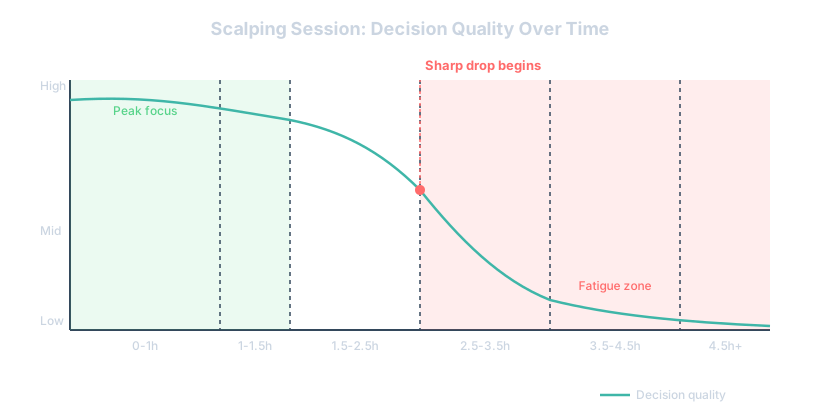
Mental fatigue also becomes a risk factor in its own right. After two or three hours of intense scalping, the quality of your decisions degrades, even if you don't notice it right away. Plenty of experienced scalpers deliberately cap their sessions into short, intense blocks rather than sitting glued to the screen all day. Accumulated fatigue that pushes you into off-plan positions looks a lot like the pattern described in our article on the mechanics of revenge trading, except here the trigger isn't necessarily a big loss, just the wear of the pace itself.
Choosing your market for scalping
Not every market suits scalping equally. Forex remains a classic playground thanks to its liquidity and extended hours, especially on major pairs during the London-New York overlap. If you're starting out on this market, our article what forex actually is lays the groundwork before you throw yourself into this rhythm.
Futures and indices also draw plenty of scalpers, largely because of readable order flow and often cleaner moves on short timeframes. Understanding the mechanics of the order book genuinely helps here, which is what our article on order flow in trading covers. Crypto attracts its own crowd of scalpers because of constant volatility, but be careful: that volatility cuts both ways, generating as many traps as opportunities for an impatient beginner.
The common thread across all these markets: you need reliable, fast execution. A broker with latency issues, a platform that freezes for half a second during a spike, a data feed that lags: any of these can turn a good scalping setup into a losing trade before you even see what happened. Test your execution quality before you commit real size to this style.
Building and testing your scalping setup
Before risking a single dollar live, you need to know whether your setup actually has an edge at this speed. Backtesting a scalping strategy is trickier than backtesting a swing approach because spread, slippage and execution speed matter enormously at this timeframe. A setup that looks great on a clean historical chart can fall apart the moment real spread and a half-second of latency get added in. Our guide on backtesting a strategy without lying to yourself applies here with extra weight on realistic cost assumptions.
Forward testing on a demo account, or with minimal size, is almost mandatory before scaling up. You want to see how the setup behaves with live spread and real order execution, not just historical candles. The difference between what looks good on paper and what survives contact with a live order book can be brutal in scalping specifically, more than in almost any other style.
Once you're live, tracking every trade with enough detail becomes essential, not a nice-to-have. With fifty trades a day, you can't rely on memory to tell you which setups actually work. You need numbers: win rate, average win versus average loss, and above all your expectancy per trade, since a single small number tells you more about a scalping strategy's real value than any story you tell yourself after a good week.
Journaling: the only way to know if your edge survives
Here's an uncomfortable truth: most scalpers have no real idea whether they're profitable, because the trade count is so high that memory becomes useless after the first hour. Was that losing streak this morning normal variance, or a sign the setup stopped working during the news release? You can't answer that from gut feeling. You answer it from data, logged consistently, trade after trade.
This is exactly where a structured trading journal earns its keep, especially at scalping speed. Instead of manually logging fifty entries a day by hand, which nobody actually sustains for more than a week, an automatic import from your broker or exchange lets you focus on the review instead of the data entry. You want your energy going into reading your stats, not typing them.
Tag each trade with what actually happened around it: your emotional state going in, a label you choose yourself for the setup type, whether you actually followed your own plan. Over a few hundred trades, patterns emerge that are invisible session by session. Maybe your win rate collapses after 11am once fatigue sets in. Maybe your best setups only work during the first ninety minutes of the session. You won't see that without the log.
How Tradoshi helps you
Scalping generates a volume of trades that makes manual tracking painful fast, and Tradoshi is built around that exact problem. Automatic import from MT4, MT5, cTrader or your crypto exchange means every scalp gets logged without you typing fifty entries by hand after a session. The statistics engine then does the heavy lifting: win rate, profit factor, expectancy, average win/loss ratio and your overall Oshi Score give you a real read on whether the setup works, instead of a vague impression shaped by your last few trades.
The risk management tools matter even more at this pace. You can set the percent of capital you risk per trade, use the position size calculator so sizing stops being a mid-session guess, and build customizable risk rules that match the tighter tolerances scalping demands. The daily risk calendar gives you a visual read on how your risk exposure builds up across a session, which is exactly the kind of thing that's easy to lose track of when you're firing trades every few minutes.
On the psychology side, the emotional check-in before a trade forces a brief pause even inside a fast rhythm, which matters given how quickly tilt can creep into scalping. The discipline score tracks how well you actually stick to your own rules over time, not someone else's generic benchmark. And when you want to understand a specific losing stretch, the trade replay and debrief in Trade Review let you go back through what happened, tag it with your own free labels, and note whether you followed your plan or improvised under pressure.
Realistic expectations: what scalping can and can't do
Scalping doesn't make trading easier, it just compresses the timeline. You can absolutely build a working strategy around it, but the idea that it's a shortcut to quick money is where most beginners get burned. The people who do well at this pace tend to have spent real time on discipline and process before layering on the speed, not the other way around. Our piece on the real steps from beginner to profitable applies just as much here, arguably more, since scalping punishes a shaky foundation faster than any other style.
It's worth asking yourself honestly whether the fast pace suits your temperament. Some traders thrive on rapid decisions and short feedback loops. Others get chewed up by the constant stimulation and end up making worse decisions than they would on a slower timeframe. There's no shame in realizing scalping isn't for you. Plenty of profitable traders never touch a 1-minute chart and do just fine on daily or weekly setups instead.
A few practical habits that separate consistent scalpers from the rest
Consistent scalpers tend to share a handful of habits that look small individually but compound over time. They warm up before the session instead of jumping straight into live size, often reviewing the prior day's trades first. They set hard limits, both on daily loss and on number of trades, and they actually respect them instead of treating the limit as a suggestion. They also review their stats weekly rather than daily, because day-to-day noise in scalping is enormous and reading too much into a single session leads to overreacting.
They also tend to specialize. Trying to scalp five different instruments across three sessions a day sounds productive but usually just spreads focus too thin. Picking one or two instruments you know intimately, at the hours you know best, beats chasing volatility wherever it appears that day.
Frequently asked questions
Is scalping profitable for beginners?
It can be, but the learning curve is steep because mistakes compound fast at this trade frequency. Most traders benefit from mastering risk management and discipline on a slower timeframe first.
How much capital do you need to start scalping?
There's no fixed number, but you need enough capital that your position sizing isn't distorted by minimum lot sizes or fees. Undercapitalized accounts often force risk percentages that are too high per trade.
What timeframe is best for scalping?
Most scalpers work on 1-minute or 5-minute charts, sometimes combined with a slightly higher timeframe for context. The exact choice depends on the instrument and your own reaction speed.
Does scalping work in every market condition?
No. Scalping generally needs decent volatility and tight spreads to function. Very quiet, low-volume periods tend to produce more false signals and worse fills.
How many trades per day is normal for a scalper?
It varies widely, from a handful of high-quality setups to over a hundred trades in aggressive approaches. What matters more than the count is whether each trade follows your defined criteria.
Is scalping allowed on prop firm accounts?
Rules vary by firm, some restrict very short holding times or high-frequency trading. Always check the specific rules before building a scalping approach around a funded account.
What's the biggest mistake new scalpers make?
Ignoring the real cost of spread and fees relative to their target profit per trade. A strategy that looks profitable on paper can turn negative once realistic costs are included.
Can you scalp manually without special software?
Yes, though many scalpers use fast execution platforms and sometimes semi-automated tools. The strategy itself doesn't require automation, but execution speed matters a lot.
How do you know if your scalping edge has disappeared?
Consistent tracking over enough trades is the only reliable way. A sudden drop in expectancy or profit factor across a meaningful sample size is a stronger signal than a few bad sessions.
Should you scalp during major news releases?
Many experienced scalpers avoid trading directly through high-impact news because spread widens and price can gap unpredictably, which distorts normal setups.