A trader who wins can still torch his account. A trader who loses often can stay profitable for years. The difference isn't talent, and it isn't chart-reading skill. It's risk management. And it's exactly the topic almost nobody takes seriously until the first time they've lost everything.
- Position size matters more than the setup itself: a great trade, badly sized, can still wreck you.
- Risk is a percentage of capital, never a fixed dollar amount or a size copied from someone else's account.
- Drawdown isn't an accident. It's a mathematical certainty you need to plan for before it happens.
- Discipline outweighs strategy: the best method in the world doesn't survive badly managed risk.
Why risk management comes before strategy
Ask yourself honestly: how many traders do you know with a decent strategy whose account still bleeds out? Plenty. Because a strategy tells you when to enter. It never tells you how much to risk. That's where everything actually gets decided. A trade with a genuine 55% win rate can still ruin an account if every loss represents 10% of capital. Meanwhile a mediocre edge can survive for years if the risk per trade stays small.
It's counterintuitive at first. Everyone wants the perfect setup, the magic indicator, the pattern that never fails. The blunt truth is that the market doesn't care about your analysis. It will hand you losing streaks, sometimes long, sometimes violent, with zero warning. The one variable you fully control is how much you put on the table each time you pull the trigger. Everything else, you simply absorb.
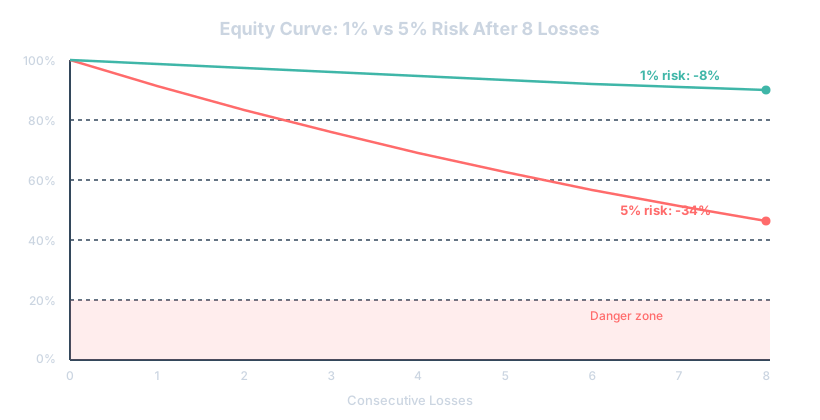
Take a simple example. Two traders run the exact same strategy on the same instrument. The first risks 1% per trade. The second risks 5%. Over a stretch of eight consecutive losses, which happens even with a solid edge, the first trader is down roughly 8% of capital. The second is down more than 30%, and now needs a 43% gain just to get back to break-even. Same strategy, same market, two completely different fates. That's the whole logic behind why risking 1% changes everything.
The risk percentage: the non-negotiable baseline
The first rule, the most basic and yet the most ignored: never risk a fixed dollar amount, always a percentage of your current capital. If you start with 10,000 and risk 100 per trade because 'that's 1%', fine, but recalculate that percentage every time your balance moves. If your account drops to 8,000, your 1% becomes 80, not 100. Obvious on paper. On the ground, mid-tilt after a loss, almost nobody recalculates spontaneously.
How much should you risk exactly? There's no universal magic number, but there are ranges that have proven themselves over time. Most serious traders sit between 0.5% and 2% of capital per trade. Below 0.5%, growth feels too slow to stay motivating on a small account. Above 2%, variance turns brutal and your psychology starts shaking by the third loss in a row. Some professionals drop even below 0.5% during highly volatile stretches or macro uncertainty.
The real challenge isn't finding THE perfect percentage, it's picking one and sticking to it with near-obsessive discipline. This gets developed fully in money management: fixed or dynamic risk, because the question doesn't stop at the percentage itself: it also covers whether you scale that percentage up as your account grows, or keep it rigid for a long stretch.
- Risking too little kills motivation and makes trading feel like a waste of time.
- Risking too much turns every loss into an emotional catastrophe.
- The right percentage is the one you can hold even after five losses in a row without changing your behavior.
Calculating position size: the step everyone rushes
Here's the classic scene. A trader decides to risk 1% of his account, so 100 on a 10,000 balance. He opens his chart, sets a stop loss 50 pips from entry, and then takes a position size at random, often the same size as usual, because calculating precisely takes thirty seconds he doesn't feel like spending. The result: he just risked 250 instead of 100, without even noticing.
The math isn't complicated though. You need three things: your capital, your accepted risk percentage, and the distance in pips or points between your entry and your stop loss. From there, position size falls out mechanically. This isn't a minor technical detail, it's literally the bridge between your strategy and your real account. The full method is laid out in position sizing: the calculation too many traders skip, worth reading closely if you're still eyeballing your lot sizes.
What stands out when you talk to struggling traders is how many know the 1% theory but never actually calculate their position. They 'feel' the size out. They keep the same lot size as yesterday no matter where today's stop sits. It's one of the most common and sneaky mistakes in trading, documented in detail in position sizing mistakes that ruin accounts.
The stop loss: where it really goes, and why you keep moving it
A stop loss isn't a box you tick to feel responsible. It's the border between a trade you control and a trade that controls you. The problem is that most beginning traders place it on an arbitrary number, 'I risk 20 pips because that's what I always risk', without asking whether market structure actually justifies that distance.
A good stop loss sits at the point where, if price reaches it, your trade idea is objectively invalidated. Not where you feel comfortable. Not wherever your position size happens to keep you under 1%. At the logical market level: a broken support, a structure that failed, a key level taken out. Then you adjust your position size to respect your risk, never the other way around.
And then there's the other problem, even more destructive: dragging the stop mid-trade. Price gets close, the discomfort builds, and the finger slides the stop a little further 'to give it room'. That's exactly the mechanism that turns a small planned loss into a disaster. The full topic deserves its own read, which you'll find in stop loss: where to really place it.
Risk/reward ratio: never trade without it in mind
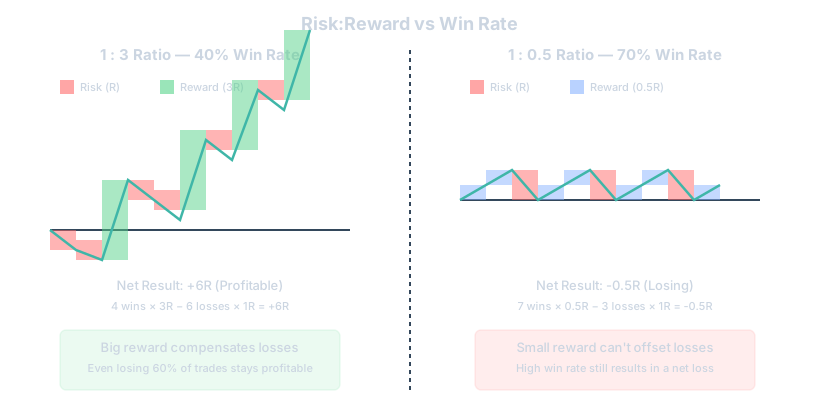
Risking 1% per trade means nothing if you don't know what you're hoping to gain on the other side. The risk/reward ratio is simply: how much am I risking against how much I can win on this specific trade. A 1:2 ratio means you risk 1 to target 2. With that ratio, you can be wrong six times out of ten and still come out ahead overall.
This is where a lot of traders mix up two separate ideas. A favorable ratio guarantees nothing on its own if your win rate is catastrophic, and a great win rate saves nothing if your losses dwarf your wins. Both have to be thought through together, which is explained in risk/reward ratio explained simply. Understanding this mechanic literally changes how you pick trades: you start rejecting setups that 'look good' but whose ratio doesn't hold up.
Drawdown: it's not a question of if, it's a question of when
Here's a truth nobody likes hearing early on: you will go through a drawdown. Not maybe. Certainly. The question isn't whether to avoid it, it's how far you're willing to let it go before you change something. A trader with no drawdown plan is a trader discovering his emotional limit at the worst possible moment, mid losing streak, judgment already warped by stress.
The maximum drawdown you're willing to accept has to be decided cold, before you trade, not during. If you set a 15% drawdown limit before cutting exposure or switching back to demo, that decision has to exist on paper before the first loss, otherwise it never shows up at the right moment. That's the whole point of maximum drawdown: your most important number, and also of drawdown: understanding and surviving your dips.
You also need to grasp the underlying math, what's called the risk of ruin. The higher your risk per trade, the higher the mathematical probability of losing everything, even with a positive edge. This isn't abstract theory, it's calculable, and it should be part of the basic toolkit of any trader taking his account seriously. The detail lives in risk of ruin: the math you need to know.
Daily limits: your most effective safety net
Here's a simple rule that saves more accounts than any sophisticated strategy: decide in advance how many losses, or what daily loss percentage, closes your laptop for the day. It's not a punishment, it's protection. After two or three losses, the brain switches modes. It starts hunting to 'get it back' instead of trading cleanly. That's exactly the ground where revenge trading grows, a mechanism worth understanding in depth through revenge trading: the mechanism that ruins you after a loss.
A lot of traders working with a prop firm already know this constraint well, often imposed by the firm itself as a strict daily loss limit. But even without a prop firm, imposing this rule voluntarily changes everything. The topic is covered thoroughly in daily loss limit: how to actually respect it and in stopping after X losses: the rule that saves accounts.
What makes this rule hard isn't understanding it. It's applying it in the moment, when your brain is already convinced the next trade will fix everything. That's precisely why it needs to exist before the emotional moment, written down, non-negotiable, almost boring in its rigidity. Boring rules are the ones that actually work.
Correlation and leverage: the risk you don't see coming
Here's a mistake that looks harmless on the surface. You open five trades. Each one risks a modest 1%. On paper, total exposure looks fine, 5% of capital at risk. Except three of those five positions are correlated, long EUR/USD, long GBP/USD, short USD/JPY, all essentially betting against the dollar in different disguises. If the dollar rallies, you don't lose 1% five times independently, you lose closer to 3% all at once because three of your trades move together.
This hidden risk gets ignored constantly, especially by traders who diversify across pairs or assets without checking what actually drives them. Correlation doesn't cancel risk, it can quietly multiply it. The mechanics are explained in position correlation: the hidden risk, and it's worth an honest look at your open trades right now to see if you're guilty of this.
Leverage compounds the same problem. High leverage doesn't just amplify gains, it amplifies every miscalculation, every correlated position, every stop placed too tight. Managing it properly means understanding that leverage is a tool for capital efficiency, not a shortcut to bigger wins, a distinction covered in managing leverage without burning yourself.
Building risk rules you'll actually follow
Knowing the theory is one thing. Following your own rules under pressure is an entirely different skill, and it's the one that actually separates consistent traders from everyone else. You can write the perfect risk plan on a Sunday evening and abandon it completely by Tuesday afternoon after two losses in a row. That gap between knowing and doing is where most accounts actually die.
This is exactly why tracking your discipline matters as much as tracking your profit and loss. Did you respect your risk percentage today? Did you move your stop? Did you size the position correctly before entering? These are yes or no questions, and answering them honestly, trade after trade, builds the kind of self-awareness that no strategy tweak ever will.
How Tradoshi helps you
Risk management only works if you can see it clearly, trade after trade, without guessing. Tradoshi's journal imports your trades automatically from MT4, MT5, cTrader or your crypto exchange, or lets you log them manually, so every position you've taken is recorded with its real risk, not your memory of it. From there, the statistics module surfaces your win rate, profit factor, expectancy, R-multiple and the overall Oshi Score, giving you a concrete read on whether your risk approach is actually working over time, not just on your best week.
On the risk side specifically, Tradoshi lets you set the percent of capital you risk per trade, use the position size calculator so you stop eyeballing your lots, build customizable risk rules that match your own limits, and check a daily risk calendar before you open your platform. And because knowing your rules isn't the same as following them, the discipline score measures specifically how well you stick to your own plan, trade after trade, which is often where the real leak in a trading account hides.
For the emotional side of risk, an emotional check-in before you trade and the emotion / performance link analysis help you notice if your risk-taking changes when you're stressed, tired or overconfident. And when you want to actually learn from a specific trade, Trade Review lets you replay it, debrief with the emotion you felt, tag it with labels you choose yourself, and check whether you truly followed your plan. None of this replaces your judgment. It just makes sure your risk decisions are visible instead of buried in a spreadsheet you never open.
Putting it all together: a simple risk framework
You don't need twenty rules. You need four or five that you never break. Something like this: risk a fixed percentage of capital per trade, decided in advance and recalculated as your balance moves. Place your stop by structure, not by comfort. Never take a trade whose risk/reward doesn't meet your minimum threshold. Set a daily loss limit that closes your session automatically once hit. And define, on paper, the drawdown level that triggers a pause or a strategy review.
Nobody follows this perfectly every single day. That's not the goal. The goal is that when you break a rule, you notice it, you write it down, and you correct course before it becomes a pattern. The traders who last aren't the ones who never make a risk mistake. They're the ones who catch it fast and don't let one bad decision cascade into three more.
| Risk element | Typical range or rule | Why it matters |
|---|---|---|
| Risk per trade | 0.5% to 2% of capital | Keeps a losing streak survivable |
| Risk/reward minimum | 1:1.5 or higher, context dependent | Allows profitability even with a moderate win rate |
| Daily loss limit | 2 to 4 losing trades or a fixed % drop | Stops revenge trading before it starts |
| Max drawdown threshold | 10% to 20%, decided in advance | Forces a pause before panic decisions |
Frequently asked questions
What percentage of my capital should I risk per trade?
Most traders who last settle between 0.5% and 2% per trade. Lower feels too slow, higher makes losing streaks dangerous. Pick a number you can hold after five straight losses without panicking, and stay there.
Is risk management more important than strategy?
In practical terms, yes. A mediocre strategy with tight risk control can survive for years. A great strategy with poor risk control eventually blows up, because losing streaks are guaranteed, not optional.
How do I calculate position size correctly?
You need your capital, your risk percentage, and the distance between entry and stop loss in pips or points. From those three numbers, position size follows mechanically instead of being guessed.
Should I move my stop loss if the trade is going against me?
No. Moving a stop loss because price is approaching it defeats its entire purpose. If the level was chosen correctly by market structure, moving it just delays and often enlarges the loss.
What is drawdown and why should I plan for it in advance?
Drawdown is the decline from your account's peak value. It's mathematically inevitable, not a sign of failure. Planning your maximum acceptable drawdown before it happens keeps you from making panicked decisions mid-crisis.
How does correlation between trades increase my risk?
If several open positions move for the same underlying reason, like multiple pairs betting against the same currency, their combined risk is higher than the sum of each individual trade's stated risk.
Should I use the same risk percentage on every setup?
Many traders keep it fixed for consistency, though some scale it slightly for higher conviction setups. What matters most is having a rule and following it, not the exact number itself.
What's a healthy daily loss limit?
A common approach is stopping after two to three consecutive losses, or after a fixed percentage drop in a single day, whichever comes first. The exact number matters less than actually respecting it.
Can good risk management make up for a weak strategy?
It can prevent ruin, but it can't manufacture profitability out of nothing. Risk management protects your capital while you refine or replace a strategy that isn't producing a real edge.
How do I know if my risk management is actually working?
Track it over enough trades to matter: your drawdown stays within your planned limits, your losing streaks don't force emotional decisions, and your account survives rough patches without requiring a full reset.