Comparison
Tradervue review: why traders switch to an AI trading journal
Tradervue is the oldest trading journal still running, and its strength has not moved: detailed execution reports. But as of 11 September 2026, its pricing grid still mentions no artificial intelligence, no backtesting, no trade replay and no annual plan. Here is what you gain by switching to Tradoshi, an AI trading journal, what to know before you do, and how to move without losing your history.
Sourced on 11 September 2026
Why a reporting-first journal is no longer enough
A reporting-first journal answers a single question: what do my trades say about my execution? Tradervue has answered it for more than ten years, and answers it well. But most losing traders are not short of statistics. They already know their losses come from the same mistakes, repeated. What they lack is what happens before and during the trade.
Since 2020, trading journals have added three building blocks. An artificial intelligence that reads your numbers and tells you what they show. Backtesting in a trading simulator that replays the market, to test an idea before putting money on it. And a discipline layer, which measures whether you kept to your rules and stops you when you no longer do. As of 11 September 2026, none of the three appears on Tradervue's pricing grid.
Keeping Tradervue therefore means paying $29.95 to $49.95 a month for the analytics part, then adding another tool to test your strategies, and another one again to work on your discipline. Tradoshi brings all three into the same AI trading journal, starting with a free plan, and a first paid plan at $19.99.
What Tradervue does not have
Six gaps, read on 11 September 2026 by counting terms in the served HTML of its pricing page, not by eye. Absent from the grid means exactly that, not “does not exist”.
No artificial intelligence
No assistant, no automatic analysis, no credits: the word “AI” does not appear once on its pricing page. In the Tradoshi Trading Journal, Oshi AI reads your state and your numbers from the Essential plan, and prepares your bias and key levels before the open, with 600 to 3,000 credits a month depending on the plan.
No backtesting, no market replay
No line for backtesting, a simulator or replay. To test a strategy before trading it, you need a second tool. Tradoshi's trading simulator replays the market candle by candle, ten strategies on Pro then unlimited on Premium, and Trade Review adds trade replay on the real chart on Premium.
No psychology or discipline layer
No pre-session check-in, no discipline score, no in-session guardrail. It analyses what you did; it does not help you keep to your rules while you do it.
No annual pricing
Silver at $29.95 and Gold at $49.95, monthly only: no occurrence of “annual” or “year” on the page. At Tradoshi, the annual plan charges ten months out of twelve.
Fees reserved for the top plan
Commission and fee tracking is only listed on Gold, at $49.95. On Silver, your P&L does not track them. At Tradoshi, fees come from the broker, on every plan.
No prop firm challenges, no mobile app
Nothing on prop firm challenge tracking, and no mobile app presented on its site. Tradoshi tracks your challenges on the Pro plan and is available on Android.
Tradervue, Tradoshi, TradeZella and TraderSync side by side
Four journals, the same lines, read on 11 September 2026 on their four public pricing pages. A “—” marks what a pricing page does not document, not what does not exist.
| What is compared | Tradervue | Tradoshi | TradeZella | TraderSync |
|---|---|---|---|---|
| First paid plan | $29.95/mo | $19.99/mo | $35/mo | $29.95/mo |
| Top plan | $49.95/mo | $49.99/mo | $99/mo | $79.95/mo |
| Free plan | Mentioned on the site, not on the pricing page | Yes, permanent, 1 synced account | — | 7-day trial |
| Annual pricing | None | Ten months paid out of twelve | Yes, $26 to $74/mo | Yes, up to 25% off |
| Artificial intelligence | — | Oshi AI, from Essential | Zella AI | AI Performance Assistant |
| Backtesting | — | Yes, with market replay | Yes, manual and automated | Yes, Market Replay |
| Trade replay | — | Trade Review on the real chart (Premium) | Yes, tick by tick | Yes, replay simulator |
| Mobile app | — | Android | — | Yes |
Monthly prices in dollars, before any temporary discount. TradeZella also bills yearly ($315, $531 and $891 a year), and TraderSync advertises up to 25% off yearly. Tradervue publishes no annual pricing.
Tradoshi and Tradervue at a glance
13 lines to decide fast, then the detail below with the sources read on Tradervue.
| What is compared | Tradervue | Tradoshi |
|---|---|---|
| Starting price | $29.95/mo | $19.99/mo |
| Number of plans | 2 | 4, one of them free |
| Free plan | Mentioned on the site, not on the pricing page | Yes, forever, no card, no trade limit |
| Annual pricing | None published | Yes, ten months out of twelve |
| Tracked accounts | Unlimited | 3 / 50 / unlimited |
| Mentoring | Unlimited from the 1st paid tier | Free mentor account, student on Pro |
| Artificial intelligence | Absent from their grid | 600 to 3,000 credits per month |
| Backtesting | Absent from their grid | 10 strategies then unlimited |
| Pre-trade psychology | Absent from their grid | Voice check-in, from Essential |
| Reports announced | 100+ | 500+ |
| Liquidity reports | Yes, unique on the market | No |
| Published integrations list | Yes | Yes, 2,024 brokers + PDF |
| US equity brokers | Robinhood, TradeStation, Webull, Thinkorswim, E-Trade, DAS, Lightspeed… | Interactive Brokers synced; DAS Trader Pro, TradeZero and E*TRADE by import |
Tradervue and Tradoshi pricing, plan by plan
Every Tradervue plan and every one of ours, with what each actually unlocks. Prices are those shown on both pricing pages on 11 September 2026.
Tradervue
Billed in dollars, monthly only$29.95/mo
no annual pricing published- Unlimited accounts
- Unlimited mentoring
- 1 GB of images
- 100+ reports
- Execution merge settings
- No commission tracking
$49.95/mo
no annual pricing published- Everything in Silver, plus:
- 5 GB of images
- Commission and fee tracking
- Liquidity reports
- Exit analysis and max potential P&L
- Advanced filters
Tradoshi
Billed in dollars$0/mo
permanent, no card, nothing to cancel- 1 synced broker account
- Unlimited file import and manual entry
- Full journal, dashboard and Day View
- 500+ reports and Oshi Score
- Discipline score
- Free mentor account
$19.99/mo
or $199/year ($16.58/mo)- Broker sync, 3 accounts
- Oshi AI coach on your data
- 600 AI credits per month
- Voice check-in and written
- Risk management and economic calendar
- No trade limit
$39.99/mo
or $399/year ($33.25/mo)- 50 accounts, multi prop firm
- Prop firm challenge tracking
- 1,500 AI credits
- Backtesting (10 strategies)
- Be followed by a mentor, free for them
- Risk tracking and economic calendar
$49.99/mo
or $499/year ($41.58/mo)- Unlimited accounts
- 3,000 AI credits
- Live session: in-session guardrails
- Trade Review on the real chart
- Unlimited backtesting
- Priority support
Every price on this page is in dollars, on both sides, and no exchange rate is applied. No annual pricing is published there, checked across their whole page HTML: there is no way to spread the cost.
Two plans, not three, and no annual pricing: there you pay every month at full price, with no way to spread it. And commission tracking, which decides whether your P&L is accurate or approximate, is reserved for the $49.95 plan. With us it comes from the broker, on every plan.
Tradervue over a year: what the missing annual plan really costs
Tradervue only sells monthly. Over twelve months, the gap with a journal that offers annual pricing becomes concrete, and it is computed from the prices published on 11 September 2026, with no discount.
| What is compared | Tradervue | Tradoshi |
|---|---|---|
| Entry plan, over a year | Silver: $359.40 ($29.95 × 12) | Essential: $199 a year |
| Top plan, over a year | Gold: $599.40 ($49.95 × 12) | Premium: $499 a year |
| What that plan adds | Commissions and fees, liquidity reports, exit analysis | AI (3,000 credits), unlimited backtesting, live session, Trade Review |
Over a year, Tradoshi Premium costs $100.40 less than Gold, and Essential $160.40 less than Silver. The free plan costs nothing and keeps one synced broker account.
An AI trading journal, not a list of reports
What you find in the Tradoshi Trading Journal, in real screenshots of the app and not mock-ups. Everything starts from the sync with your broker: you type nothing for these screens to fill up.
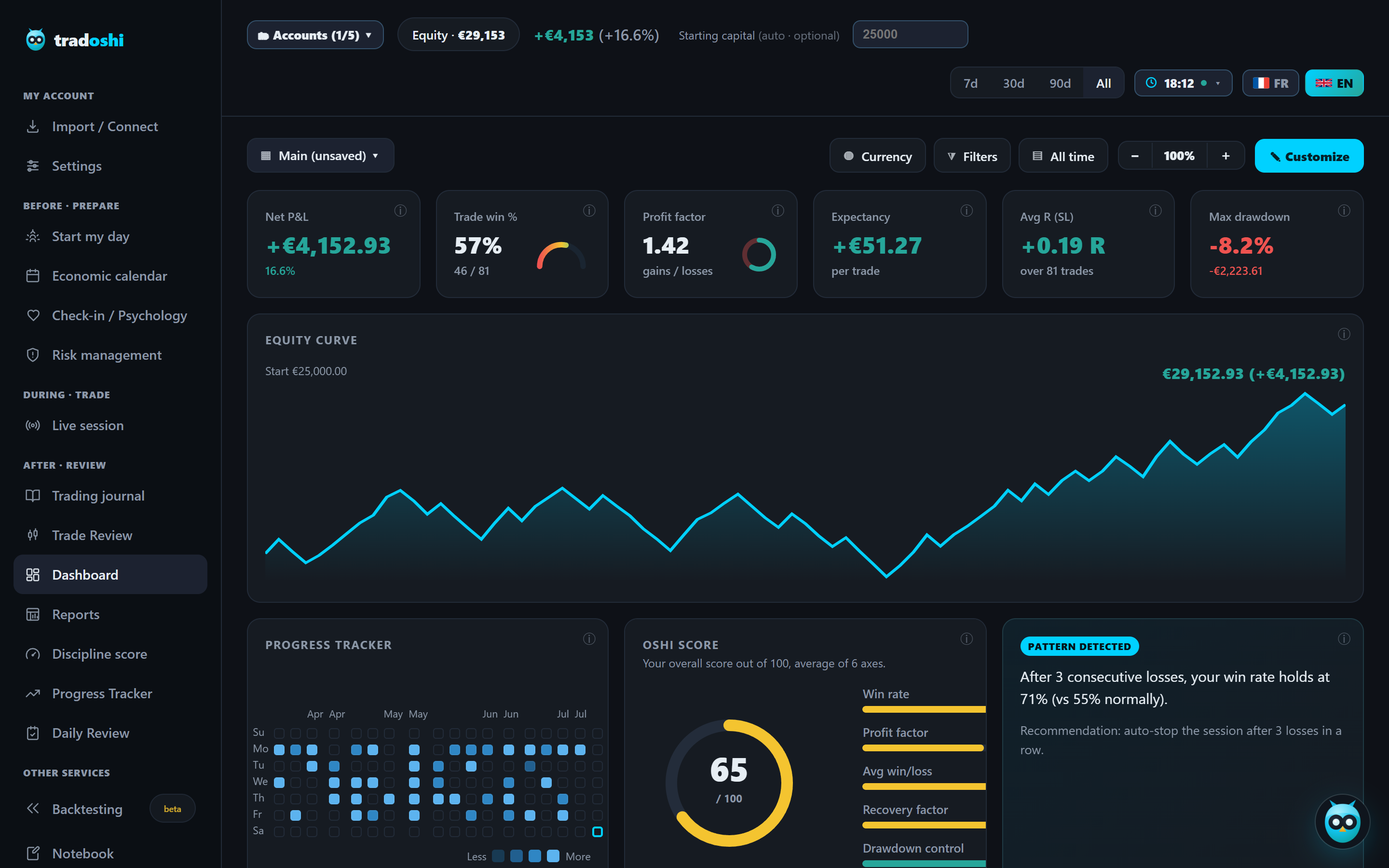
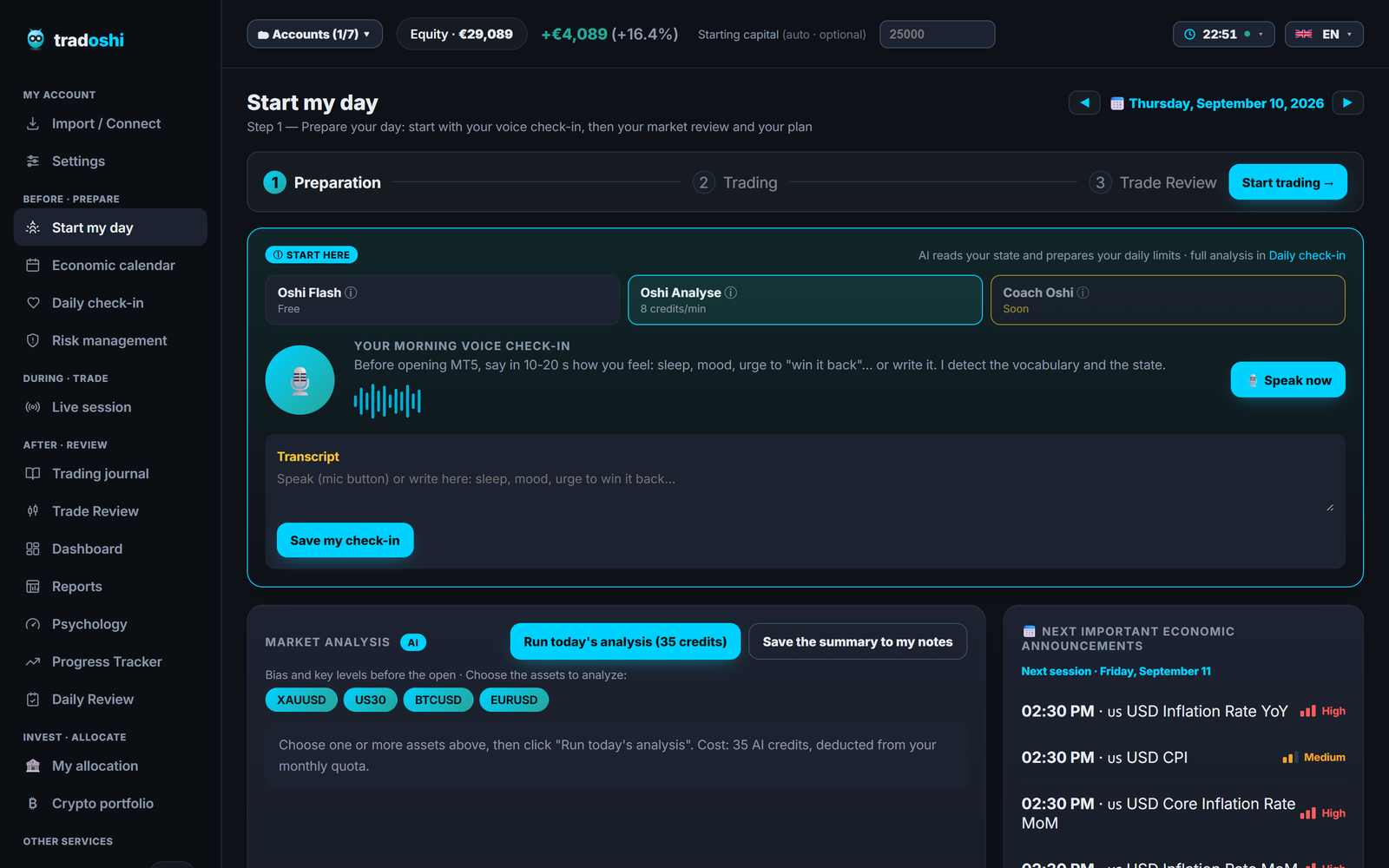
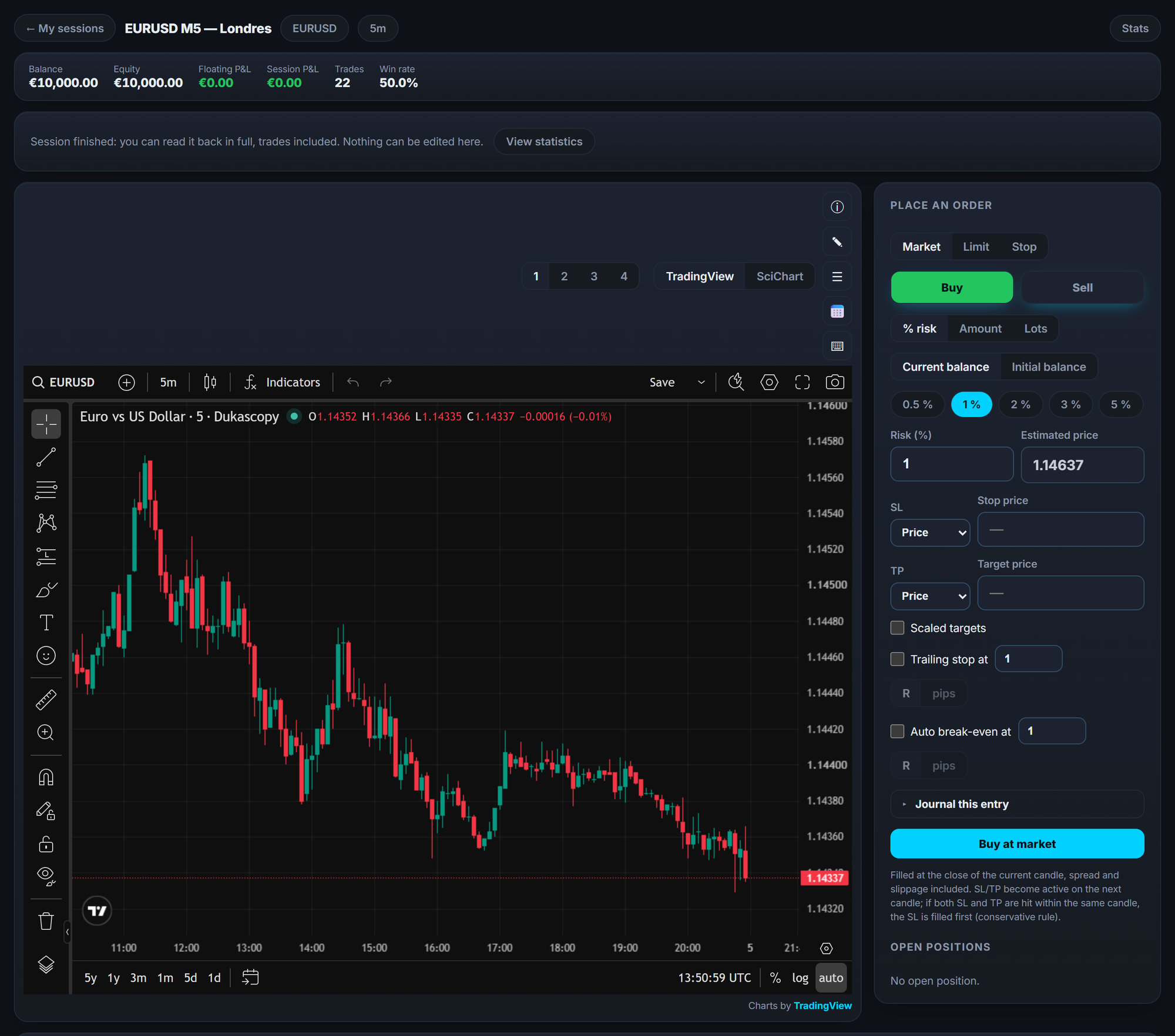
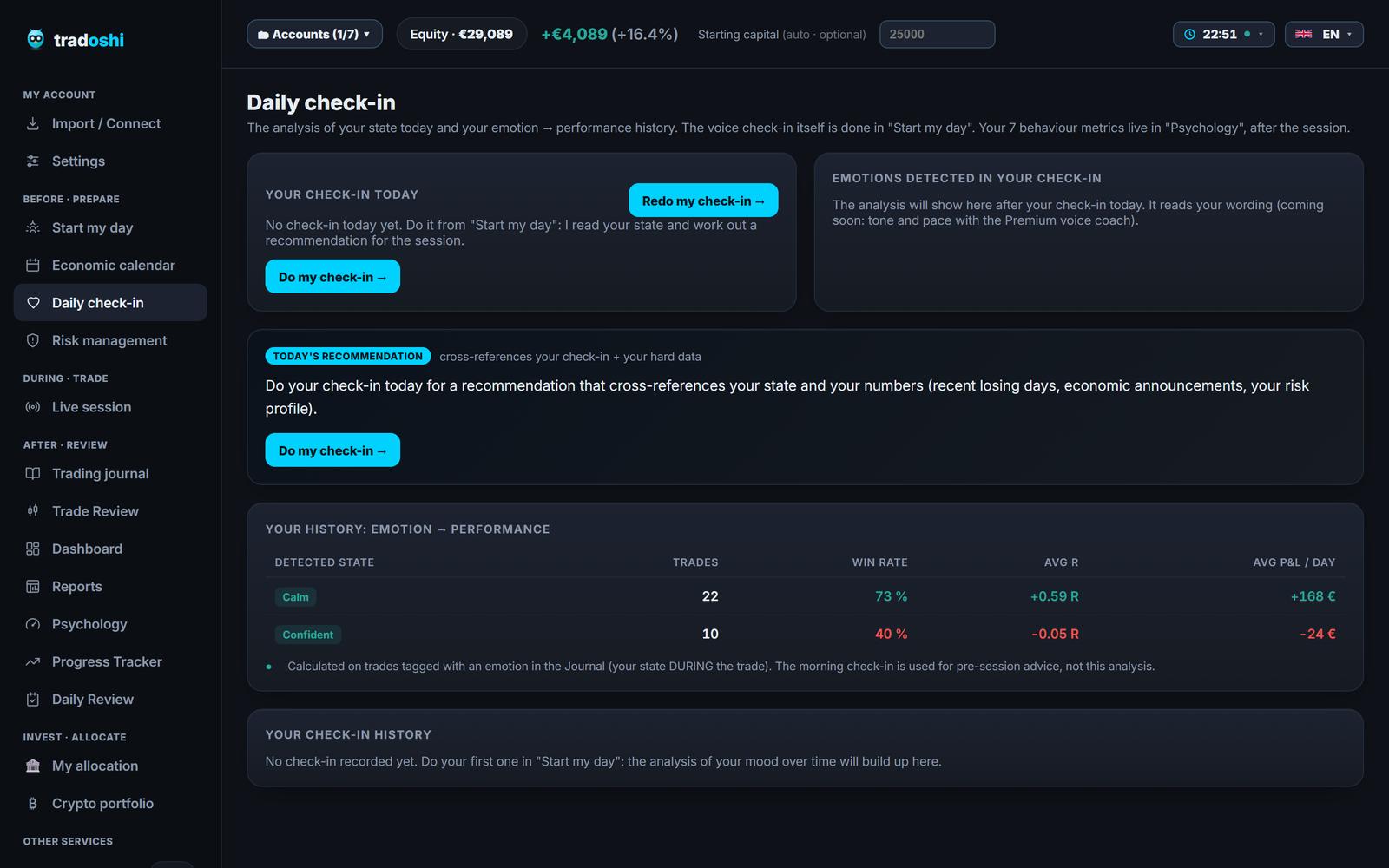
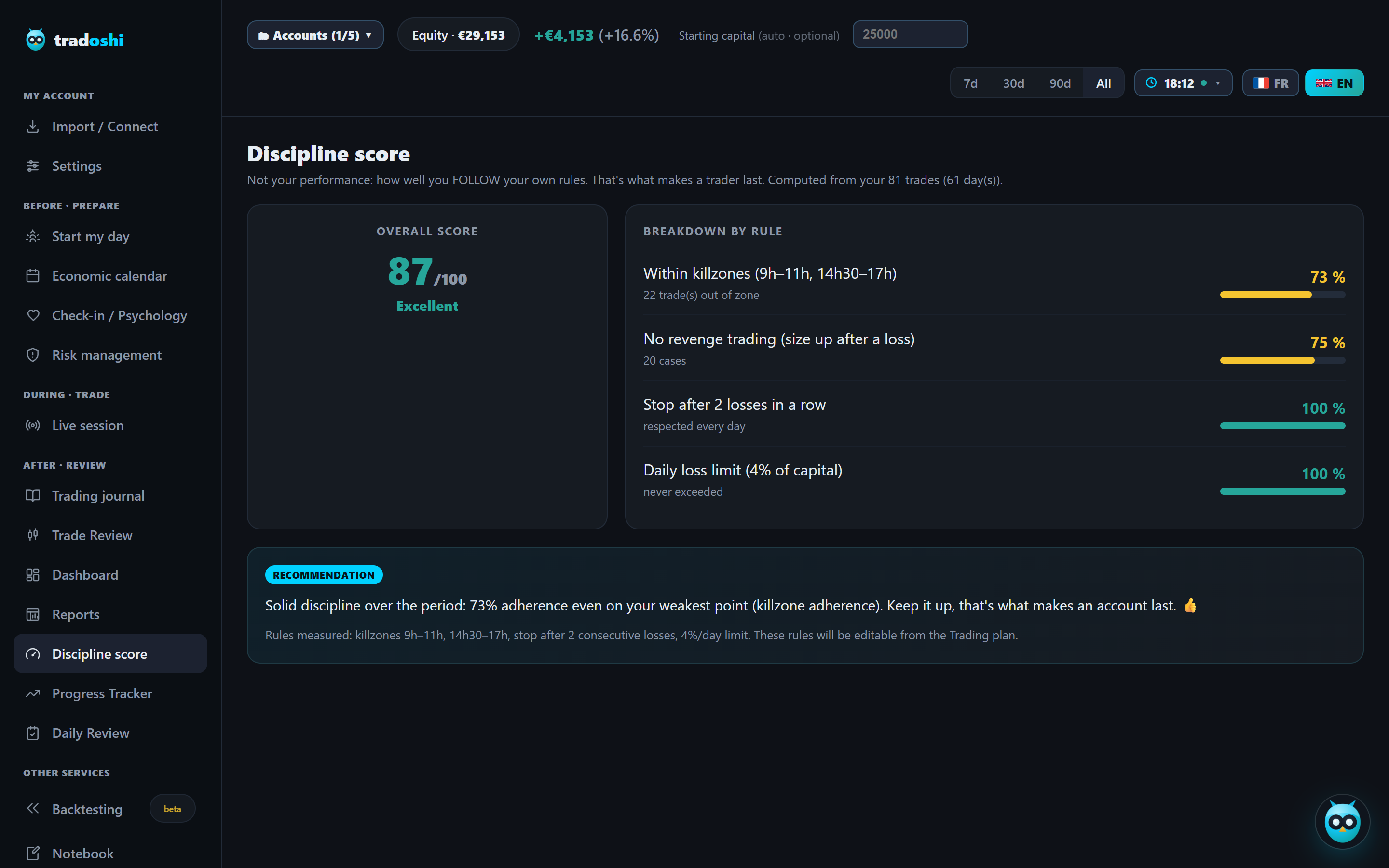
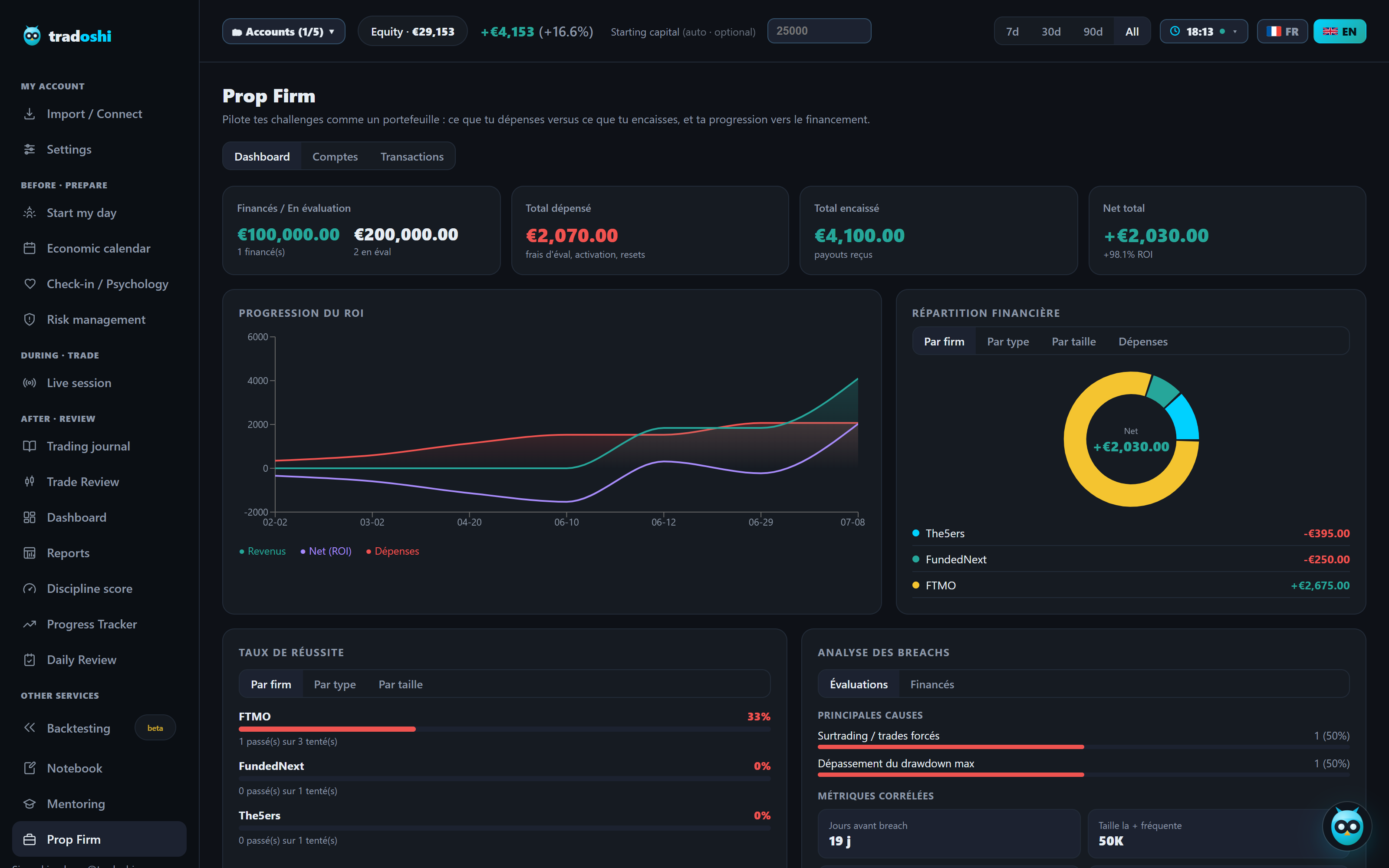
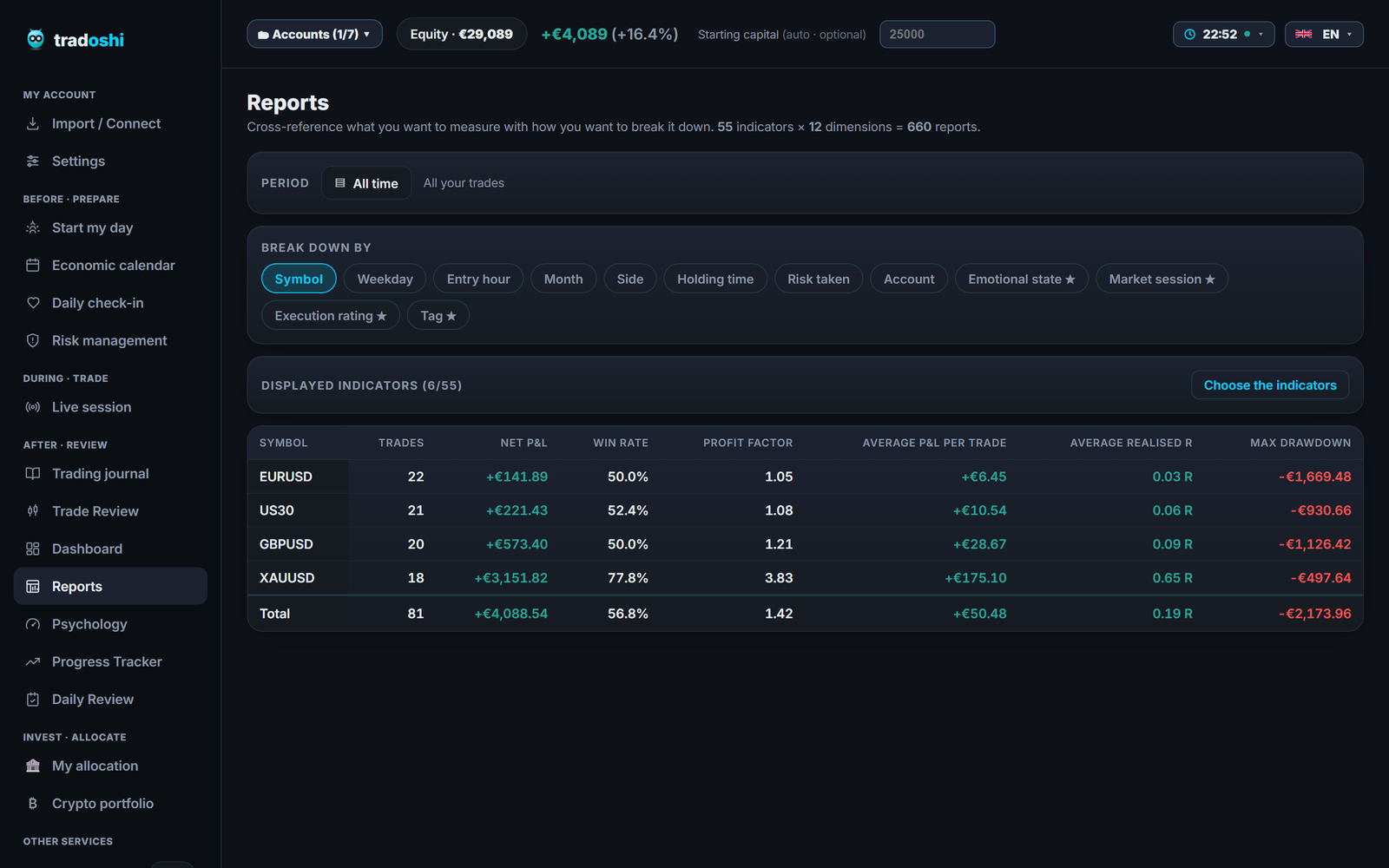
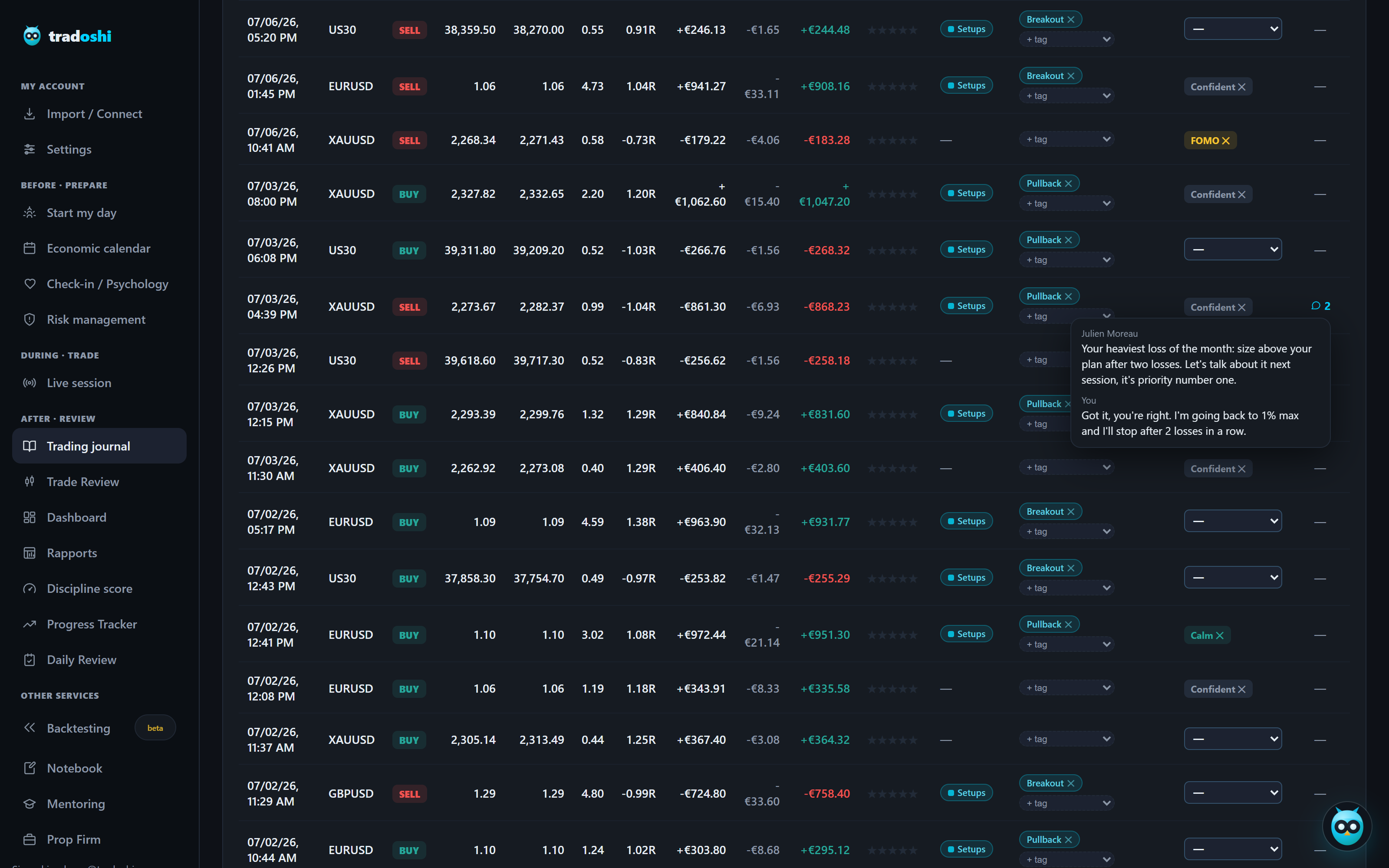
The Tradoshi Trading Journal · Oshi AI analysis · Backtesting with replay · The discipline score · Watch the video demo
The full comparison, feature by feature
Every line comes from both public pricing pages, read on the same day. Nothing is pulled from a help centre on one side and a grid on the other: on unequal evidence, a comparison stops being honest. “Absent from the grid” means exactly that, not “does not exist”.
What the product does
Tradervue is an analytics journal in the strict sense. Everything added to the category since 2020, AI, backtesting, replay, is not there.
| What is compared | Tradervue | Tradoshi |
|---|---|---|
| Journal and statistics | Yes, the historical benchmark | Yes |
| Reports | 100+ | 500+ |
| Exit analysis | Yes, max potential P&L | MFE / MAE and R-multiple |
| Liquidity reports | Yes, nobody else does it | No |
| Renko, Volume, Range charts | Yes | No |
| Artificial intelligence | Absent from their grid | Oshi AI from Essential |
| Backtesting | Absent from their grid | 10 strategies then unlimited |
| Trade replay | Absent from their grid | Trade Review on the real chart |
Psychology, discipline and risk
None of this appears on their pricing grid as of 11 September 2026.
| What is compared | Tradervue | Tradoshi |
|---|---|---|
| Emotional check-in | Absent from their grid | Written and spoken from Essential |
| Discipline score | Absent from their grid | From the entry plan |
| In-session guardrails | Absent from their grid | Live session (Premium) |
| Prop firm tracking | Absent from their grid | Multi prop firm and challenge tracking |
Access and billing
Two structural differences: they have no annual pricing, and they reserve commission tracking for their top plan.
| What is compared | Tradervue | Tradoshi |
|---|---|---|
| Annual pricing | None | Ten months paid out of twelve |
| Commission and fee tracking | Top plan only | Supplied by the broker, all plans |
| Image storage | 1 GB / 5 GB | 1 / 3 / 5 GB |
| Publicly listed integrations | Yes, including MT4, MT5, cTrader, Tradovate | 2,024 MetaTrader brokers + 98 on a direct API |
| US equity brokers | Yes, around ten platforms | IBKR synced; DAS, TradeZero, E*TRADE by import |
| Mobile app | Absent from their site | Android published on Google Play, iOS not published to date |
| Site languages | English | French, English and Spanish |
Look up your broker in our list · See every plan in detail · Watch the video demo
Mentoring, and who pays for whom
This is the only competitor in this series whose mentoring is better than the market average: unlimited from Silver, at $29.95 per month, with no published student cap. Where others reserve student invitations for a $59 plan, they open it on the first paid tier.
At Tradoshi the billing runs the other way: the mentor account is free, the student is the subscriber from Pro up. The mentor pays nothing, ever, whatever the number of students.
The difference is subtle and deserves honesty. There, the mentor subscribes at $29.95 per month and follows as many students as they like, which is $359 a year. Here they pay nothing, but each student must be on Pro. For a school whose students already pay, we are free; for a lone mentor whose students do not pay, Tradervue is simpler.
How mentoring works at Tradoshi · The offer for educators and schools
How to move from Tradervue to Tradoshi
There is no Tradervue file to convert: your trading journal history comes from your broker, and that is where we take it from.
- Create your Tradoshi account, free and with no credit card.
- Connect your broker. MetaTrader 4 and 5 (more than 2,000 brokers), Interactive Brokers, cTrader, TradeLocker, NinjaTrader, Tradovate and IG sync, and the history your broker keeps comes up with them.
- No sync at your broker? Import its statement: that is the case for DAS Trader Pro, TradeZero or E*TRADE, and for most crypto exchanges.
- Keep Tradervue open for a few days and compare both journals on the same trades: the P&L should match, fees included.
- Invite your mentor. Their account is free, and they find your trades and notes in your journal.
What the move does not carry over: the notes and tags you wrote there. Tradervue lets you export them to Excel: do it before you cancel if you want to keep them. Look up your broker in our list.
The verdict
Tradervue taught a whole generation to keep a trading journal, and its execution reports remain solid. But in 2026, observing is no longer enough: most traders already know where they lose, what they lack is the means to change. Tradoshi adds the AI that reads your numbers, a trading simulator with market replay, trade replay on the real chart and discipline before and during the session, from the free plan for the journal and from $19.99 for the AI, a third less than Silver. If you trade US stocks at Robinhood, Webull or TradeStation, stay with Tradervue. For everything else, trying costs nothing: connect your broker and compare on your own trades.
Customer reviews of the trading journal
“I found in Tradoshi a complete and thorough tool to track my trades, I use it every day. The interface is playful and clear, and it takes both the technical and the psychological side into account. I recommend it 100%.”
“A very good platform for traders of all levels, the pricing is attractive and customer support is responsive. The site itself is harmonious, easy to navigate, and you can connect your MetaTrader account to keep proper track of your trades. I recommend it!”
“I have been using Tradoshi for a few months for my SMC/ICT trading journal, and it is the first platform where the free plan really lets you log your trades and follow your stats, with no cap from week two like everywhere else. Setup-by-setup tracking (order blocks, FVG, liquidity sweeps) is precise, not a generic table, and I can tag my trades exactly. Simple interface, quick to get to grips with. I recommend it to any trader who wants to structure their discipline without pulling out a card in the first month. Support is very responsive.”
Testimonials appearing on this website may not be representative of other clients or customers and is not a guarantee of future performance or success.
Frequently asked questions
Is Tradoshi a good Tradervue alternative?
Yes, if you want an AI trading journal with what Tradervue's grid does not have: an assistant that reads your numbers, backtesting with market replay and a discipline layer before and during the session. If your only need is execution analysis on US stocks at Robinhood, Webull or TradeStation, Tradervue remains the better fit.
How much does Tradervue cost?
As of 11 September 2026, two monthly plans: Silver at $29.95 and Gold at $49.95. No annual pricing is published. Tradoshi starts with a permanent free plan, then $19.99, $39.99 and $49.99 a month, with an annual plan that charges ten months out of twelve.
Is Tradervue free?
Its site offers a free sign-up, but its pricing page lists only Silver and Gold and does not publish the limits of the free version. Tradoshi's free plan is permanent, with no credit card, one synced broker account and unlimited file import.
Does Tradervue have artificial intelligence?
None appears on its pricing page as of 11 September 2026: no assistant, no automatic analysis, no credits. It is a journal and a statistics engine, with no AI layer. Tradoshi includes Oshi AI from the Essential plan.
Does Tradervue do backtesting or trade replay?
Neither appears on its pricing grid. Tradoshi offers backtesting in a trading simulator with market replay, ten strategies on Pro then unlimited on Premium, and trade replay on the real chart with Trade Review.
What do I lose by leaving Tradervue?
Three things, to be precise. Its liquidity reports, which nobody else offers. Its Renko, Volume and Range charts. And part of US equity brokerage: Robinhood, Webull, TradeStation and Lightspeed are not with us, while Interactive Brokers syncs and DAS Trader Pro, TradeZero and E*TRADE can be imported. Your notes there can be exported to Excel before you leave.
Which is better for a mentor?
It depends who pays. At Tradervue the mentor subscribes at $29.95 per month and follows as many students as they like. At Tradoshi the mentor pays nothing, but each student must be on Pro. For a school whose students already subscribe, Tradoshi is free; for a lone mentor whose students do not pay, Tradervue is simpler.
Tradervue vs TradeZella?
As of 11 September 2026, TradeZella costs more at entry, $35 against $29.95 a month, but adds what Tradervue's grid does not mention: an AI, backtesting and trade replay. Tradoshi has all three as well, from $19.99 a month and with a free plan. The four-column table above details every line.
Tradervue vs TraderSync?
Same entry price, $29.95 a month, but TraderSync adds an AI, a replay simulator, a mobile app and annual pricing, which Tradervue's grid does not mention. Tradoshi ticks the same boxes from $19.99, with a permanent free plan.
Is there a Tradervue app?
None is presented on its site as of 11 September 2026. Tradoshi has an Android app, and the journal runs in the browser on any device.
Does Tradervue publish its broker list?
Yes, a public list of platforms, including MetaTrader 4 and 5, cTrader, Tradovate and Interactive Brokers, and a large part of US equity brokerage. On our side, we publish the list of 2,024 MetaTrader brokers with a PDF, plus 98 brokers reachable through their own API. The two lists do not count the same thing, and both can be read.
The partner offer, in months of revenue
Tradervue has an affiliate program, mentioned on its site, but its terms are not published: no rate, no duration, no payout threshold. A creator cannot know what they would earn without writing in and waiting.
Our schedule is public and pays from the first customer: 15% for life on every payment collected, 20% from fifteen active subscribers, 25% from fifty-one.
Comparing two percentages means nothing while the durations differ. The honest unit is months of the referred customer's revenue: it neutralises both the product price and the commission duration. Read it as: for a customer who stays N months, the partner has earned the equivalent of X months of that customer's revenue.
| Program | Stays 6 months | Stays 12 months | Stays 24 months | Stays 36 months |
|---|---|---|---|---|
| Tradoshi 15% (from the 1st customer) | 0.90 | 1.80 | 3.60 | 5.40 |
| Tradoshi 20% (15 customers and up) | 1.20 | 2.40 | 4.80 | 7.20 |
| Tradoshi 25% (51 customers and up) | 1.50 | 3.00 | 6.00 | 9.00 |
The table only holds our rows, and that is not an oversight: you do not compute what a competitor does not publish. If they publish their schedule, this page will be updated with the survey date.
On our side, the commission lands on every payment collected for as long as the customer stays subscribed, with a 30-day holding period and a €500 payout threshold.
Compare with another trading journal
Try it, and compare on your own trades
Connect your broker, let your journal fill itself, and judge on your own numbers rather than on a table.
Start for free Free plan · no credit card · nothing to cancelMethod and sources. Every figure attributed to Tradervue was read on 11 September 2026 on its own public pages, in the served HTML, and not taken from a third-party comparison: www.tradervue.com/site/pricing/ · www.tradervue.com/ · www.tradervue.com/site/platforms/ · www.tradezella.com/pricing · tradersync.com/pricing/. The “absent from the grid” statements were obtained by counting term occurrences in the served page, not by eye. The months-of-revenue values are computed from the published schedules on both sides, month by month, not typed by hand. A publisher's pricing can change without notice, sometimes overnight: when in doubt, the Tradervue page prevails over this one. If you spot a mistake, write to us and it will be corrected with the date. Report an error to us.