 By Benjamin Roure L'Hermitte
Futures, or futures contracts, are standardized contracts that commit you to buying or selling an asset at a price set today, on a specific future date. Unlike a stock, you never own the underlying asset: you take a position on its price, with leverage built into the contract itself. This guide explains simply what a futures contract is, how to trade one, the different types of contracts that exist, and how this market fundamentally differs from stocks, forex and options.
- A future is a standardized contract, not a title of ownership: you're betting on a price, never holding the asset.
- Margin replaces the full price: you control a high-value contract with a fraction of its notional amount on deposit.
- There's a futures contract for almost everything: indices, commodities, currencies, interest rates.
- Broker and platform are two separate choices: check who holds your funds first, compare software second.
Futures trading has a reputation for being reserved for professionals, because of its technical vocabulary and the notional amounts a single contract displays. Micro contracts, ten times smaller than the E-minis, lowered the capital required without changing the mechanics: a standardized contract, traded on an exchange and quoted nearly 24 hours a day on weekdays. The risk did not shrink with them. The CFTC's page on the basics of futures trading warns that speculating in these contracts is a volatile, complex and risky venture that is rarely suitable for individual investors, that many individuals lose all of their money, and that they can be required to pay more than they invested initially.
This guide starts from the simplest possible definition and builds up progressively: what a futures contract is, how to open an account and choose a platform, the major contract families that exist, how margin works, and the mistakes that cost beginners the most on this market.
What a futures contract is
A futures contract is a standardized agreement between a buyer and a seller that fixes today the price at which an asset will change hands on a specific future date, called the expiration. The CFTC Glossary, published by the US derivatives regulator, defines it as an agreement to purchase or sell a commodity for delivery in the future, at a price determined at initiation, that obligates each party and that may be satisfied by delivery or offset. The futures definition carries two ideas that change everything compared to a stock: the contract has an EXPIRATION DATE, and it doesn't involve owning the asset. Offset is the opposite trade that cancels the position, and it is the ordinary way out: writing about WTI crude oil, the US Energy Information Administration (EIA) notes that most market participants close their contracts ahead of expiration and that only about 1% of futures traded go to physical delivery.
Every futures contract is standardized by the exchange that lists it (the CME for most US contracts, Eurex in Europe): the quantity of the underlying asset, the quote unit, the smallest possible price movement (the tick) and the expiration months are all fixed in advance and identical for every participant. This standardization is what makes the market liquid: an E-mini S&P 500 contract bought in New York is rigorously identical to another sold the same minute, which is never the case for an over-the-counter agreement.
How to trade futures: broker and platform
Trading futures involves two distinct things that often get confused: a broker, who executes your orders and holds your margin account, and a software platform, on which you actually place your orders and read the market. On stocks, both are often the same app. On futures it is common to separate them: specialized software, connected to the broker, brings the tools this market calls for (order book, Depth of Market, session replay).
NinjaTrader is one example of such software. According to NinjaTrader's website, the platform is always free to use for charting, backtesting and trade simulation, and its documentation on the Playback connection describes Market Replay, which replays a session with the exact sequence of quotes and market depth. It's also the platform Tradoshi automatically syncs your executions from, with no file to export by hand. Full details are on our recommended tools and services page and on the NinjaTrader page.
Before opening a live account, check three things: the minimum deposit required, commissions per contract, which add up fast if you trade frequently, and whether a simulation account exists, so you can learn the order book mechanics without risking capital.
What is a futures commission merchant (FCM)?
In the United States, the intermediary that takes your futures orders and receives your money has a regulatory name: futures commission merchant, or FCM. The CFTC Glossary defines it as the individual or firm that solicits or accepts orders for the purchase or sale of any commodity for future delivery and that accepts payment from, or extends credit to, those whose orders are accepted. A firm that takes orders without accepting any money or securities to margin the trades is an introducing broker, under the same glossary. The difference tells you who actually holds your margin deposit.
Registration of futures commission merchants was delegated by the CFTC to the National Futures Association in 1984, according to the CFTC's page on FCMs, and the NFA's page on FCM registration gives the same definition: an entity that solicits or accepts orders and accepts money or other assets from customers to support them. The check is free and comes before you send a cent: the NFA's BASIC tool lets you research the background of a firm or an individual. The CFTC's worksheet on how to select a futures broker advises moving on if the firm is not registered, then asking about commissions, fees and margin requirements. If your broker is European, ask it the same question: which entity holds the funds, and under which regulator.
Futures vs Options vs Stocks vs Forex
Futures share common ground with each of the other three major markets, which is why they get compared so often, but their differences determine which one actually suits you.
| Futures | Options | Stocks | Forex | |
|---|---|---|---|---|
| What you own | Nothing, a contractual commitment | A right, not an obligation | A share of the company | Nothing, a position on an exchange rate |
| Leverage | Built into the contract, via margin | Built into the premium paid | Optional, via the broker | Often high, via the broker |
| Hours | Nearly 24/5 | Hours of the underlying exchange | Exchange hours (+ pre/post-market) | 24/5 |
| Expiration | Yes, monthly or quarterly | Yes, often shorter-dated | No | No |
| US tax treatment | 60/40 rule (section 1256) | Holding period on stocks, 60/40 on broad-based indexes | Depends on holding period | Special foreign currency rules (section 988) |
The options vs futures comparison turns on one structural difference, the obligation: a futures contract commits you firmly, while an option leaves you the choice not to exercise your right. A future only loses value if the price moves against you, without the time decay that erodes an option's value even when the price doesn't move at all. What an option is finally worth is settled at expiration by the strike, the premium paid and the closing price, which is exactly the subtraction the option profit calculator runs. There's also a hybrid third instrument, 'options on futures', which gives the right to enter a futures contract at a given price, reserved for traders already comfortable with both mechanics separately.
Compared to stocks, futures stand out for the absence of ownership (no dividends, no voting rights) and structurally higher leverage: a stock is generally paid for in full or with the limited margin a broker allows, while a futures contract only requires a fraction of its notional value as a deposit. Compared to forex, both markets share very extended hours and heavy use of margin, but forex has no expiration date and is limited to currencies, while futures cover dozens of different asset classes under the same contractual mechanism. The tax row of the table comes from IRS Publication 550, which lists regulated futures contracts and listed broad-based stock index options among section 1256 contracts, and sends certain foreign currency transactions to special rules.
Do not confuse an exchange-listed futures contract with a CFD on an index or a commodity either, which is entered into with the CFD provider rather than on an organized market. In Europe, CFDs have their own rules: the measures ESMA announced in March 2018 cap retail leverage on opening a position, at 20:1 on major indices and gold, require positions to be closed out when margin falls to 50% of the minimum required, and guarantee that an account cannot end with a negative balance, and the French regulator AMF took them over in France from August 1, 2019. That text covers CFDs, not futures contracts: on a future, nothing guarantees you will not lose more than your deposit.
The different types of futures contracts
The word 'futures' actually covers four broad contract families. An index futures contract and a crude oil contract share only their contractual mechanics, not their price drivers.
| Family | Examples | What moves the price |
|---|---|---|
| Stock indices | E-mini S&P 500 (ES), Micro E-mini Nasdaq (MNQ), Nikkei 225 | Earnings, macroeconomics, market sentiment |
| Commodities | Gold (GC), crude oil (CL), silver (SI) | Physical supply and demand, geopolitics, the US dollar |
| Currencies | Euro FX (6E), Japanese yen (6J) | Relative interest rates, central banks, trade flows |
| Interest rates | 10-year Treasury notes, Fed Funds | Central bank decisions, inflation, rate expectations |
Each family behaves differently. Stock indices react to the same news as the stocks that make them up, but in a smoother way, which often makes them the most readable entry point for a beginner. Commodities are more sensitive to supply shocks (a drought, a production cut) and can move sharply on news unrelated to financial markets in the strict sense. Bond futures and the other interest rate contracts are the most technical, reserved for traders who follow monetary policy decisions closely.
The arrival of micro contracts (a tenth of the size of a standard E-mini contract) changed the market's accessibility: a Micro E-mini Nasdaq (MNQ) requires a fraction of a standard contract's margin, which lets you learn the mechanics with real but contained risk, rather than simulating indefinitely. Every contract has its own tick value (the gain or loss for the smallest possible price move), a number worth knowing by heart before your first trade: our futures calculator gives it for the most actively traded contracts.
For contracts listed in the United States, the regulator publishes every week who holds the positions, by broad category of trader: that is the Commitment of Traders report, to be read as a snapshot of the market and not as a signal.
What a point is worth: 100 points on NQ, in dollars
On an index contract, profit or loss is the number of points multiplied by the contract multiplier. The figures below come from a secondary source, the pages of a regulated US broker: according to Charles Schwab's page on E-mini Nasdaq futures, the NQ contract represents 20 times the Nasdaq-100 index, its minimum tick of 0.25 point is worth $5.00, and the Micro is one tenth of its size. For the S&P 500, its page on stock index futures tick values gives $50 times the index on the E-mini (ES), which makes the 0.25-point tick worth $12.50, and $1.25 for the same tick on the Micro (MES). On the official side, a CME rule filing lodged with the CFTC sets the index point at $2.00 for the option on one Micro E-mini Nasdaq-100 futures contract, and at $5.00 for the option on one Micro E-mini S&P 500 futures contract.
| Contract | Value of one point | Calculation for 100 points | Result per contract |
|---|---|---|---|
| E-mini Nasdaq-100 (NQ) | $20 | 100 × $20 | $2,000 |
| Micro E-mini Nasdaq-100 (MNQ) | $2 | 100 × $2 | $200 |
| E-mini S&P 500 (ES) | $50 | 100 × $50 | $5,000 |
| Micro E-mini S&P 500 (MES) | $5 | 100 × $5 | $500 |
So 100 points on NQ comes to $2,000 per contract, in either direction, and $200 on the Micro. The same sum gives your risk before you enter: a stop placed 40 points away on one MNQ is 40 × $2 = $80 per contract, before fees, and on one NQ 40 × $20 = $800. In Europe the principle is the same in euros: Eurex's page on DAX futures gives 25 euros per point for the DAX contract, 5 euros for the Mini-DAX and 1 euro for the Micro-DAX. Our futures calculator runs the conversion for the most actively traded contracts.
Margin: how leverage works on futures
Unlike a stock, where leverage is an option your broker grants you, margin is structurally built into every futures contract. The CFTC Glossary defines it as the money or collateral a customer deposits with their broker, and adds that margin is not partial payment on a purchase. Initial margin is the amount required when a position is opened, maintenance margin the amount that must stay on deposit at all times: if the account drops to or below that level, the broker issues a margin call to bring it back to the initial level. Minimums are set by exchanges, and firms can add to them, as the CFTC's worksheet on how to select a futures broker points out.
A calculation gives the order of magnitude. Take a Nasdaq-100 at 20,000 points, purely as a working assumption: one Micro E-mini then carries 20,000 × $2 = $40,000 of notional value. Charles Schwab's page on Micro E-mini futures, a secondary source, says margin could run from just 5% to 7% of notional, here $2,000 to $2,800, which is leverage of 14 to 20. A 100-point drop, 0.5% of the index, costs 100 × $2 = $200, that is between 7% and 10% of the deposit. And the loss does not stop at the deposit: the same page points out that you may lose more money than you initially invested and that the brokerage may liquidate your position without contacting you to meet a margin call.
This mechanism answers the question many beginners ask before their first trade: how many contracts to risk, and on what capital. The right approach is never to trade the full margin available, but to calculate, like on any other market, a risk as a percentage of total capital and convert that risk into a number of contracts using your stop's distance and the relevant contract's tick value.
Margin doesn't measure what you can afford to trade, it measures what the exchange and your broker require to open the position. Your own risk is calculated separately, from your stop, never from the maximum leverage available.
How to read a futures symbol
A futures symbol isn't an arbitrary ticker like a stock's, it's an address that comes apart. Take ESZ26: the first two letters, ES, are the contract root, here the E-mini S&P 500. The next letter, Z, is the delivery month, December. The closing digits give the year, and that is already the first trap: depending on the platform and the data feed, the year is written with two digits (ESZ26) or with a single one (ESZ6), both forms pointing at exactly the same contract. Root, month, year: that is the convention the exchange applies to its own contracts. Software rewrites it each in its own way, as you will see three lines below.
The root is the part worth memorizing. ES for the E-mini S&P 500, NQ for the E-mini Nasdaq-100, MES and MNQ for their micro versions, GC for gold and MGC for micro gold, CL for WTI crude oil, 6E for the euro against the dollar. An M in front of a root almost always signals a micro contract, a convention that saves time when you explore a new market. Watch out instead for roots that start with a digit, like 6E or 6J: those are the currencies, and many platforms file them separately, outside the alphabetical list where you would go looking for them.
What throws beginners most is that the same contract isn't written the same way from one piece of software to the next. Some platforms, thinkorswim among them, put a slash in front of the root (/ES) to separate a future symbol from a stock ticker carrying the same letters. TradingView appends a digit and an exclamation mark (ES1!) to designate not one fixed expiration but the nearest-expiration contract, stitched end to end over time, with ES2! being the one after it. NinjaTrader writes the month and year in digits: its guide to rolling over a futures contract gives the example of moving from "ES 09-16" to "ES 12-16". This shifting futures symbology is only packaging, and recognizing it stops you from journaling two instruments where there is only one, a subject our guide to futures trading platforms takes further on the software side. That leaves the only part nobody guesses, the month letter.
| Code | Month | Code | Month |
|---|---|---|---|
| F | January | N | July |
| G | February | Q | August |
| H | March | U | September |
| J | April | V | October |
| K | May | X | November |
| M | June | Z | December |
Expiration and the rollover
Every futures contract dies on a date known in advance. CME stock index contracts follow a quarterly cycle, March, June, September and December, so the only month letters you will ever see on ES or NQ are H, M, U and Z, and the contract goes out on the third Friday of its expiration month. What happens that day depends on the contract: an index contract settles in cash, the difference simply credited or debited, while others provide for physical delivery. According to the EIA, anyone holding a WTI crude oil contract through expiration must make or take delivery of crude in Cushing, Oklahoma, unless other arrangements were made ahead of time. No retail trader wants to end up on the wrong side of that second clause.
Long before expiration, the market moves house. Traders who want to stay exposed close the position on the current contract and reopen it on the next one: that is the rollover, and it happens in bulk over a few days, ahead of expiration. Two ideas get mixed up here, so let's separate them once and for all. The front month, or nearest-expiration contract, is the one whose expiration comes soonest: that is a calendar definition, and it only changes at expiration. The contract you have any reason to work is the one carrying traded volume, and for the few days of the rollover those are no longer the same, the front drying up while the next one fills. What you are looking for is therefore not a date but a crossover: the moment traded volume on the next expiration overtakes traded volume on the current one. That is also TradingView's starting point for switching ES1! from one contract to the next: according to its help page on how the switching date of continuous futures is determined, the main condition is the daily volume of the next contract exceeding that of the current one, but the rule is set once per symbol from statistical averages, for example six business days before expiration. The series therefore changes contract before expiration, sometimes a little before or a little after the real volume crossover.
You observe that crossover on the traded volume of both expirations set side by side, or on the daily volume and open interest figures the exchange publishes. The order book teaches you nothing here: it shows resting size, not what actually changed hands, and two expirations don't compare inside a DOM. Anyone hunting for futures contract rollover dates is really hunting for that volume crossover on NQ, and the exchange does not decree it, it observes it like everyone else.
- Find your contract's expiration date before the week opens, not on the morning itself.
- Roll when volume has rolled, not when the calendar says so: compare traded volume across both expirations.
- Never let an open position cross expiration, above all on a physically delivered contract.
- Check your chart after the roll: the levels you were watching belong to the old contract.
That move leaves a visible mark on charts. Two contracts on the same underlying rarely quote at the same price, because the more distant one carries the cost of holding the asset until its own expiration. On an index, that cost is financing minus the dividends expected in between, so the gap runs both ways: the far expiration can quote above the near one or below it, depending on which of the two terms wins. The CFTC Glossary names both situations: contango when prices in succeeding delivery months are progressively higher than in the nearest one, backwardation when futures prices are progressively lower in the distant delivery months. When your software switches from one contract to the other, that gap shows up in one block, without a single trade having happened at that level. Two treatments exist from there, and knowing which one you are looking at changes your reading.
By default, TradingView leaves the hole visible: on a factory-setting ES1!, you see a gap at the join and, before it, prices that really existed. According to its help page on back-adjustment, the B-ADJ button at the bottom of the chart, or the 'Adjust for contracts changes' box in the settings, turns that adjustment on, and it is off to begin with: the platform then shifts the previous contracts by the difference between the closes of the new and the old contract at the join, which gives a continuous curve, handy for reading a long trend, but whose old prices are no longer prices that ever traded. A level marked on adjusted history therefore matches nothing in today's market. Even without adjustment, a level drawn before a rollover gets re-marked on the current contract rather than carried across as is. The same care applies when you review a run of trades spread over several expirations, a subject our futures trading journal guide takes further.
Futures vs forwards: the most common confusion
Both words translate the same idea, a commitment to exchange later, which is why people use one for the other. The mechanics diverge on the point that matters most: who guarantees the other side will pay. A future trades on an exchange, and a clearing house steps between buyer and seller: the CFTC Glossary describes clearing as the procedure through which it becomes the buyer to each seller and the seller to each buyer. A forward is an over-the-counter agreement between two parties facing each other directly, with no intermediary, each carrying the risk that the other defaults.
| Futures | Forward | |
|---|---|---|
| Standardization | Size, expiration and tick set by the exchange | Every clause negotiated to measure |
| Where it trades | An organized market, public price | Over the counter, price known to the two parties only |
| Payment guarantee | A clearing house steps in between | None, each side carries the other's risk |
| Profits and losses | Settled daily, debited from or credited to the account | Settled once, at expiration |
| Exit before term | An offsetting order, cleared at once | Renegotiation with the counterparty, or nothing |
That table explains why a forward is not an instrument for active trading. The CFTC Glossary describes it as a transaction common in commodity merchandising, in which a commercial buyer and seller agree upon delivery of goods at a specified future date, on terms more personalized than those of a standardized futures contract. Once signed it exists only for its two signatories, and getting out means convincing the other one to renegotiate. It has no displayed price either, so no way to know what it is worth today without computing that yourself. These contracts serve to lock a price or an exchange rate on one specific delivery or invoice, not to get in and out within the session.
The difference between futures and forwards also has a daily consequence beginners discover late: daily settlement. On a future, your open loss is taken from your account every evening and your open gain is paid into it, which forbids you from ignoring a position going against you, it costs you cash every day. On a forward, nothing moves until expiration, and the whole loss lands at once at the end. That daily settlement looks like a constraint, it is in fact the mechanism that stops a loss from piling up in silence until it becomes unpayable, for you as much as for your counterparty.
Common mistakes beginners make in futures
The first and most costly mistake is sizing a position off available margin rather than off the stop loss. Because a micro contract's initial margin can look small, a beginner opens several contracts simply because the account allows it, without having calculated the actual loss if the stop is hit. Contract count should always follow the risk accepted in dollars, never available margin.
The second mistake is unknowingly trading a contract close to expiration, for want of reading the month letter in its symbol. Spreads widen, liquidity thins, and nothing on screen warns you: it is on the trader to look. The two sections above give you the reading grid and the signal to roll.
The third, more subtle mistake is underestimating the impact of market hours. According to Charles Schwab's page on E-mini Nasdaq futures, the contract trades from Sunday 6 p.m. to Friday 5 p.m. Eastern Time, with a one-hour maintenance break each day, which gives the impression of a continuously open market. Volume, however, is not spread evenly across those hours: in a quiet stretch the book is thinner and moves are more erratic. Look at your contract's volume hour by hour before you choose your trading windows.
How Tradoshi helps you with futures
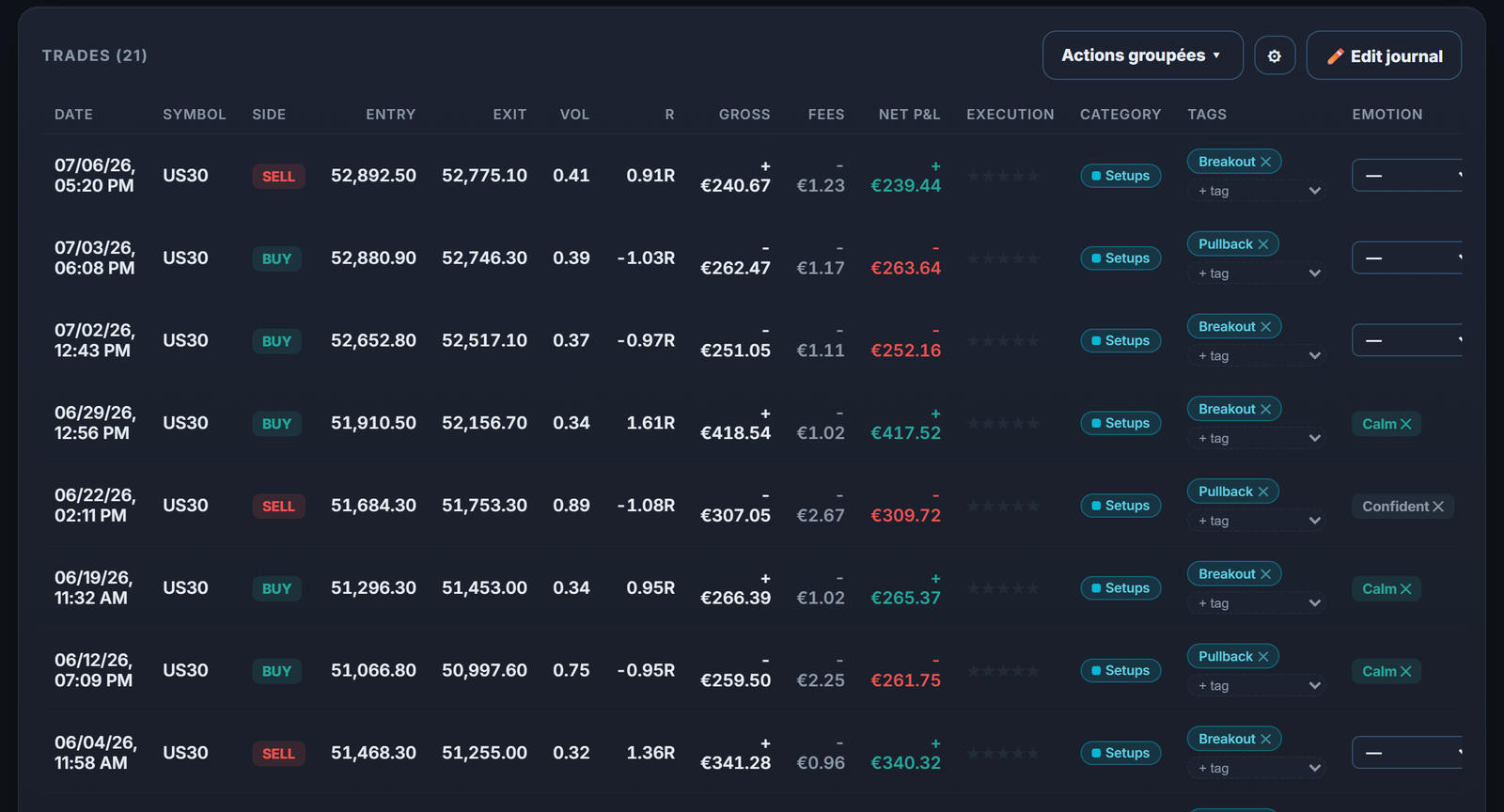
Whether you're starting on a micro index contract or expanding into commodities, Tradoshi centralizes your futures trades in a journal that computes your actual risk per contract, without you having to look up tick value on every position.
- Automatic sync with NinjaTrader, with no file to export by hand.
- Risk per trade as a percentage, tracked day by day, tightening on its own after a loss.
- And before the trade, our futures calculator, free and without signing up: tick value, contract count and risk in dollars.
- Per-contract statistics to see where your edge is real, across indices, commodities and currencies.
- Your P&L plotted on entry time, to see which trading windows actually pay you.
Frequently asked questions
What is a futures contract, in one sentence?
A futures contract is a standardized agreement that commits you to buying or selling an asset at a price set today, on a specific future date, without ever owning the underlying asset.
Micro vs mini futures: what's the difference?
A micro contract is generally a tenth of the size of an equivalent mini or standard contract, with margin and tick value reduced in the same proportion. It lets you trade with real but contained risk, rather than simulating indefinitely.
Are futures subject to the pattern day trader rule?
No. The pattern day trader rule is a FINRA rule aimed at securities margin accounts at US brokers; futures fall under the CFTC and their own margin requirements. FINRA has in fact announced its replacement by intraday margin requirements, with no $25,000 minimum, effective June 4, 2026, with a transition period for brokerage firms through October 20, 2027.
How are futures gains taxed in the US?
In the US, regulated futures contracts are section 1256 contracts under the tax code, which brings a so-called 60/40 treatment. According to IRS Publication 550, 60% of the capital gain or loss is treated as long-term and 40% as short-term, regardless of how long the contract was actually held, and a contract still open at year end is treated as sold at its fair market value. This treatment differs from stocks and is worth checking with a tax professional for your situation.
What do the futures month codes mean (H, M, U, Z)?
Each letter designates a delivery month standardized by the exchange: H for March, M for June, U for September, Z for December, among others. A contract like ESZ26 therefore designates the E-mini S&P 500 contract expiring December 2026.
Can you trade futures on a demo account before risking real capital?
Yes, and it is a good place to start. NinjaTrader, for example, states that its platform is always free to use for trade simulation. Just check which market data is included and for how long, since that varies from one provider to the next, and keep in mind that a simulation account reproduces neither slippage nor the pressure of a real position.
What is the difference between a futures contract and a forward contract?
Both are contracts for delivery at a later date, but a futures contract is standardized by an exchange and guaranteed by a clearing house that steps between buyer and seller, with profits and losses settled on the account every day. A forward is an over-the-counter agreement, cut to measure between two parties, with no central guarantee, no public price and no resale market. That is why a forward serves to hedge one specific delivery or invoice, not to trade within the session.
What is a futures contract rollover?
The rollover is the migration of traded volume from the expiring contract to the next one. Traders who want to stay exposed close the position on one and reopen it on the other, in bulk, over the days that precede expiration. In practice you roll when volume has rolled, comparing traded volume across both expirations, and you never let a position cross the expiration date.
Why is the same contract written /ES, ES1! or ES 12-26 depending on the platform?
Because each piece of software dresses the same exchange reference its own way. The slash separates a future from a stock of the same name, the ES1! notation on TradingView designates the nearest-expiration contract rather than one fixed expiration, and NinjaTrader spells the month and year out. Those are three spellings of one instrument, not three symbols to journal separately.
How much is 100 points on NQ worth?
On the E-mini Nasdaq-100 (NQ), one point is worth $20, so 100 points is 100 × $20 = $2,000 per contract, as a gain or as a loss. On the Micro E-mini (MNQ), one point is worth $2, which makes 100 × $2 = $200 per contract. Then multiply by the number of contracts and subtract fees.
Can you lose more than your deposit trading futures?
Yes. The CFTC writes that many individuals lose all of their money and can be required to pay more than they invested initially. Margin is a performance deposit, not a cap on losses: your stop and your contract count are what bound your risk, and a stop does not guarantee the execution price.