 By Benjamin Roure L'Hermitte
A futures broker is the regulated firm that holds your margin account and gets your orders cleared, while the platform is the software you place them on: in futures the two are often separate, which stocks almost never teach you. This guide explains what really sets a futures broker apart from a platform, the criteria that matter before opening an account, and why NinjaTrader is the platform we recommend, with the criteria behind that choice.
- Broker and platform are often separate on futures, unlike stocks where the broker's app is enough.
- Required margin varies between brokers for the same contract: the exchange sets a minimum, the broker can ask for more.
- The futures demo account is worth comparing too: how long it lasts and what data it shows change from one platform to the next.
- NinjaTrader automatically syncs your trades with Tradoshi, with no file to export by hand.
If you're coming from stocks or forex, the first surprise on arriving at futures is this split between who executes your orders (the broker) and the software you read the market and click on (the platform). Understanding this distinction keeps you from comparing things that don't compare, and choosing on the wrong criterion.
This guide starts from that distinction, breaks down the criteria that actually make a difference between two offers, covers NinjaTrader in detail, and briefly places the other well-known platforms on the market.
Broker and platform: two separate things
The broker is the regulated entity that holds your account, manages your margin, and gets your trades cleared through the exchange's clearing house. In the United States it has a regulatory name, futures commission merchant: the CFTC Glossary defines it as the firm that solicits or accepts orders for futures contracts and accepts payment from those whose orders it takes. The platform is the software you use to view prices, place orders and manage risk day to day: order book, charts, replay tools. On stocks, a single app usually covers both roles. On futures, it is common to pick your platform (NinjaTrader, Tradovate, or another) and then connect it to a compatible broker, or the reverse.
This split has a concrete upside when your platform connects to several brokers: you can switch without relearning new software, keeping the same interface and the same shortcuts. That's also why platform choice deserves as much attention as broker choice, whereas on other markets the question barely comes up separately.
How to pick the best futures broker: what to check before opening an account
| Criterion | Why it matters |
|---|---|
| Margin required per contract | Determines how many contracts a given capital lets you open, and varies between brokers for the same contract. |
| Commissions per contract | A fixed cost per trade that adds up fast if you trade frequently, compared round-trip, not one-way. |
| Demo account | Check how long it lasts and what data it shows: this is where you learn without risking capital. |
| Data feed | Feed quality and latency change what you actually see of the order book, especially for scalping. |
| Platform compatibility | Confirm the broker actually connects the platform you want before opening an account there. |
Required margin deserves particular attention because it isn't set by the exchange alone: the CFTC's worksheet on how to select a futures broker notes that minimum margin requirements are set by exchanges, but firms can add to them. Two brokers can therefore display different margin on the same E-mini contract, which directly changes how many contracts your capital lets you trade within your risk. The same worksheet advises moving on if the firm is not registered.
A futures demo account is a criterion beginners in a hurry to open a live account rarely look at. Learning to read an order book, understanding Depth of Market behavior, and getting a feel for a contract's rhythm takes time, and that time should never cost real money before you're ready. Terms differ from one house to the next: Tradovate's website advertises a 14-day free demo with live streaming data, while NinjaTrader's European pricing page lists free simulated trading among the tools available without funding, and real-time market data among those unlocked once the live account is funded.
NinjaTrader, our recommended platform
According to NinjaTrader's website, the platform is free for advanced charting, backtesting and simulation, making it a no-cost entry point to learn the market before funding anything. The same site advertises thousands of trading apps and add-ons, and three ways in, desktop, web and mobile. Market Replay, which replays a session tick by tick, is among the tools its pricing page unlocks once the live account is funded. NinjaTrader also displays a 2024 Best Trading Software award from the readers of Stocks & Commodities. Our recommendation remains an opinion, based on three criteria: software you can use without paying while you learn, a fee schedule published line by line, and automatic sync with Tradoshi.
It's also the platform our add-on automatically pushes your executions into Tradoshi from, with no file to export by hand: you trade on NinjaTrader, your journal fills itself in. Full details, with account opening links, are on our recommended tools and services page, and the full writeup is on our NinjaTrader page.
Other platforms on the market
NinjaTrader isn't the only serious option, and it's worth knowing what else exists before choosing. Tradovate presents itself as a platform for trading futures from any device, where orders are held in the cloud, with apps for Mac, PC, tablet and phone. It belongs to the same group as NinjaTrader, and its site says one login opens both platforms. tastytrade is a stock and options broker that also offers futures and futures options, with an interface built for active futures traders according to its futures page, a sensible choice if you already trade both instruments. Other active traders route through order and data infrastructure like Rithmic or CQG, resold to them by the broker: CQG describes itself as a solution for trade routing, market data and technical analysis that partners with more than one hundred futures commission merchant environments.
The right choice depends less on an absolute ranking than on your actual use case: NinjaTrader's free access and depth of tools make it our default recommendation for learning and active trading alike, but if you're already set up on an options platform and futures are just a complement, staying in the same software ecosystem has its own merit too.
Comparing two offers on the real cost of a round trip
A futures broker usually quotes commission 'per side', so for one half of the trade. Opening then closing is two sides: the number on the pricing page has to be doubled before any comparison. Commission is then only one line out of five. The exchange listing the contract takes its own fees, clearing bills its own, and a regulatory contribution goes to the US self-regulatory body: according to the NFA's page on its assessment fees, it is $0.01 per side on any futures contract, whatever its size, rising to $0.02 on July 1, 2027. The fifth line appears on no statement: the spread. Crossing the book to get filled immediately costs one tick over the full round trip, half a tick on entry and half a tick on exit measured against the mid. On the E-mini S&P 500 the minimum tick is worth $12.50 per contract, according to a Charles Schwab article on tick values, a secondary source: when the book is one tick wide, that tick weighs more than the commission itself, and it sits on no pricing page.
| Cost line | Who sets it | What it changes between two brokers |
|---|---|---|
| Commission | The broker, often quoted per side | The most visible line and the most advertised |
| Exchange fee | The exchange listing the contract | Little: the broker passes the exchange's schedule through |
| Clearing fee | The clearing firm that carries your account | A lot: folded into an all-in rate at some brokers, billed line by line at others |
| Regulatory fee | The US self-regulatory body | Nothing: the same amount per side, set by the NFA |
| Spread | The book, the moment you cross it | Nothing either: it depends on the contract and the hour, not on the brand |
Three lines hardly separate two brokers: the exchange one, the regulatory one, and the tick left in the book. The broker passes the first two through, and the third never reaches it at all. Commission depends on the broker, and so does clearing, because it goes to the firm that actually carries your account. Some houses sell the software and the brokerage together: according to the legal notice on Tradovate's website, NinjaTrader Clearing, LLC, registered with the CFTC as a futures commission merchant and an NFA member, provides the brokerage under the NinjaTrader and Tradovate names. For a European resident, NinjaTrader's European pricing page states that the service is provided by a company authorised by the Cypriot regulator, CySEC. An independent broker can instead go through another clearing firm, and the line then reappears further down the schedule, separate from the advertised rate. Two offers are therefore not separated by the headline number, but by the total rebuilt for the exact contract you'll trade, micro or standard. A platform also often sells several tiers. NinjaTrader's European pricing page shows three: no subscription at $1.29 per side on a standard contract and $0.39 on a micro, monthly at $99 a month for $0.99 and $0.29, lifetime at $1,499 for $0.59 and $0.09, with exchange, clearing and NFA fees on top. The right tier depends on how many contracts you actually send in a month, not on the advertised promise. If the mechanics of the contract itself aren't clear yet, they're covered in our futures trading guide.
No broker is cheaper in absolute terms. It's cheaper for a given trading pace, and your pace is what decides the ranking.
Intraday margin and overnight margin: the number the platform shows you
Two very different numbers carry the same word, and confusing them is the fastest way to get liquidated. The exchange sets the initial margin, required to hold a position into the next trading session: it is a minimum, which the broker can raise. Many brokers grant a second one, called intraday margin, far lower, which they set themselves. On NinjaTrader's European pricing page it is $500 on the E-mini S&P 500 and $50 on the Micro, while the initial margin in the same table was above $28,000 for the first and $2,800 for the second when we read it. It holds on one condition only: closing the position before a specific time. The broker publishes that time: at NinjaTrader, intraday margin applies from the open until 15 minutes before the session close, that is 3:45 p.m. Chicago time for a 4:00 p.m. close on the E-mini S&P 500, and the time changes by contract. That margin schedule is a separate document from the commission schedule: ask for it before comparing two offers, because it decides how many contracts your capital lets you carry.
| Intraday margin | Margin to hold overnight | |
|---|---|---|
| Who sets it | The broker, on its own schedule | The exchange, with the broker free to demand more |
| When it applies | Inside the window published by the broker | As soon as the daily close is crossed |
| Its level | A fraction of what the exchange requires | Full margin, sometimes marked up |
| If you don't comply | Possible liquidation of the whole position, with fees | Margin call, then liquidation if the account doesn't follow |
If the position is still open when the deadline hits, initial margin becomes due, and an account that doesn't cover it is exposed to liquidation of the whole position, with fees: that is what NinjaTrader writes in its position management rules. A liquidation respects neither your stop nor your plan. The trap plays out on screen: with an intraday margin of a few hundred dollars, a modest account looks like it allows contracts it could never carry past the close. A broker can also raise margins ahead of an announcement: NinjaTrader sets its own to four times the standard rate 15 minutes before key economic releases, for any new position, and reserves the right to adjust them without notice as volatility changes. It is also the criterion that separates two offers for a swing trader: intraday margin is useless to them, so they compare overnight margin, rollover handling and what the broker demands ahead of a release.
Intraday margin is not permission to trade bigger. It's a deadline, and it expires at a specific time.
Market data, the line missing from every comparison
Real-time exchange data isn't your broker's product: the exchange bills it, the broker passes it through. That's why it sits apart in a fee schedule, under exchange data fees, and why that line separates little between two brokers. It only concerns the live account, and the amount depends on your status. On NinjaTrader's European pricing page, CME Group data costs a non-professional user $4 a month per exchange for top of book, or $12 for the bundle of all four exchanges, and $16 or $48 with full depth, against $156 a month per exchange for a professional. You declare that status yourself when the account opens: read the definition before ticking the box.
| Data level | What you see | Who it's enough for |
|---|---|---|
| Delayed data | Prices behind the market | Studying a closed chart, never placing an order |
| Real time, level 1 | Best bid, best offer, last traded price | Swing and day trading off a chart signal |
| Market depth, level 2 | Orders stacked around the best price | Scalping and close reading of the book |
Each exchange in the CME group carries its own subscription line, sold individually or as a bundle: trading gold and the S&P 500 index isn't the same subscription. Infrastructure fees sometimes come on top: the same NinjaTrader schedule charges $0.25 per contract for order routing through Rithmic. Rithmic and CQG hold no account and clear nothing: they are the routing and data pipes your broker resells you. So the right question in front of two offers isn't only what the platform costs, but who bills what between the software, the broker and the infrastructure, and what you would still pay if you changed broker while keeping the same screen.
A platform advertised as free can stay free on a live account, but the free part moves: it gets paid for in a higher per-side commission, in feed fees or in an inactivity fee, and that reads on the schedule, not on the home page. NinjaTrader's no-subscription plan charges $35 for a month in which you log in to the platform without placing a single live trade, according to its European pricing page. The right data level then comes from your style. Paying for market depth when you take two trades a week is renting a tool you never look at, and scalping on level 1 alone is trading blind, since order flow lives precisely in what level 1 doesn't show. So check that the depth subscription is actually included in the offer you're comparing, otherwise the book the platform promises you will stay empty the day you need it.
Does the broker carry the contracts you want?
Not every broker gives access to every exchange, and the information doesn't always sit on the home page. The CME group covers four distinct exchanges, CME, CBOT, NYMEX and COMEX, each with its own data subscription. A broker can therefore cover indices without opening energy or metals to you, which a marketing page saying futures as one block doesn't let you guess. The table below follows the exchange column of NinjaTrader's margin schedule.
| Exchange | What mainly trades there |
|---|---|
| CME | Equity indices (E-mini and Micro E-mini S&P 500, Nasdaq) and currencies |
| CBOT | US interest rates, grains and the Dow Jones index |
| NYMEX | Energy: crude oil, natural gas |
| COMEX | Metals: gold, silver, copper |
The micro contract range calls for the same check, symbol by symbol: the list a broker offers isn't necessarily up to date with everything the exchange lists. A platform can display a symbol your account isn't cleared to trade, and the rejection then lands when you send the order. Access to exchanges outside the CME group is checked the same way: NinjaTrader's schedule lists Eurex, ICE Futures US and Coinbase Derivatives, for instance, next to the four CME exchanges, a list that changes from one broker to the next.
This check covers the pair, never just one of the two: your platform has to display the symbol, your broker has to be cleared to route it. When the software and the brokerage come from the same house, as with NinjaTrader or Tradovate, the question comes up once. When you connect third-party software to an independent broker, it comes up twice, and that's where the bad surprises live. So send the exact list of your symbols to support, in writing, before you deposit. A broker who stays vague on a question that precise has just told you something else.
Personal account or a prop-firm-funded account
One last question comes up before even picking a broker: trade on your own capital, or go through a prop firm that funds you after an evaluation. A personal account gives you full control but puts your own money on the line from the first trade. A funded account reduces your direct financial risk, in exchange for loss rules (daily limit, maximum drawdown) specific to each firm, and crossing them can end the account. Both approaches work, provided you know exactly what rules you're committing to before you start.
How Tradoshi helps, whichever platform you use
Whether you trade on NinjaTrader, a personal account or a funded account, Tradoshi centralizes your futures trades in a journal that computes your actual risk per contract and shows you where your edge is real.
- Automatic sync with NinjaTrader, with no file to export by hand.
- Prop firm rule tracking: drawdown and daily loss limit in real time.
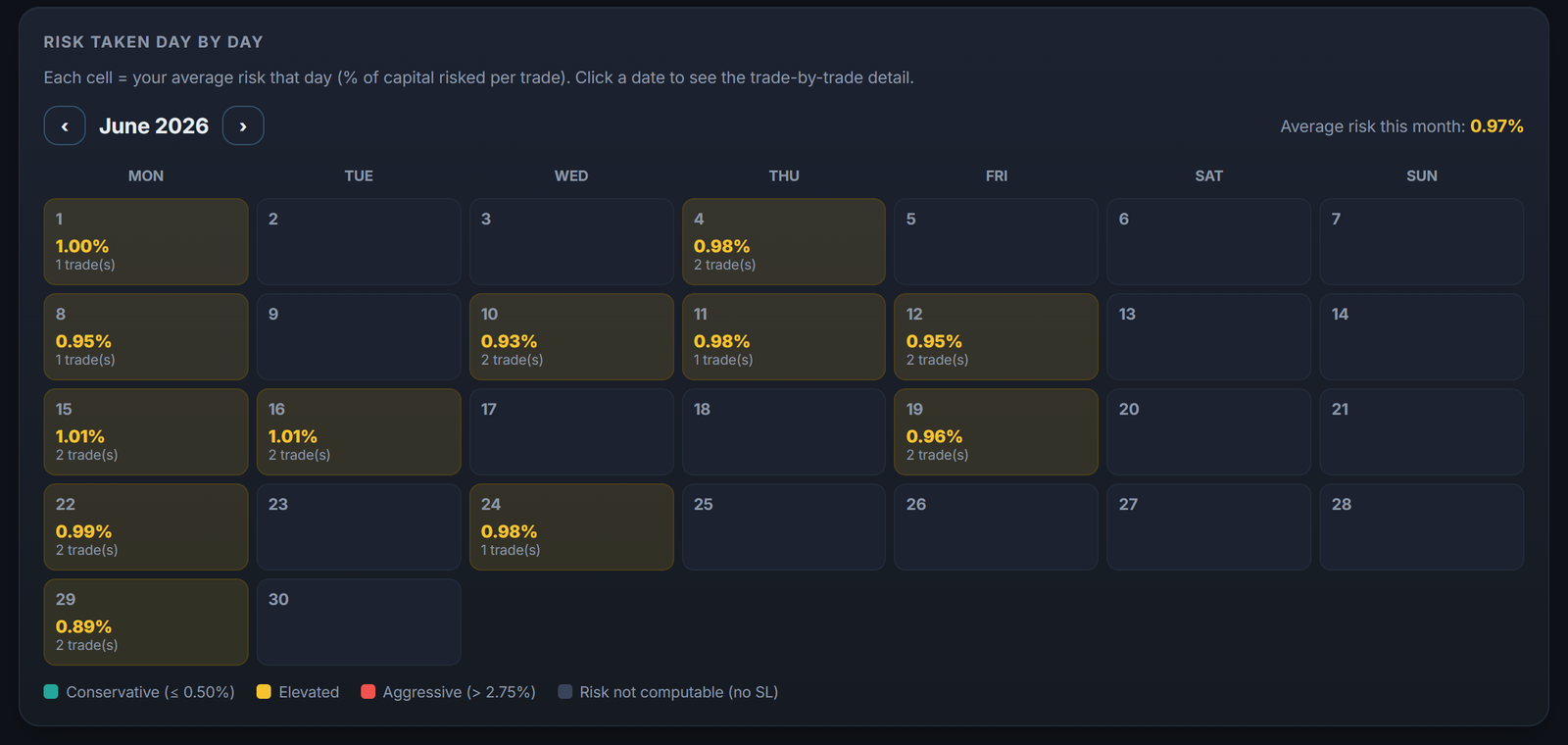
- Risk per trade as a percentage, tracked day by day, tightening on its own after a loss.
- And before the trade, our futures calculator, free and without signing up: tick value, contract count and risk in dollars.
- Per-contract and per-session statistics to know where to focus your trading time.
Frequently asked questions
What's the difference between a broker and a futures trading platform?
The broker is the regulated entity that holds your margin account and clears your trades. The platform is the software you place orders and read the market on. On futures, unlike stocks, these two roles are often handled by two separate entities.
Is NinjaTrader really free?
Yes for advanced charting, backtesting and simulation, according to its website. On a live account, the no-subscription plan is paid for in a higher per-side commission, exchange, clearing and NFA fees come on top, and an inactivity fee applies in a month when you log in without placing a trade.
Do you need a lot of capital to start trading futures?
No, especially since the arrival of micro contracts, which require a fraction of a standard contract's margin. The priority before funding an account remains practicing on a futures demo account.
How do I choose between several futures brokers?
Compare the margin required per contract, round-trip commissions, data feed quality, and confirm the broker actually connects the platform you want before opening an account.
Can you trade futures through a prop firm instead of your own capital?
Yes, prop firms offer futures evaluations, funded once you hit the targets. It reduces your direct financial risk, in exchange for loss rules specific to each firm, and crossing them can end the account.
What does a futures round trip really cost?
Four elements add up: the broker's commission, the fee of the exchange listing the contract, the clearing fee and a regulatory contribution. The spread comes on top without appearing on any statement, since crossing the book costs one tick over the full round trip, handed to your counterparty. A commission quoted 'per side' has to be doubled to get the round trip. Exchange and regulatory fees are passed through by the broker, while commission and the clearing line vary from one broker to another.
What's the difference between intraday and overnight margin?
The exchange sets the margin required to carry a position past the daily close. Many brokers also grant a much lower intraday margin, which they set themselves, valid only if the position is closed before a specific time written into their schedule. Past that time the full margin applies, and if the account doesn't cover it, the broker liquidates at market.
Do you have to pay for market data on futures?
Usually yes as soon as you trade live on real-time data: it's billed by the exchange, not by the broker, who passes it through. The rate depends on your status, retail or professional, and each exchange carries its own subscription line. Some plans include the first level, which you check on the schedule. Delayed data only serves to study a closed chart.