 By Benjamin Roure L'Hermitte
Fintech affiliate programs give publishers, creators, comparison sites, and finance educators a way to earn commissions by referring audiences to financial technology products. The strongest results come from matching the right offer to the right audience, explaining the product responsibly, and tracking what happens after each click. Because finance is a trust-based category, long-term earnings depend as much on credibility and compliance as on commission rates.
How does a fintech affiliate program work?
A fintech affiliate program pays an affiliate when a referred user completes a defined action, such as opening an account, submitting a lead form, funding an investment account, requesting financing, or subscribing to a financial tool. The affiliate promotes the offer with a tracked link, the fintech company or affiliate network attributes the conversion, and payment is made according to the program’s rules.
That sounds simple, but finance affiliate marketing has more moving parts than many consumer categories. A visitor may compare several products, return days later, or convert on another device. For that reason, strong tracking, clear payout terms, and audience-product fit matter more than chasing the highest headline commission.
Common commission models include:
- CPA, or cost per acquisition: You earn when a user becomes an approved customer.
- CPL, or cost per lead: You earn when a user submits a qualified inquiry or application.
- Revenue share: You receive a percentage of revenue generated by the referred customer.
- Recurring commissions: You earn ongoing payments while the customer remains active.
- Tiered incentives: Your rate improves after you reach certain volume or quality benchmarks.
- Hybrid structures: A program may combine a flat bounty with recurring or performance-based bonuses.
Profit starts with audience fit
The most profitable affiliate marketing programs for finance are not always the ones with the largest payout. A budgeting newsletter, for example, may convert better with credit monitoring, banking, or savings products than with advanced trading platforms. A business owner audience may respond more naturally to a financing affiliate program, invoice funding, or credit-building solution.
Before joining a fintech affiliate program, define what your audience is already trying to solve. Are they trying to invest for the first time, compare financial services, get business funding, monitor credit, send money internationally, or reduce fees? The closer the offer is to that intent, the easier it is to create helpful content that converts without feeling forced.
Think in terms of niches rather than broad categories:
- Beginner investing: investing affiliate programs, robo-advisors, brokerage platforms, investing education tools.
- Active traders: investment affiliate programs, market research tools, charting software, crypto exchanges.
- Personal finance: budgeting apps, credit monitoring, savings accounts, debt tools, tax software.
- Small business finance: business banking, payment processors, lending marketplaces, invoice financing.
- International money: remittance apps, multi-currency accounts, travel cards, cross-border business tools.
This approach also protects your reputation. Promoting affiliate marketing financial services to the wrong audience can lead to low conversion rates, refund issues, unsubscribes, and loss of trust.
What makes a fintech offer worth promoting?
A fintech offer is worth promoting when it solves a real reader problem, has transparent terms, offers reliable tracking, and comes from a brand your audience can reasonably trust. The commission matters, but it should be evaluated alongside approval rules, cookie window, payout schedule, compliance support, and the quality of the user experience after the click.
When comparing financial services affiliate programs, look beyond the landing page. Read the affiliate terms, check whether conversions require approval or funding, and understand what can disqualify a lead. A high payout is less attractive if only a tiny share of referrals qualify.
Use this selection checklist before applying:
- Niche fit: Does the product match a problem your audience actively has?
- User trust: Is the brand clear about fees, risks, eligibility, and support?
- Commission structure: Is the payout one-time, recurring, revenue share, or lead-based?
- Cookie duration: Is there enough time for a user to research and return?
- Conversion requirements: Does the user need to register, deposit, get approved, or remain active?
- Tracking quality: Are dashboards, custom links, sub-IDs, and reporting available?
- Creative support: Does the program provide compliant copy, banners, widgets, or product data?
- Compliance rules: Are disclosure requirements, claim restrictions, and promotion limits clearly explained?
- Payout reliability: Are payment thresholds, timing, and reversal policies transparent?
- Long-term value: Can you build multiple useful articles or campaigns around the product?
The best financial affiliate programs usually make these details easy to understand. If a program hides important terms or makes tracking difficult, that is a signal to proceed carefully.
Program types across the fintech landscape
Affiliate marketing for financial products covers a wide range of offers, and each behaves differently. Some convert quickly because the user action is simple. Others take longer because people need time to compare terms, understand risks, or complete an application.
Investing affiliate programs often work well for creators who publish educational content, platform comparisons, beginner guides, or portfolio tool reviews. These programs may pay when a user opens an account, funds it, or meets other activity requirements. Because investing decisions carry risk, content should explain suitability, fees, and limitations rather than making exaggerated earnings claims.
Credit monitoring and personal finance tools can fit audiences looking for practical, everyday financial improvement. These offers often pair well with guides about building credit, organizing money, or preparing for major purchases. The key is to avoid implying guaranteed credit outcomes.
Business financing and lending-related offers can produce strong payouts because customer value is high, but they also require extra care. Eligibility, rates, approval, and funding timelines can vary widely. If you promote a financing affiliate program, focus on who the product may serve, what information users should compare, and why reading terms matters.
Banking, payments, and money transfer products often fit comparison content. Readers want to know about fees, access, speed, limits, and convenience. If your audience includes freelancers, travelers, ecommerce sellers, or international families, these categories can provide natural angles for helpful content.
Content strategies that convert without losing trust
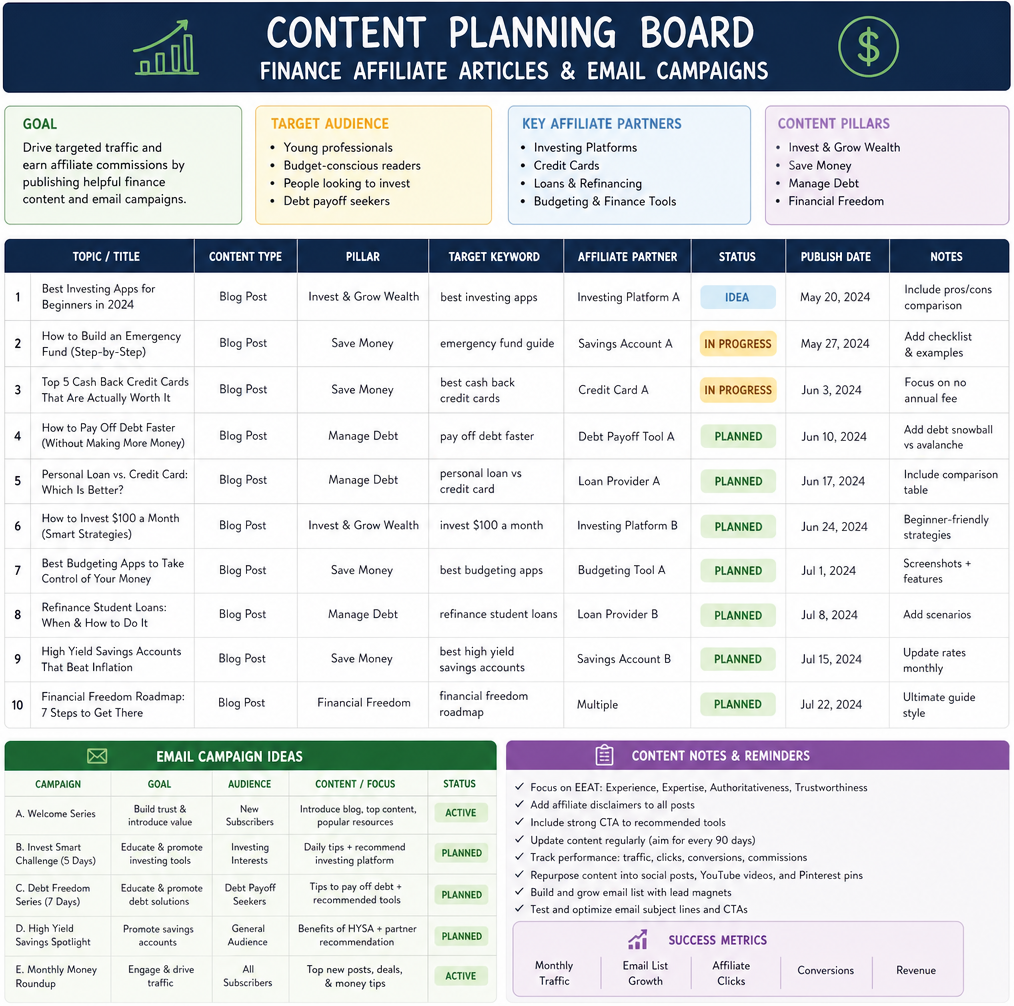
Strong finance affiliate marketing starts with useful content. Readers do not want a sales pitch disguised as advice. They want context, trade-offs, and help making a better decision.
Create content around real decision moments:
- Comparison articles: Help readers choose between product categories or use cases.
- Product reviews: Explain who a product is for, what it does well, and what to check before signing up.
- Beginner guides: Teach the concept first, then introduce relevant tools naturally.
- Calculators and checklists: Give users a reason to engage before clicking.
- Email sequences: Follow up with educational context, not repeated hard sells.
- Case-based content: Show scenarios such as “new investor,” “freelancer,” or “small business owner,” without inventing performance claims.
For example, instead of writing “Best app to start investing,” a stronger article might explain how new investors can compare account minimums, fees, educational resources, asset options, and risk disclosures. Then you can introduce investment affiliate programs that fit those criteria. This feels more useful, ranks for intent-rich searches, and builds confidence before the reader clicks.
Compliance is part of the revenue strategy
Compliance is not just a legal box to tick. In affiliate marketing financial services, it is part of the reader experience and a major factor in whether brands want to keep working with you. Clear disclosures, balanced claims, and accurate descriptions help protect both your audience and your affiliate relationships.
At minimum, affiliates should clearly disclose when they may earn compensation from links. Disclosures should be easy to notice, written in plain language, and placed where readers can see them before acting on a recommendation. Avoid hiding disclosures in a footer or using vague language that a normal reader would miss.
Also be careful with claims. Do not promise approval, returns, savings, credit score improvements, or funding speed unless the advertiser explicitly allows the claim and you can support it. For investing content, avoid language that suggests guaranteed profits or risk-free outcomes. For lending content, remind readers that terms and eligibility can vary.
A practical compliance habit is to build a review checklist for every article:
- Does the page include a visible affiliate disclosure?
- Are product claims accurate and current?
- Are risks, limitations, fees, or eligibility factors mentioned where relevant?
- Are recommendations framed as educational, not guaranteed advice?
- Are screenshots, rates, and promotional details checked before publishing?
- Does the content follow the advertiser’s brand and compliance guidelines?
Tracking turns traffic into better decisions
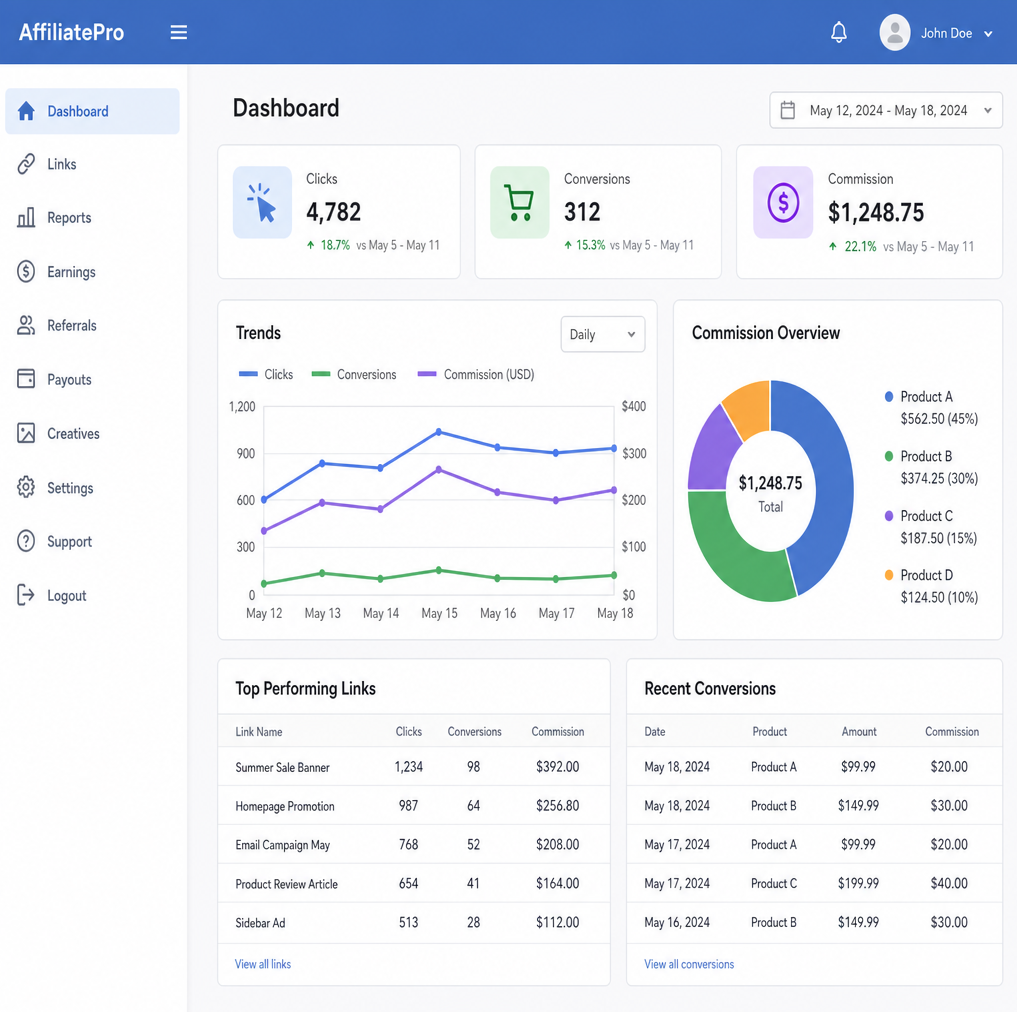
Without tracking, you are guessing. Good reporting helps you see which pages, placements, audiences, and messages actually produce revenue. This is especially important in affiliate marketing programs for finance because a click may not equal a qualified conversion.
Use custom tracking IDs for different pages, buttons, email campaigns, and traffic sources. If your affiliate platform supports sub-IDs, create a consistent naming system so you can compare performance later. A product review, sidebar link, newsletter mention, and comparison widget should not all look the same in your reporting.
Watch these performance signals:
- Click-through rate: Are readers interested enough to visit the offer?
- Conversion rate: Does the traffic match the advertiser’s qualification rules?
- Earnings per click: Which placements produce the most revenue per visitor?
- Reversal rate: Are leads or sales being rejected after initial tracking?
- Time to conversion: Do users need more education before taking action?
- Content path: Which articles introduce the topic and which close the decision?
Optimization often comes from small changes. A clearer comparison section, stronger call-to-action, better disclosure placement, or more specific audience framing can improve results without increasing traffic.
Build a portfolio instead of relying on one offer
Relying on one fintech affiliate program is risky. Commission rates, eligibility rules, tracking platforms, and advertiser priorities can change. A healthier approach is to build a portfolio of offers that serve related audience needs.
For a personal finance site, that might mean combining budgeting apps, credit monitoring, savings tools, and beginner investing affiliate programs. For a small business audience, it may include business banking, payment tools, lending marketplaces, accounting software, and a financing affiliate program. The goal is not to promote everything. It is to create a thoughtful ecosystem of financial services affiliate programs that match your editorial focus.
Diversification also gives you more content options. You can guide readers through a journey, from learning the basics to comparing tools to choosing a next step. That creates more opportunities to earn while keeping the content genuinely useful.
Key takeaways for sustainable fintech affiliate earnings
Maximizing earnings with fintech affiliate programs is not about adding more links. It is about earning trust, matching offers to intent, and improving decisions with data.
Keep these priorities in mind:
- Choose offers based on audience fit, not headline commission alone.
- Explain financial products clearly, including limitations and risk factors.
- Use visible disclosures and follow advertiser compliance rules.
- Track links by page, placement, campaign, and audience segment.
- Compare earnings per click, not just total commission.
- Diversify across relevant categories so one program change does not erase your income.
- Update finance content regularly because terms, offers, and product details can change.
The affiliates who last in this space act less like traffic brokers and more like trusted guides. When your content helps readers make informed choices, affiliate revenue becomes a byproduct of real value rather than a short-term conversion tactic.