
You've typed 'ict concepts books' into Google for the tenth time this week and landed on sketchy PDFs, forty dollar ebooks, and Twitter threads that assume you already know the vocabulary. Fair enough. Because the official book you're picturing doesn't exist. Something else does, and you need to understand what before you pull out your card.
- No official book has ever been published by ICT (Michael J. Huddleston) through a traditional publisher.
- Unofficial compilations exist, built by independent traders who transcribed his videos and mentorships.
- The core vocabulary (Order Blocks, FVGs, liquidity, kill zones) is documented for free on YouTube and in community glossaries.
- The real danger isn't missing a book, it's mistaking a pile of jargon for an actually profitable trading method.
Who ICT is, and why everyone's hunting for a book
ICT stands for Inner Circle Trader. Behind that handle is Michael J. Huddleston, a former institutional trader who started posting YouTube videos back in 2014 to explain, in his framing, how banks and large funds actually move price. The guy is polarizing. Some traders see him as the person who best popularized an institutional read of price action. Others think he's selling a dream wrapped in proprietary vocabulary for concepts that already existed elsewhere under different names.
What's undeniable is the size of his following. Hundreds of thousands of traders, often young, mostly self-taught, spending hours on videos that each run for hours themselves. And that's exactly the problem. Who has time to watch four hundred hours of content to extract one coherent method? That's where this near obsessive search for a book comes from, a PDF, a summary that could compress everything into two hundred pages you could read on a lazy Sunday.
Here's the thing though. That search starts from a false premise. You're not really looking for a book. You're looking for a shortcut. And in trading, shortcuts get expensive fast, especially when they're dressing up a method that's already demanding to understand properly.
Does an official ICT book actually exist?
No. Let's say it plainly because this is confusion number one circulating on forums and Discord servers: Michael Huddleston has never published a book in the traditional sense, through a publisher, with an ISBN and shelf space in a bookstore. No title signed 'ICT' exists on Amazon, aside from occasional fakes or unauthorized compilations riding on his name to sell content he never personally approved.
His teaching was built almost entirely through three channels: YouTube, where he's posted hundreds of videos over the past decade; a paid mentorship he ran for several years with small private groups; and Twitter, now X, where he commented on live trades and dropped technical vocabulary in short bursts for years. In 2022 and 2023 he released the entire mentorship for free on YouTube, which the community widely treated as the closest thing to an 'official' resource, even though it's still not a book by any definition.
So why does the impression of a hidden official book persist? Because independent traders, often longtime students, took it upon themselves to transcribe everything into writing. Some did it carefully, with diagrams and real pedagogical structure. Others just pasted auto generated video subtitles into a Word document and sold it for thirty dollars on a homemade website. The two categories look similar from the outside. Their actual value couldn't be further apart.
The ICT concepts any serious written guide has to cover
Before you judge an ebook or a compilation, you need to know what it should minimally contain to be taken seriously. The ICT method rests on a fairly specific vocabulary, sometimes overlapping with other schools of price analysis, but organized around one core idea: price gets pushed around by large players hunting liquidity before the real directional move even starts.
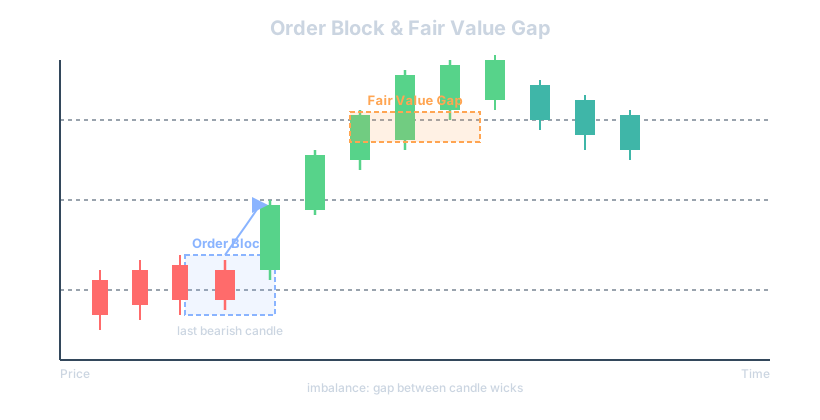
- Order Blocks, the last opposing candle before an impulsive move, supposedly marking where institutions placed their orders.
- Fair Value Gap (FVG), a visible imbalance across three candles, a gap in price that the market tends to revisit and fill.
- Liquidity, the pools where retail stop orders sit, just above obvious highs and below obvious lows.
- Market Structure, reading trend direction through breaks of structure (BOS) and changes of character (CHoCH).
- Kill Zones, specific time windows (London open, New York open) where directional movement is supposedly more likely.
- PD Arrays, premium and discount arrays, a grid of zones showing whether price sits 'expensive' or 'cheap' relative to a given range.
- Optimal Trade Entry (OTE), a precise retracement zone, usually between 62 and 79 percent, where ICT recommends looking for entries.
A guide covering only three or four of these ideas, with no logical thread connecting them, isn't a real compilation. It's a patchwork. And unfortunately a good chunk of the ebooks sold online fall exactly into that bucket: vocabulary thrown together with no structure, no real chart examples, no warning about the method's actual limitations. If you're serious about the smart money framework rather than just the jargon, spending time on the ICT and smart money concepts primer will get you further than most paid ebooks.
The best unofficial ebooks and guides: how to actually judge one
Since the official book doesn't exist, the real question becomes: how do you spot a compilation worth reading among the mountain of PDFs floating around? There are a few simple criteria, almost obvious ones, that ninety percent of impulsive buyers forget to check before paying anything.
First move: check who actually wrote the thing. An identifiable author, with a public track record (an active YouTube channel, an X account running for years, real user feedback), earns more trust than an anonymous site that popped up last month. Second move: look for real, dated chart examples with explanations that go beyond a textbook definition. A good guide shows you why an Order Block worked here and failed there, not just its theoretical definition rephrased ten different ways.
Third point, a subtler one: be suspicious of any document promising a 'complete, validated method' in forty pages. The ICT method, in its original videos, sprawls across dozens of hours because the author keeps qualifying his own statements, revisiting his own examples, sometimes contradicting what he said two years earlier. An honest summary owns that complexity instead of erasing it to sell you a ten minute read dressed up as mastery.
| Resource type | General reliability | Typical price |
|---|---|---|
| Original ICT YouTube videos | High (primary source) | Free |
| Ebook compiled by an identifiable, serious student | Moderate to good | 0 to 50 dollars |
| Anonymous PDF sold on social media | Low, often copied | 20 to 100 dollars |
| Collaborative community glossary (Notion, wiki) | Good for vocabulary, not strategy | Free |
Learning through the YouTube videos and the 2022/2023 mentorship
If you're serious about this, the best resource remains, by a wide margin, the original videos. Especially the mentorship ICT released for free in 2022 and completed in 2023, a long series covering the essential framework from basic to advanced, with dozens of live charted examples.
The advantage of video over an ebook is context. A concept like the London kill zone only makes sense once you see how ICT reacts live to a market that isn't doing what he expected. A book freezes the theory. A video shows the hesitation, the mistake, the correction happening in real time. That's exactly what's missing from ninety five percent of unofficial ebooks: they present the method as some infallible algorithm, when in practice it's a reading framework leaving enormous room for subjective interpretation.
The downside, obviously, is time. Nobody wants to burn three hundred hours of their life learning one trading method. The realistic compromise is this: use a glossary or a written guide to quickly grasp the vocabulary and general structure, then go watch the original videos only for the concepts you actually plan to use. You don't need to master all of it perfectly. A trader who deeply understands three or four ICT concepts and applies them with discipline will always outperform someone who can recite fifteen without truly understanding any of them.
The risks of pirated or low quality PDFs sold online
Let's be honest here because it's a real issue inside the ICT community: a good chunk of the 'books' sold online are actually unauthorized transcriptions of free content, resold to beginners who have no idea the original source is available for zero dollars. That's ethically questionable, and it's mostly just a bad deal for the buyer.
In practice these documents get thrown together fast: auto generated subtitles pasted end to end, sloppy formatting, zero cross checking between chapters. You end up with a paragraph that contradicts the video three pages later, and nobody ever caught it. Since these products are usually sold through short lived websites, good luck asking for a refund once you realize the content is worthless.
There's a subtler risk too. Some sellers add their own flawed interpretation of ICT concepts to 'simplify' things, and that distortion then spreads across social media as if it came straight from the source. You end up learning a watered down, sometimes wrong, version of the method while believing you're learning the original. That's exactly how something like the Silver Bullet, a specific time window for fast entries, gets butchered in amateur guides into a mechanical rule stripped of the market structure context that actually justifies it.
Alternatives and complementary resources to structure your learning
Outside of videos and ebooks, other formats can genuinely help. Collaborative glossaries, often hosted on Notion or shared as community wikis, let you look up a term in thirty seconds instead of scrubbing through a two hour video. YouTube channels run by longtime ICT students, distinct from ICT himself, often break down single concepts in short, focused videos, which is far more digestible for a beginner than the original marathon sessions.
None of that replaces structured practice though. Reading about an Order Block teaches you nothing if you never sit down and mark twenty of them on a real chart, then check what price actually did afterward. This is where a lot of ICT learners go wrong: they accumulate vocabulary for months without ever testing whether the concept produces an edge for them specifically, in the markets and timeframes they actually trade. Reading is passive. Trading is not.
A practical way to bridge that gap is treating every session as a mini experiment. Tag your setups with the specific concept you used to justify the entry, whether that's an FVG fill or a liquidity sweep, and review those trades honestly a week later. That kind of feedback loop teaches you more in a month than three more ebooks ever will, and it's also the fastest way to notice if you're leaning too heavily on one idea, something the discussion in this piece on spotting your own trading patterns covers well beyond just ICT vocabulary.
Structuring your ICT learning without an official book
Given there's no single authoritative text, you basically have to build your own curriculum. Start with market structure. It's the backbone everything else hangs on: you can't place an Order Block or read a liquidity sweep with any confidence if you can't first tell a break of structure from a change of character. Get that foundation solid before touching kill zones or PD Arrays, which are refinements, not starting points.
From there, pick two or three concepts you'll actually commit to testing, not fifteen. Say you choose Fair Value Gaps and liquidity sweeps. Spend a month doing nothing but marking those two on historical charts, then forward testing them on a demo or small live account. Write down every single trade, what concept triggered the entry, what your emotional state was going in, and whether you actually followed your own plan or improvised halfway through. That last part matters more than most traders admit. A concept can be theoretically sound and still lose you money if you keep abandoning your rules the moment price wobbles, which is exactly the trap described in this breakdown of the revenge trading spiral.
One more thing worth saying bluntly: ICT concepts don't remove the need for basic risk management. You can nail a perfect Order Block entry and still blow up your account if you're sizing positions carelessly or ignoring your daily loss limit. The method gives you an entry framework, not a substitute for the boring, unglamorous discipline of protecting your capital, which is covered in far more practical depth in this guide to fixed versus dynamic risk than in any ICT ebook you'll find online.
Smart Money Concepts (SMC) versus ICT: what's actually different
This confusion comes up constantly, so let's clear it up. Smart Money Concepts, usually shortened to SMC, is the broader umbrella term that emerged from ICT's teaching but got adopted, renamed, and slightly reshuffled by a wave of other educators and YouTube channels. Most SMC content you'll find today uses near identical vocabulary: Order Blocks, liquidity grabs, structure breaks. The core ideas trace back to ICT, whether the creator credits him or not.
The practical difference tends to be presentation rather than substance. ICT's original material is dense, repetitive, occasionally self contradicting across years of videos, and heavy on esoteric side commentary. SMC content, especially from newer creators, is usually cleaner, more visually polished, and often stripped of the more controversial or speculative elements ICT sometimes weaves in. Some traders find SMC easier to digest for exactly that reason. Others argue it loses nuance in the simplification, turning a flexible reading framework into a rigid checklist that doesn't hold up when the market refuses to cooperate.
Bottom line: if you see a book or ebook labeled 'SMC' instead of 'ICT', you're looking at the same family of concepts filtered through a different teacher's interpretation. Neither label guarantees quality. What matters is whether the material explains the why behind each concept, not just the what.
How Tradoshi helps you
Reading about Order Blocks and Fair Value Gaps is one thing. Knowing whether they actually work for you, on your pairs, at your timeframes, is another problem entirely, and that's where a trading journal earns its keep. Tradoshi lets you log every trade through automatic broker import from MT5, MT4, cTrader, or crypto exchanges, plus manual entry and CSV import, so you're not stuck guessing whether a concept helped or hurt your results.
Once trades are logged, you can attach your own free labels to each one, things like 'FVG fill' or 'liquidity sweep', and pair that with an emotional check-in before the trade and a note on whether you actually followed your plan. Over time the statistics, win rate, profit factor, expectancy, average win/loss ratio, and the overall Oshi Score, show you honestly whether a given ICT concept is contributing to your edge or just adding noise and confidence you haven't earned yet. Trade Review lets you replay a setup, add your notes, and check plan adherence, which is a far more reliable teacher than any ebook. And since none of this replaces sound position sizing, the built-in risk tools, percent of capital per trade, position size calculator, customizable risk rules, keep the concepts you're testing from ever costing more than they should.
The honest verdict on ICT concepts books
If you came here hoping someone would hand you a title to buy on Amazon, sorry, that book doesn't exist and probably never will given how ICT has always distributed his teaching. What does exist is a scattered but learnable body of knowledge: free videos, a handful of decent unofficial compilations, and a lot of noise you need to filter through with a skeptical eye.
The traders who actually get value out of ICT concepts aren't the ones who bought the fanciest looking PDF. They're the ones who picked two or three ideas, tested them relentlessly, kept notes on what worked, and threw out what didn't. That's not a glamorous answer, but it's the honest one, and it applies to pretty much every trading method you'll ever study, not just this one.
Frequently asked questions
Is there an official ICT book I can buy?
No. Michael J. Huddleston has never published an official book through a traditional publisher. Anything labeled that way online is an unofficial, third-party compilation.
Where does ICT's teaching actually come from?
Mainly YouTube videos posted over the past decade, a paid mentorship later released for free in 2022 and 2023, and older Twitter/X threads.
Are unofficial ICT ebooks worth buying?
Some are, if the author is identifiable and the content includes real chart examples and nuance. Many others are low-quality transcriptions not worth the price.
What's the fastest way to learn ICT concepts without watching hundreds of hours of video?
Use a glossary or written guide to grasp vocabulary quickly, then watch original videos only for the two or three concepts you actually plan to trade.
What are the most important ICT concepts to learn first?
Market structure first, since it underlies everything else, followed by liquidity and Order Blocks before moving on to kill zones or PD Arrays.
Is Smart Money Concepts (SMC) the same as ICT?
SMC uses largely the same vocabulary and ideas that trace back to ICT, usually presented in a cleaner, more simplified format by other educators.
Are pirated ICT PDFs dangerous to use?
They're often low quality, inconsistent, and sometimes distort the original concepts, which can teach you a flawed version of the method without you realizing it.
Can I learn ICT concepts for free?
Yes. The original YouTube videos and the 2022/2023 mentorship release are free and remain the most reliable primary source.
Does knowing ICT concepts guarantee profitable trading?
No. The concepts offer a framework for reading price, but results still depend on risk management, discipline, and consistent execution.
What's the best way to test if an ICT concept actually works for me?
Log trades where you used that specific concept, tag them clearly, and review the statistics after enough sample size instead of trusting the theory blindly.