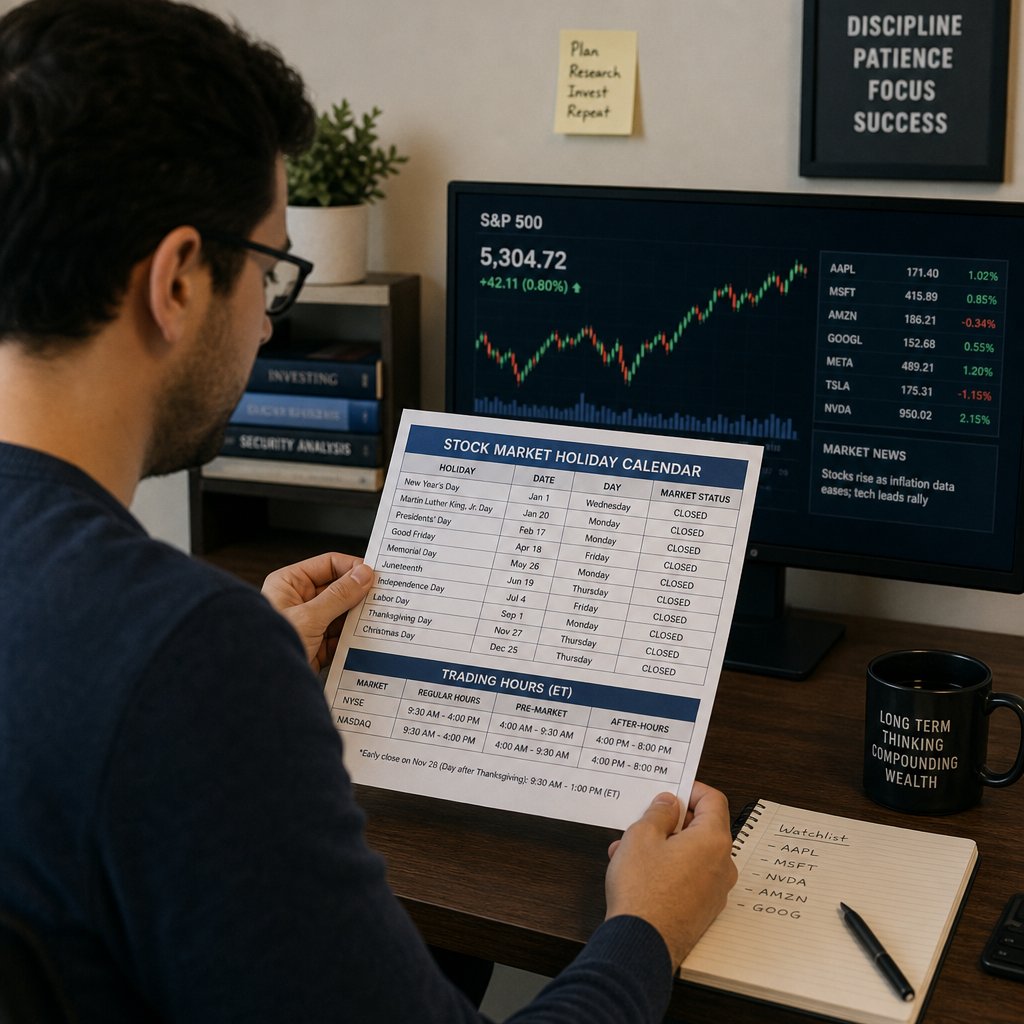
Year-end is getting closer, with its shortened sessions: it is a good time to reset your watchlist, and your calendar too. For U.S. investors, the question is not only where indexes may go next, but when markets are actually open, when holiday sessions end early, and how longer trading windows could change execution habits.
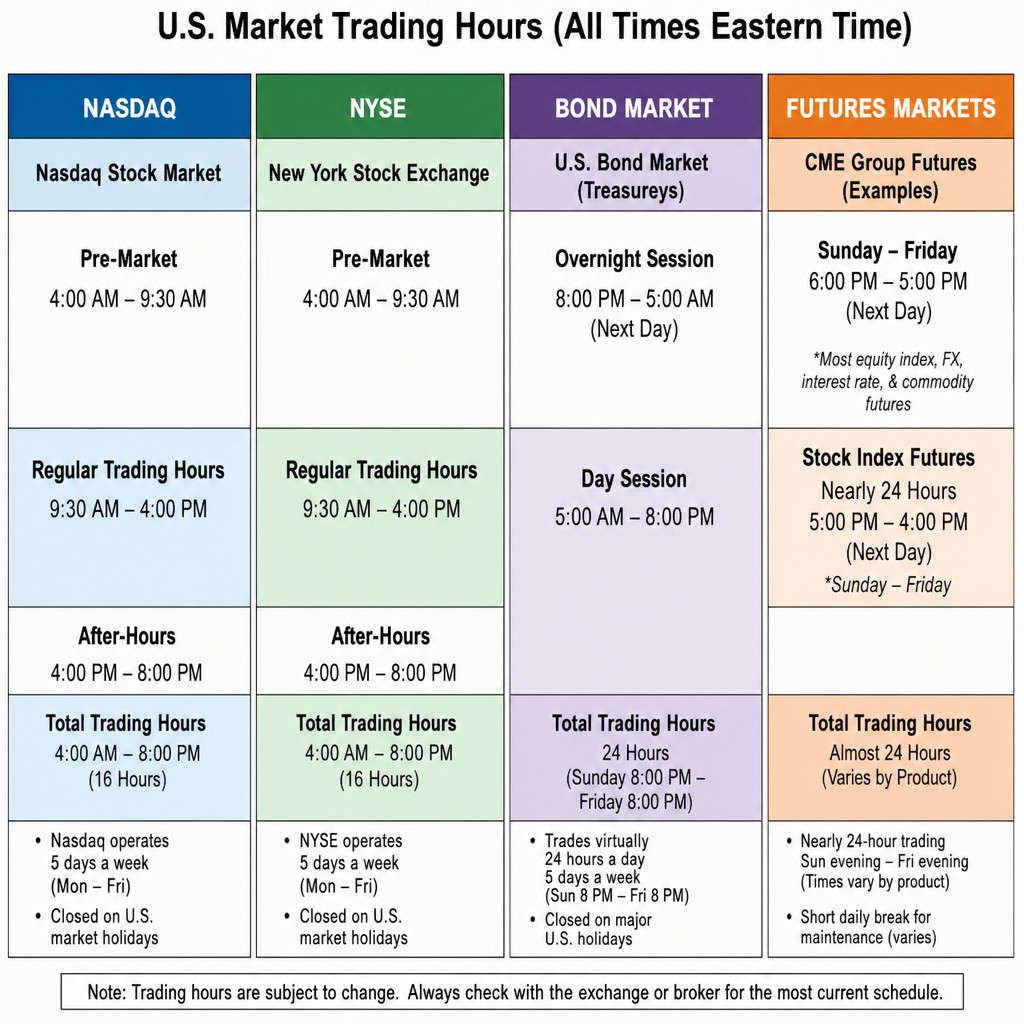
- Regular session: Nasdaq and NYSE trade from 9:30 a.m. to 4:00 p.m. ET, Monday through Friday.
- Extended hours: Nasdaq pre-market runs from 4:00 a.m. to 9:30 a.m. ET, after-hours from 4:00 p.m. to 8:00 p.m. ET.
- Early closes in 2026: 1:00 p.m. ET on Friday, November 27 and on Thursday, December 24.
- What changes next: Nasdaq plans a night session from 9:00 p.m. to 4:00 a.m. ET starting December 6, 2026, for 23 hours of trading a day.
What time does the stock market open?
For most U.S.-listed stocks, the market opens at 9:30 a.m. ET, Monday through Friday, unless the day is a market holiday. The Nasdaq and NYSE core sessions both run from 9:30 a.m. to 4:00 p.m. ET, which is the window most investors mean when they talk about the market open or the market close. Nasdaq also lists pre-market trading from 4:00 a.m. to 9:30 a.m. ET and after-hours trading from 4:00 p.m. to 8:00 p.m. ET, though access, order types and execution quality depend on your broker, as the Nasdaq trading hours page points out.
That distinction matters because "the market is open" can mean different things. A long-term investor placing a mutual fund or ETF order may care mainly about the regular closing price. An active trader may be watching pre-market quotes before the opening auction. Someone outside the U.S. has to convert Eastern Time to a local time zone before placing an order.
The practical takeaway is simple: plan around the regular session first, then treat pre-market and after-hours activity as a separate environment. Extended sessions offer flexibility, but Nasdaq warns that volatility tends to be much higher there, with less liquidity, meaning fewer people trading and prices that can move more sharply.
Stock market holidays 2026: the full calendar
Holiday confusion is one of the easiest ways to miss a trade, misread a quote, or assume an order should have filled when the market was closed. U.S. exchanges do not follow every bank holiday, and bonds, futures and stocks do not always share the same schedule.
| Holiday | Date in 2026 | U.S. stock market |
|---|---|---|
| New Year's Day | Thursday, January 1 | Closed |
| Martin Luther King Jr. Day | Monday, January 19 | Closed |
| Presidents Day (Washington's Birthday) | Monday, February 16 | Closed |
| Good Friday | Friday, April 3 | Closed |
| Memorial Day | Monday, May 25 | Closed |
| Juneteenth | Friday, June 19 | Closed |
| Independence Day (observed) | Friday, July 3 | Closed |
| Labor Day | Monday, September 7 | Closed |
| Thanksgiving Day | Thursday, November 26 | Closed |
| Day after Thanksgiving | Friday, November 27 | Early close, 1:00 p.m. ET |
| Christmas Eve | Thursday, December 24 | Early close, 1:00 p.m. ET |
| Christmas Day | Friday, December 25 | Closed |
These NYSE holidays are the same on the Nasdaq holiday schedule. Independence Day is the only holiday actually moved in 2026: July 4 falls on a Saturday, so the market closes on Friday, July 3.
Federal holidays when the stock market stays open
Not every federal holiday closes Wall Street. On two of them, the Federal Reserve is closed and SIFMA recommends closing the bond market, but stocks trade a normal session.
| Federal holiday | Date in 2026 | Stocks (Nasdaq, NYSE) | Bonds (SIFMA) |
|---|---|---|---|
| Columbus Day | Monday, October 12 | Normal session | Close recommended |
| Veterans Day | Wednesday, November 11 | Normal session | Close recommended |
Key dates to mark before year-end
- Friday, November 27, 2026: U.S. equity markets close early at 1:00 p.m. ET, the day after Thanksgiving.
- Thursday, December 24, 2026: Christmas Eve is an early-close day for U.S. equities, ending at 1:00 p.m. ET.
- Friday, December 25, 2026: Christmas Day is a full stock market holiday.
- Thursday, December 31, 2026: a normal day for U.S. stocks, but SIFMA recommends a 2:00 p.m. ET early close for U.S. bond markets ahead of New Year's Day.
- Friday, January 1, 2027: U.S. equity markets are closed for New Year's Day.
What time does the stock market close on Christmas Eve?
In 2026, the stock market closes at 1:00 p.m. ET on Christmas Eve, Thursday, December 24, on both Nasdaq and NYSE. Both exchanges list the same early equity close for that date.
Early closes deserve more respect than many traders give them. The session is shorter, desks may be lightly staffed, and participation can fade as the day goes on. That does not mean prices cannot move: thin liquidity can make a modest order or a news item feel larger than it would on a normal day.
If you need to rebalance, harvest tax losses, make a charitable stock transfer or close a position before the holiday, avoid waiting until the final minutes of an early session. A 1:00 p.m. ET close arrives quickly, and order handling can become less forgiving when volume is light.
Nasdaq and NYSE trading hours remain the baseline
The regular U.S. cash-equity session has not changed: 9:30 a.m. to 4:00 p.m. ET, on both Nasdaq and the New York Stock Exchange. Nasdaq separately lists extended hours from 4:00 a.m. to 9:30 a.m. and from 4:00 p.m. to 8:00 p.m. ET, while NYSE lists early and late sessions for some of its markets, such as NYSE Arca, outside the core session.
| Market or session | Typical schedule | Planning note |
|---|---|---|
| Nasdaq regular session | 9:30 a.m. to 4:00 p.m. ET | Main liquidity window for most investors. |
| Nasdaq extended hours | 4:00 a.m. to 9:30 a.m. and 4:00 p.m. to 8:00 p.m. ET | Useful for news-driven moves, but liquidity is lower and volatility higher. |
| NYSE core session | 9:30 a.m. to 4:00 p.m. ET | Standard reference for the U.S. equity open and close. |
| U.S. fixed income | Holiday recommendations vary | SIFMA recommends 2:00 p.m. ET early closes on December 24 and December 31, 2026. |
| Equity index futures | Nearly around the clock on CME Globex | Schedules are product-specific; check holiday hours before each shortened week. |
The table also explains why a single search for "trading hours" can produce mixed answers. Stocks, options, bonds and futures are different markets with different operating rules. A stock trader asking when the market opens usually means the equity cash session. A futures trader may be asking about Sunday evening access on Globex.
Futures and bonds follow their own clock
Overnight price discovery keeps gaining weight. Equity index futures tied to the major U.S. benchmarks trade outside the cash stock session, which is why futures hours become a focal point before the first stock-market bell after a holiday. On CME Globex, Micro E-mini equity index futures trade from Sunday to Friday, 6:00 p.m. to 5:00 p.m. ET, with a daily maintenance break from 5:00 p.m. to 6:00 p.m. ET (CME Group contract specifications). Holiday schedules differ, so check them before acting.
This matters around New Year's Day, when global markets can react while U.S. cash equities are closed. Futures can move overnight, but that does not guarantee the stock market will open at the level they imply. Liquidity, holiday staffing, economic releases, overseas markets and currency moves all shape the gap between futures pricing and the next cash open.
Bonds add another wrinkle. The SIFMA holiday schedule is a set of recommendations, not mandatory exchange rules, and each firm decides whether its fixed income desk stays open. For December 24 and December 31, 2026, SIFMA recommends 2:00 p.m. ET early closes for U.S. bond markets, while stocks close at 1:00 p.m. ET on Christmas Eve and trade a full session on New Year's Eve.
Longer trading windows: Nasdaq's 23-hour day
The biggest structural change heading into year-end is the move toward longer stock trading days. On April 10, 2026, the SEC issued an order granting accelerated approval of Nasdaq's proposal to extend its trading hours to 23 hours a day, five days a week. Nasdaq then published an Equity Trader Alert announcing the new hours for December 6, 2026, with a new session from 9:00 p.m. to 4:00 a.m. ET.
That does not reduce the weight of the regular session. According to the Nasdaq FAQ, the 9:30 a.m. to 4:00 p.m. ET session, with its Opening and Closing Crosses, will keep setting the reference prices across all operating hours. The 23-hour model adds a night session, a daily pause from 8:00 p.m. to 9:00 p.m. ET, and a trading week that starts on Sunday evening and ends on Friday evening. Nasdaq still describes the launch date as expected, pending the readiness of the consolidated data feed (the SIP) and any applicable SEC rule changes.
When does trading open under the 23-hour model?
Under the announced schedule, the first night session opens at 9:00 p.m. ET on Sunday, December 6, 2026, and runs until 4:00 a.m. ET. Trading then continues through the existing 4:00 a.m. to 8:00 p.m. window, followed by the one-hour pause. In other words, "when does trading open" will soon need a follow-up question: regular session, pre-market, after-hours, or night session?
Two details are worth knowing before trading at night. Trades executed between 9:00 p.m. and midnight ET carry the next trading day's trade date, and settlement follows that trade date as it does today. Overnight, orders priced outside static bands of 20% around the reference price are rejected, a protection that comes from an amendment to the market-wide limit up-limit down plan.
Longer hours can help investors react to overseas news, earnings or currency shocks without waiting for the next U.S. morning. They do not automatically mean better execution: overnight order books can be thin. For retail investors, the safer mindset is to treat night trading as a specialized tool rather than a default habit. Limit orders, position sizing and a clear reason to trade matter more when fewer participants sit on the other side of the order.
Liquidity, volatility and order discipline around holidays
Shortened sessions and extended sessions share one trait: the market can behave differently when participation is lower. That does not mean avoiding every holiday-week trade. It means adjusting the process. A year-end rebalance is better spread over several regular sessions than forced into the last hour of Christmas Eve, and a breakout seen on a thin pre-market quote deserves confirmation from volume before you act on it.
A simple checklist before placing an order
- The asset class. Stocks, bonds, options and futures do not always share the same calendar.
- The session. Regular hours, pre-market, after-hours, or the coming Nasdaq night session.
- The time zone. U.S. exchange schedules are quoted in Eastern Time.
- The order type. Market orders get riskier when spreads widen; limit orders keep control of the price.
- The trade date. A night-session trade can carry the next trading day's date.
- Your broker's rules. A session open at the exchange is not always open at your broker.
- The next catalyst. Earnings, economic data, Federal Reserve news and overseas moves weigh more when liquidity is thin.
Whether these extra windows actually suit you is something you can measure rather than guess. In a trading journal such as Tradoshi, your results can be broken down by market session (New York, London, Tokyo, or outside the main sessions). If the trades you take outside the New York session or during holiday weeks cost you money, the numbers will show it long before your memory admits it.
The bigger trend is market availability
The old rhythm was easy to remember: U.S. stocks opened at 9:30 a.m., closed at 4:00 p.m., and stayed shut on weekends and major holidays. That rhythm still defines the regular session, but the market around it is changing. Futures already let traders act outside cash hours, brokers offer extended sessions, and Nasdaq's 23-hour model points toward a more global trading day.
For investors, the opportunity is flexibility: more ways to respond to information, manage risk and enter or exit positions outside the traditional window. The risk is overtrading simply because a screen is open.
As year-end approaches, the trend most worth watching may be your own routine. Know the official trading hours, mark the early closes, check the holiday schedules, and decide in advance when you actually want to take part. Markets may be open for longer, but disciplined investors still gain from choosing their moments.
Frequently asked questions
Is the stock market open today?
On a regular weekday, yes: from 9:30 a.m. to 4:00 p.m. ET, Monday through Friday. It is closed on weekends and on the ten 2026 market holidays listed above, and it closes early, at 1:00 p.m. ET, on November 27 and December 24, 2026.
What time does the stock market open?
The U.S. stock market opens at 9:30 a.m. ET and closes at 4:00 p.m. ET, Monday through Friday, on both Nasdaq and NYSE. Nasdaq also runs a pre-market session from 4:00 a.m. ET and an after-hours session until 8:00 p.m. ET.
What time does the stock market close?
At 4:00 p.m. ET on regular days, on both Nasdaq and NYSE. On the early-close days of 2026, November 27 and December 24, it closes at 1:00 p.m. ET. Nasdaq after-hours trading then runs until 8:00 p.m. ET.
What time does the stock market close on Christmas Eve 2026?
At 1:00 p.m. ET on Thursday, December 24, 2026, on both Nasdaq and NYSE. The market is then closed on Friday, December 25.
Is the stock market open on New Year's Eve?
Yes. Thursday, December 31, 2026, is a full trading day for U.S. stocks. SIFMA recommends a 2:00 p.m. ET early close for bond markets that day, and stocks are closed on Friday, January 1, 2027.
What are the stock market holidays in 2026?
New Year's Day (January 1), Martin Luther King Jr. Day (January 19), Presidents Day (February 16), Good Friday (April 3), Memorial Day (May 25), Juneteenth (June 19), Independence Day observed (July 3), Labor Day (September 7), Thanksgiving (November 26) and Christmas (December 25). The market also closes early, at 1:00 p.m. ET, on November 27 and December 24.
Is the stock market open on Columbus Day?
Yes. On Monday, October 12, 2026, Nasdaq and NYSE trade a normal session. The Federal Reserve is closed that day, and SIFMA recommends a full close for U.S. bond markets.
Is the stock market open on Veterans Day?
Yes. On Wednesday, November 11, 2026, stocks trade normally on Nasdaq and NYSE. The Federal Reserve is closed, and SIFMA recommends a full close for U.S. bond markets.
Will Nasdaq trade 23 hours a day?
That is the plan. The SEC approved Nasdaq's proposal on April 10, 2026, and Nasdaq has announced a night session from 9:00 p.m. to 4:00 a.m. ET starting on Sunday, December 6, 2026, pending the readiness of the consolidated data feed. A one-hour pause will run from 8:00 p.m. to 9:00 p.m. ET.