
You open a position, close it twenty minutes later, open another, and by 3pm your account looks like a rollercoaster chart. A small voice in your head asks: is intraday trading gambling, or am I actually doing something structured here? Fair question. Let's answer it honestly instead of dodging it.
- Intraday trading is not gambling by nature: it can rest on a tested method, a documented statistical edge, and real risk control.
- It turns into gambling the moment you trade without a plan, without a stop, chasing a rush instead of a measured outcome.
- Most retail day traders lose money, not because the market is rigged like a casino, but because they treat it like one.
- The line is drawn by three things: do you have a documented edge, do you follow your own risk rules, and are decisions made cold or hot?
What is intraday trading, exactly?
Intraday trading means opening and closing a position on the same trading day, on stocks, forex, indices or crypto, without carrying anything overnight. No exposure to a surprise gap the next morning. No position sitting quietly while you sleep. You're in the market's rhythm all session long: in, out, sometimes several times a day, sometimes just once with a strong conviction and a tight stop.
This is different from swing trading, where positions run for days or weeks, and light years away from long-term investing, where the horizon is measured in years. Day trading demands near-constant screen time, fast price reading, and a stomach for noise that can wreck your nerves if you're not prepared for it. If you want to compare the two horizons side by side, the piece on swing trading strategy and method is a useful contrast on time frames alone.
Here's why intraday specifically fuels the gambling debate: speed. On a position held for three weeks, you have time to think between decisions. On a position held for eight minutes, emotion grabs the wheel before logic even wakes up. That's fertile ground for impulsiveness, but the speed itself isn't the actual cause. It just amplifies whatever was already there, good habits or bad ones.
Trading vs gambling: where's the real line?
At a casino, roulette has a negative expected value for the player, built into the wheel by design. No skill, no analysis, no amount of practice changes that over time. Trading doesn't work that way. There's no fixed expectancy baked into the market. Yours depends entirely on your method, your edge, and whether you actually execute it with discipline instead of improvising. That single difference changes everything about the question 'is intraday trading gambling'.
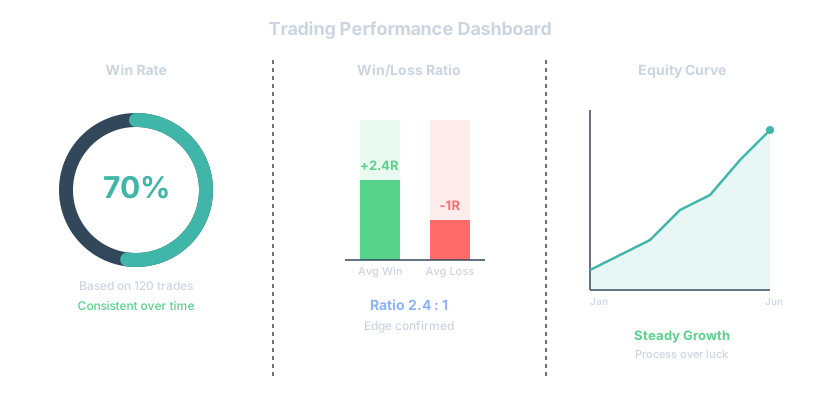
An edge is a repeated statistical advantage: a strategy that, tested over hundreds of trades, shows a win rate and a win/loss ratio which, combined, produce positive expectancy. That guarantees nothing on a single trade. You can lose with the best strategy in the world on any given afternoon, exactly like a casino can lose money to a lucky gambler on a good night. The difference only shows up over a large sample, never on one isolated hand.
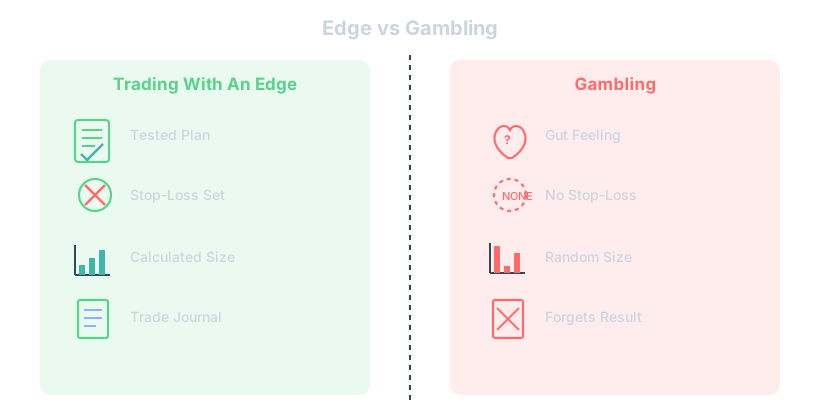
A trader with a documented edge knows, before clicking buy, roughly how much they're risking, what they're aiming for, and what the historical probability of success looks like. A gambler bets on a hunch or a craving. No statistical backup, no framework, nothing to lean on except a feeling. That's exactly why the question never gets settled by the fact that you trade fast, it gets settled by whether there's any structure behind each click.
Why so many retail day traders lose money
It's a well documented pattern in financial research: a large share of individual day traders end up losing money over time, often a crushing majority. Academic work on retail investor behavior, including studies that tracked day traders on equity markets, points to this result again and again. This isn't a rumor, it's structural.
Why? Not because the market is fixed against them, but because most beginners unknowingly copy gambler behavior. They enter without a written plan, double their size after a loss to 'get it back', ignore their stop because 'it'll bounce', and switch strategies every two weeks the moment a bad month hits. None of that qualifies as a method. Those are casino reflexes, just applied to a price chart instead of a felt table.
There's also a brutal selection effect: spreads, commissions and slippage quietly eat away at an already fragile edge. A trader with a slight theoretical advantage can end up net negative once fees are subtracted, simply from trading too much. This is exactly where overtrading meets gambling head on: the more you multiply bets without discernment, the closer you drift, statistically, toward the roulette wheel.
The psychology: where the slide into gambling really happens
Here's an uncomfortable truth. Your brain barely distinguishes between winning a trade and winning at a slot machine. The dopamine circuits fire the same way. That rush, that quick hit of victory, can quietly become the real reason you trade, more than the analysis itself. You stop executing a plan and start chasing a feeling. That's the exact mechanism that pushes a gambler to feed one more coin into the machine.
The clearest warning sign is revenge trading: you just lost, frustration spikes, and you reopen a position immediately, bigger this time, with no valid setup, just to 'get it back'. This behavior is broken down in the article on the revenge trading mechanism, and it perfectly illustrates the tipping point between trading and compulsive play: the decision is no longer driven by analysis, it's driven by raw emotion.
FOMO plays a similar role. You watch a move take off without you, the fear of missing out spikes, and you jump on a moving train without checking your plan first. That's not trading anymore, that's pure reaction, the same reflex as a gambler betting on a number because it 'feels due'. This pattern is covered in depth in the guide to FOMO in trading. The good news: these patterns can be spotted and corrected, as long as you observe them coldly instead of denying them.
Trading addiction is real, clinically documented, and it shares mechanisms with gambling addiction: needing to raise your size to feel the same excitement, being unable to stop after a losing streak, lying to yourself about the time and money actually involved. If you recognize yourself in that description, it's not a moral judgment, it's a signal worth taking seriously before your trading account becomes a symptom instead of an activity.
Signs you've quietly crossed into gambling territory
Some behaviors don't lie. Here are the most common ones, the kind every honest trader has run into at least once, usually early on.
- You enter a position without knowing exactly where you'll exit, in profit or loss, before you even click.
- You double your size after a loss to 'catch up', a martingale logic that eventually blows up every account that relies on it.
- You move your stop-loss mid trade because 'it's about to turn around', instead of accepting the loss and cutting it.
- You take ten, fifteen, twenty trades a day with no connection between them, just to stay in the action.
- You can't say, at the end of the month, how many trades you took or why you took them.
- You feel an odd emptiness or intense frustration on days the market is closed or unusually quiet.
If two or three of these ring a bell, that's not a catastrophe, but it is a serious warning sign. The risk of ruin climbs almost mechanically once these habits settle in, and the math behind that is laid out in the article on the risk of ruin. This isn't abstract theory, it's literally the path that takes a 10,000 dollar account to zero in a matter of weeks.
What separates professional trading from gambling
On the other side of the fence, professional trading, even done by a solo retail trader from a home office, rests on identifiable pillars. The first one is a strategy tested before it's traded live: backtested against history, or run on a demo account across enough trades to reveal a reliable statistical tendency, not three lucky trades on a random Tuesday afternoon.
The second pillar is money management: how much you risk per trade, expressed as a percentage of your capital, not as a function of your mood. A serious trader risks a fixed, reasonable slice of capital on every position, and that single habit changes everything about long term survival. This is covered thoroughly in the guide to fixed and dynamic risk, an almost mandatory read before risking a single dollar intraday.
The third pillar, often overlooked, is the trading journal. Logging every trade, its context, its result, the emotion you felt at the time, pulls you out of the fog and lets you see objective patterns instead of vague impressions. It's the difference between 'I think I lose on morning trades' and 'I actually lose 60 percent of my trades before 10am, and here's the data'. This is developed in the complete guide to trading journals.
Comparing intraday trading to other forms of speculation
The trading versus gambling debate doesn't stop at stocks or forex intraday trading. Options carry a rough reputation because they allow extreme leverage, capable of multiplying a small move into a huge percentage swing in minutes. Read the basics first in what options in trading actually are before assuming they're inherently reckless. Leverage isn't gambling either, it's a tool, and the danger comes from sizing it like a lottery ticket instead of a calculated risk.
Crypto day trading gets lumped into the same conversation, often unfairly. Volatility is higher, sure, but the same logic applies: a trader running a tested strategy with fixed risk per trade on Bitcoin is doing something structurally different from someone throwing rent money at a meme coin because a stranger online said it would 10x. The asset doesn't decide whether you're gambling, your process does.
Sports betting makes an interesting mirror here. A sharp sports bettor who tracks closing line value, sizes bets as a percentage of bankroll, and keeps records over hundreds of wagers is running something structurally close to systematic trading. A casual bettor throwing money on a Sunday hunch is not. Notice the pattern? The label on the activity, trading, betting, investing, matters far less than whether there's a repeatable process with measured expectancy behind it.
Real risks of intraday trading for a beginner
Let's be blunt about the risks a beginner actually faces, because pretending intraday trading is risk free would be dishonest. Leverage can wipe out an account fast if position sizing isn't calculated properly. If leverage is a topic you're still fuzzy on, the article on using leverage without getting burned is worth reading before your first live trade, not after your third margin call.
There's also a steep learning curve most beginners underestimate. Reading price action well enough to have any edge takes months, sometimes years, of deliberate practice, not a weekend of YouTube videos. Combine that with the emotional intensity of watching your capital move in real time, and you get a recipe where discipline erodes fast unless it's actively protected.
None of this means beginners should avoid intraday trading altogether. It means the real risk isn't the format itself, it's starting with real money before the process is proven on paper or on small size. Trading small, boring size while you validate a method is not weakness, it's exactly what separates someone building a skill from someone chasing a jackpot.
How to trade without sliding into compulsive behavior
Start by writing your rules down before you place a single trade: entry criteria, stop placement, position size, maximum trades per day. A rule you haven't written is a rule you'll break the first time you're tired or angry. Put a hard cap on your daily loss and treat it as non negotiable, the same way a poker pro treats a bankroll limit.
Track your risk per trade as a percentage of capital, not a dollar figure pulled from nowhere. The risk/reward ratio explained simply is a good starting point if you've never formalized this. Then measure yourself honestly: win rate alone tells you almost nothing, which is why comparing it against profit factor matters, a distinction covered in win rate vs profit factor.
Build in a cooling off habit after a loss. Step away from the screen for ten minutes, breathe, check whether you're about to size up out of frustration. This single habit alone prevents most revenge trading episodes before they start. And keep a record of everything, not just the P&L, but how you felt going into each trade. Patterns you can't see in the moment become obvious once they're written down in black and white.
Prop firms and training: professionalizing the activity
Proprietary trading firms have changed the conversation around intraday trading in an interesting way. To get funded, a trader typically has to pass an evaluation with strict rules: maximum daily loss, maximum drawdown, minimum trading days, consistency requirements. Those rules exist precisely to filter out gambling behavior and keep only traders who can operate within a framework. If you're considering this path, choosing a prop firm based on criteria that matter is worth reading before signing up for the first flashy offer you see.
What's notable is that the rules imposed by prop firms mirror almost exactly what separates trading from gambling: fixed risk per trade, daily loss limits, no martingale sizing, consistent behavior across many sessions. A trader who can't stay funded past one evaluation usually isn't failing because the market is unfair, they're failing because the underlying process was closer to gambling than to a tested method. The evaluation just makes that visible faster than a personal account would.
How Tradoshi helps you
None of this works from memory or good intentions alone, you need to actually see your own behavior. Tradoshi's trading journal pulls trades automatically from your broker (MT4, MT5, cTrader) or crypto exchange, or lets you log them manually, so nothing gets conveniently forgotten after a bad session. From there, the statistics dashboard shows your win rate, profit factor, expectancy, drawdown and R-multiples in one place, alongside an overall Oshi Score, giving you a number to check against your feelings instead of just trusting your gut.
On the risk side, you can set the percentage of capital you're willing to risk per trade, use the position size calculator to size trades consistently, and define your own risk rules through the daily risk calendar. The discipline score then tracks how well you actually stick to those rules you set, which is a direct, honest answer to the question 'am I trading my plan or trading my mood'. Add the emotional check-in before a trade, the emotion/performance link analysis, and the Trade Review feature with replay, free labels and plan adherence notes, and you get a full picture: not just what you traded, but why, and how close it was to gambling versus method.
So, is intraday trading gambling?
No, not inherently. But it can absolutely become gambling in disguise if you strip away the plan, the risk limits and the honest self review. The market doesn't care whether you call yourself a trader or a gambler, it only responds to the quality of your decisions, repeated over hundreds of trades. That's the real test, not the speed of your entries or the number of screens on your desk.
Ask yourself this, honestly: if you had to explain your last ten trades to someone else, could you point to a reason for each one beyond 'it felt right'? If the answer is yes, you're probably closer to trading than you think. If the answer is no, that's not a failure, it's useful information. Use it to rebuild the process before the account tells you the same thing the hard way.
Frequently asked questions
Is intraday trading gambling according to financial regulators?
No. Regulators classify day trading as a speculative financial activity, not gambling, even though they often warn retail traders about the high failure rate and the risks of leverage.
What is intraday trading in simple terms?
It means buying and selling the same financial instrument within a single trading day, without holding any position overnight, whether on stocks, forex, indices or crypto.
What is a intraday trading strategy that reduces the gambling feel?
Any strategy that's been tested beforehand, uses a fixed risk per trade, and includes clear entry and exit rules written down before you open the position.
Why do most day traders lose money if it's not gambling?
Mostly because they trade without a tested edge, oversize positions after losses, and let emotion override their plan, which produces the same losing pattern gambling does, even though the underlying activity isn't inherently random.
Can trading become addictive like gambling?
Yes. Trading can trigger the same dopamine driven reward loops as gambling, especially when the goal shifts from a measured outcome to chasing the emotional rush of a win.
Is trading intraday riskier than swing trading or investing?
It carries different risks: faster decisions, more exposure to short term noise, and higher sensitivity to leverage, but it isn't automatically riskier if position sizing and risk per trade are controlled.
Does using a stop-loss mean I'm not gambling?
A stop-loss is necessary but not sufficient. It helps control risk, but you also need a tested edge and consistent execution to move meaningfully away from gambling behavior.
How can I tell if I'm gambling instead of trading?
Check whether you have a written plan, whether you size positions consistently, and whether you can explain the statistical reasoning behind your last several trades without referencing a feeling or a hunch.
Do prop firms help traders avoid gambling behavior?
Their evaluation rules, like daily loss limits and consistency requirements, are designed to filter out gambling style behavior, which indirectly pushes traders toward more disciplined habits.
Is day trading crypto more like gambling than day trading stocks?
Not inherently. Crypto is more volatile, but whether it's gambling depends on the trader's process, fixed risk and tested strategy, not on the asset class itself.