 By Benjamin Roure L'Hermitte

A bad strategy isn't the only way to lose your capital when you start out. Without a method, that is without defined risk, without a journal, without a written plan, and with a position size decided on instinct, a good strategy loses money just as surely as a bad one. Here's how to start trading with 10 concrete tips to lay the right foundations before your first real trade, with, for each one, what research has measured and what it hasn't.
- Method matters more than strategy in the early months: risk, journal and plan come first.
- Start small and stay small until you prove, with numbers, that you can execute your plan correctly.
- One market learned deeply beats five markets skimmed superficially.
- Comparing yourself to others' success is the surest way to sabotage your own progress.
Trading is deceptive in that it gives the illusion of being accessible: opening an account takes five minutes, placing an order takes ten seconds. That ease of access hides a far more demanding reality, one where most beginners lose their capital, and that majority has been measured. On CFDs and forex, the AMF study of 14,799 active clients in France counts more than 89% losing clients over four years of observation, with an average loss of €10,887 per client; ESMA, the European markets regulator, noted in 2018 that 74% to 89% of retail accounts lost money on these products; and the SEC writes in 'Day Trading: Your Dollars at Risk' that day traders typically suffer severe financial losses in their first months. These figures cover all clients, beginners included, and they measure the outcome without measuring its cause: none of these sources separates those who lacked ideas from those who lacked a method. This guide doesn't promise miraculous entries: it bets on method, because that's the part you control from day one, one tip at a time, one habit at a time.
This pillar guide gathers 10 concrete tips to lay the right foundations before your first real trade. Each one is developed in detail below, with the reasoning behind it, what the studies cited actually measure, and how to put it into practice starting now.
The 10 tips at a glance
Before detailing each tip, here's the full list, in the order that makes the most sense for a beginner starting from zero. Each point is developed in a dedicated section below, with concrete examples and the logic behind it. And if you are still asking what trading is, start there.
- Start on demo or minimum size, never with capital you can't afford to lose.
- Define your risk per trade before even choosing your entry strategy.
- Keep a journal from your very first trade, not once you're 'serious'.
- Pick a single market or instrument and learn it deeply before diversifying.
- Write a complete trading plan before placing your first live order.
- Track and log your emotional state before, during and after each session.
- Accept that losses are the normal cost of the business, not proof of failure.
- Avoid revenge trading: a loss never calls for a vengeance trade.
- Do a weekly review, not just a trade-by-trade analysis.
- Never compare your month 1 to someone else's year 5 on social media.
This list can look obvious on paper, and that's exactly the trap: every tip is easy to understand intellectually, but hard to apply under the real pressure of the market. The rest of this guide explains why each one matters, and how to turn it into a habit rather than just an intention.
1. Start on demo or minimum size
The demo account exists for a specific reason: to let you validate your understanding of order mechanics, the platform and your strategy before real money enters the picture. Skipping this step out of impatience, convinced you'll learn faster 'for real', is a costly bet: mechanical errors (wrong order, wrong size, wrong execution timing) cost money live and nothing on demo. Our guide on how to start paper trading walks through that step week by week.
Once you move to live trading, size should stay minimal for an extended period, often much longer than impatience would want, and always with money you can do without: the SEC says it plainly in 'Day Trading: Your Dollars at Risk', only risk money you can afford to lose, never money needed for daily living expenses or retirement. The goal of this phase isn't to make money, it's to prove you can execute your plan with real money on the line. That real money changes something has been measured: in the study by Lo and Repin published in 2002 in the Journal of Cognitive Neuroscience, ten professional traders fitted with sensors during live trading sessions showed physiological responses, skin conductance and pulse, correlated with market events, despite their experience. No study read for this guide directly compares demo and live results; what is measured is that the body reacts when the money is real. Increasing size before you have that proof means increasing risk before you have the skill to manage it.
2. Define your risk before your strategy
The order in which a beginner builds their approach to trading says a lot about their odds of survival. Searching first for the perfect strategy, which indicator, which setup, which candlestick pattern, is the reverse of what protects an account. Risk per trade, expressed as a percentage of your capital, must be set before you even know which strategy you'll use, because it's what determines whether you can survive a normal losing streak.
A brilliant strategy with poorly calibrated risk per trade can blow up an account, while a mediocre strategy with well calibrated risk simply lets you lose slowly while you learn. Defining your risk before your strategy means accepting that risk management outranks the search for the 'best' entry, whatever your analysis method.
3. Keep a journal from trade one
The classic mistake is putting off the journal until 'later', once you're 'serious' or have a 'real system'. That's exactly backwards: the journal should start from your very first trade, because those first weeks are when your biases and recurring mistakes show up for the first time, and without a written record you won't be able to find them again. The effect of written tracking has been measured: the meta-analysis by Harkin and colleagues, published in 2016 in Psychological Bulletin, across 138 studies and 19,951 participants, finds that monitoring progress toward a goal helps attain it, with an average effect of d+ = 0.40, and more so when progress is physically recorded. Those studies cover health and habit goals, not trading; what they establish is the mechanism.
A useful journal isn't limited to the trade's dollar result. It captures the context (why you entered), the execution (did you follow your plan), and your emotional state at the moment of the decision. That combination is what lets you spot, weeks later, patterns invisible trade by trade: for example that your heaviest losses almost always happen in the afternoon, or after an undigested previous loss.
4. Pick ONE market and learn it deeply
The temptation to follow everything, forex, indices, crypto, stocks, commodities, all at once, is strong for a curious beginner. Yet it's one of the surest ways to master nothing properly. Every market has its own dynamics, active hours, behavior around economic announcements. Jumping between markets prevents you from building the fine intuition about its behavior, the familiarity no catalogue of generic patterns can replace.
Choosing a single market doesn't mean locking yourself into it forever, it means building a solid base before diversifying, if you ever do. A trader who knows one instrument inside out, its active hours, typical volatility, reactions to announcements, has a real edge over a trader spreading attention across five markets without knowing any of them deeply.
5. Write a plan before trading live
A written trading plan forces a clarity that thinking alone doesn't produce. It should contain, at minimum: the markets you trade, your precise entry criteria, your risk per trade and per day, your exit rules (win and loss), and the conditions under which you stop trading for the day. Deciding in advance 'if this situation, then this action' has a measured effect: the meta-analysis by Gollwitzer and Sheeran, across 94 independent tests, finds that these implementation intentions improve goal attainment with a medium-to-large effect, d = 0.65. Again, these are everyday goals, not trades. Without this document, every decision gets made in the moment, under pressure, precisely the worst time to decide well.
The plan doesn't need to be perfect from the start, it needs to exist and be followed. An imperfect plan that's respected is worth infinitely more than a sophisticated one that gets abandoned at the first surprise. The point of a written plan isn't to predict the market, it's to give you a stable reference to compare your actual behavior against, to see where you deviate and why.
6. Track your emotional state
Trading is as much an emotional discipline as a technical one, and yet most beginners only track their financial results, never their inner state. Yet your state before a session, fatigue, outside stress, the urge to win back yesterday's loss, directly influences the quality of your decisions. Logging that state, even briefly, before each session, lets you spot over time the conditions under which you trade best and worst.
This practice isn't esoteric, it's measurement applied to a factor whose effect has been observed. The study by Lo, Repin and Steenbarger, 'Fear and Greed in Financial Markets', followed 80 anonymous day traders for five weeks with a daily emotional-state survey: those whose reaction to gains and losses was most intense, on both the positive and the negative side, had significantly worse trading performance. The sample is modest, the volunteers came from a single training program, and a correlation doesn't say what causes what; it is, however, exactly what a pre-session check-in lets you measure on yourself. A trader who discovers, journal in hand, that their worst losses happen when trading tired or frustrated has concrete, actionable information: avoid trading under those conditions, rather than keep hoping 'this time will be different'.
7. Accept that losses are a cost of the business
No trader, not even the most experienced, wins on every trade. Losses aren't an anomaly to eliminate, they're a structural cost of the business, like rent for a shopkeeper. This shift in perspective is fundamental: as long as a beginner perceives every loss as a personal failure or proof they 'aren't cut out for this', they're reacting emotionally to a perfectly normal event, which opens the door to revenge trading and overreaction.
What separates a trader who lasts from one who quits isn't the absence of losses, it's the relationship they have with them. A loss taken within your plan, with risk calibrated ahead of time, isn't a failure, it's the normal execution of a strategy that wins on average, not systematically. Refusing the loss has a measured cost: in Terrance Odean's study of the disposition effect, across 10,000 accounts at a US discount broker from 1987 to 1993, investors realized 14.8% of their paper gains against 9.8% of their paper losses, and the winners they sold went on to beat the losers they kept by 3.4 points over the following year. Those are stock investors, not leveraged traders; the mechanism is the same. Accepting this principle frees you from the pressure of 'never losing'.
8. Avoid revenge trading
Revenge trading, the urge to re-enter immediately after a loss to 'win it back', is a classic behavior for a beginner, and it has been measured in professionals too: in the study by Coval and Shumway published in the Journal of Finance, Chicago Board of Trade traders who had lost in the morning were about 16% more likely to take above-average risk in the afternoon than those who had gained. Thaler and Johnson named this reflex the 'break-even effect': in their real-money experiments, after a loss, bets that offer a chance to get back to zero become especially attractive. It turns a normal, isolated loss into a series of bigger losses, taken with judgment degraded by frustration. The trap is that revenge trading gives the illusion of taking action, when in reality it's an emotional reaction disguised as a trading decision.
The most reliable defense isn't to 'reason with yourself' in the moment, it's to define a simple rule cold: after a loss, take a pause before re-entering, or stop after a certain number of consecutive losses in the day. This rule, decided outside of emotion, protects you precisely when your willpower is weakest to respect it on its own.
9. Do a weekly review, not just a daily one
The daily review, useful for adjusting tomorrow's session, isn't enough to see trends that only reveal themselves at the scale of several days. A weekly review, usually done on the weekend, steps back over the whole set of your sessions: which setups worked well, which days your discipline cracked, which rules deserve adjusting. It's at this scale that patterns like 'I perform badly on Mondays' or 'my discipline erodes toward the end of the week' become visible.
Without this weekly step back, you stay stuck in the detail of each day without ever seeing the overall trajectory, which deprives you of adjustments the daily review alone can't produce. Scheduling this moment into your calendar, like a fixed appointment, guarantees it won't be sacrificed when the week gets busy.
10. Don't compare your month 1 to someone else's year 5
Social media mostly shows other people's best results, rarely their worst months or the years it took to get there. The CFTC, the US futures markets regulator, writes it in its customer advisory on internet hype: for every post about taking it to the moon, there are many more about people losing some or all of their money, and the individuals posting may be newcomers themselves or have an interest in you buying. A beginner comparing their first, inevitably clumsy months to the screenshots of a trader with years of experience behind them sets an impossible standard, which feeds frustration and pushes them to take disproportionate risks to 'catch up' on a gap that never actually existed.
The only comparison that matters is between you and yourself, month after month: are you improving in execution, in discipline, in the consistency of your plan? It's this personal trajectory, measured by your own journal, that determines your long-term success, not an imagined ranking against strangers whose real path and real capital you never actually know. The stages from beginner to profitable trader give you markers to place that trajectory.
How Tradoshi helps you start right
Tradoshi was built with these 10 tips in mind, because they are easy to agree with and hard to keep without a tool to make them concrete. Rather than asking for abstract discipline, the app turns each tip into a usable feature from your very first trade, so the right method becomes the easiest path, not the most constraining one.
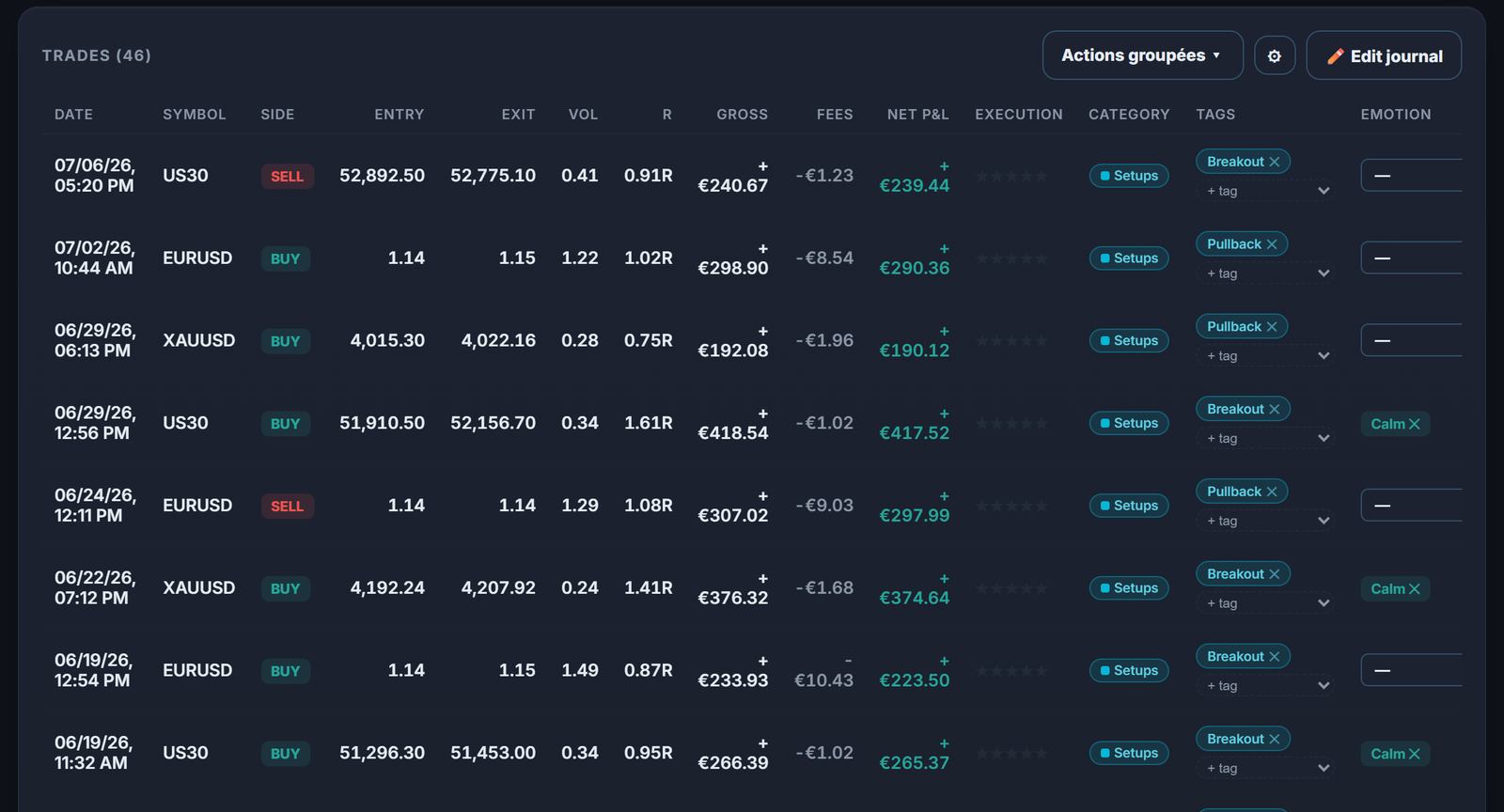
- Automatic journal from the first trade, synced with your broker or imported via CSV.
- Risk calculator that sets your position size before you even choose your setup.
- Emotional check-in before each session to track your state, not just your result.
- Built-in weekly review that steps back over the whole set of your sessions, not trade by trade.
Frequently asked questions
What should a beginner focus on first in trading?
Method, not strategy: open a demo account or trade minimum size, define your risk per trade before searching for the 'best' entry, and keep a journal from your very first trade. Regulators measure a large majority of losing retail clients on CFDs and forex; they don't measure why, and these foundations are the part you control.
Do I really need to journal from the very start?
Yes, because those first weeks are when your biases show up for the first time, and because written progress tracking is one of the best-measured mechanisms for sticking to a goal. Putting off the journal until 'later' makes you lose track of your own progress and prevents you from spotting the patterns that explain your recurring losses, like a specific time of day or emotional state.
How many markets should a beginner follow?
One, learned deeply, beats several skimmed superficially. Every market has its own dynamics, active hours, behavior around announcements. Diversifying too early prevents you from building the fine intuition that distinguishes an experienced trader from a beginner recognizing generic patterns.
How do I avoid revenge trading as a beginner?
By defining a simple rule cold, before you even trade: a mandatory pause after a loss, or a stop after a certain number of consecutive losses in the day. This rule, decided outside of emotion, protects you precisely at the moment your willpower is weakest to respect it on its own.
Why shouldn't I compare myself to other traders?
Because social media mostly shows other people's best results, rarely their worst months or the years it took to get there. Comparing your month 1 to someone else's year 5 sets an impossible standard and pushes you to take disproportionate risks to catch up on a gap that never existed.
Isn't a daily review enough?
No, it's useful but not enough on its own. The weekly review reveals trends that only appear at the scale of several days, like discipline eroding toward the end of the week. Without that step back, you stay stuck in the detail of each day without ever seeing your overall trajectory.