 By Benjamin Roure L'Hermitte
Fear and greed are the two emotions at work behind the most classic trading mistakes. Fear makes you cut winners too early and hesitate on entries; greed makes you hold losers and over-risk. Together, they build the losing trader's profile: small gains, big losses. Understanding them is the start of taking back control.
- Fear cuts gains too early and makes you hesitate on good entries.
- Greed holds losses and pushes you to over-risk to make more.
- Together, they invert your ratio: small gains, big losses, the classic losing profile.
- The counter isn't to feel nothing, it's to decide cold so emotion no longer executes.
Behind the two most classic trading mistakes, the gain cut too early and the loss left to run, you find the same two emotions: fear and greed. They aren't personal flaws: the tendency to sell winners more readily than losers has been measured on thousands of retail accounts, and the choices that produce it show up in the laboratory among people who have never traded. The problem is that in trading, these two reflexes push you to do the opposite of what you should. That is a good part of why trading is so hard.
Fear makes you flee risk at the wrong moment; greed makes you seek it at the worst moment. Together, they sit behind the behaviors that drain accounts: too many orders, positions too large, losses left to run. This guide breaks down how each concretely acts on your decisions, why they alternate to trap you, and how to build safeguards that neutralize their grip without pretending to make them vanish.
How fear acts on your decisions
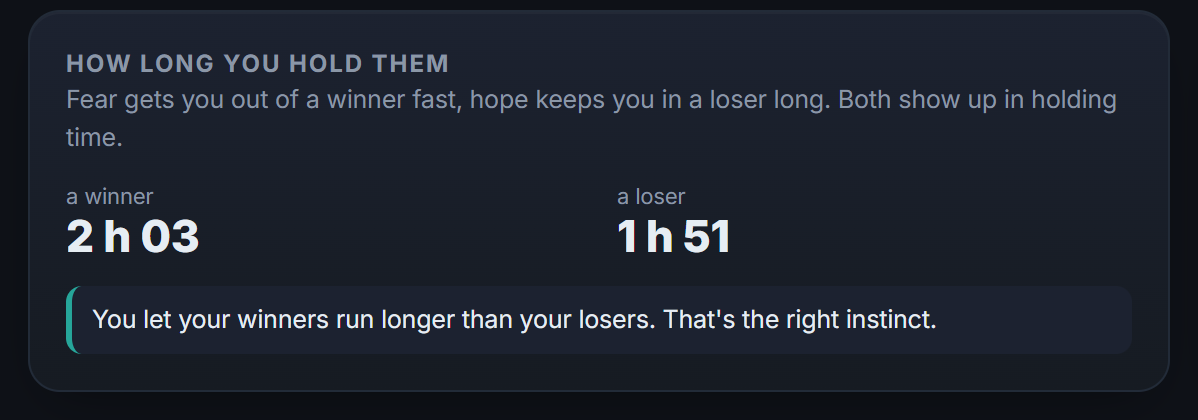
Fear in trading wears several masks. The most common is fear of losing a secured gain: you're in profit, a little voice says it could reverse, and you cut your position well before your target. You secure a small gain and watch price continue without you. Repeated over dozens of trades, this reflex systematically shaves off the top of your gains and destroys your ratio. This isn't a character flaw, it's a measured bias. On the records of 10,000 accounts at a large US discount brokerage from 1987 to 1993, Terrance Odean observes that investors realize their gains far more readily than their losses: on the days they sold, 14.8% of their winning positions were sold against 9.8% of their losing ones, and the winners sold went on to beat the losers kept by 3.4 points over the following year. That is the disposition effect, and subsequent performance does not justify it.
Fear also acts at entry: fear of being wrong makes you hesitate, wait for one confirmation too many, or miss the trade entirely. And there's fear after a loss, which paralyzes you and makes you miss the following setups, sometimes the best ones. In every case, fear makes you flee the risk needed at the right moment. It protects your immediate comfort at the cost of your performance.
How greed acts on your decisions
Greed is the exact mirror of fear. Where fear makes you cut too early, greed makes you hold too long. Facing a loss, it whispers 'it'll come back', and you let a losing position run well beyond your stop, turning a planned small loss into a big hole. It's the exact symmetric of the gain cut too early: the loss held too long. The trader then tells themselves a different story than the one they'd tell in a calm moment, simply to justify not cutting a position that should have been cut long ago. The reflex has a name in the laboratory: in experiments with real money, Thaler and Johnson observe that after a loss, a gamble offering the chance to break even becomes especially attractive, the break-even effect. And it isn't limited to retail traders: among Chicago Board of Trade proprietary traders, Coval and Shumway find that those who lost in the morning are about 16% more likely to take above-average risk in the afternoon than those who gained in the morning.
Greed also pushes over-risk: the urge to make more, faster, makes you increase your size beyond reason, load up on a 'sure' trade, or multiply positions. And after a gain, it feeds the euphoria that makes you think you can afford more: in the same experiments, Thaler and Johnson find that a prior gain makes people more willing to take risks, what they call gambling with the house money. Greed makes you seek risk precisely when you should be containing it.
Fear clips your wings when you should fly; greed throws you into the void when you should land. Together, they do everything at the wrong time.
The alternation that builds the losing trader
The real trap is that fear and greed alternate to make you make exactly the wrong choices at the wrong moments. On your gains, fear takes over and makes you cut early: small gains. On your losses, greed takes over and makes you hold: big losses. The result of this alternation is mechanical and devastating: an inverted ratio, where your gains are smaller than your losses.
| Situation | Dominant emotion | Mistake produced |
|---|---|---|
| Trade in profit | Fear of giving back the gain | Cutting too early |
| Trade in loss | Greed (it'll come back) | Holding too long |
| Before an entry | Fear of being wrong | Hesitating or missing |
| Urge to make more | Greed | Over-risking |
| After a gain | Greed (euphoria) | Loading up, feeling invincible |
This table describes how the classic losing trader operates. None of these mistakes is technical: they're all emotional decisions. And that's good news, because it means correcting this profile doesn't require a better strategy, just neutralizing these two emotions' grip on your key decisions.
Neutralizing their grip
The solution isn't to pretend to feel nothing: fear and greed are reflexes, you won't suppress them by willpower. The solution is to take the decision away from emotion, by making it cold, in advance. If your target and stop are decided before you enter, fear can no longer make you cut too early and greed can no longer make you hold too long: the decision is already made, emotion only has to execute.
That's the whole principle of cold-decided safeguards: a stop placed and non-movable, a fixed target, a risk rule, a stop rule. Each takes away one emotion's field of action. Fear and greed remain present, but they no longer have a grip on your decisions, because those decisions were made by your clear-headed self, not your in-the-moment emotional self.
Making emotion visible
The first step to neutralizing an emotion is to see it. As long as fear and greed act behind the scenes, they win. An emotional check before the session ('am I in fear, in greed?') and linking your state to your results bring them from shadow into light. You then discover, with numbers to back it, which states cost you money, and that awareness is already part of the cure. Linking mood to results is exactly what Lo, Repin and Steenbarger did with 80 volunteer US day traders from July 7 to August 9, 2002: 69 of them returned 755 daily mood-and-result reports over 25 trading days, and those whose emotional reaction to gains and losses was most intense, in either direction, had on average markedly worse results. The study is small and should be read as such; the authors also find no personality profile specific to the good trader.
Naming the emotion diminishes its power, and that isn't just an impression: in brain imaging, Lieberman and colleagues observed that putting a word on what one feels, in front of negative images, reduced the amygdala's response and increased activity in a region of the prefrontal cortex. It is a laboratory result, not a measurement taken in front of a chart, but it points the same way as what you notice yourself: saying 'I'm wanting to win it back out of greed' brings you back to your plan. That's why measuring and naming your emotional states isn't a self-help exercise, it's a directly profitable performance tool.
The emotion of a trade is not a parasite to remove, it is data to record. A trade taken in euphoria and one taken in calm do not behave alike, and only a journal shows it. Trading without emotion is an unrealistic goal; knowing which emotion accompanied which result is an achievable one.
Where these two emotions come from, and what is actually measured
Fear and greed are often presented as reflexes inherited from evolution: flee danger, grab scarce resources, two reactions that were useful when survival depended on speed and are unsuited to a chart. That is a plausible reading, not a measurement. What is measured is the asymmetry that feeds them. In hypothetical choices between gambles put to students and university faculty, in Israel and then in Stockholm and Michigan, Kahneman and Tversky show in 1979 that a loss weighs more than a gain of the same size: the aggravation of losing a sum appears greater than the pleasure of gaining it, and most respondents turn down a symmetric coin-flip bet. In 1992, Tversky and Kahneman find the full pattern again in a new experiment: caution on probable gains, risk-taking on probable losses, with loss aversion at the center.
The circuits involved have also been looked at in the laboratory. In the brain-imaging experiment by Kuhnen and Knutson, nineteen volunteers chose between two stocks and a bond: activation of the nucleus accumbens, a region of the reward circuit, preceded risky choices and risk-seeking mistakes, while activation of the anterior insula preceded riskless choices and risk-aversion mistakes. Two distinct signals, one that pushes and one that brakes, in people who were not trading: a laboratory result, not a measurement in front of a chart. Understanding this is liberating, because it spares you from judging yourself as weak or undisciplined when you feel these emotions. You don't feel them because you're a bad trader, you feel them because you're human. So the question isn't to feel nothing, which is impossible, but to build safeguards that stop these reflexes from commanding your financial decisions.
The crypto market has its own gauge of these two emotions: the Fear and Greed Index, a sentiment index from 0 to 100 computed on Bitcoin. It describes the market's mood, not yours.
The physical manifestations of fear and greed
Fear and greed aren't only mental. In a pilot study, Lo and Repin recorded the skin conductance and cardiovascular variables of ten professional traders during live sessions: the physiological responses tracked transient market events and volatility, with patterns that differed with the traders' experience. Ten people is not many, but it is enough to show that the body reacts to the market, even in professionals. In you, it may take the form of muscle tension, short breathing, a knot in the stomach, an urge to close the position to make the discomfort stop; on the euphoria side, excitement, an impatience to act, a feeling of invincibility. These bodily signals can arrive before you're conscious of the emotion.
Learning to spot these physical signals gives you an early warning system. When you feel your body tense or excite, it's the moment to pause and ask which emotion is taking over. This simple stop, triggered by bodily awareness, helps you regain control before making an emotional decision. The body is a good emotion detector, provided you learn to listen to it rather than suffer it.
Turning fear and greed into information
Rather than trying to suppress fear and greed, you can learn to use them as sources of information. Intense fear on a trade can signal your position is too big for your comfort, so poorly sized. Sudden greed can signal you're deviating from your plan to chase a gain. Instead of suffering these emotions, you read them as messages about your own state and the quality of your decisions.
This approach turns your enemies into allies. Fear becomes an over-risk indicator: if a trade really scares you, maybe your size is too big, and the answer is to reduce, not flee. Greed becomes a warning signal: if you feel an irrepressible urge to load up, it's probably the moment to be especially cautious. By listening to what your emotions tell you instead of obeying them, you turn destructive reflexes into tools of clarity about your own behavior.
Overconfidence, greed disguised as skill
After a string of wins, a particular form of greed sets in, sneakier than the others because it disguises itself as legitimate confidence. It is Thaler and Johnson's house money effect stretched over a streak: after gains, you accept risks you would have refused cold. You start believing you've 'figured it out', that your judgment has become infallible, and that belief pushes you to increase your size, to stray from your plan because 'this time is different', to ignore signals that would normally have made you hesitate. It's greed wearing the costume of skill.
The telltale sign of this overconfidence is that it feels exactly like real skill: the same certainty, the same absence of doubt. The only way to tell them apart is objective, not felt: compare your position size and your plan adherence during winning streaks to those during your normal stretches. If you notice your discipline degrading precisely when your results improve, that isn't skill growing, it's greed taking the wheel under a more convincing disguise than usual.
FOMO, the greed that makes you chase the market
FOMO, the fear of missing out, is one of the most common expressions of greed, and it strikes before you've even entered a position. You watch a move start without you, the urge not to 'miss the trade' rises, and you take a FOMO trade: late, with no valid setup, just to be in the move. It's greed disguised as opportunity: you're not reacting to a setup you identified in advance, you're reacting to the pain of watching a potential gain slip away.
The problem with FOMO is that it makes you enter exactly when the move is most advanced, and therefore least favorable in terms of risk/reward. The trader who gives in to FOMO enters higher and later than the one who patiently waits for their setup, by construction: they are reacting to a move that has already happened. The counter is the same as for any emotional decision: if your setup wasn't there when the move started, it isn't there once the move is well underway either. The train you missed isn't a loss, it's simply a train you were never meant to catch.
A worked example: what fear and greed really cost you
Take a purely illustrative example. Imagine a trader whose edge, executed without emotion, would produce an average risk/reward ratio of 1:2. On winning trades, fear makes them systematically cut at half the planned target: their real ratio drops to 1:1. On losing trades, greed makes them hold on average 50% beyond their initial stop: their average loss grows accordingly. At a 45% win rate, expectancy goes from +0.35 R per trade on paper to about −0.38 R in reality: over 100 trades, a winning system becomes a clearly losing one.
This calculation isn't scientific, it's deliberately simplified to illustrate a real mechanism: the edge you measure on paper and the edge you actually capture can be two completely different things, and the gap between them is measured very precisely in unmanaged fear and greed. That's why measuring, not just feeling, what these emotions cost you is an exercise that directly changes your profitability, not just your psychological comfort.
How Tradoshi helps
Tradoshi makes fear and greed visible and measurable, so you see their real cost and can neutralize them instead of suffering them.
- Emotional check-in: it detects your state before the session and returns a tailored recommendation.
- Emotion → performance: it links your emotional state to your P&L to prove which states cost you.
- Risk management: your stops and computed size take away fear's and greed's field of action.
- Discipline score: it spots the breaches (cutting early, holding a loss, over-risking) in your real trades.
Frequently asked questions
How does fear affect my trading?
Fear makes you cut gains too early (fearing to give them back), hesitate on entries (fearing to be wrong), and paralyze after a loss (making you miss the following setups). In every case, it makes you flee the risk needed at the right moment. Repeated, this reflex systematically shaves the top off your gains and destroys your ratio.
How does greed affect my trading?
Greed makes you hold losses too long ('it'll come back'), over-risk to make more faster, and load up after a gain out of overconfidence. It's the exact mirror of fear: where fear cuts too early, greed holds too long. It makes you seek risk precisely when you should be containing it.
Why do fear and greed cause losses?
Because they alternate to make you do the opposite of what you should: on your gains, fear makes you cut early (small gains); on your losses, greed makes you hold (big losses). The mechanical result is an inverted ratio, the classic losing trader's profile. None of these mistakes is technical: they're all emotional decisions.
Can you suppress fear and greed?
No, they're human reflexes you won't make vanish by willpower. The solution isn't to feel nothing, but to take the decision away from emotion by making it cold, in advance. If your stop and target are decided before you enter, fear can no longer make you cut early nor greed make you hold too long.
How do I neutralize their grip on my decisions?
With cold-decided safeguards: a stop placed and non-movable, a fixed target, a risk rule, a stop rule. Each takes away one emotion's field of action. Fear and greed remain present, but they no longer have a grip, because the decision was made by your clear-headed self, not your in-the-moment emotional self.
How does naming your emotions help?
Naming an emotion diminishes its power. Saying 'I'm wanting to win it back out of greed' instantly brings you back to your plan. An emotional check before the session and linking your state to your results bring fear and greed from shadow into light: you discover with numbers which states cost you money, and that awareness is already part of the solution.
What is FOMO in trading and why is it dangerous?
FOMO, the fear of missing out, is a form of greed that makes you enter late, with no valid setup, just to be in a move that's already well underway. It's the worst moment to enter: degraded risk/reward, move already spent. If your setup wasn't there when the move started, it isn't there once the move is underway either.
How do I measure what fear and greed really cost me?
By comparing your theoretical edge (what your strategy should produce if executed without drift) to your real edge (what you actually capture). The gap between the two, often invisible without precise data, shows up as gains cut too early and losses held too long. A journal that logs every trade reveals that gap with numbers to back it.