 By Benjamin Roure L'Hermitte
You hear it everywhere: 90% of traders lose money. No study says exactly that. The closest figure comes from France's market regulator, the AMF: out of 14,799 French retail clients active on CFDs and forex, more than 89% lost money over four years. That measures leveraged products, not traders as a whole, and what it ties to losses is the number of orders and their size.
- No study says '90% of traders': the AMF measured 89% of losing clients on CFDs and forex in France, ESMA 74% to 89% of losing retail accounts on CFDs in Europe.
- What these studies tie to losses: the number of orders and the size of positions. Four years of practice barely change it.
- Three leaks drain accounts: uncontrolled risk, revenge trading, and decisions made under emotion.
Across 66,465 households with accounts at a US discount broker from 1991 to 1996, Barber and Odean found almost no difference in returns before costs between the fifth that traded the most and the fifth that traded the least. After costs, the first group earned 11.4% a year and the second 18.5%. What separates them isn't stock picking, it's the number of orders, in other words overtrading.
This guide goes through what those studies actually measure, the three leaks that drain an account, and how Tradoshi measures your discipline and detects your emotional state to show you, with numbers, what your controlled days earn compared with the others.
Why it isn't your strategy
The Taiwan Stock Exchange gave researchers the record of every order placed from 1995 to 1999. Barber, Lee, Liu and Odean read two things in it. In a typical six-month period, more than eight out of ten day traders lose money. And the heaviest day traders make money before costs: their trades are executed at favorable prices, just not favorable enough to cover commissions and the tax on sales. Reading the market was not their weak point. Occasional day traders, for their part, lose even before costs.
That doesn't prove your strategy is good. It shows that a decent method isn't enough, and that the first job isn't finding a better indicator but stopping what eats the result. That sabotage runs through three specific leaks.
The three leaks that drain accounts
Leak #1: uncontrolled risk
Position size is the first setting, and it's arithmetic. Ten losses in a row at 1% of remaining capital cost 9.6% of the account. The same ten losses at 10% cost 65%, and you then have to multiply what's left by 2.9 to get back to where you started. The AMF study (in French) finds the same slope in real accounts: clients whose average order exceeded €10,000, leverage included, made up 62% of the sample and lost €14,876 on average over the period. The larger the average order, the larger the loss.
Leak #2: revenge trading
After a loss, the urge to get the money back right away pushes you to take more risk, not less. You size up, you take a trade you'd never take cold, you force an entry: that's revenge trading. Professionals aren't spared. Among proprietary traders at the Chicago Board of Trade, Coval and Shumway (Journal of Finance, 2005) found that after a losing morning they regularly took above-average risk in the afternoon to make it back. Tversky and Kahneman described the mechanism in 1992: facing a highly probable loss, most people prefer the gamble to the sure loss.
Leak #3: trading on emotion
Stress, FOMO, fatigue, euphoria after a big win: these states weigh on your decisions without warning. One study measured it on real day traders. It is small and should be read as such. From July 7 to August 9, 2002, Lo, Repin and Steenbarger asked 80 volunteers trading their own accounts to rate their mood every evening: 69 returned reports, 755 in all over 25 trading days. Those whose mood tracked their daily gains and losses most closely had, on average, worse results. The authors found no personality profile specific to good traders.
The real culprit: your psychology, not the market
These three leaks share one root, and it has been measured: a loss doesn't weigh the same as a gain. In Tversky and Kahneman's experiment, run on 25 graduate students, a 50-50 bet was only accepted if the possible gain was at least twice the possible loss. The consequence shows up in real accounts. Across 10,000 accounts at a US discount broker from 1987 to 1993, Terrance Odean showed that investors realize gains far more readily than losses: on a day with a sale, 14.8% of winning positions were sold versus 9.8% of losing ones. And the winners they sold went on to beat the losers they kept by 3.4 points over the following year. These aren't character flaws, they're biases measured across thousands of accounts.
As long as these biases stay invisible, you can't correct them. The method in this guide has two steps: make them visible and measurable, then put guardrails decided cold, before emotion arrives.
What separates the trader who loses from the one who lasts
How many actually make it? In Taiwan, from 1992 to 2006, about 360,000 individuals day traded each year. About 13% ended a typical year with a profit after fees, but fewer than 1%, roughly a thousand people, reliably went on to beat the market after fees the following year (Barber, Lee, Liu and Odean). The table below doesn't come from that study or any other: it's a grid of behaviors to check against your own trades.
| Behavior | The trader who loses | The trader who lasts |
|---|---|---|
| Risk per trade | Variable, big to win it back | Fixed and modest (0.5-1%) |
| After a loss | Sizes up (revenge) | Cuts or stops |
| Emotional state | Ignored, endured | Checked before trading |
| Judging a trade | On the result (P&L) | On plan adherence |
| Their data | Watches only P&L | Measures their discipline |
In practice, three guardrails answer the three leaks:
- Set your risk per trade and don't touch it when you lose.
- Impose a stop rule after a set number of losses in a day.
- Do a quick mental check before each session: are you calm, or trying to win it back?
Where the 90% figure really comes from
The '90%' circulates without an author, but it has two verifiable origins, and both are about leveraged products. The first is the AMF study of October 13, 2014 (in French): out of 14,799 clients active on CFDs and forex with brokers authorized in France, more than 89% lost money over four years, with an average loss of €10,887 per client and a median loss of €1,843. In any single year, the share of losing clients is close to 84%. The second is ESMA, the European securities regulator: in March 2018 it reported that 74% to 89% of retail accounts lose money on CFDs, depending on the country.
Since August 1, 2018, every CFD provider has had to display, in a standardized risk warning, the percentage of its own retail accounts that lose money. The measure was European and temporary; France's AMF made it permanent on August 1, 2019. That's the figure you read on those brokers' websites and in their ads, and it only applies to them.
What these figures don't measure: stocks, futures, options, prop firm accounts. They count clients of CFD brokers, not 'traders'. And losing doesn't mean the same thing everywhere. In Barber and Odean's study, the average US household investing in stocks earned 16.4% a year after costs between 1991 and 1996, while the market returned 17.9%: it didn't lose money, it lagged the index.
The most telling part of the AMF study is that experience fixes nothing. Of the 1,881 clients who stayed active every year from 2009 to 2012, 82.5% lost money in the first year and 87.6% over the four years combined, with an average loss going from €4,989 to €26,745. The AMF concludes that there is no learning effect. If screen time were enough, those numbers would move the other way.
How to take back control, concretely
Make your discipline measurable
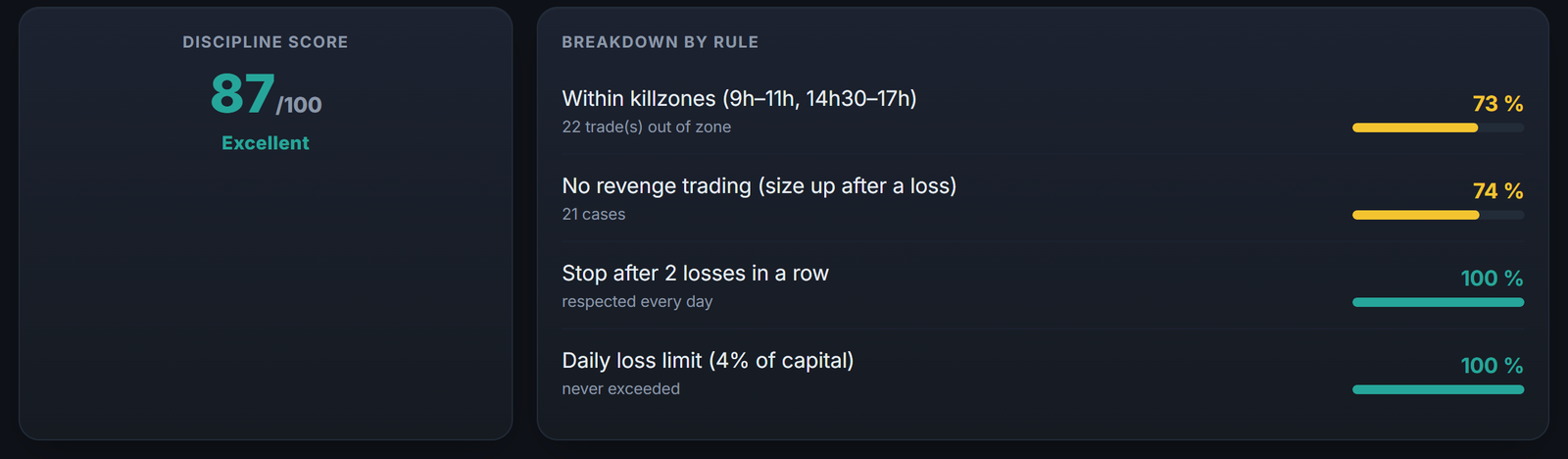
As long as 'I lack discipline' stays a feeling, you have nothing to act on. When it becomes a daily score that checks your rules on your real trades, you see when and where you crack, and you can correct.
Name your state before trading
An emotional check-in of a few seconds before the session guarantees nothing, but it forces you to put a word on what you feel ('I'm trying to win it back') before the first order. And by tying that state to your performance, you see in black and white whether some states cost you money.
How Tradoshi helps, concretely
- Daily discipline score: it spots revenge trading, over-risking and off-plan entries in your real trades.
- Emotional check-in: it detects your state before the session and gives you a matching recommendation.
- Emotion → performance: it ties your mood to your P&L to prove which states cost you money.
- Risk management: your position size is computed to stay constant, a guardrail against over-risking.
- Proof in numbers: you compare your controlled days with the others, in your own data.
Frequently asked questions
Is it true that 90% of traders lose?
No study measures '90% of traders'. The closest figure comes from France's regulator, the AMF: more than 89% of the 14,799 French retail clients active on CFDs and forex lost money over four years. ESMA, for its part, reported 74% to 89% of losing retail accounts on CFDs in Europe. These measurements are about leveraged products, not stocks or traders as a whole.
Does psychology really matter more than strategy?
The studies don't pit one against the other; they show that strategy isn't enough. In Taiwan, the heaviest day traders made money before costs and lost after. In the US, the households that traded the most had the same returns before costs as the others, and 7 points less per year after costs. Strategy can give you an edge; the number of orders, their size and how you handle a loss decide whether you keep it.
How do you stop revenge trading?
With a rule decided cold, not willpower in the moment: after a set number of consecutive losses (two or three), you stop for the day, no negotiation. And you never size up after a loss. A discipline score that measures these rules makes the slip visible and costly.
Can you really measure your emotions in trading?
Not perfectly, but usefully. A check-in before the session lets you name and date your state, then cross it with your performance. You move from a hunch ('I trade badly when stressed') to usable data ('my losses are bigger on stressed days').
How long does it take to fix your psychology?
None of the studies cited here gives a timeframe, and time alone isn't enough: in the AMF study, clients active four years running lost almost as often as the others. What you can do is make your discipline measurable, hold your guardrails every day, and watch whether your numbers move.
Should I change strategy if I'm losing?
Not before checking the rest. Jumping from one strategy to another keeps you from knowing what each was worth: fifteen trades aren't enough to judge, since at a 50% win rate the margin of error is about 25 points either way. Before changing methods, first check that you respect your risk management and discipline: that's what the AMF study ties to losses, the number of orders and their size.