 By Benjamin Roure L'Hermitte
Overtrading is taking too many positions, too often, for the wrong reasons. It's one of the most costly behaviors in trading, and one of the most insidious, because it disguises itself as productive activity. You feel like you're working hard, seizing opportunities, when all you're doing is multiplying fees, errors and mental fatigue. Trading more isn't trading better.
- Overtrading disguises itself as productivity: you think you're working, you're just piling up mistakes.
- Its causes are emotional: boredom, revenge, FOMO, need for action, not real opportunities.
- It costs twice: in fees that pile up and in poor-quality trades.
- The counter is selectivity: fewer trades, but only the best ones.
There's a stubborn belief among beginners: the more I trade, the more I make. After all, it's like that in most activities, the more you work, the more you produce. But trading doesn't work that way. Here, value doesn't come from the volume of activity, it comes from the quality of a few well-chosen decisions. Multiplying trades doesn't multiply gains, it multiplies fees and errors.
Overtrading is treacherous because it gives the illusion of a job well done. Staying at the screen all day, stringing together positions, reacting to every move, looks like serious engagement. In reality, it's often the opposite: the sign that you're trading your boredom, your frustration or your need for action, rather than real opportunities. This guide explains where overtrading comes from, what it really costs you, and how to regain the selectivity that makes profitable traders.
Why trading more doesn't make more
Your edge, your statistical advantage, only applies to certain precise setups, the ones where your strategy genuinely has an advantage. Outside those setups, you have no edge: you're flipping a coin, minus fees. Every trade taken outside your optimal conditions dilutes your performance, because you add zero- or negative-expectancy bets to your positive-expectancy ones.
Trading more therefore means drowning your good trades in a mass of mediocre ones. Your average degrades, your fees pile up, and your real edge gets smothered. Quality always beats quantity in trading: ten excellent trades beat a hundred average ones. The profitable trader isn't the one who trades the most, it's the one who waits the most.
This isn't just reasoning, it has been measured. Across 66,465 households with accounts at a large US discount broker from 1991 to 1996, Barber and Odean found very little difference in returns before costs between the households that placed the most orders and those that placed the fewest. After costs, the former earned 11.4% a year and the latter 18.5%, while the market returned 17.9% and the average household 16.4%. In an earlier study by Odean on 10,000 accounts at the same kind of broker, from 1987 to 1993, the stocks bought even returned 3.3 percentage points less over the following year than the stocks sold, before any costs. Those figures describe individuals holding US stocks in the 1990s, not day trading forex or futures, but the mechanism is the same: the extra trade doesn't add performance, it adds costs.
The real causes of overtrading
Overtrading doesn't answer a market signal, it answers an emotional need. Identifying which one concerns you is the first step to correcting it. Here are the causes you come across, and what research has measured for some of them:
| Emotional cause | What's happening |
|---|---|
| Boredom | You trade to fill the void, not on a signal |
| Revenge | You multiply trades to win back after a loss: that's revenge trading |
| FOMO | You jump on every move for fear of missing out |
| Need for action | Trading becomes an addiction to the thrill |
| Overconfidence | After gains, you feel entitled to take everything |
Two of these causes have been measured, and not among beginners. Among proprietary traders at the Chicago Board of Trade, Coval and Shumway observed that those who had lost in the morning were about 16% more likely to take above-average risk in the afternoon than those who had won: that's revenge, with a number on it. In the laboratory, with real money and Cornell University students, Thaler and Johnson described the two faces of the same reflex: after a gain, people accept more risk, the 'house money' effect; after a loss, bets that offer a chance to break even become especially attractive. As for overconfidence, Barber and Odean tested it on over 35,000 households at a US discount broker, from 1991 to 1997: men, whom psychological research describes as more confident than women in their financial judgments, placed 45% more orders than women, and that extra activity reduced their net returns by 2.65 percentage points a year, against 1.72 for women.
The common thread of all these causes is that none is a market signal. You're not trading because a valid opportunity presents itself, you're trading because an inner state pushes you to act. Understanding that changes everything: overtrading isn't cured with a better strategy, it's cured by identifying and managing the emotional need that triggers it.
What overtrading really costs you
Overtrading costs in three ways, and their combination is devastating. First fees: every trade has a cost (spread, commission), and multiplying positions multiplies these fees that silently erode your performance. Over a large number of mediocre trades, fees alone can turn a positive edge into a negative result.
Overtrading doesn't make you win more often, it makes you pay more often: more fees, more errors, more fatigue.
Then quality: by taking trades outside your best setups, you lower your win rate and your average ratio, degrading the very edge that was meant to make you win. Finally mental fatigue: staying on permanent alert, chaining decisions, reacting to everything, drains your capacity for focus and discipline, and the decisions taken after a loss are the most exposed, as the afternoon risk-taking of the Chicago Board of Trade traders cited above shows. Overtrading impoverishes your account and your mind at the same time.
The counter: selectivity
The solution to overtrading fits in one word: selectivity. The profitable trader doesn't try to trade a lot, they try to trade well, which means patiently waiting for their best setups and ignoring everything else. Every trade they don't take is as important as every trade they take: saying no to mediocre setups protects the quality of their average.
- Define precisely what a quality trade is for you, and accept only those.
- Set a maximum number of trades per day, to impose scarcity on yourself.
- Before each trade, ask: is this a real setup, or am I bored / seeking revenge / afraid to miss out?
- Consider no-trade days as successes, not wasted time.
- Measure your trading frequency to spot the periods where you drift.
Inaction is a position
The hardest part of fighting overtrading is accepting that doing nothing is often the best decision. The inexperienced trader feels inaction as a failure, a missed opportunity. The mature trader understands that not trading when there's no opportunity is a trading act in its own right, as important as entering at the right moment. Waiting is acting.
Cultivating the patience to do nothing is a skill that's worked on, and perhaps the most profitable of all. Every day you resist the urge to trade for the sake of trading, you protect your capital and your mind for the real opportunities. Among the households Barber and Odean followed, those who placed the fewest orders earned the best net return: overtrading is ultimately just impatience disguised as work.
Overtrading as addiction
For some traders, overtrading goes beyond a mere bad habit and looks like an addiction, and clinicians have taken an interest. In a French addiction unit, Grall-Bronnec and colleagues described 8 excessive traders among 221 patients seeking treatment for a gambling problem, with the same trajectory as gamblers: small early wins, chasing losses, loss of control. Among 795 Americans who were both active gamblers and stock market investors, Mosenhauer, Newall and Walasek found that the higher the problem gambling score, the faster the portfolio turned over, at equal financial literacy and overconfidence. What happens in the brain has been looked at in the laboratory, not in front of a chart: in nineteen volunteers choosing between two stocks and a bond, Kuhnen and Knutson saw activation of the nucleus accumbens, a region of the reward circuit, precede risky choices and risk-seeking mistakes. They measure an activation, not dopamine. The trader caught in that relationship no longer trades to make money, they trade for the sensation, and the absence of a position becomes uncomfortable, almost unbearable.
Recognizing this addictive dimension is important, because it calls for a different response. If you feel a craving when you're not trading, if you open positions just for the excitement, if you can't stop watching the markets constantly, you may be in an addictive relationship with trading. The solution then isn't only technical, it's behavioral: imposing strict limits, screen-free windows, and rebuilding a relationship with trading based on the pursuit of long-term gain, not immediate sensation.
Quality over quantity
Overtrading rests on a false but deeply anchored belief: that more activity produces more result. In trading, it's the opposite. Your profitability comes from a small number of high-quality trades, not a large number of mediocre ones. Every trade outside your best setups dilutes your edge by adding low- or zero-expectancy bets to your positive-expectancy ones. Multiplying trades means drowning your gold in sand.
The decisive mindset shift is valuing selectivity over activity. A trader who takes three excellent trades a week is far more profitable than one who takes thirty mediocre ones. Learning to see each trade not taken as a victory, not a missed opportunity, is at the heart of this transformation. The best trade is often the one you don't take, because it protects your capital and your attention for the rare opportunities truly worth it.
Regaining the patience to do nothing
The skill that cures overtrading is the hardest to acquire: the patience to do nothing. Sitting at your screen without taking a position, waiting for hours, even days, for your setup to appear, goes against all your instincts. The emptiness of inaction is uncomfortable, and it's precisely that discomfort overtrading seeks to fill. Learning to bear that emptiness is the real remedy.
Concretely, this means reframing what 'working' means as a trader. Patiently waiting for a good setup isn't inaction, it's an active part of the craft, as important as executing the trade when it comes. The mature trader understands that most of their time is spent waiting, observing, not trading, and that it's precisely that patience that protects their results. Cultivating the ability to do nothing when there's nothing to do is, paradoxically, one of the most profitable skills in trading.
A numeric example of what overtrading costs
Take a purely illustrative example, with assumptions set for the occasion. Two traders risk $100 per trade, pay $5 in spread and commission per round trip, and have the same edge on their best setups: +0.2 R per trade, or $20 on average. Trader A takes 5 trades a week, only their best setups: they make $100 and pay $25 in costs, ending the week at +$75. Trader B takes the same 5 trades, plus 20 others that vaguely resemble an opportunity and whose expectancy before costs is zero: they make the same $100, but pay $125 in costs, five times more, and end at −$25.
Even if trader B 'gets it right' on a few of their extra trades, the costs of the twenty additional positions are enough here to turn a winning week into a losing one, and if those trades have negative rather than zero expectancy, the loss deepens. This is a simplified example, not a statistic, but it shows why two traders starting with the same edge can end up with opposite results: one protected their edge by concentrating it, the other drowned it by diluting it.
Setting concrete limits that actually hold
Knowing you should be selective isn't enough; you need to translate that into precise limits, decided cold, that don't depend on your willpower in the moment. A maximum number of trades per day is the simplest limit to set: beyond it, the platform closes, whatever conviction you feel. A mandatory pause after a loss, even a short one, breaks the automatic chain that leads to the next trade being taken on reflex rather than analysis.
These limits matter even more if you're trading a prop firm account, where overtrading doesn't just erode performance: it mechanically pushes you toward the daily loss limit, sometimes in a single rushed session. A simple rule, like stopping after three losing trades in a day, protects both your edge and your funded account. The discipline of limiting your frequency isn't an external constraint you endure, it's a protection you choose, once you've understood what overtrading really costs.
Decision fatigue, a driver to put in perspective
You often read that every decision draws on a limited mental resource, which would wear down over the day like a tiring muscle, and that this 'decision fatigue' would explain bad end-of-session trades. The idea is fragile: the replication coordinated by Hagger and colleagues across 23 laboratories, on 2,141 participants, measured an effect close to zero (d = 0.04, with a confidence interval that includes zero). And none of it has been measured in traders.
What has been measured tells a different story. Among Chicago Board of Trade traders, at the same hour of the afternoon, those who had lost in the morning took more risk than those who had won: the gap came from the morning's result, not from the clock. A daily trade limit and a pause after a loss therefore remain good rules, for a more modest reason than a draining battery: they cut the chain that leads from a loss to the next trade, and they keep your decisions for the moments when you're in a state to make them.
Relearning to tell boredom apart from a lack of opportunity
A confusion that feeds overtrading is failing to distinguish boredom from a genuine lack of opportunity, even though both produce the same uncomfortable feeling: the urge to do something. Yet these are opposite situations. A lack of opportunity is information about the market, telling you today offers nothing matching your edge. Boredom is information about you, telling you your mind is seeking occupation, independent of what the market is actually doing.
Learning to separate these two signals is a skill in its own right. One simple way is to ask yourself, the moment the urge to trade rises without a clear setup: 'if I didn't have a trading account open right now, would I even notice anything interesting about this market?'. If the answer is no, you're probably facing boredom, not a missed opportunity. That simple question, asked honestly, helps defuse the trades taken purely to fill the void.
How Tradoshi helps
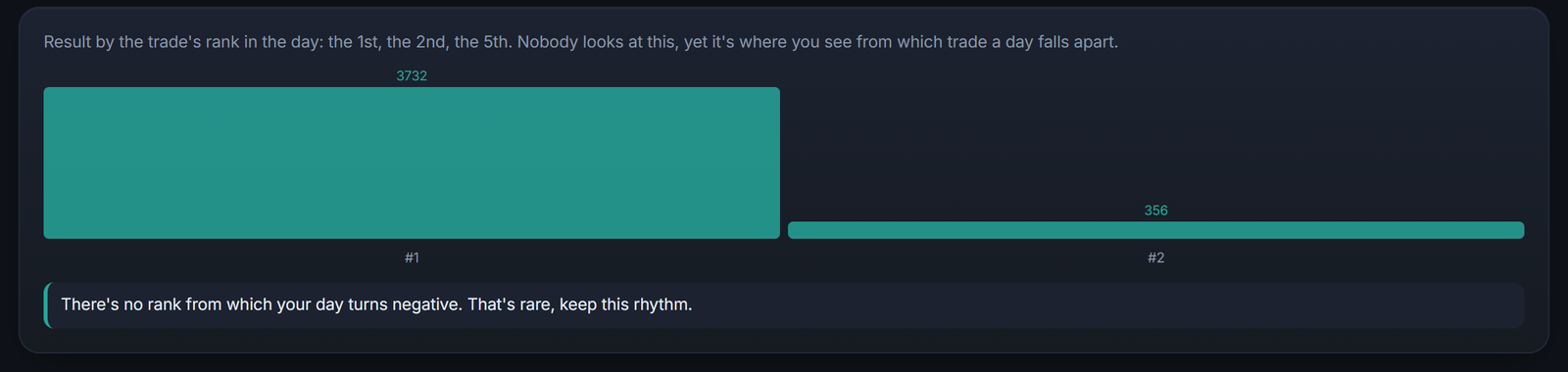
Tradoshi measures your trading frequency and spots overtrading in your real behavior, so you see when you drift and what it costs you.
- Frequency tracked: your number of trades per day is measured and compared to your profitable days.
- Discipline score: overtrading is among the behaviors detected and scored.
- Emotional check-in: it helps you spot boredom, revenge or FOMO before they make you trade.
- Emotion → performance: you see whether your overtrading days are your worst.
Frequently asked questions
What is overtrading?
It's taking too many positions, too often, for the wrong reasons (boredom, revenge, FOMO, need for action) rather than on real opportunities. It disguises itself as productivity (you feel like you're working hard), but it only multiplies fees, poor-quality trades and mental fatigue. Trading more isn't trading better.
Why doesn't trading more make more?
Because your edge only applies to certain precise setups. Outside them, you're flipping a coin minus fees. Every trade outside your optimal conditions dilutes your performance by adding zero- or negative-expectancy bets. Multiplying trades drowns your good ones in a mass of mediocre ones: quality always beats quantity.
What are the causes of overtrading?
Emotional: boredom (trading to fill the void), revenge (winning back after a loss), FOMO (fear of missing a move), need for action (thrill addiction), and overconfidence after gains. Two of them have been measured: risk-taking after a loss among professional traders, and the link between overconfidence and the number of orders among individuals. None is a market signal: you're trading an inner state, not an opportunity. That's where to act.
What does overtrading really cost?
It costs in three combined ways: fees (every trade has a cost that piles up and can turn a positive edge negative), quality (mediocre trades lower your win rate and ratio), and mental fatigue (permanent alert drains your focus, and the decisions taken after a loss are the most exposed). It impoverishes your account and your mind at the same time.
How do I stop overtrading?
Through selectivity: take only your best setups and ignore the rest. Define precisely what a quality trade is, set a maximum number of trades per day, and before each trade ask whether it's a real setup or whether you're bored, seeking revenge or afraid to miss out. Consider no-trade days as successes, not wasted time.
Is doing nothing a good trading decision?
Yes, often the best. Not trading when there's no opportunity is a trading act in its own right, as important as entering at the right moment. The inexperienced trader feels inaction as a failure; the mature trader understands that waiting is acting. Cultivating the patience to do nothing is perhaps the most profitable skill of all.
Can two traders with the same edge end up very differently?
Yes. A trader who only takes their best setups captures that edge almost intact; a trader who multiplies trades dilutes the same edge across zero or negative expectancy positions while paying far more in fees. That's what Barber and Odean measured on 66,465 US households between 1991 and 1996: almost no difference before costs between the most and least active, but 11.4% against 18.5% a year after costs.
How do I set limits that actually prevent overtrading?
Set a maximum number of trades per day and stop once you hit it, no negotiation. Impose a pause after a loss to break the automatic chain. In a prop firm, a rule like stopping after three losing trades in a day protects both your edge and your daily loss limit.