 By Benjamin Roure L'Hermitte

Patience in trading is the ability to wait: wait for your setup to be complete before entering, let an open position run to the end of its plan, and do nothing when the market offers you nothing. Many costly mistakes come less from a lack of knowledge than from waiting cut short. This guide explains what research has measured among the investors who trade the most, where impatience comes from, and how to build your patience with rules rather than willpower.
- Impatience takes three forms: forced entries, rushed exits, overtrading.
- Patience isn't passive: it's an active discipline of selective waiting.
- It's built through rules, a journal, and measuring what impatience costs you.
- Trading more often was costly for the investors studied: 11.4% net a year for the most active households against 18.5% for the least active, on US stocks from 1991 to 1996 (Barber and Odean's study cited below).
Waiting is the least visible part of trading: not taking the mediocre trade, not cutting the winner out of nervousness, not jumping on the market out of boredom. Impatience is the common thread of these three mistakes.
The problem is that waiting is uncomfortable. This guide looks at what impatience costs, what studies have measured and what they haven't, then how to replace the effort of willpower with written rules. None of these rules promises a result: they reduce the number of decisions made in the heat of the moment.
Why impatience costs so much
Impatience shows up in several forms, all costly. It makes you enter too early, before your setup is complete, because you're afraid of missing the move. It makes you exit a winner too early, out of nervousness, before it has given its full potential. It pushes you to trade when there's nothing to do, out of boredom, just for the action.
The common thread of these mistakes is that they weigh on your edge. A premature entry is a trade taken in worse conditions. A rushed exit is a truncated gain. A boredom trade is risk taken for no reason, plus extra costs. Added up over hundreds of trades, these small impatiences can turn a winning system into a neutral or losing one, without you having changed anything about your strategy.
Research has measured this cost on stocks. Across 66,465 households with accounts at a large US discount broker, from 1991 to 1996, Barber and Odean's study Trading Is Hazardous to Your Wealth finds very little difference in gross performance between those who trade frequently and those who trade infrequently. After costs, the most active fifth earns 11.4% a year, the least active fifth 18.5%: the gap comes from transaction costs. These households held stocks for months. The study measures neither day trading nor impatience itself, only what trading more often costs.
On CFDs and Forex in France, the AMF study of retail investors' results followed 14,799 active clients over four years: more than 89% lost money, and the regulator writes that the more transactions a client makes, the higher their loss. This is a relationship read off charts, not proof that each additional trade causes a loss: the study does not say which way the cause runs, and a losing client may also trade more to make it back.
Patience isn't passivity
We often confuse patience and inaction, but they're two different things. The trader's real patience is active: it's a selective waiting, a vigilance that refuses everything that isn't excellent to seize only what is. The patient trader isn't asleep at their screen, they're hunting, ready to act fast, but only when their precise conditions are met.
The patient trader doesn't trade less out of lack of desire, they trade less out of excess of standards. They wait for the obvious trade and let everything else pass without regret.
This distinction changes how you go about it. Being patient doesn't mean holding back your urge to trade by sheer willpower, trade after trade. It means redefining what a good trade is: so precise, so demanding, that most setups are ruled out from the start. Patience then becomes a consequence of your standards, not a permanent effort against yourself.
Where your impatience comes from
Three explanations come up often. None has been measured on traders: take them as leads for observing yourself, not as laws. The first is the fear of missing out, FOMO: seeing the market move without you is unpleasant enough that you'd rather take a mediocre trade than no trade at all. The second is the need to act. It has been observed far from the markets: across 286 penalty kicks in top leagues and championships, the study by Bar-Eli and colleagues on soccer goalkeepers calculates that staying in the centre was the best option, yet goalkeepers dived to one side in 93.7% of cases. The authors explain it by the norm: a goal conceded after standing still feels worse than a goal conceded after diving. These are goalkeepers, not traders, but the situation resembles yours when doing nothing would be the right choice and feels the hardest one to own. It's one of the reasons trading is so hard to practise.
The third is your relationship to money: when you think in terms of money to make right now, every minute without a trade looks like a missed opportunity. These leads have a practical use. Rather than asking yourself for more willpower, you can act on each one: expose yourself less to what feeds FOMO, give your need to act another task, and shift your attention from immediate gain to the quality of your execution.
Building patience through rules
Patience isn't decreed, it's built with rules. The most powerful is a very precise definition of your setup: the stricter and more written your entry criteria, the less room you have for impatience. A trade that doesn't check all your boxes isn't a trade, period. This rigor turns waiting into simply applying a rule, not an emotional battle.
Other rules point the same way: limiting the number of trades per day, which forces you to select; imposing a pause after each trade, which cuts the impulsive chaining; defining precise time windows when you trade, which avoids the boredom trade. These guardrails don't depend on your composure in the moment: they are decided with a cool head, before the session, not when the urge is there.
Two received ideas are worth setting aside along the way. The first holds that willpower is a reserve that drains with effort: the replication coordinated by Hagger and Chatzisarantis across 23 laboratories and 2,141 participants measured an effect close to zero (d = 0.04, with a confidence interval that includes zero). The second comes from the marshmallow test, according to which a child's ability to wait for a reward would foretell their success. The replication by Watts, Duncan and Quan, focused on American children whose mothers had not completed college, finds between waiting at around age 4 and school achievement at age 15 a link half the size of the one in the original studies, reduced by a further two thirds once family background and early cognitive ability are taken into account. None of these experiments involves traders. They suggest not betting on a character trait, and writing rules instead.
Waiting during the trade
Patience doesn't only concern the entry, it also concerns managing the ongoing trade. Once your position is open according to your plan, impatience pushes you to intervene: tighten your stop too fast, take your gains at the first profit, exit at the slightest market hesitation. Each of these interventions can truncate the potential of a trade you had nonetheless chosen by your rules.
Taking gains quickly is one of the best-documented behaviours among individual investors. Across 10,000 accounts at a large US discount broker, from 1987 to 1993, Odean's study Are Investors Reluctant to Realize Their Losses? shows that these investors realize their gains more readily than their losses, and that the winning stocks they sold went on, over the following year, to do 3.4 percentage points better on average than the losers they kept. Here again these are stocks held for months, not intraday positions. The study says nothing about your stop or your target: it shows that the urge to cash in early is widespread, and that it had a cost in this sample.
The patient trader lets their trade work according to the plan they defined cold. They know the market doesn't go in a straight line, that fluctuations are normal, and that intervening under the sway of nervousness amounts to letting emotion rewrite a considered plan. Holding your position until the plan is invalidated or reached, without giving in to the urge to tinker, is a form of patience as important as waiting for the right setup.
Measuring what impatience costs you
The most direct way to take your impatience seriously is to see in numbers what it costs you. As long as it stays a feeling, it is hard to correct; once quantified, you know what to act on. A journal that distinguishes your planned trades from your off-plan trades shows you whether the latter weigh on your performance, and by how much.
The result isn't known in advance, and that is the point of measuring. If your boredom trades have a negative expectancy, or if your rushed exits cost you a share of your potential gains, you have a quantified reason to wait, drawn from your own history rather than from advice. If your off-plan trades do no worse than the others, it is your plan that needs rewriting.
Patience against social media FOMO
Social media has added an extra layer to trader impatience. Seeing other traders' gain screenshots in real time, often presented without context or proof of consistency, feeds a different kind of FOMO than the market itself: the fear of missing not a move, but a social success. This pressure is particularly insidious because it doesn't come from the chart, but from an outside comparison you don't control.
The best defense is simple but demanding: limit your consumption of trading content during your active trading hours, and remind yourself that an account shown online almost never displays the variance, the losses or the real number of attempts behind a single spectacular result. Comparing your patience to other people's apparently profitable impatience is a losing game from the start, because you never see their full history, only their best moment.
A concrete exercise to build your patience
A simple exercise is to impose a count-to-ten rule on yourself: as soon as you feel the pressing urge to enter a trade that doesn't check all your boxes, mentally count to ten before acting, then reread your criteria. Nothing establishes that ten seconds is enough. The point is to place one action between impulse and execution, and to give yourself time to check your list.
Another exercise is to keep, for a week, a count of trades you consciously let pass because they didn't meet your criteria. If, at the end of the week, you let more setups pass than you took, that isn't a failure: it is the visible trace of your selectivity. Making what you pass on visible is as useful as tracking what you take, and it follows the same logic as tracking your trading habits: counting a behavior, not a result.
Patience between sessions: knowing when not to trade
Patience isn't confined to inside a session, it also extends to the decision not to trade at all for a day, or a week. A market with no clear setup, news blurring the technical picture, or a personal state that isn't good are all legitimate reasons to stay completely on the sidelines.
This larger-scale form of patience is hard, because it goes against the common belief that a trader must be active to progress or to justify their activity. Recognizing an unfavorable environment and abstaining for several days spares you from forcing mediocre trades to stay busy, with the risk and costs that come with them. Doing nothing is a trading decision in its own right.
A worked example: the cost of impatience over a month
Imagine a trader who, over a twenty-day month, took fifteen trades within their plan and five impatience trades, off-setup or out of boredom. Their fifteen planned trades show a net result of +600. Their five off-plan trades show a net result of -450, a loss almost as big as the entire month's total gain.
Without those five impatient trades, this trader would have closed the month at +600. With them, the month drops to +150, and the total hides what the planned trades produced. The numbers are made up for the example; the calculation, though, can be redone on your own trades, and only that tells you whether the same holds for you.
Patience and position size: waiting to increase your risk
Patience also applies to how you increase your position size. Many traders want to accelerate their progress by raising their risk as soon as they string together a few good results, without waiting for a sufficient sample to confirm their edge is real and not just a lucky streak. This impatience about size is just as dangerous as impatience about entries, because it multiplies the impact of any misjudgment.
No number of trades guarantees that an edge is real. What is certain is that the larger your sample, the less a good streak weighs in the result. So wait for a history far longer than a few good trades before increasing your size, and do it in steps rather than all at once. This patience in scaling up risk limits what you commit during the period when your edge is still uncertain.
Patience through a prolonged drawdown
A prolonged drawdown tests patience differently from everyday impatience: the problem is no longer the urge to act right away, but the temptation to abandon a system going through a rough patch. Switching methods in the middle of a losing streak, without knowing whether that streak falls outside what the system usually produces, amounts to deciding under the sway of emotion.
Telling an ordinary drawdown apart from a genuinely failing system means looking at facts: are your rules still being followed, does your profit factor over a sufficient sample still hold up, does the degradation touch one specific instrument or your whole trading. Patience isn't about clinging to a system that no longer works, but about not judging it on a streak too short to conclude from.
How Tradoshi helps you be patient
Tradoshi makes your impatience visible and measurable. By spotting your off-plan trades, your overtrading and your rushed exits, and crossing all of it with your performance, it shows you what these deviations weigh in your result.
- Discipline score that measures your rule adherence, including overtrading and out-of-zone entries.
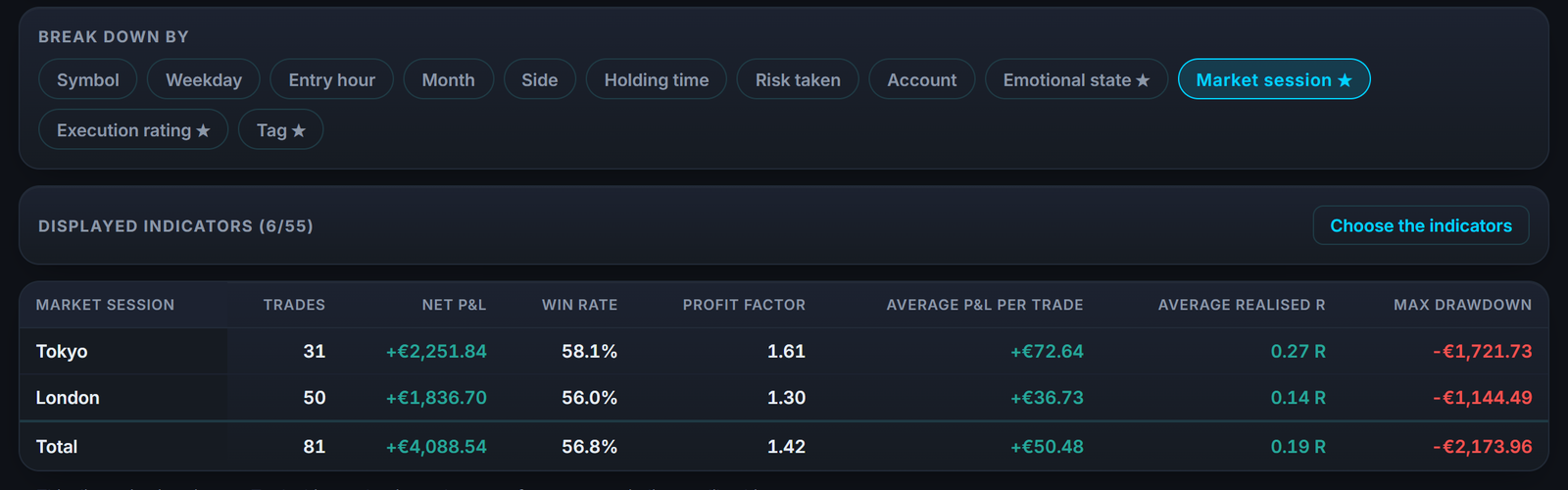
- Breakdowns by time and setup to see where your impatient trades weigh on your performance.
- Emotional check-in to spot boredom and FOMO before they make you trade.
- Configurable rules (number of trades, killzones) that impose selectivity from the outside.
Frequently asked questions
Why is patience so important in trading?
Because impatience is paid for in several ways: forced entries before the setup is complete, rushed exits that truncate gains, boredom trades, overtrading. Research has put a number on the cost of activity for US stocks: from 1991 to 1996, the households that traded the most earned 11.4% net a year against 18.5% for those that traded the least, according to Barber and Odean's study. That study does not cover day trading and does not measure impatience itself.
Is patience about doing nothing?
No. The trader's real patience is active: it's a selective waiting, a vigilance that refuses everything that isn't excellent to seize only what is. The patient trader is hunting, ready to act fast, but only when their precise conditions are met. They trade less out of excess of standards, not lack of desire.
How do I develop patience in trading?
Through rules, not willpower alone. Define a very precise, written setup (a trade that doesn't check all your boxes isn't a trade), limit your number of trades per day, impose a pause after each trade, set time windows. These guardrails are decided with a cool head, before the session, not when the urge is there.
Where does a trader's impatience come from?
Three explanations come up, without having been measured on traders: fear of missing out (FOMO), which makes it unpleasant to see the market move without you; the need to act, observed for instance in goalkeepers who almost always dive on a penalty kick when staying in the centre would have been preferable; and the relationship to money, which makes every minute without a trade look like a missed opportunity. You can act on each of these leads instead of relying on willpower alone.
How do I stop cutting my winners too early?
By letting your trade run to the end of the plan defined with a cool head, knowing the market doesn't go in a straight line and fluctuations are normal. The habit is widespread: across 10,000 accounts at a US broker, Odean's study shows that stock investors sell their winners more readily than their losers. Measure on your own history what your exits before target have cost you: that number, not advice, will tell you whether to change.
How does social media feed impatience in trading?
By displaying other traders' gains without context or proof of consistency, it creates a social FOMO different from the market's own: fear of missing a displayed success rather than a price move. The best defense is limiting this content during your trading hours and remembering that a displayed result never shows the variance or the real number of attempts behind it.
Should I sometimes not trade at all for a day?
Yes, it's a larger-scale form of patience. A market with no clear setup, news blurring the picture, or a degraded personal state are legitimate reasons to stay completely on the sidelines. Recognizing an unfavorable environment and abstaining spares you from forcing mediocre trades to stay busy.