 By Benjamin Roure L'Hermitte
Price takes off without you, your heart races, and you jump in at the top with no clear stop so you don't 'miss the move of the day'. FOMO trading, the fear of missing out, is one of the most reliable magnets for bad entries. The good news: it's a named, predictable bias, and therefore one you can defuse, as long as you understand it before it makes you click.
- Missing isn't losing: you experience a missed opportunity as a loss, even though you had nothing at stake.
- FOMO makes you enter late: often at the worst spot, right before the pullback, with no logical stop.
- It takes three forms: move FOMO, social FOMO, and catch-up FOMO after a loss.
- Urgency is a red light, not green: when it rises, the right move is to NOT act.
Price takes off without you. Your heart races, you tell yourself you're going to miss the move of the day, and you jump in, at the top, with no clear stop. That's FOMO, the fear of missing out, and it's a magnet for bad entries. It takes no special skill to trigger: all it needs is a screen, a fast move, and a human brain.
FOMO isn't beaten by willpower in the moment, because by then your judgment is already biased. When the urgency is there, you're no longer analyzing, you're chasing. So it's beaten upstream, by understanding its mechanism and setting simple guardrails that decide for you when your judgment is out of service.
This article covers where the fear of missing out comes from, why it's so powerful, the three forms it takes, what it really costs, how to defuse it upstream, what to do when it rises mid-session, and how to turn it into a stop signal rather than an entry signal.
What does FOMO mean in trading?
FOMO stands for fear of missing out. In trading, it means taking a position because price is moving without you, not because your setup is there. The definition fits in one test: if the only reason you want to enter is that the move might happen without you, it is FOMO. It shows up as a late entry after a big candle, a trade taken because someone online is in profit, or a position added to catch up on a move you missed.
Why FOMO is so powerful
The word comes from psychology, not from trading. Przybylski and colleagues defined FOMO in 2013 as a pervasive apprehension that others might be having rewarding experiences from which one is absent, and measured it with a ten-item scale, first on 1,013 adults recruited online across several countries, then on a representative sample of 2,079 British adults: their study is about social media use and well-being, not about markets. Missing a move is experienced as a loss, even though objectively you've lost nothing: you simply weren't in it. This bias pushes you to chase price instead of waiting for it to come to you, which is the exact opposite of what a patient trader does.
At the root is anticipation. What lights up in front of a fast-rising price is the imagined reward, not a real gain. In a brain-imaging experiment by Kuhnen and Knutson, nineteen volunteers chose between two stocks and a bond, and activation in a region of the reward circuit, the nucleus accumbens, preceded risky choices and risk-seeking mistakes: a laboratory result, not a measurement taken in front of a chart. You react as if the money were already within reach and slipping away, when there's nothing but a green candle on a screen. It's that phantom reward that creates the urgency.
Add the herd effect: when everyone is talking about an asset that's flying, not being in it feels like being shut out of an 'easy' gain that others are cashing in. That is the definition of FOMO quoted above, applied to a chart. And the reflex has been measured: in All That Glitters, Barber and Odean observe, on the accounts of US retail clients at three brokers between 1991 and 1999, that individual investors are net buyers of attention-grabbing stocks, those in the news, with abnormal volume or an extreme one-day return, and that this attention-driven buying does not generate superior returns. By the time everyone is talking, the move is already well advanced.
The three forms of FOMO
FOMO doesn't always show up the same way. Recognizing its three variants helps you locate yourself, because you never think 'I'm in full FOMO', but you can think 'I'm chasing a move'.
1. Move FOMO
The classic form: an asset takes off fast, you're not in it, and you jump aboard so you don't miss the train. You enter when the move is already well advanced, so at the worst possible risk/reward, right before those who were in before you take their profits at your expense.
2. Social FOMO
Everyone's talking about an asset on social media, your contacts are posting their gains, and you feel stupid for not being in. This FOMO isn't even triggered by your own screen, but by other people's. It's the most dangerous, because it makes you trade assets you don't follow, with no plan, purely out of fear of being left on the platform. Regulators have spelled it out: ESMA warns against trading decisions based exclusively on exchanges of views and informal recommendations on social networks, the AMF tells investors to be wary of promises of quick gains and to question the credibility and interests of whoever is posting, the SEC notes how tempting it is to jump on the bandwagon and that short-term trading in these stocks can lead to significant and unanticipated losses, and the CFTC points out that for every post about taking it to the moon, there are many more about people losing some or all of their money.
3. Catch-up FOMO
After a loss, you see a move and tell yourself it's the chance to win it back in one shot. Here FOMO combines with revenge trading: you're no longer looking for a good trade, you're trying to erase a loss, and the urgency is amplified by frustration. It's the cocktail that does the most damage.
The situations that trigger FOMO
- A fast, vertical move you didn't anticipate.
- An asset everyone is talking about on social media.
- A day when you haven't taken anything yet and you're bored.
- A winning streak that makes you overconfident.
- A recent loss you want to 'make back' with one big shot.
- A news release that spikes the price before you've had time to think.
The real cost of a FOMO entry
Entering on FOMO means entering late, often at the worst spot: right before the pullback. With no plan, you have no logical stop, so either you cut in panic as soon as it turns against you, or you let the loss run and hope. Both outcomes are bad. The move you had to catch becomes the loss you wanted to avoid.
The cost doesn't stop at the trade itself. A losing FOMO entry often feeds a second impulse (the catch-up), and puts you in a degraded emotional state for the rest of the session. A single trade taken out of fear of missing out can thus contaminate your whole day.
| Planned entry | FOMO entry |
|---|---|
| You wait for price to come to your level | You chase price |
| Logical stop defined in advance | No clear stop, placed at random |
| Known risk/reward ratio | Unfavorable ratio (you enter late) |
| Cold decision | Decision on adrenaline |
| Missing = zero consequence | Forcing = real loss |
FOMO doesn't only hit entries
We associate FOMO with entries, but it also attacks exits. The same mechanism makes you hold a winning trade too long for fear of missing the rest of the move, until price reverses and erases your gain. Conversely, it can make you cut another trade too early to 'secure' and jump on an asset moving faster elsewhere. In both cases, it's the fear of missing something else that decides, not your plan.
Defusing FOMO upstream
The counter fits in one sentence: if there's no entry in your plan, there's no trade. The market produces opportunities every day. Missing one doesn't matter; forcing a bad one costs real money. This framework is built before the session, while you're still calm:
- Write your entry conditions before the session. If they aren't met, you don't enter.
- Prepare a watchlist and levels in advance: you only trade what you've already studied, not what's flailing at random.
- Remind yourself there will be another setup tomorrow, and the day after.
- Accept cold the idea that you'll miss moves. It's the normal price of selectivity, not a failure.
- If you really want in, wait for the pullback and a genuine entry point, stop included.
What to do when FOMO rises mid-session
Rules prevent, but you also need to react when you feel the urgency rising, finger on the mouse. The goal isn't to 'trade well' in that moment, it's to break the automatism:
- Impose a few seconds' pause before any unplanned click: the urgency fades fast.
- Ask the test question: would I have taken this trade an hour ago, before it moved?
- If the move is real, wait for the pullback rather than buying the top: either a genuine entry appears, or you're glad you didn't enter.
- Name what you feel, out loud or in writing: 'I'm chasing price right now'.
Turning urgency into a signal
Urgency isn't a green light, it's a red one. Once you've internalized that, every rise of FOMO becomes a useful alert instead of a buy order. Tradoshi's emotional check-in helps you name that state before you trade. Putting a word on what you feel is more than a trick: in a brain-imaging study, Lieberman and colleagues observed in thirty participants that labeling the emotion, in response to negative images, reduced the amygdala's response and increased activity in a region of the prefrontal cortex; a laboratory result, not a measurement taken in front of a chart, but it points the same way as what you notice yourself: putting words on it brings you back to your plan.

Measuring what FOMO costs you
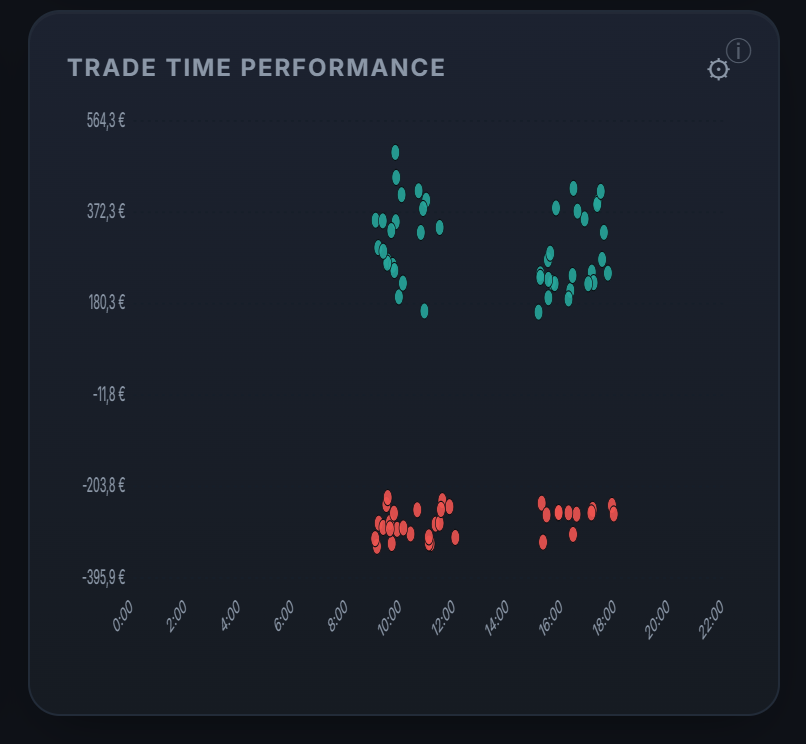
As long as 'I do FOMO' stays a feeling, you won't change much. When it becomes 'my off-plan entries cost me X over the month, with numbers to prove it', the argument becomes impossible to ignore. By analyzing your trades, Tradoshi surfaces the entries taken outside your conditions and their real result: you see in black and white that chasing price costs you money, which makes the rule far easier to hold.
A concrete example
An asset you don't follow spikes 4% in ten minutes after a news release. Two traders see it. The first doesn't have that market in their plan: they note the opportunity, don't trade, and move on. The second enters at the top out of fear of missing out, with no thought-out stop; price retraces half the move within the hour, they cut in panic with a loss, then try to win it back elsewhere. The move was real in both cases. The difference isn't in the market analysis, it's in the relationship to the fear of missing out.
Frequently asked questions
Does FOMO go away with experience?
It fades but doesn't fully disappear, because it rests on an emotional reaction, not on a lack of knowledge. Experience doesn't remove the urgency, it teaches you not to obey it. The difference isn't in the emotion, it's in the response.
How do I tell a FOMO entry from a real signal?
Ask yourself one simple question: was this entry in your plan before price moved? If yes, it's a signal. If you justify it after the fact because 'it's leaving', it's FOMO. FOMO is recognizable by the fact that it always arrives after the move, never before.
What if I really miss the big move of the year?
You will miss some, and that's fine. A profitable strategy doesn't need to catch every move, just to play well the ones that fit its plan. A missed big gain costs nothing; a series of forced entries can cost your account.
Does FOMO only exist on very volatile cryptos?
No, it exists on every market. It's just more visible on heavily hyped, highly volatile assets. On forex or indices it takes the quieter form of 'jumping into the ongoing trend' without a clean entry point.
How do I handle FOMO coming from social media?
By remembering that you only see other people's gains, never their losses. Social feeds are a staged highlight reel of wins, and FINRA says it in its own words: social media thrives on emotional engagement, and the steeper the rise or the fall, the more appealing it can seem to derail a strategy with a snap decision. Trading an asset just because it's trending, with no plan or prepared level, is one of the most reliable ways to lose. Cut the noise during your sessions.
Doesn't waiting for the pullback make me miss real moves?
Sometimes yes, and that's acceptable. When a pullback comes, it gives you a far better entry point and a closer stop; when it doesn't, you've simply avoided buying a top. What you lose in missed moves, you gain in forced entries avoided, and those are the entries that cost real money.
Can FOMO also make me hold a trade too long?
Yes. The fear of missing the rest of the move makes you hold a winner beyond your plan, until it reverses. FOMO doesn't only hit entries: it attacks exits too. The counter is the same, decide your exit in advance and stick to it.
Is naming my emotion really enough?
Often, yes, at least enough to break the automatism. Putting a word on an emotional state creates a moment of distance, and that is the effect measured in the laboratory in the study cited above: a weaker emotional reaction once it is named. It's not magic, but combined with a clear rule, it puts a pause between the impulse and the click.