
You buy a call at 9:35, sell it at 11:10 for 40% more than you paid. Feels great on a screenshot. But day trading options is one of the least forgiving corners of intraday trading, and most people who jump in underestimate how fast theta and the bid-ask spread eat their account before the underlying even moves in their favor.
- Leverage cuts both ways: an option magnifies gains, but it magnifies losses just as fast, and the speed is the part people forget.
- The PDT rule forces a 25,000 dollar minimum on US margin accounts once you hit 4 day trades in 5 business days.
- Short expirations (0DTE, weeklies) concentrate gamma and theta, which makes timing far more critical than on standard monthly options.
- The real cost isn't the commission, it's the bid-ask spread, invisible until you've paid it a few dozen times.
Day trading options: what it actually means
The definition is simple enough. You buy or sell option contracts, calls or puts, on a stock, an ETF or an index, and you close everything before the session ends. No position carried overnight. Zero exposure to tomorrow's opening gap, zero surprise headline hitting at 3am while you sleep and blowing up your position. That's the pitch, and it's a real one.
But the flip side is just as real: an option loses value every single day, that's theta decay, and it accelerates as expiration gets closer. On a 0DTE option, one expiring the same day you bought it, theta stops being a background variable and becomes a constant pressure chewing through your position minute by minute. You can be right on direction and still lose money because time did its job faster than price moved.
So why options instead of the stock itself? Leverage. With 500 dollars you can't control much stock, but you can control the equivalent of several thousand dollars of underlying through options. That leverage is the hook. It's also what wipes accounts out in three sessions when risk management isn't there. If the basics are still fuzzy, the article on option fundamentals is a non-negotiable prerequisite before going further.
Why traders pick options over the underlying stock
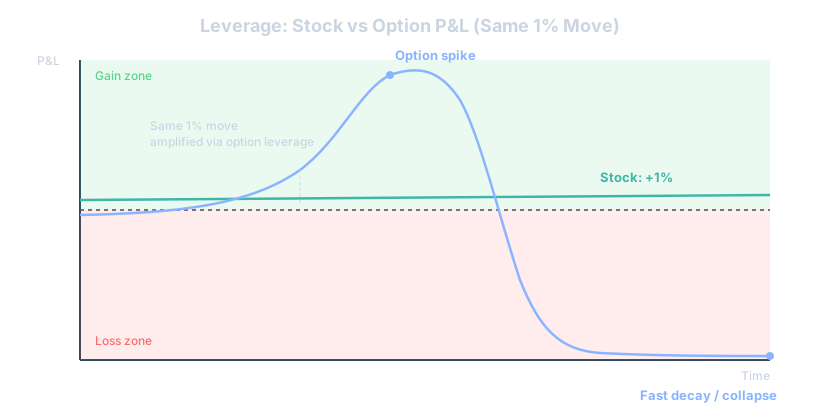
Take a concrete, illustrative case. SPY trades at 500 dollars. You expect it to pop 1% in the hour following a macro release. In stock, you'd need 50,000 dollars to control 100 shares and pocket roughly 500 dollars on that move. In options, a near-the-money call priced at 3 dollars can gain 60% or 70% on that same 1% underlying move, because delta and gamma accelerate hard near the strike. Your capital at risk is ten times smaller for a percentage gain that's massively bigger.
Nobody posts the other side of that coin on social media. That same call can lose 50% of its value in twenty minutes if the underlying stalls or drifts slightly lower, while in stock you'd just be sitting on a small paper loss. Implied volatility works against you too: if it deflates after the news (the classic volatility crush), your option can lose value even while the underlying goes your way. That's mistake number one for traders coming from stocks: they trade direction and forget the option has three other dimensions, time, volatility, distance to strike, that matter just as much.
The Pattern Day Trader rule: a wall you need to know before you start
In the US, FINRA enforces the PDT rule: place more than 3 day trades in a rolling 5 business day window on a margin account and you get flagged 'Pattern Day Trader', which requires a 25,000 dollar minimum account balance. Fall below that and your broker locks you out of opening new trades once you hit the quota. A lot of newer traders discover this the hard way, mid-session, blocked, which is the worst possible time to learn about it.
There are partial workarounds: trading a cash account instead of margin (though you lose immediate access to funds after a sale, which hurts if you want to chain trades), opening accounts at multiple brokers, or going through a prop firm that supplies capital in exchange for following its own rules. That last option deserves real thought if being undercapitalized is your main obstacle, and choosing the right prop firm with the correct criteria keeps you away from overly restrictive intraday conditions. For the full regulatory picture and the gray areas, the dedicated piece on the Pattern Day Trader rule covers it in depth.
Picking your strike and expiration: the decision that shapes everything
Two variables alone almost define your trade's risk profile: strike and expiration. An at-the-money option reacts fast to any move in the underlying, high delta, but costs more in premium. An out-of-the-money option is cheaper, offers a bigger theoretical percentage leverage, but needs a much larger move to turn profitable, and bleeds value faster if nothing happens.
On expiration, 0DTE contracts, expiring the same day you buy them, have become the trend. They're wildly popular on SPY and QQQ because they're cheap and react violently to intraday swings. The catch: gamma is enormous near expiration, meaning the option's price can double or get cut in half in a few minutes without the underlying doing anything extraordinary. That's a tool for an experienced trader who can handle a position moving at that speed, not an entry point for someone discovering options this month.
A more reasonable path while you're still building skill: standard weekly options, a few days left on the clock. Theta weighs less on a 3 to 5 day expiration than on 0DTE, which leaves some breathing room if the trade takes a bit longer than expected to play out. Most traders who actually last in this business start there before dropping down to 0DTE once they've internalized how gamma behaves.
| Expiration | Advantage | Main risk |
|---|---|---|
| 0DTE (same day) | Low premium, extreme reactivity | Explosive gamma, brutal theta |
| Weekly | A bit of time cushion | Higher premium cost |
| Monthly | Slower theta, less stress | Weaker intraday leverage |
The bid-ask spread: the silent killer of options day traders
Everyone talks about commissions, almost nobody talks enough about the spread. On a liquid option, a near-the-money SPY call for instance, the spread might be a penny, negligible. On a less liquid one, a mid-cap stock or a far-out strike, the spread can eat 5%, 8%, sometimes 15% of the option's value. You buy at the ask, you sell at the bid: that difference gets paid on every round trip, win or lose.
Run the numbers honestly. If you're trading options with an average 4% spread, you already need a 4% move in your favor just to break even. Multiply that across ten trades a week and you understand why some traders who are 'right' on direction most of the time still end up net negative for the month. Underlying liquidity isn't a cosmetic detail, it's a profitability factor in its own right, right up there with your directional edge.
Building an intraday options strategy that actually holds up
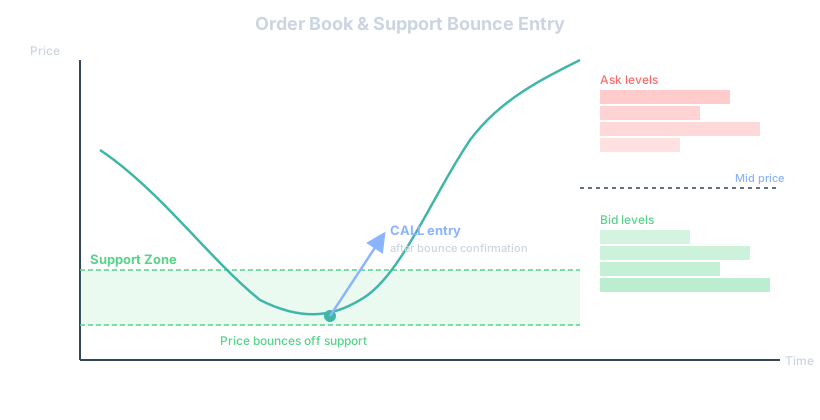
Intraday technical reading is still the foundation: support and resistance levels, volume, price action around key zones. Many options day traders also lean on order book and order flow reading to anticipate very short term moves. If that part is still fuzzy for you, the piece on order flow in trading lays the groundwork before you risk it on options, where execution speed counts double.
Reversal or continuation zones, often mapped through supply and demand areas, act as entry triggers for a lot of intraday options traders. The idea: you don't enter randomly, you wait for the underlying to react at a defined level before buying your call or put, which gives you a clear invalidation point and a risk/reward ratio defined before you even place the order.
That ratio needs to be reframed for options compared to stocks. A losing option trade can cost you up to 100% of the premium if you hold to worthless expiration, while a stock loss is usually linear and more gradual. That means your mental stop, your loss threshold, needs to be tighter as a percentage of premium, not as a percentage of underlying movement. Revisiting the risk/reward ratio explained helps you recalibrate that thinking specifically for options.
Risk: the part nobody likes talking about
Day trading options has one brutal quirk: unlike forex or plain stock, a position can go to zero. Not near zero. Zero. An option that expires out of the money is worth nothing, full stop. That reshapes your entire relationship with risk: you don't generally 'lose a little', you lose a significant chunk or the whole stake on a trade gone wrong, and it happens more often than beginners expect.
That's exactly why defining how much you're willing to lose per trade, in dollars and as a percentage of account, before you place it, isn't optional. A common approach among traders who survive this style: cap risk per trade at 1% or 2% of total capital, sized through the option's premium, not through some vague sense of confidence in the setup. If position sizing still feels like guesswork, the guide on fixed versus dynamic risk money management gives you a framework you can actually apply to option premiums instead of share counts.
There's also a psychological trap specific to this instrument. Because losses can be total and fast, the temptation to average down or reopen a bigger position right after a loss is enormous. That's the exact mechanism behind revenge trading, and options make it worse because the next trade can be sized up in seconds with a single click. Recognizing that pull before it happens matters more here than in almost any other instrument.
Costs, commissions and the mental math traders skip
Beyond the spread, per-contract commissions add up fast when you're doing five, ten, fifteen round trips a day. A dollar per contract sounds trivial until you multiply it by volume and realize it's shaving a meaningful slice off your monthly edge. Add regulatory fees, and the breakeven point on a high-frequency options day trading approach is higher than most beginners assume when they first run the numbers.
There's also an underestimated cost: slippage on market orders during fast-moving 0DTE sessions. You click buy expecting to pay the displayed ask, and by the time the order fills, price has already ticked against you. On a highly liquid underlying like SPY this is usually small. On a smaller-cap stock's options chain, it can be the difference between a winning and a losing trade before you've even started managing the position.
Liquidity and underlying selection: not all tickers are equal
SPY, QQQ, and a handful of mega-cap stocks dominate options day trading for a reason: tight spreads, deep order books, predictable price action around key levels. Straying into a thinly traded underlying because you spotted a chart pattern there is a classic beginner move, and it usually ends with a spread wide enough to erase whatever edge the pattern gave you. Liquidity should be a filter applied before the technical setup, not an afterthought.
Volatility of the underlying matters too, separately from liquidity. A stock that gaps 8% on earnings surprises might look tempting for options day trading, but that same volatility makes premium pricing unstable and spreads wider around news catalysts. Sticking to underlyings with consistent, well-understood volatility patterns, rather than chasing whatever moved most yesterday, tends to produce steadier results over time.
Tracking your options trades: the discipline most people skip
Here's an uncomfortable truth: most options day traders have no real record of what actually worked. They remember the big winning call and forget the six small losing puts that funded it. Without a proper log, you're managing a strategy from memory, and memory is a terrible risk manager. Keeping a useful trading journal isn't busywork, it's the only way to know if your 0DTE approach actually has an edge or just felt good on the days it worked.
What you track matters as much as the fact that you track. Strike chosen versus strike that would have performed better, time held versus theta lost, spread paid versus profit realized: these details, tagged consistently over dozens of trades, are what separate a trader who improves from one who repeats the same mistake with a different ticker symbol every week.
How Tradoshi helps you
Tradoshi won't tell you which strike to buy or predict where SPY goes at 10am, and it doesn't automatically tag your trades by news event or session, you fill that context in yourself. What it does is give you the structure that options day trading desperately needs. Import your fills automatically from MT4, MT5, cTrader or a crypto exchange, or log manually when your broker doesn't sync, and every option trade gets recorded with the numbers that matter: R-multiple, win rate, profit factor, expectancy.
The position size calculator and customizable risk rules help you size premium exposure as a percentage of capital instead of eyeballing contract counts, which is exactly the discipline the PDT-constrained, leverage-heavy world of options demands. The Discipline Score shows you whether you're actually following your own rules on strike selection and stop-outs, not just whether you made money this week. And Trade Review lets you replay a fast 0DTE trade, tag it with your own free labels, note the emotion you felt going in, and check plan adherence after the fact, which is often where the real lesson about theta and spread cost finally sinks in.
Common mistakes that wreck options day traders
Buying deep out-of-the-money options because they're cheap is the classic trap. Cheap doesn't mean good value, it usually means the market is pricing in a low probability of the move you need happening in the time you have left. Another frequent error: holding a losing 0DTE position into the final hour hoping for a reversal, when theta in that window is working against you at its fastest rate of the entire day.
Overtrading is its own category of damage here. Because commissions per contract feel small and execution is instant, it's tempting to fire off trade after trade chasing every wiggle on the five-minute chart. That's overtrading in its purest form, and options make the consequences sharper because each entry carries a built-in decay clock the moment it's placed. Slowing down and waiting for setups that actually meet your criteria beats forcing volume for the sake of staying busy.
Frequently asked questions
Is day trading options profitable for beginners?
It can be, but the odds are stacked against anyone without a tested plan. The combination of leverage, theta decay and bid-ask spread means beginners often lose faster than they would trading stocks with the same capital.
What's the minimum capital needed to day trade options?
In the US, if you exceed 3 day trades in 5 business days on margin, the PDT rule requires 25,000 dollars. Below that, a cash account or a prop firm arrangement are the common alternatives.
Are 0DTE options too risky for most traders?
For anyone still learning how gamma and theta behave, yes, they're extremely unforgiving. Weekly options with a few days left offer a gentler learning curve before moving to same-day expirations.
Why did my option lose value even though I predicted the direction correctly?
Time decay and a drop in implied volatility can outweigh a small favorable move in the underlying, especially on short-dated contracts. Direction alone isn't enough, magnitude and speed matter just as much.
How much of the cost comes from the bid-ask spread versus commissions?
On liquid underlyings like SPY, the spread is often minimal, but on less liquid names it can dwarf commission costs, sometimes representing several percent of the option's value on every round trip.
Should I day trade options on stocks or on indices like SPY and QQQ?
Index-linked ETFs like SPY and QQQ generally offer tighter spreads and deeper liquidity, which matters more for day trading than the specific narrative behind an individual stock.
Can I day trade options without hitting the PDT rule?
Yes, by staying under 4 day trades in a rolling 5 day window, using a cash account, or trading through a firm that provides its own capital and rules.
What's a reasonable risk per trade when day trading options?
Many disciplined traders cap risk at 1% to 2% of account capital per trade, sized against the premium at stake rather than the number of contracts.
Do I need to understand the Greeks to day trade options intraday?
At minimum, yes, for delta and theta. Gamma becomes critical once you move into short-dated contracts like weeklies or 0DTE, where price sensitivity changes fast near the strike.
How is day trading options different from day trading crypto?
Options carry expiration and time decay, which crypto positions don't, but both share the intraday discipline problem of overtrading and emotional exits; the mechanics differ, the psychology often doesn't, as covered in the piece on day trading crypto.