
Someone told you day trading is just gambling with extra steps. Maybe after a rough month, you started wondering if they were right. Is day trading gambling, or is that just an easy insult thrown at something people don't understand?
- Most day traders lose money, that part is well documented and looks a lot like gambling statistics.
- The activity itself is not inherently random, it can produce a real statistical edge when built properly.
- The split happens in the approach: tested plan and risk control versus impulse and blind sizing.
- Gamblers and undisciplined traders share the same brain wiring: illusion of control, chasing losses, FOMO.
Gambling, speculation and investing are not the same thing
Let's get the definitions straight first, because people mix these up constantly. Pure gambling, in the strict sense, is an activity where the mathematical expectation is negative by design. At roulette, the zero (or double zero) hands the house a permanent structural edge. You can win one night. You can even win ten nights in a row through sheer luck. But across thousands of spins, the outcome converges toward loss. No skill reverses that, aside from rare exceptions like blackjack card counting, which casinos actively hunt down and ban precisely because it breaks their edge.
Speculative trading carries no such built-in guarantee. There's no dealer skimming a fixed cut off every trade with the sole purpose of making you lose. There are fees, a spread, sometimes a commission, but the expectancy of the activity itself is not mathematically negative for everyone involved. Some participants, market makers, certain funds, some disciplined individual traders, run a positive expectancy over time. Others, the majority, run a negative one because they pay the costs, eat the spread, and make poor decisions under pressure. That distinction matters: the activity allows for an edge, it just doesn't hand one to anybody for free.
Long-term investing runs on yet another logic: broad economic growth, dividends, a company's valuation compounding over years. Day trading has almost nothing to do with that. It plays out on very short-term price moves, often within a single session, where statistical noise usually drowns out any real signal. That's exactly why the gambling comparison keeps coming back. Over short horizons, telling a good trade apart from a lucky one is genuinely hard, even for the person who placed it.
What the numbers actually say about day trader success
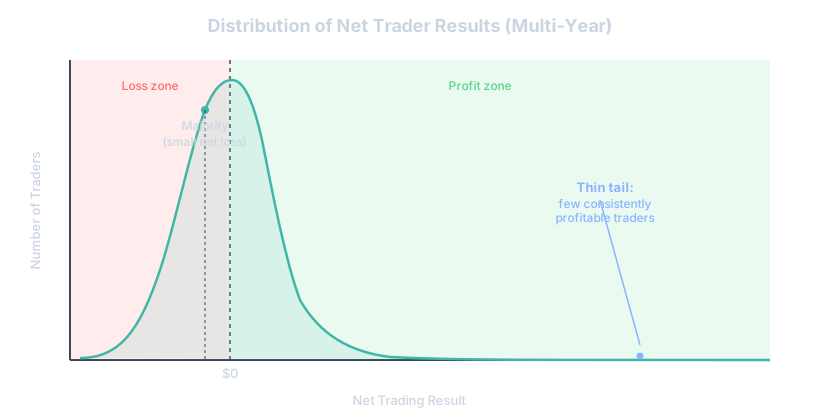
Several academic studies have tracked cohorts of individual day traders, notably in Brazil and Taiwan, alongside analyses from regulators such as France's AMF. The pattern that shows up again and again is fairly consistent: a large majority of active day traders end up net losers over periods spanning several months to several years, and only a small minority, often estimated at a low single-digit percentage, manage to pull a regular net profit once costs are stripped out.
That figure alone fuels the gambling argument. If almost everyone loses, isn't that the signature of a negative-sum game, just like a casino? The argument sounds solid on the surface. But it blends two separate things: the average outcome across a population of traders, and the nature of the activity itself. In poker, most players also lose money over the long run, against a small minority who make a living from it. Nobody claims poker is pure luck because of that. It's a game of incomplete information where skill weighs heavily, but where short-term variance is enormous and where most players master neither the odds nor their own psychology.
Day trading looks a lot more like poker than roulette. The gap between the person who blows up their account and the person who trades for a living isn't rooted in market randomness, it's rooted in whether an edge exists, whether risk is managed, and whether execution is disciplined. That's where the question turns personal: which side of that line are you actually standing on, right now, with your own numbers?
The statistical edge: what actually separates a trader from a gambler
An edge is the measurable statistical advantage of a strategy over time. In plain terms, it's a positive expectancy: across a hundred trades taken under the same rules, you come out ahead in aggregate, once fees are included. Without a demonstrated edge, you're just betting on whatever your gut says in the moment, the same way someone bets on red because they've got a feeling. With a tested edge, each individual trade still carries uncertainty, but the series of trades converges statistically toward a positive result.
Here's an illustrative example. A trader runs a method that wins 40 percent of the time, with an average reward-to-risk ratio of 2 to 1. Over ten trades, they typically lose six and win four. Risking 100 dollars per trade, the four winners bring in 800 dollars, the six losers cost 600: net result, 200 dollars in profit across the series, despite losing on the majority of trades. This is exactly the mechanism most people shouting 'gambling' completely miss: a trader can lose more often than they win and still stay profitable, as long as the size of the wins comfortably outweighs the frequency of the losses.
The catch is that this edge can't be invented and can't be felt. It has to be measured, over a sufficient sample of trades, under comparable conditions. Plenty of day traders have simply never checked whether their method has a positive expectancy. They trade on a feeling, which statistically amounts to flipping a coin with transaction costs stacked on top. This is exactly where backtesting changes the game: testing a strategy against historical data before risking a single dollar live is the difference between betting and verifying.
Short-term variance, long-term skill
Here's mental trap number one in day trading: on a short timescale, the result of an individual trade looks a lot like a random draw, even when real skill is quietly at work behind it. A genuinely strong trader can string together five losses in a row purely through statistical variance, while executing their method flawlessly. A beginner with zero edge can, on the flip side, string together ten winning trades through pure luck and walk away convinced they've cracked the market.
That confusion between short-term outcomes and long-term skill is exactly what drags so many people into gambling-style behavior. After a lucky streak, overconfidence creeps in: position sizes grow, stops get loosened. After a losing streak, even one where the plan was followed to the letter, doubt and panic set in, and the urge to 'get it back immediately' takes over. In both cases you're reacting to statistical noise as if it were a reliable signal, and that's the exact mechanism behind revenge trading after a poorly digested loss.
The only real way out of this trap is thinking in series, not in isolated trades. A trader who thinks 'this trade has to win' already has one foot in gambler logic. A trader who thinks 'across a hundred trades like this one, my stats say I'm profitable' has understood that variance exists and that it doesn't invalidate anything as long as the sample stays small.
Psychological biases: is day trading like gambling in the brain department?
This is where the two worlds genuinely overlap, and where the gambling critique lands a real hit whether you like it or not. Illusion of control, first. The casino gambler who blows on the dice believes they're influencing a purely random outcome. The day trader who piles indicator after indicator onto their chart, adding trendlines, patterns, retracements, until they finally get the 'confirmation' they'd already decided on before opening the chart, is doing the exact same thing: hunting for control where there's only, at best, a slightly favorable probability.
Chasing losses shows up almost identically in both worlds. The gambler who just lost doubles the next bet to 'get it back in one shot'. The trader who just lost a trade doubles the size of the next position, with no plan, just to erase the pain of the previous loss. It's an emotional reflex, not a rational decision, and it very often leads to the same place: an account drained even faster. FOMO, the fear of missing the move, pushes you into a position with no valid setup, simply because 'it's ripping' and standing on the sidelines feels unbearable. You see the same pattern in the gambler who joins a table because 'everyone's winning tonight'.
The good news is that these biases can be spotted and worked on, which isn't true at a casino, where no amount of skill offsets the house's structural edge. Recognizing these patterns in yourself, naming them, is already half the battle. A dedicated piece breaks down this exact mechanism behind FOMO in trading and how to defuse it before it triggers an impulsive entry.
Warning signs you're trading like a gambler, not a professional
Some behaviors don't lie, and if you recognize yourself in several of these, it's time to get honest. These are the ones prop firms and serious mentors spot first in a struggling trader.
- You open positions without knowing precisely why, just because the market is moving and you want in.
- You've never placed a stop loss, or you keep moving it every time price gets close.
- Your position size swings from small to triple-sized depending on your mood, not on a risk calculation.
- You take ten, fifteen, twenty trades a day and none of them match a setup you'd actually written down beforehand.
- After a loss, your immediate reflex is jumping back into a position within the minute to 'make it back'.
- You can't say, with numbers to back it up, whether your method has actually been profitable over the last three months.
That last point deserves a pause, because it sums up nearly everything else. The real dividing line between a trader and a gambler isn't the market they touch, it's whether they can answer that question honestly. Most people can't, not because the answer is bad, but because they've never actually tracked it.
Structure versus impulse: the real difference in practice
Picture two people trading the exact same instrument on the exact same day. The first one has a written plan: a specific setup, a maximum risk per trade set at 1 percent of capital, a stop loss placed before the entry, a profit target defined in advance. The second one watches a candle spike, feels a jolt of adrenaline, and clicks buy because 'it looks like it's about to explode'. Same market, same minute, two completely different activities happening under the same label of 'day trading'.
The first trader might lose that specific trade. That's fine, losses are part of any edge, even a good one. What matters is that the loss stayed within a predefined, survivable boundary, and that the decision came from a repeatable process rather than a gut reaction. The second trader might actually win that particular trade, purely by chance, and that's arguably worse for them long term, because a lucky win reinforces exactly the impulsive behavior that will eventually blow up the account. Overtrading often grows out of this second pattern: no plan means no natural stopping point, so trades just keep piling up.
This is also where money management earns its keep. Deciding, before you ever open a position, how much of your capital you're willing to put at risk removes the emotional negotiation that happens mid-trade, when your brain is flooded with cortisol and desperately wants to move the stop loss 'just a little further'. A gambler negotiates with the dealer in their head. A structured trader already settled that argument the night before, on paper.
Regulation and legal treatment: another clue the two aren't equal
Regulators don't treat day trading and gambling the same way, and that distinction is worth something. Financial trading falls under securities and market regulation, brokers must be licensed, trades are recorded and reportable, and in several jurisdictions profits are taxed as capital gains or business income rather than as gambling winnings. The US Pattern Day Trader rule, for instance, exists specifically to protect undercapitalized retail traders from themselves, requiring a minimum equity threshold before allowing frequent day trades in a margin account, a safeguard that has no real equivalent at a casino cashier.
That regulatory framework doesn't prove trading is skill-based on its own, but it reflects a broader consensus: financial markets serve an economic function (price discovery, liquidity, capital allocation) that gambling simply doesn't. A casino exists purely for entertainment and house profit. A market exists because companies need capital and buyers need counterparties. Day traders operate inside that structure, even when their individual behavior looks reckless. The activity has legitimate infrastructure around it. What you do inside that infrastructure is entirely up to you.
What professional traders and prop firms actually think
Ask anyone who has passed a serious prop firm evaluation, and you'll hear a similar refrain: the traders who fail almost always fail on risk control, not on market analysis. Prop firms build their entire evaluation model around this insight. Daily loss limits, maximum drawdown thresholds, consistency rules, all of it exists because firms know that raw prediction skill without discipline is worthless, and honestly dangerous. A trader who correctly calls market direction 70 percent of the time but risks 20 percent of their account per trade will still blow up. A trader who's right only 45 percent of the time but respects a tight risk framework can compound steadily for years.
Professional desks don't talk about 'winning trades' the way retail forums do. They talk about expectancy, drawdown curves, R-multiples, Sharpe ratios. The vocabulary itself signals a different mindset: probability management instead of prediction worship. When a prop firm evaluator reviews an application, they're not asking 'did this person call the market right', they're asking 'would this person survive a bad month without breaking the account'. That question alone tells you where the real skill in this activity lives.
How to shift out of a gambling mindset, step by step
If parts of this article made you uncomfortable, good, that discomfort is useful. Turning your trading from a series of impulsive bets into something closer to a repeatable process doesn't require reinventing your entire strategy overnight. It requires a few concrete habits, applied consistently.
- Write your setup down before you take it, in one or two sentences, so 'I felt like it' stops being an acceptable reason.
- Define your risk per trade as a fixed percentage of capital, and calculate position size from that number rather than from a round lot you're used to.
- Place your stop loss the moment you enter, not after, and treat moving it as a rule violation rather than a flexible option.
- Track every trade in a structured way so you can actually calculate your win rate, average win/loss ratio and expectancy instead of guessing.
- Review losing streaks against your rules, not against your emotions, to check whether the plan failed or you did.
- Backtest any new idea on historical data before risking live capital on a hunch.
None of these steps guarantee profitability. Nothing does, and anyone promising otherwise is selling something. But they shift the nature of the activity itself, from a string of disconnected bets toward a measurable process you can actually audit and improve. That audit is exactly what turns 'is day trading gambling' from a rhetorical jab into a question you can answer with your own numbers.
How Tradoshi helps you
This is precisely the gap Tradoshi is built to close. Instead of trading from memory and vague impressions, you log every position through automatic broker import from MT5, MT4 or cTrader, plus crypto exchanges, CSV import or manual entry, and the platform calculates your win rate, profit factor, expectancy, drawdown, R-multiples and average win/loss ratio automatically, alongside an overall Oshi Score out of 100 that gives you a single read on where you stand.
On the risk side, you set the percent of capital you're willing to risk per trade, use the position size calculator to remove the guesswork, and define your own risk rules through a daily risk calendar, the exact structural discipline that separates a plan from a bet. The discipline score then measures how well you actually follow your own rules over time, which is often the most honest number in the entire app.
On the psychological front, an emotional check-in before each trade combined with emotion / performance link analysis lets you see, in your own data, whether your worst trades cluster around specific emotional states, the same states that drive gambling-style decisions. Trade Review adds replay, debrief, plan adherence tracking and free labels you choose yourself, so patterns that used to feel like bad luck start looking like something you can actually name, track and correct.
FAQ
Frequently asked questions
Is day trading gambling from a legal and tax standpoint?
No. Day trading falls under securities regulation, brokers must be licensed, and profits are generally taxed as capital gains or business income rather than gambling winnings, which reflects a different legal treatment than betting.
Is day trading like gambling if I use a strategy I found online?
It behaves like gambling if you've never verified that strategy has a positive expectancy on your own data. A strategy someone else claims works isn't an edge until you've tested it yourself.
Is day trading considered gambling by professional traders?
Most professional traders and prop firms consider it a skill-based activity when practiced with risk control and a tested method, but they openly acknowledge that the majority of retail participants trade in a way that closely resembles gambling.
Why do most day traders lose money if it's not pure luck?
Because having access to a market doesn't hand you an edge automatically. Most retail traders never test their method, ignore transaction costs, and make emotional decisions, which produces losing results even though the activity itself isn't structurally rigged.
What's the single biggest difference between a trader and a gambler?
Risk management applied before the decision, not during it. A trader defines position size and stop loss ahead of time; a gambler negotiates with themselves mid-bet.
Can day trading ever have a real statistical edge?
Yes, if a method is tested across a large enough sample of trades and shows a measurable positive expectancy after costs, the edge is real, even if any single trade remains uncertain.
Is short-term variance proof that day trading is random?
No. Variance over a small number of trades looks similar to randomness even when a real edge exists underneath, the same way a skilled poker player can still lose several hands in a row.
How can I tell if I personally trade like a gambler?
Check for overtrading without setups, absent or frequently moved stop losses, position sizes that swing with your mood, and an inability to state your actual win rate or expectancy from tracked data.
Does regulation like the Pattern Day Trader rule prove trading isn't gambling?
It shows regulators treat trading as a distinct, structured financial activity requiring safeguards, which reinforces the difference from gambling, though it doesn't guarantee any individual trader is using a sound method.
What's the fastest way to stop trading like a gambler?
Start tracking every trade with its rationale, risk taken and outcome, so decisions get judged against a written plan instead of a feeling, and patterns of impulsive behavior become visible instead of invisible.