 By Benjamin Roure L'Hermitte

The best prop firm is the one whose published rules fit the way you trade, and you find it by reading those rules on each firm's own pages, not by comparing advertised capital. Drawdown type, daily loss, consistency rule, fees, payout conditions, allowed instruments and the real nature of the account differ from one firm to the next, and they change: everything this article cites was read in October 2026 on FTMO's and Topstep's pages, and is to be checked on each firm's page before paying for any challenge.
- Advertised capital matters less than the rules: read the drawdown, daily limit, conditions.
- The rules that eliminate are written down: minimum days, overnight holding, consistency rule, each on the firm's page.
- Check payout reliability, not just the advertised split.
- The 'funded' account is simulated: FTMO and Topstep write it themselves, and regulators have said so too.
The prop firm market has exploded, and with it the marketing: '100,000 in capital', '90% of profits for you', 'paid in 24h'. These promises say nothing about what matters: the rules you will have to respect not to lose the account, and the real conditions for getting paid. Choosing on advertised capital alone is like signing a contract without reading the clauses.
A prop firm is a business partner, with a contract. This guide explains which criteria to compare, where to read them, what the firms themselves write about the nature of their accounts, and what regulators have published about these offers. It does not rank firms: a ranking without written criteria is worth nothing, and rules and prices change.
Advertised capital isn't the real criterion
The candidate's first reflex is to compare prop firms on offered capital: 'this one offers 100,000, that one 200,000'. It's the wrong angle. Capital only has value if the rules genuinely let you trade it and draw gains from it. Large capital with a tiny drawdown and stifling rules is worth far less than modest capital with livable rules.
What truly counts is the profit target / loss margin pairing, and it is read on the firm's page. At FTMO, according to its page on its trading objectives, the 2-Step asks for 10% then 5% in verification, with a static maximum loss of 10% of the initial capital and a 5% daily loss; the 1-Step asks for 10% with a 3% daily loss and a 10% end-of-day trailing maximum loss. A firm asking 10% while granting 5% of margin puts you in a far tighter spot than one asking 8% with 10% of margin. Always look at these numbers together: their ratio defines the real difficulty, not the amount displayed in big letters on the homepage.
The rules that truly matter
Before paying for a challenge, you must know by heart the rules that will decide your success or failure. Here are the essential criteria to compare:
| Criterion | Question to ask yourself |
|---|---|
| Profit target | What percentage, in how much time? |
| Total loss (drawdown) | Fixed or trailing? On balance or equity? |
| Daily loss | What amount, computed how? |
| Minimum days | How many trading days required? |
| Position holding | Can you hold overnight, over weekends? |
| Consistency rule | Is there a required steadiness target? |
Each of these rules can fail you regardless of your performance. The trailing drawdown follows your highest balance; what moves it and where it locks differ from firm to firm, and that dedicated guide compares the pages of Topstep, FTMO and Take Profit Trader. Minimum days exist at FTMO on the 2-Step: at least four trading days, according to its page. The consistency rule caps your best day: at Topstep, the help page on the Consistency Target writes that your single best day must stay at or below 55% of the Trading Combine's profit target, otherwise the target increases; at FTMO, on the 1-Step, the best day must not represent more than 50% of the positive days' profit. Ignoring just one of these rules can invalidate a perfectly profitable account.
The tricky rules to spot
Some rules are counterintuitive, and a trader who has not read them gets eliminated without understanding what happened. The trailing drawdown computed in real time on the unrealised peak is the harshest: a gain you never banked raises your limit, so a mere pullback after a good trade can knock you out. No firm we read publishes the share of failures due to each rule; the only published statistic is an overall one: Topstep writes on its program page that 16.8% of all Trading Combines initiated from January through December 2025 were successfully completed, and that its evaluations are, in its words, difficult to pass even for experienced traders.
A rule you discover after failing was written in black and white before you paid. Reading the rules isn't optional, it's the first step of the challenge.
Read too the bans on holding positions overnight or over weekends, which exclude some strategies, the consistency rules, and the clauses on 'trading behavior', which leave room for interpretation. Rule clarity is itself a criterion: a dated rules page with figures can be compared, a vague one cannot.
Payout reliability, the decisive criterion
Everything else is useless if you are not paid when you succeed. A 90% split says nothing about the delay, the conditions or the cap, and those three are read on the firm's page. At Topstep, the Express Funded Account parameters page writes a 90/10 split, five winning days of at least $150 before a payout can be requested, and a payout capped at 50% of the balance, up to $5,000, on the standard account. At FTMO, the page on how it works writes a reward of up to 90% of simulated profits and, on the 2-Step, a 100% refund of the initial fee with the first reward withdrawal. These conditions carry an update date, and they change.
Beyond the pages, look for proof of payouts actually paid: verifiable feedback, track record, longevity in the market. By this measure, the firms that pay best are not the ones advertising the biggest split but the ones that pay on the announced date, every time: a young firm with spectacular promises and no payout history calls for more caution than an established firm with documented payouts, even with a slightly less generous split. The best split in the world is only worth what its payout conditions leave of it.
Where the money that pays you comes from
The question to ask is not 'does this firm want me to succeed', which nobody can answer from the outside, but 'where does the money it pays me come from'. Both firms we read write it themselves. FTMO states at the bottom of its pages that all accounts it provides to its clients are demo accounts with fictitious funds and that any trading is in a simulated environment only; Topstep writes that its Trading Combines and Express Funded Accounts are realistic simulations of trading under actual market conditions. What you receive is therefore a reward paid by the firm, computed on a simulated result. What the firm does with that result on its side, hedging on a real market or not, the page does not say: it is a question to ask it directly, and its answer is worth keeping in writing.
This has one simple consequence: your ability to get paid depends on a company's cash, not on a market. That is why longevity, the clarity of the pages and the payout track record matter more than marketing, and why the question of who is the counterparty to your trades is worth asking every firm, whatever its reputation.
Profit split and its schedule
Beyond the displayed split percentage, two details determine what you'll actually receive: the payout frequency and the conditions to qualify. A firm can display a generous split but only allow a first withdrawal after a long delay, a minimum number of trading days, or reaching a certain profit. Others require a consistency that forbids a single big day from making up too large a share of your gains. Read these conditions as carefully as the drawdown: they decide the timing and real amount of what you cash in.
The payout schedule also impacts your cash flow and motivation. A short withdrawal cycle lets you materialize your gains regularly, which is psychologically important when you trade for a living. A long cycle ties up your profits and exposes you longer to the risk of losing everything before you could withdraw. So compare firms not only on how much they share, but on when and under what conditions, because a nice distant percentage is worth less than a decent one accessible quickly.
One or several accounts with the same firm
Some firms allow one funded account per trader, others let you stack several, or grow them in tiers as you succeed (scaling plan). At FTMO, the page on its scaling plan writes the conditions read in October 2026: a minimum of four months as an FTMO Trader, at least 10% net simulated profit above the starting balance within those four months and at least two processed rewards in the same period, for a 25% increase in account size, up to $2,000,000. This policy matters, because it determines your growth potential without repaying a challenge each time.
Conversely, a firm that caps capital or charges for each new account limits your potential or makes your growth more expensive. If your goal is to make funded trading a lasting activity, the scaling and multi-account policy is a major criterion, often more important than the split: a good progression plan rewards your consistency over time.
The real cost of a challenge
A challenge's displayed price is not its real cost. You must relate it to your probability of passing and the number of attempts you risk paying for. With the rate Topstep publishes for 2025, 16.8% of Trading Combines completed, the average candidate pays for several attempts before passing one; the same page writes that 51.8% of participants who entered one or more Trading Combines reached the funded level in at least one of them. A cheap challenge with narrow rules can therefore cost more than a pricier one with livable rules.
Look at the ancillary fees too, and read them on the firm's page rather than in a comparison. At Topstep, the help page on pricing, read in October 2026, writes a monthly subscription of $49 to $199 depending on account size on the standard path, with a $149 activation fee charged once per Express Funded Account earned, or a $95 to $229 subscription with no activation fee; a reset costs the subscription price, and Level 2 data is billed $38 a month. These prices change: the right calculation is the total price related to your chance of passing and keeping the account, fees included.
Simulated account or real account: what it changes
The 'funded accounts' of the firms we read are not accounts that send your orders to a market. FTMO writes it: all accounts provided are demo accounts with fictitious funds, and the reward is computed on simulated profits. Topstep writes that simulated trading does not involve financial risk and that no simulated trading record can completely account for the impact of financial risk in actual trading; its page also publishes that 0.71% of participants trading in an Express Funded Account were called up to a Live Funded Account in 2025. It is not hidden, but it is written at the bottom of the page, and every candidate should read it before paying.
Regulators have said it in their own way. In Belgium, the FSMA published a warning on 7 March 2024: it describes a fictitious investment game in which the consumer does not really trade, and stresses that prop trading firms hold no licence and are therefore not authorised to offer investment services. In Italy, CONSOB published a press release on 8 July 2024: it has received reports concerning 'both the level of difficulty of the tests, which are allegedly contrived to push players to try again, and the failure to share the alleged profits', and refers to similar warnings from the FSMA and Spain's CNMV. These texts describe the offers in general, without naming a firm.
How to compare several firms before deciding
Faced with dozens of firms that look alike on the surface, a method beats a gut-feel choice. For three or four firms, record in a table, from their official pages and with the date of each page: the drawdown type, the daily loss, minimum days, the consistency rule, the target, the fees (evaluation, reset, activation, data), the split and withdrawal conditions, the allowed instruments, and the exact sentence on the nature of the account. This step alone often eliminates half the candidates, because their rules turn out incompatible with your style once written down.
Next, look for recent, detailed reviews, not just the testimonials showcased on the firm's own site: feedback on payout speed and regularity is the most useful part, and a claim about payout speed is to be read with its conditions, as Topstep's 'in as little as 3 days' comes with five winning days of at least $150. Also send one precise question to support before paying, and time the answer. Finally, if budget allows, test the firm that seems most serious on its cheapest evaluation before committing to a bigger account: that trial, even a modest one, teaches more than a month of reading reviews.
How Tradoshi helps with your prop firm
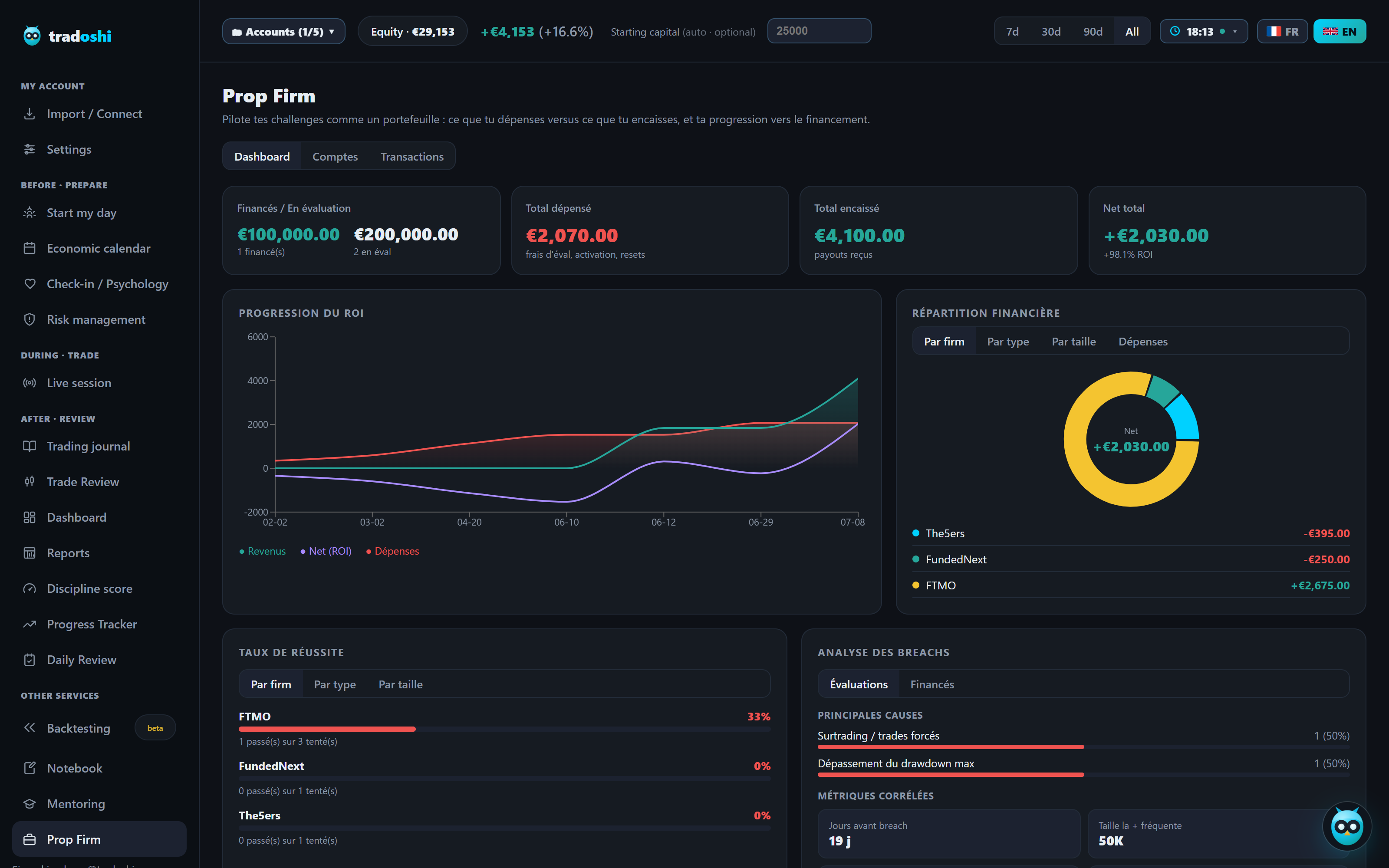
Once your firm is chosen, Tradoshi helps you respect its rules by tracking them in real time on your connected account, so you never lose a funded account over a forgotten rule.
- Rules tracked: maximum drawdown, daily limit and target tracked against your real performance.
- Multi-account: you can track several prop firm accounts with their own rules.
- Real-time drawdown: your loss margin is computed continuously, floating P&L included.
- Discipline: your adherence to your personal limits is measured to avoid breaches.
The challenge, the payout, and what to check before paying
A prop firm challenge is a paid evaluation: you pay a fee, you must hit a profit target without breaching loss limits, and you get a funded account if you make it. The only published pass statistic among the firms we read is Topstep's for 2025: 16.8% of Trading Combines initiated were completed, 33.3% of participants at the funded level received a payout, and 0.71% of participants in an Express Funded Account were called up to a live account. The other pages we read publish no rate. Knowing it changes how you approach the evaluation: not an exam to rush, a sequence to survive.
To pass, the rule is counterintuitive: aim at respecting the limits rather than at the target. Cutting size, spacing trades and accepting three weeks where others try three days is the method detailed in our guide on passing a prop firm challenge.
On payouts, compare three things: the real delay, your share, and the allowed frequency, read on each firm's page with their conditions. A ranking of the best prop firms is only worth those written columns; without them, it is an opinion. And tracking your own payouts in a spreadsheet beats trusting a dashboard you do not control.
One rule sits outside the funding firms: the pattern day trader rule, which applied to US margin accounts and required $25,000 of minimum equity from anyone making four or more day trades in five business days, options included, according to FINRA's investor page. According to FINRA Regulatory Notice 26-10, it is replaced by an intraday margin standard in force since June 4, 2026, with a transition until October 20, 2027. Our article on the pattern day trader rule details what changes; what your broker applies today deserves a direct question.
Frequently asked questions
How do I choose a good prop firm?
On the rules read on its page, not on advertised capital: the profit target / loss margin pairing, the drawdown type (static or trailing, end of day or real time), the daily loss, minimum days, the consistency rule, the fees, the payout conditions, the allowed instruments and the exact sentence on the nature of the account. And check the real payout conditions, not just the advertised split.
Is the offered capital the right criterion?
No, it's the worst angle. Capital only has value if the rules genuinely let you trade it and draw gains from it. Large capital with a tiny drawdown and stifling rules is worth less than modest capital with livable rules. Look at the profit target / loss margin ratio, not the amount displayed in big letters.
Which tricky rules should I spot?
The trailing drawdown computed in real time on the unrealised peak (a gain you never banked raises your limit), bans on overnight or weekend holding, consistency rules (at Topstep, the best day must stay at or below 55% of the target, according to its help page), and vague 'behavior' clauses that leave room for interpretation. Rule clarity is itself a quality criterion.
How do I verify a prop firm actually pays?
Read its payout conditions on its page first: delay, frequency, cap, winning days required. Topstep, for instance, writes five winning days of at least $150 and a payout capped at 50% of the balance on its standard Express Funded Account. Then look for proof of payouts actually paid: verifiable feedback, track record, longevity. A young firm with no payout history calls for more caution than an established one, even with a slightly less generous split.
What is a trailing drawdown?
A maximum loss that follows your highest balance instead of staying fixed: as your balance rises, the limit rises too, and a pullback after a good trade can fail you while you are still in profit. What moves it (end-of-day balance or real-time peak) and where it locks differ from firm to firm: our guide on the trailing drawdown in prop firms compares the pages of Topstep, FTMO and Take Profit Trader.
What do regulators say about prop firms?
Belgium's FSMA published a warning on 7 March 2024 describing a fictitious investment game in which the consumer does not really trade, and recalling that these firms hold no licence to offer investment services. Italy's CONSOB published a press release on 8 July 2024 about the reports it received, concerning the difficulty of the tests and the failure to share profits.
Is a funded account real money on the market?
At the firms we read, no. FTMO writes that all accounts provided to its clients are demo accounts with fictitious funds, and Topstep that its Trading Combines and Express Funded Accounts are simulations. You receive a reward computed on simulated profit and paid by the firm: its cash, its longevity and its payout track record therefore matter more than its marketing.
How do I compare several prop firms effectively?
Build a table from the official pages, with their date: drawdown, daily loss, minimum days, consistency, fees, payout conditions, allowed instruments, nature of the account. This step often eliminates half the candidates. Then look for recent reviews on payouts, ask support one question, and test the firm you keep on its cheapest evaluation before committing to a bigger one.