 By Benjamin Roure L'Hermitte
To backtest a trading strategy is to apply its rules to historical data and measure what it would have returned, and the result is only worth as much as the honesty of the test. Without a rigorous method, you don't test your strategy, you manufacture the proof you wanted to find. Backtesting without kidding yourself requires knowing the traps that turn a good backtest into a comforting, costly illusion.
- A poorly done backtest proves what you want, not what's true.
- Hindsight bias makes you see obvious signals that weren't obvious live.
- Over-optimization creates a strategy perfect on the past, useless on the future.
- An honest backtest follows strict rules: sufficient sample, realistic data, no cheating.
Backtesting is a wonderful tool: it lets you test an idea on historical data before risking a cent. But it's also one of the easiest tools to rig, often without even realizing it. Patterns are quick to find in a price history and quicker still to believe in, and a poorly framed backtest becomes a mirror that reflects back the conclusion you hoped for.
A backtest that 'proves' your strategy is brilliant is worthless if it's tainted by bias. Worse, it's dangerous, because it gives you unjustified confidence that will make you risk real money on an illusion. This guide explains the classic backtest traps, how to avoid them, and how to run a test honest enough to tell you the truth, even when it's not the one you wanted to hear.
Why a backtest lies so easily
The fundamental problem of backtesting is that it pits your desire to validate your strategy against the rigor needed to test it honestly. When you want a strategy to work, your brain collaborates: it interprets the data favorably, minimizes the bad trades, unconsciously adjusts the rules to improve the results. You don't lie deliberately, but you deceive yourself, which amounts to the same.
That's why a positive backtest should always be viewed with suspicion: the question isn't 'did my strategy perform well?' but 'was my test honest?'. A brilliant result from a biased test is more dangerous than a mediocre result from a rigorous test, because the first makes you risk real money on thin air, while the second at least told you the truth.
Published research knows this flaw. In Halbert White's paper published in Econometrica in 2000, reusing the same data set several times to pick a model has a name, data snooping: a good result may then be due to chance alone, and the author calls the practice endemic. Harvey, Liu and Zhu, in an NBER working paper, catalogued 316 factors claimed to explain stock returns. They conclude that most claimed research findings in financial economics are likely false, and that a newly discovered factor should clear a higher statistical hurdle, a t-ratio above 3.0 instead of the usual 2.0. That work covers forecasting models and stocks, not your strategy, but the mechanism is the same as soon as you try several ideas on a single price history.
Hindsight bias
The most insidious trap is hindsight bias: when you look at a chart of the past, everything seems obvious. The top was clearly there, the break was clean, the entry was obvious. But live, at the right edge of the chart, nothing was obvious: you didn't know if the top would hold, if the break was real, if the signal was valid. The visual backtest makes you believe you'd have taken those perfect trades, when in reality you'd have doubted, hesitated, executed poorly.
On a chart of the past, every trader is a genius. The truth reveals itself at the right edge, where the future is still unknown.
The counter to hindsight bias is testing by advancing bar by bar, without seeing the future, as in real conditions. A market replay that hides what's coming forces you to make your decisions in uncertainty, exactly as live. It's far harder, and far more honest, than a backtest where you contemplate a complete chart already knowing how it ends.
This bias has been measured for a long time. In Baruch Fischhoff's study published in 1975, people who had been told how an event turned out judged that outcome more likely than it was, and were largely unaware that the information had changed their judgment. Automated backtesting has its equivalent, look-ahead bias: the code uses a piece of data that was not yet known when the signal fired. The Pine Script documentation on repainting lists scripts that leak future information into the past among unacceptable behaviors, and notes that a strategy recalculated on every tick will most probably not generate the same order executions in real time as on historical bars, which invalidates its backtesting results.
Over-optimization
The second big trap is over-optimization, or overfitting. It consists of tweaking your parameters until the strategy is perfect on the historical data: the best threshold, the best period, the best filter. The result is spectacular on the past and disappointing on the future, because you've fitted your strategy to the specific noise of your test data, not to a reproducible market reality.
The number of trials matters as much as the setting you keep. In the paper by Bailey, Borwein, López de Prado and Zhu published in 2014 in the Notices of the American Mathematical Society, trying only seven independent configurations of a strategy with no skill, on a two-year backtest, is enough for the best one to show an expected Sharpe ratio of 1 in sample while its expected Sharpe ratio out of sample is 0. With five years of data, the limit rises to forty-five configurations. Their conclusion holds for any tester: a backtest that does not report how many variants were tried makes it impossible to assess the risk of overfitting. So write down every variant you test, including the ones you drop.
| Robust strategy | Overfitted strategy |
|---|---|
| Few simple parameters | Many precise parameters |
| Good across varied markets | Perfect on a single history |
| Holds out of sample | Collapses on new data |
| Clear logic | Arbitrary opaque settings |
The rule for avoiding overfitting is simplicity and out-of-sample validation. A robust strategy rests on few parameters, with clear logic, and works across several markets and periods. Always test your strategy on data that wasn't used to optimize it: if it holds on that new data, it has a chance of being real; if it collapses, you were just fitting noise.
Testers build this validation in. The MetaTrader 5 Strategy Tester documentation describes a Forward option that splits the period in two, one part where the parameters are fitted and one where they are checked, in order to avoid fitting to certain time intervals. NinjaTrader's page on walk forward optimization describes the same principle repeated: you optimize on one segment of history, test on the following segment with the chosen values, then move both segments forward and start again, judging performance on the test data and not on the data used in the optimization. Even out of sample, expect a drop: across 97 variables shown to predict stock returns, the McLean and Pontiff study published in 2016 in the Journal of Finance measures portfolio returns 26% lower out of sample and 58% lower after publication.
Realistic data
A backtest is only honest if its conditions resemble reality. Many backtests ignore the spread, commissions, slippage (the gap between expected and obtained price), or assume perfect executions impossible in practice. Over a large number of trades, these ignored costs can turn an apparently winning strategy into a losing one. A backtest without realistic fees is a backtest that lies by omission. The same goes for a test that covers the entry alone: a system also includes the exit, the size and the stop, and it is the whole that produces the curve, so many disappointing tests come from a sound entry paired with position management that is not.
A tester does not protect you by default. According to the Pine Script documentation on strategies, a strategy applies no commission to filled orders unless one is specified, and slippage, dynamic and unpredictable, cannot be simulated precisely: it advises applying a small fixed amount to every order so that results align more closely with reality. In the MetaTrader 5 tester, per the documentation cited above, the mode based on real ticks provides conditions close to real ones, while the 1 minute OHLC mode emulates only four prices per one-minute bar. The arithmetic is quick: a strategy that makes 1 point per trade on average before costs, and pays 1.2 points in spread, commission and slippage, shows a 300-point gain over 300 trades in a test without costs, and a 60-point loss in an honest one.
You also need quality data and a sufficient sample. Testing on thirty trades proves almost nothing: by the confidence interval calculation set out in the NIST statistics handbook, from the US standards institute, a 50% win rate measured on 30 trades sits, at 95%, between roughly 33% and 67%, between 40% and 60% on 100 trades, and between 45% and 55% on 400. A credible backtest therefore rests on hundreds of trades, across varied market conditions (trend, range, high and low volatility), to verify the strategy holds in different environments and not just the one that suited it.
From backtest to reality
Even a perfectly honest backtest guarantees nothing, because it only tests the strategy, not the trader. In real conditions, you add a variable the backtest ignores: you. Your ability to execute the strategy without deviating, to hold your stops, not to panic in a drawdown, not to overtrade. An excellent strategy in backtest can become a loser in your hands if you don't execute it as planned.
That's why the real test of a strategy is confronting your backtest with your real results. If your real performance is far below your backtest even though you followed your rules, it is the test that needs another look, its costs or its overfitting; if you strayed from them, it's your execution. Measuring your real trades and comparing them to what the strategy promised is the only way to tell a strategy problem from a discipline problem.
Backtest, forward test and live account
An honest backtest is only the first step of a three-stage validation. After the backtest (test on past data) comes the forward test (test on new data, in real time but without money), then going live with a small size. Each stage filters illusions the previous one didn't reveal: the forward test puts overfitting to the past on trial, and the live account reveals the gap between theory and your emotional execution. The difference between the first two stages is covered in backtesting vs forward testing.
Skipping stages is a costly mistake. Going directly from a nice backtest to a big live account means risking discovering live, with money, that your strategy was overfitted or that you can't execute it. Prudent progression (backtest, then forward test, then live at small size, then gradual increase) protects you by validating your strategy at each stage before committing more. Each level confirms or refutes what the previous suggested, and it's that accumulation of evidence that gives you justified confidence, not a mere flattering backtest.
What a backtest can't capture
Even perfectly done, a backtest has structural limits you must know. It doesn't capture your psychology: on a chart of the past, you didn't feel the fear of loss nor the temptation to cut too early. It also doesn't capture real execution conditions (variable slippage, unfilled orders, delays), nor the exceptional events that weren't in your historical data. A backtest tests a strategy in an idealized world, not the real one.
That's why a good backtest is necessary but never sufficient. It tells you whether your strategy has a chance of working, but it doesn't tell you whether you, with your emotions and in real conditions, can make it work. Keeping these limits in mind spares you the dangerous overconfidence that comes from a brilliant backtest. A strategy's real validation is never entirely done on the past, it's done on your ability to reproduce it in reality, which only real, measured trading can confirm.
Backtesting your behavior, not just your strategy
We almost always backtest a strategy (the entry and exit rules), but forget to backtest the most important variable: yourself. Two traders with the same backtest can get very different real results, if one executes the strategy faithfully and the other deviates. The real 'backtest' that counts is therefore the comparison between what your strategy promised and what you actually got, once passed through the filter of your execution.
This comparison is the most instructive of all. If your real result is close to your honest backtest, your strategy and your execution are aligned. If it's clearly lower, first check whether you followed your rules. If you strayed from them, it's your discipline to work on, not your method; if you followed them, the backtest was promising too much. Measuring this gap between theoretical and real is the only way to know where to focus your efforts, and to see whether your main improvement lever is behavioral or technical.
The tools for backtesting seriously
Two broad families of tools exist for backtesting, and they don't replace each other: the comparison of manual and automated backtesting sets them side by side. Manual backtesting means scrolling through a chart bar by bar, noting every trade you'd have taken according to your rules. It's slow, but it's the method that confronts you best with real uncertainty, because you never see the future as you advance. It's irreplaceable for discretionary strategies, based on a visual read of the market, that no code can perfectly capture.
Automated backtesting means coding your rules in a language like Pine Script and letting an engine test them across years of data in seconds. It's incomparably faster and lets you test on huge samples, which solves the sample-size problem discussed earlier. Its limit is that it can only test perfectly objective rules: as soon as your strategy includes a discretionary judgment ('this looks like a good setup'), code can't reproduce it faithfully. The right instinct is often to combine both: automate what's objective in your strategy to validate the statistical core on a large sample, then manually backtest the discretionary nuances on a smaller but realistic sample.
A third option worth knowing about sits between the two: market replay, where you step through historical price action tick by tick or bar by bar inside a simulator that hides the future but still lets you place real orders and manage them as if live. It combines the speed advantage of not having to wait for real time to pass with the honesty advantage of never seeing ahead. For strategies that mix objective entry rules with discretionary trade management, replay is often the most realistic middle ground between a manual chart review and a fully coded engine.
How much time to spend backtesting before going live
There's no universal rule, but here's a useful benchmark: your backtest should cover enough trades and different market conditions for you to trust your statistics, without becoming an excuse to endlessly postpone going live. Some traders backtest for months, endlessly tweaking, which is also a trap: at some point, the only way to learn what a backtest can't capture (your psychology, your real execution) is to start trading, even small.
A pragmatic benchmark is to aim for a backtest of at least a hundred trades (a floor: at that size, a win rate is still only known to within about ten points) covering several market types (trend, range, high and low volatility), then move to forward testing once that threshold is reached and results are stable. The time gained polishing a backtest beyond that threshold is usually less valuable than the time spent observing how you actually execute the strategy under live conditions, on a small account. The backtest tells you whether the idea is good; only real trading, rigorously measured, tells you whether you're capable of executing it.
Finally, keep one limit in mind: a backtest only contains what has already happened. The event without precedent, what is called a black swan event, is not in it, however long the history.
One practical way to know you've backtested enough is to notice whether new trades keep changing your conclusions. Early on, each additional batch of trades will shift your expectancy and profit factor noticeably, sometimes swinging a strategy from apparently great to merely decent. Once your numbers stop moving much as you add more trades, your sample has become large enough to trust, and further backtesting mostly just delays the moment where you find out how you personally handle the strategy under real pressure.
How Tradoshi confronts your results with reality
To backtest without lying to yourself, Tradoshi has its own tool, in beta: the replay advances candle by candle and keeps the future hidden, which cuts off hindsight bias, and your orders pay realistic spread, slippage and commissions. The tool is included from the Pro plan.
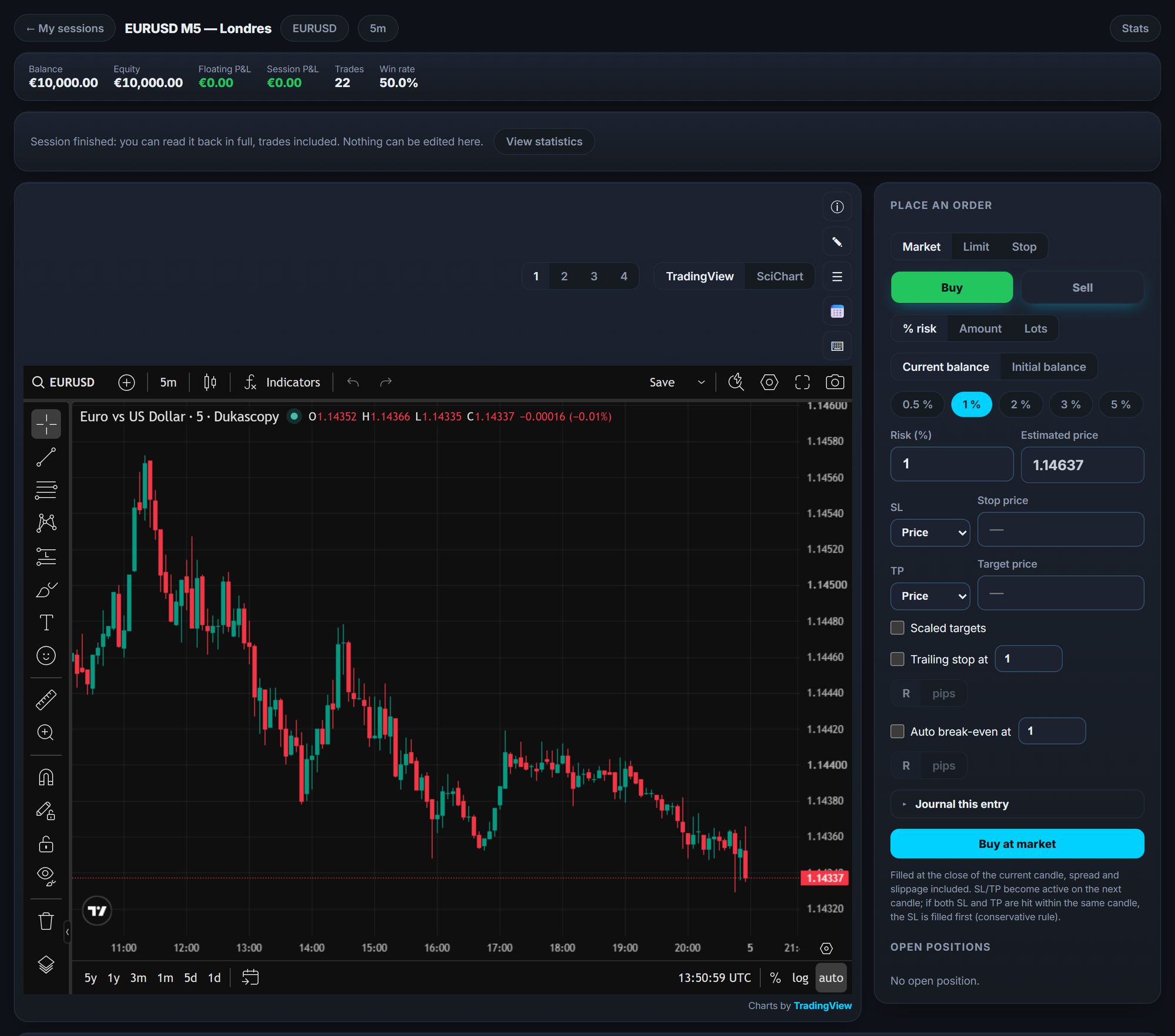
Once you go live, Tradoshi gives you your real statistics to confront what your strategy promised with what you actually get, and tell a strategy problem from an execution problem.
- Real stats: expectancy, profit factor and average R computed on your real trades, not an optimistic backtest.
- Backtest / real gap: compare what you expected with your real performance to spot execution problems.
- Discipline score: it tells you whether your underperformance comes from the strategy or your breaches.
- Sufficient sample: your stats are placed in the context of your number of trades to stay credible.
Frequently asked questions
Why can a backtest be misleading?
Because without a rigorous method, your brain collaborates with your desire to validate the strategy: it interprets the data favorably, minimizes the bad trades, unconsciously adjusts the rules. You don't lie deliberately, but you deceive yourself. A positive backtest from a biased test is more dangerous than a mediocre result from an honest test.
What is hindsight bias in backtesting?
It's the fact that, on a chart of the past, everything seems obvious: the top was clear, the break clean, the entry obvious. But live, at the right edge of the chart, nothing was obvious. The visual backtest makes you believe you'd have taken those perfect trades, when in reality you'd have doubted and executed poorly. The counter is testing bar by bar, without seeing the future.
What is over-optimization?
It's tweaking your parameters until the strategy is perfect on historical data. The result is spectacular on the past and disappointing on the future, because you've fitted your strategy to the specific noise of your test data. The counter is simplicity (few parameters) and out-of-sample validation: test on data that wasn't used to optimize.
Should I include fees in a backtest?
Yes, absolutely. A backtest that ignores the spread, commissions and slippage lies by omission: over a large number of trades, these costs can turn an apparently winning strategy into a losing one. A backtest is only honest if its conditions resemble reality, realistic fees included and imperfect executions.
On how many trades should I backtest?
On hundreds of trades, across varied market conditions (trend, range, high and low volatility). On thirty trades, a 50% win rate can in reality sit anywhere between roughly 33% and 67%, so a brilliant or catastrophic result may be due to chance alone. A credible backtest verifies the strategy holds in different environments, not just the one that suited it.
Does a good backtest guarantee winning live?
No, because the backtest only tests the strategy, not the trader. Live, you add a variable: your ability to execute without deviating, hold your stops, not panic. An excellent strategy in backtest can become a loser if you don't execute it as planned. The real test is confronting your honest backtest with your real results to tell a strategy problem from an execution problem.
Manual or automated backtesting, which should I choose?
Both have their use. Manual, bar-by-bar backtesting confronts you best with real uncertainty and suits discretionary strategies. Automated backtesting (coded, for instance in Pine Script) tests thousands of trades in seconds but can only test perfectly objective rules. The right instinct is often to combine both: automate the statistical core, then refine the discretionary nuances manually.
How long should I backtest before going live?
There's no universal rule, but aim for at least a hundred trades covering several market types, then move to forward testing once that threshold is reached and stable. Backtesting endlessly for months is also a trap: at some point, only real trading reveals what a backtest can't capture, your psychology and your execution.