There are two main ways to backtest a strategy: by hand, replaying the chart candle by candle, or automatically, letting a program apply your rules over years of data in seconds. Each has its strengths and weaknesses, and the right choice depends on your strategy and your goal. This guide compares manual and automated backtesting to help you choose.
- Manual backtest builds intuition but is slow and limited in volume.
- Automated backtest is fast and massive but requires codable rules and clean data.
- Manual suits discretionary strategies, automated suits mechanical ones.
- Many combine both: manual to learn, automated to validate at scale.
When we talk about backtesting, we often imagine sophisticated software testing strategies over decades of data. But that's only one of the two approaches. The other, manual, only requires a chart and patience, and remains one of the most instructive for a trader. The two meet different needs, and confusing them, or picking the wrong one for your situation, is a mistake that costs time and sometimes money.
Understanding the strengths and limits of each approach saves you from wasting time with the wrong one. A discretionary trader doesn't have the same needs as a systematic trader, and wanting to automate a strategy that rests on judgment is as futile as testing by hand a strategy that requires thousands of trades. This guide helps you choose the approach suited to your case, and avoid the pitfalls specific to each, which can turn a promising backtest into a false promise.
Manual backtesting
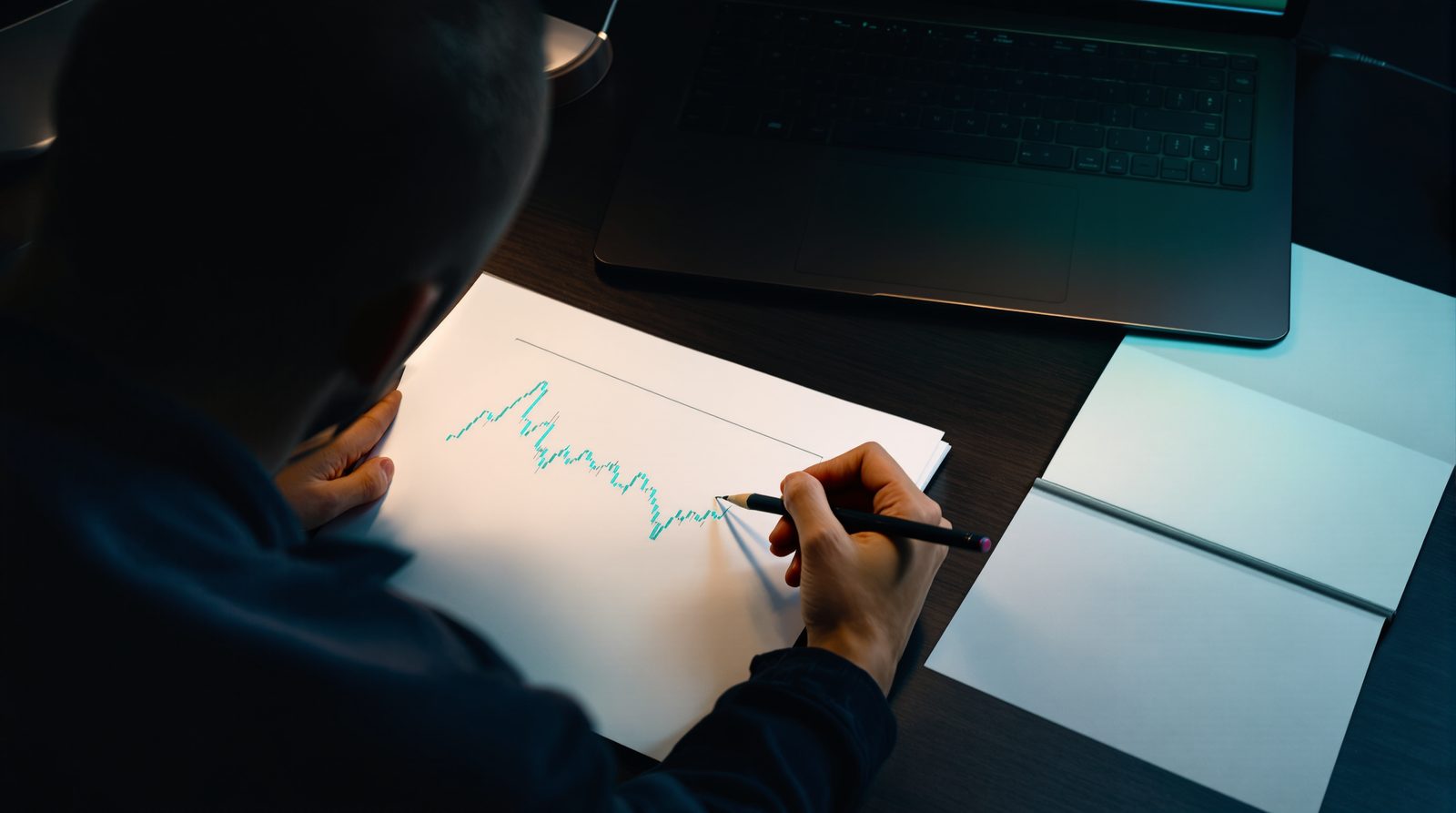
Manual backtesting consists of scrolling through a historical chart, one candle at a time, and applying your rules candle by candle, noting each trade you'd have taken. It's slow and tedious, but it has a virtue nothing else replaces: it makes you live your strategy from the inside. By replaying hundreds of situations, you develop an intuitive recognition of your setups and a fine understanding of their behavior.
This approach is ideal for learning and for discretionary strategies, those that rest partly on the trader's judgment and don't reduce to purely mechanical rules. It's also accessible to all, without code or expensive software: manual work is backtesting free of any licence, a chart and a spreadsheet are the whole toolkit, and that makes free backtesting trading a realistic starting point for beginners who want to understand trading from the inside before investing in more sophisticated tools. Its flaw is obvious: it's slow, which limits the number of trades you can reasonably test, and it's subject to hindsight bias if you lack rigor. An afternoon of manual backtesting rarely gives more than fifty trades, which is valuable for understanding a strategy but insufficient to validate it statistically.
Automated backtesting
Automated backtesting entrusts the application of your rules to a program, which executes them over years of data in seconds. Its advantage is spectacular: it lets you test thousands of trades across multiple instruments and periods, giving far more robust statistics than a necessarily-limited manual backtest. For a mechanical strategy, it's incomparably faster and more complete. Where manual testing takes hours to cover a handful of months, automated testing runs through decades of data while you make a coffee.
But automation has a price. It first requires your strategy to be entirely codable in objective rules, with no judgment zone, which excludes discretionary approaches. It also demands quality data and technical skills to code and verify the test, or failing that, a budget to pay someone who has them. The entry ticket is lower than people assume, though: the Strategy Tester ships with every free MT4 or MT5 install, so free backtesting software does exist and you can backtest free of charge from day one. The honest question is not whether backtesting software free of licence is available, but whether its data is clean enough to trust. And it hides a major trap: the ease of optimizing dozens of parameters until a magnificent but overfitted backtest, which will never work live.
The comparison table
Let's summarize the essential differences between the two approaches, to clarify the choice based on your profile and strategy.
| Criterion | Manual | Automated |
|---|---|---|
| Speed | Slow | Very fast |
| Trade volume | Limited | Massive |
| Intuition building | Excellent | Weak |
| Discretionary strategies | Suited | Impossible |
| Skills required | None | Code, data |
| Overfitting risk | Low | High |
This table shows that no approach is superior in absolute terms: they meet different needs. Manual wins on training and accessibility, automated on speed and volume. The right choice doesn't depend on which is best, but on which matches your strategy and your goal of the moment. Keep this table in mind next time you hesitate between the two: it settles most cases in seconds.
Which to choose based on your strategy
The decisive criterion is the nature of your strategy. If it's discretionary, resting partly on your judgment, your reading of context, your feel of the market, then the manual backtest is the only one possible, because these elements can't be coded. Wanting to automate a judgment-based strategy amounts to betraying its essence, and will give a test that doesn't really test what you do.
If your strategy is purely mechanical, defined by objective rules with no judgment zone, then automation becomes possible and often desirable, because it gives you the statistical robustness of large numbers. Many systematic traders in fact start with a manual backtest to understand their strategy, then move to automated to validate it at scale once the rules are well fixed. Between the two, there are also hybrid, semi-discretionary strategies, where only part of the rules is codable: in that case, a manual backtest on the discretionary part usefully complements an automated backtest on the mechanical part.
Combining both approaches
For many traders, especially those transitioning from a purely discretionary style toward something more systematic, the best solution isn't to choose but to combine. The manual backtest first serves to learn: replaying hundreds of candles to understand your strategy, refine your rules, and develop an intuition of your setups. It's an irreplaceable learning phase that automation can't offer.
Once the rules are clarified and stabilized by manual work, automation takes over for large-scale validation, over many trades and periods. This sequence, manual to understand then automated to validate, gets the best of each approach. It avoids the double pitfall of the trader who automates too early a poorly-understood strategy, and the one who stays stuck in manual without ever validating their edge over a sufficient sample. In practice, a few weeks of manual backtesting are often enough to know whether an idea deserves to be coded, before investing the time needed to automate it.
The pitfalls of manual backtesting
Manual backtesting has a specific pitfall you need to know: hindsight bias. When you scroll through a historical chart, you already know what comes next, even without consciously wanting to, and this knowledge colors your reading of the context at that moment. You see a setup and think, that was obvious, when in real time, without knowing what followed, that setup was probably far more ambiguous. This bias artificially inflates the results of a poorly run manual backtest.
The other classic pitfall is insufficient logging. Many traders scroll through dozens of candles in their head without noting each trade with the same rigor as live trading: exact entry, stop, target, reason for taking it. Without this logging discipline, it's impossible to know afterward whether the backtest truly reflects your strategy or an idealized version of it. The fix is simple: treat every backtested trade with the same rigor as a real trade, down to the screenshot.
The pitfalls of automated backtesting
Automated backtesting has its own pitfalls, more technical but just as destructive. The most insidious is look-ahead bias: your code uses, without you realizing it, information that wouldn't have been available at the time of the trade, for example the closing price of a candle that hasn't finished forming. This bias produces results impossible to reproduce live, and it's particularly hard to detect without rereading your code line by line.
The other pitfall is data quality. A price feed with gaps, errors or insufficient granularity silently distorts every downstream result, with nothing looking abnormal. You also need to include realistic costs (spread, commission, slippage), otherwise the backtest systematically overstates real performance. An automated backtest is only as reliable as the data feeding it. Always check your data source against a known sample before running a full backtest, comparing a handful of candles to another provider: a gap of a few points on a price is enough to turn a marginal result into a losing one.
How many trades do you need to trust it?
The volume question comes up often, and the answer depends on the method. In manual backtesting, imagine a trader scrolling through three months of hourly chart on one instrument: they might get 40 to 60 trades, which starts to show a trend but remains a fragile sample for solid statistics. In automated backtesting, the same strategy tested over five years of data can generate several hundred, even thousands of trades in seconds, giving statistical robustness manual backtesting can't reach.
That's not a reason to dismiss manual backtesting though: a sample of 50 carefully documented trades, deeply understood in context, is often worth more than 5000 trades generated by a poorly understood strategy you never lived through. The question isn't only how many trades, but also what you understand about each one. Numbers reassure statistically, understanding protects you live when data diverges from the past.
Documenting your backtest, whatever the method
Whether you backtest by hand or with a program, documentation makes all the difference between a useful exercise and a waste of time. For manual, that means systematically noting each simulated trade with a screenshot, as if it were a real journal entry. For automated, that means keeping the code, the exact parameters and the tested period, so you can reproduce and verify the results later.
This documentation gets a second life once you go live: it becomes your point of comparison. You know what to expect (win rate, typical drawdown, losing streak) and you can verify, trade by trade, that your real system behaves as predicted. Without this trace, every backtest stays an isolated exercise with no follow-up; with it, it becomes the first chapter of ongoing tracking.
A concrete example: manual then automated
Let's take a concrete example to illustrate the approach. Imagine a trader who wants to validate a reversal setup on a pullback to a moving average at the end of an uptrend. In manual backtesting, they scroll through six months of a 15-minute chart on an index, note every occurrence of the setup, its theoretical result respecting a 1:2 risk/reward ratio, and get, say, 45 trades with a 55% win rate. That's an encouraging starting point, but the sample remains too small to draw a definitive conclusion.
To go further, this same trader then codes the setup's precise rules (position relative to the moving average, pullback distance, trend filter) and runs an automated backtest over five years of data and several comparable indices. If they get, say, 800 trades with a win rate close to 52% and a profit factor above 1.3 across most tested instruments, the statistical robustness confirms what the manual test had only suggested. If instead the automated results collapse outside the initial period, it's a clear signal the setup doesn't generalize, despite looking good on the manual sample.
How Tradoshi complements your backtests
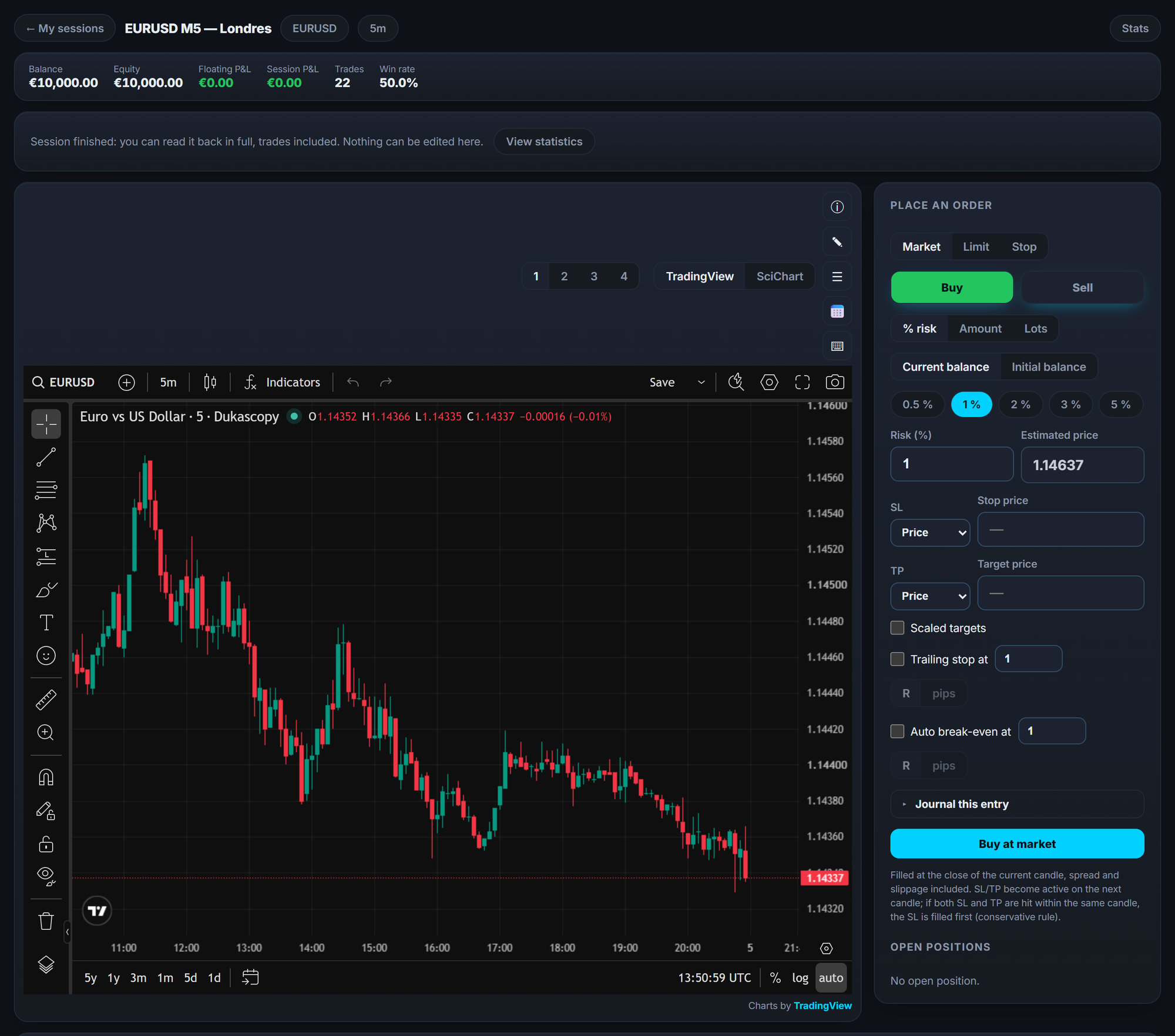
For manual backtesting, Tradoshi has its own module, in beta: you replay the market candle by candle without seeing what comes next, place your orders as in real trading with spread, slippage and commissions, and each session stays attached to a strategy. It's included from the Pro plan.
Whatever your backtest style, Tradoshi takes over on your real trades: it tracks your statistics in live conditions to verify that your strategy, tested manually or automatically, keeps its promises.
- Real statistics to compare to the benchmarks from your backtest, manual or automated.
- CSV import to integrate the results of a backtest or demo account into your tracking.
- Breakdowns by instrument and period to see where your strategy holds live.
- Tracking over time to detect overfitting, when a backtest edge doesn't hold live.
- Searchable history at any time, to compare a new idea against previous backtests.
Free backtesting software: what actually exists
The first question every beginner asks is the price, and the good news is that free backtesting software genuinely exists. The Strategy Tester that ships with MetaTrader 4 and MetaTrader 5 costs nothing, it is installed by default at most brokers, and it is enough to test a mechanical strategy over years of data. MetaTrader backtesting is where most systematic traders start, and MT4 backtesting alone has probably validated more strategies than every paid tool combined. Manual backtesting is free by nature: a chart and patience are all it takes. Between the two, several backtesting platforms offer a trial that lets you backtest your strategy for free before you have seen what the tool is worth.
Where free backtesting stops is on data quality and history depth. A free backtester often works from closing candles only, without the detail of the wicks or the real spreads, and that difference is paid for in results that look too good. Before choosing between backtesting tools, look at three things: how deep the history goes, how fine the data is, and whether you can export your results. A backtesting tool that lets nothing out locks you inside its own numbers. This is the honest answer to where can I backtest my trading strategy for free: several places, none of them with institutional data.
The best backtesting platform is not the most complete one, it is the one you will actually use. A free backtesting website is enough to check an intuition in ten minutes; installed back testing software earns its place when you test dozens of variants. Start with free trade backtesting, measure what you are missing, and pay only for that precise gap. The best trading backtesting software for you is defined by your strategy, not by a feature list.
Backtesting by market: futures, forex, stocks and options
Each market imposes its own constraints. In a futures backtest everything turns on tick value and contract rollover: a test that ignores expiries stitches together prices that do not follow each other. Free futures backtesting exists in most platforms, but futures backtesting software that handles rollover correctly is rarer. In forex, the spread varies by hour and by broker, so forex backtesting software that assumes a fixed spread systematically overstates performance, and any free forex backtesting software should be checked on that point first. For stocks, splits, dividends and survivorship bias distort long tests, because the companies that disappeared were removed from the sample: that is the main trap of stock backtesting software, and the reason free stock backtesting rarely matches a live account.
Options are a case apart, and the most demanding one. Options backtesting requires the history of implied volatility and of the full chain, not just the underlying price, because a contract's value depends first on time and volatility. This is why option backtesting software is rarer and dearer than the rest, and why an approximate options backtest misleads more than elsewhere. If you are wondering how to backtest options strategies, start by asking what the tool does with implied volatility: an options backtester that ignores it is not testing what you trade.
The common rule is this: the market decides which data you need, and the data decides what your test is worth. The same backtesting platform can be excellent on one market and unusable on another.
How to backtest a strategy, step by step
The method fits in five steps, and it is the same whichever approach you choose. Write your entry, exit and risk rules until another person could apply them without asking you a question. Pick a period and an instrument, keeping part of the history aside for the final check. Replay the period without ever looking ahead. Record every trade, winners and losers alike. Then compute your statistics, starting with your profit factor and your expectancy. That is how to backtest a trading strategy, and the answer does not change whether you backtest stocks, futures or a forex pair.
The step everyone skips is the fourth. A backtest that records only the good trades is not a test, it is a tidied-up memory. A backtesting dashboard, even one built in a spreadsheet, beats an impression: it makes the maximum losing streak and the flat period visible, the two things that make traders abandon an otherwise sound strategy. This is also what separates backtested trading strategies from remembered ones.
A trading system is judged over time, not on one test. Once you are live, the real question becomes whether the backtest numbers show up in your journal. That is where the loop closes, and it is the only judge that counts.
Frequently asked questions
Manual or automated backtest, which to choose?
It depends on your strategy. Manual (replaying the chart candle by candle) builds intuition, requires no code, and suits discretionary strategies resting on judgment, but it's slow and limited in volume. Automated is fast and massive, but requires codable rules and clean data, and suits purely mechanical strategies.
Does the manual backtest have advantages?
Yes. It makes you live your strategy from the inside: by replaying hundreds of situations, you develop an intuitive recognition of your setups impossible to get otherwise. It's accessible to all, without code or software, and it's the only option for a discretionary strategy. Its flaw is slowness, which limits the number of trades tested.
Can you automate a discretionary strategy?
No, not really. A discretionary strategy rests partly on the trader's judgment, their reading of context, their feel, and these elements can't be coded into objective rules. Wanting to automate it betrays its essence and gives a test that doesn't measure what you really do. For these strategies, only the manual backtest is possible.
What's the main risk of automated backtesting?
Overfitting: the ease of optimizing dozens of parameters until a magnificent backtest that only models the tested period's randomness. An overfitted strategy collapses live. The counter is simplicity (few rules) and robustness (working across several periods and instruments), and a too-perfect backtest should trigger suspicion.
Should I combine manual and automated backtesting?
Often, it's the best solution. Manual first serves to learn and clarify your rules by replaying situations; automated then takes over to validate at scale once the rules are stabilized. This sequence avoids automating too early a poorly-understood strategy, or staying stuck in manual without validating your edge over a sufficient sample. It also tends to produce cleaner code, since you already know exactly what behavior you're trying to reproduce.
Does hindsight bias really distort manual backtesting?
Yes, and it's one of its most insidious pitfalls. Scrolling through a historical chart, you already know what comes next, which colors your reading of the context at that moment and makes setups look more obvious in hindsight than they were live. The fix is to log every trade with the same rigor as a real trade, without letting knowledge of what follows influence you.
How many trades do you need to validate a strategy?
There's no magic threshold, but the bigger the sample, the more reliable the statistics. In manual backtesting, a few dozen well-documented trades start to show a trend. In automated backtesting, several hundred trades across different periods and instruments give far superior statistical robustness. Numbers alone aren't enough: understanding each trade matters too.
How do I backtest a trading strategy when starting out?
Write your rules down, pick an instrument and a period, then replay the chart without looking ahead and record every trade. Backtesting a strategy needs neither code nor a subscription to begin: a chart and a spreadsheet are enough to produce a first usable sample. That is how to backtest trading strategies at any level, and how to back test trading strategies without spending a cent.
Can you backtest for free?
Yes. Manual backtesting is free by nature, and the MetaTrader 4 and 5 Strategy Tester is included at no extra cost with most brokers. Several sites also let you do free backtesting online. If you are looking for the best website to backtest trading strategies for free, know that the limit of free trade backtesting software is never access, it is data quality. Free backtest results deserve more scepticism, not less.
How do I backtest stocks?
Stock backtesting needs a history corrected for splits and dividends, and a sample that still contains the companies that disappeared. Without that correction, back test stock results over a long period overstate performance because only the survivors remain. This is what separates serious stock backtesting from a stock back testing exercise that flatters you.
How do I backtest an options strategy?
You need the history of implied volatility and of the full chain, not just the underlying price. An options backtest that ignores volatility is not testing what you trade. Options strategy backtesting is the one case where a dedicated option backtester earns its price, and free options backtesting software is usually where the data stops being good enough.
How do I backtest futures?
Watch contract rollover and tick value. A test that chains expiries without splicing them adds up prices that do not follow each other, and produces results unrelated to what a real account would have lived. Free futures backtesting exists in most platforms; a futures backtesting platform that handles rollover properly is rarer.
What about forex?
The critical point is the spread, which varies by hour and by broker. A forex backtest with a fixed spread systematically overstates a short-horizon strategy. Any forex backtester should let you see what it applies by default, and free forex backtesting software rarely does.
What is backtest in trading?
It is applying a strategy's rules to past data to estimate what it would have produced. It is not a prediction: it is a consistency check, telling you whether your rules made sense over the period tested. Trading strategy backtesting answers one question only, and it is a question about the past.
What is forward testing?
It is testing the same strategy on data it has never seen, moving forward in time. It is the real judge, because it defeats overfitting: a strategy optimised on the past often loses its entire edge there.
Does a trading system validate on a single test?
No. Backtesting a trading system means several periods, several instruments, and above all time spent live. A backtest is a hypothesis; your journal is the verification. Backtested trading strategies earn that name only after the second step.
Which backtesting tools should I choose?
The right tool matches your market and gets opened. Start with whatever ships with your broker, measure what you are missing, and pay only for that precise gap. A trading backtester you never launch is worth less than a spreadsheet you fill in.
Is profit factor enough to validate a backtest?
No, but it is the first number to look at. A profit factor above 1 says the strategy wins more than it loses over the sample; it says nothing about the losing streak you will have to sit through to get there.
What do I do once the backtest is done?
Go live small, and compare. The test's numbers only matter if they show up in your journal. That comparison, and only that, turns a hypothesis into an edge.
Can a beginner start with automated backtesting directly?
Technically yes, but it's rarely the best path. Without first understanding a strategy by living it through manual backtesting, a beginner risks coding rules they don't truly grasp, and mistaking a statistical fluke for a real edge. Starting manual, even briefly, builds the intuition that makes automated results meaningful rather than abstract numbers on a screen, and it makes debugging a misbehaving automated test far easier down the line.