
You typed 'is day trading legal' into Google at midnight, probably after a forum thread scared you or a broker's fine print made your head spin. Fair question. Short answer: yes, you're allowed to do it. Longer answer: it depends on your country, your account type, and how much capital you're sitting on. Let's go through it properly, no shortcuts, no scare tactics.
- Day trading is legal in nearly every country for a retail trader using a regulated broker.
- The US PDT rule doesn't ban anything, it just requires 25,000 USD minimum equity on a margin account for frequent day trades.
- Restricted is not the same as illegal: cash accounts, forex, futures and non-US brokers all sidestep the PDT threshold legally.
- The real danger isn't legal at all, it's blowing up your account through bad risk management, which happens far faster than any regulatory fine.
Where the confusion around day trading and legality starts
Let's kill the persistent myth first. No, nobody is going to knock on your door because you bought and sold Tesla stock in the same afternoon. Day trading, meaning opening and closing a position on the same instrument before the session ends, is completely legal for a retail investor. Doesn't matter if you're in London, Toronto, Singapore or New York. No law anywhere bans a private citizen from buying and reselling a financial asset quickly.
So where does this question keep coming from? Almost entirely from the United States, and specifically from a rule set by FINRA, the Financial Industry Regulatory Authority that oversees US brokers. That rule is called Pattern Day Trader, and it has been misunderstood, poorly explained, and turned into internet folklore: 'day trading is illegal under 25,000 dollars.' That's false. Or rather, it's a dangerous oversimplification of something more nuanced.
That nuance is the entire difference between an illegal activity and a regulated one. Driving a car is legal. It's also governed by rules: a license, an age minimum, speed limits. Day trading works the same way. Legal, yes, but with access conditions that shift depending on where you live and which account you open.
The Pattern Day Trader rule, explained without the jargon
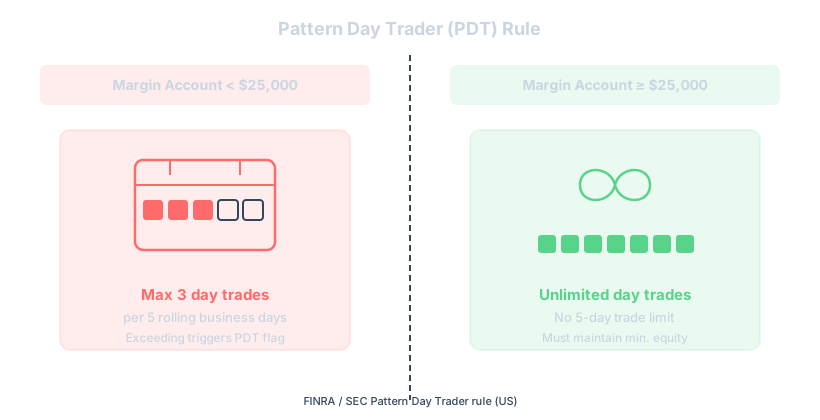
The PDT rule applies only to margin accounts held at a US broker regulated by FINRA. If your account gets flagged as 'Pattern Day Trader,' which happens automatically once you place 4 or more day trades within any rolling 5 business day window and those trades exceed 6 percent of your total trading activity in that period, FINRA requires you to keep a minimum of 25,000 USD equity in that account. Drop below that number and your day trading privileges freeze until you top the account back up.
Why does this exist at all? It traces back to the aftermath of the dot-com bubble, when thousands of undercapitalized retail traders piled into margin day trading with heavy leverage and blew up their accounts within weeks. The logic behind PDT is that a trader using borrowed money (margin) to trade frequently needs a real financial cushion to absorb losses without dragging the broker into counterparty risk.
Picture Sarah. She opens a margin account at a US broker with 5,000 USD. She fires off 5 round-trip trades on Apple stock in one week. Her account gets tagged PDT. Now she can't day trade anymore on that account until she reaches 25,000 USD. She can still invest, hold positions for days, swing trade freely. She just can't stack intraday round trips on this particular account. That's a usage restriction, not a ban on the activity itself.
Illegal, regulated, restricted: three words people mix up constantly
You need to separate three ideas that beginners blend together way too often. Illegal means the state can prosecute you. Regulated means there's a framework of rules to follow in order to operate, similar to a driver's license. Restricted means a private actor, your broker in this case, limits access to a service based on specific criteria of its own.
Day trading in general is legal. It's regulated in the sense that brokers need approval from an authority (the SEC and FINRA in the US, the FCA in the UK, CySEC in Cyprus, and equivalents elsewhere) and must meet transparency obligations toward clients. And it's sometimes restricted, as with PDT, depending on how much you deposit and which account type you pick.
This three way confusion explains why so many new traders wrongly believe they 'aren't allowed' to trade intraday below a certain amount. That's only true in one very specific scenario: margin account, US broker, capital under 25,000 USD. Step outside that box and the rule simply doesn't apply to you at all.
Legal ways around the 25,000 dollar threshold
Good news: there are several perfectly legal ways to sidestep the PDT constraint without breaking a single rule. The first is a cash account. On a cash account, as opposed to margin, you're not borrowing money from the broker, you trade only with funds that are actually available and settled. PDT does not apply to cash accounts. The tradeoff is settlement time (T+1 or T+2 depending on the market), which limits how fast you can recycle the same capital, but it stays fully legal with zero 25,000 USD requirement.
The second option is switching markets entirely. Forex and futures aren't subject to the PDT rule, which specifically targets stocks and certain equity derivatives traded in the US. A trader day trading EUR/USD or E-mini S&P 500 futures faces no PDT related capital minimum, even at a US broker. That's exactly why so many undercapitalized American day traders gravitate toward forex or futures instead of stocks. If you want the full mechanics of this rule, there's a dedicated breakdown in this explainer on the Pattern Day Trader rule.
Third option, more drastic: open an account with a non-US broker. If you don't live in the United States, you're simply not covered by a rule written by a US regulator for accounts domiciled there. A trader based in Germany, Canada or Australia who opens an account with a broker regulated locally never runs into PDT in daily practice, unless they deliberately choose a US broker.
Crypto day trading sits in a different bucket entirely
Crypto adds a layer of complexity, or freedom, depending how you look at it. PDT doesn't apply to crypto assets because most tokens traded on major platforms aren't classified as securities under FINRA rules. That means you can fire off 15 round trips on Bitcoin in a single day with 500 dollars in your account and no federal rule stops you.
That doesn't mean anything goes without oversight. Exchanges still have to meet KYC and anti money laundering obligations depending on jurisdiction, and capital gains taxes on crypto profits are very real even though trade frequency itself is unrestricted. If this market interests you specifically, this piece on crypto day trading walks through the volatility and 24/7 schedule that completely change how you should think about risk compared to traditional stock markets.
Taxes: the part everyone forgets to ask about
Here's something new traders routinely ignore, and it has far more real impact on their bottom line than the legality question ever will. Profits from day trading are taxable. The rate and the regime differ enormously depending on where you live and sometimes on your status (retail trader versus professional).
In the US, tax law separates short term gains, taxed as ordinary income, from long term gains, which get preferential rates. Frequent day trading almost always produces short term gains by definition, which mechanically pushes active traders into a heavier tax bill than someone holding positions for months. Other countries apply flat capital gains rates or progressive brackets, and the rules shift again if you're classified as a professional trader rather than a private individual.
The advice here is simple and applies no matter your country: don't discover your tax situation the following spring when the bill arrives. Look into it before you start, or talk to a professional once your volumes get meaningful. A trader who nets 20,000 for the year but set nothing aside for taxes ends up in a far worse spot than one who earned less but planned ahead.
Day trading through a prop firm: what's the legal setup?
Another popular entry point lately is trading someone else's capital through a proprietary trading firm instead of funding your own account. You pay for an evaluation, and if you pass, you get access to a funded account where you trade the firm's money in exchange for a profit split.
Legally, this isn't the same relationship as a standard brokerage account. You're usually not an employee, you're often treated as an independent contractor under a specific agreement, which carries different tax implications depending on your country. And PDT doesn't apply the same way either, since you're not technically trading your own FINRA regulated brokerage account. Each prop firm sets its own internal risk rules instead, often stricter than any government regulation: daily loss limits, maximum drawdown, profit targets to hit before scaling up. If you're weighing this route, this guide on choosing a prop firm covers the criteria that actually matter beyond the marketing.
The real risk was never legal, it's financial
Here's the blunt truth nobody tells you upfront. Nobody blows up their trading account because of a legal technicality. They blow up because they risk 10 percent of their capital on a single trade, or because they double down after a loss trying to get even. That's not a courtroom problem, that's a math problem, and math doesn't negotiate.
Think about a trader with a 10,000 USD account who risks 500 USD per trade, 5 percent, and hits a rough stretch of 8 losses in a row. That's not a rare tail event, it happens to real strategies with a 50 percent win rate more often than people assume. That trader is now down 40 percent and needs a 67 percent gain just to get back to even. No regulator caused that. Poor position sizing did. If you want to understand the mechanics behind this kind of spiral, the article on risk of ruin lays out the math in plain terms.
This is also where emotional patterns creep in and make things worse. A trader who just took a painful loss on a legal, well regulated account will often try to win it back immediately, oversized, undisciplined. That's revenge trading, and it has nothing to do with whether your broker is regulated by the SEC or the FCA. It's a behavioral trap that sits entirely on your side of the screen.
Choosing a broker that's actually legitimate
Since day trading itself is legal almost everywhere, your real job is picking a broker that's properly regulated, not dodging some imaginary ban. Check for registration with a recognized authority: the SEC and FINRA in the US, the FCA in the UK, CySEC or BaFin in Europe, ASIC in Australia. A regulated broker segregates client funds, participates in investor protection schemes, and has to answer to someone if things go wrong.
Red flags are usually obvious once you know what to look for. Guaranteed returns. Pressure to deposit more money immediately. No verifiable license number. Customer support that vanishes the moment you ask to withdraw. None of this is about day trading being illegal, it's about basic due diligence you'd apply to any financial service.
Common myths about day trading legality, debunked
Myth one: 'you need 25,000 dollars to day trade, period.' False, that number only applies to US margin accounts flagged as Pattern Day Trader. Myth two: 'day trading is banned in Europe.' Also false, it's simply regulated differently, with no PDT equivalent in most EU jurisdictions. Myth three: 'if it's legal, there's no real risk.' The most dangerous myth of all, because legal and safe are not the same word.
A trader who understands this distinction stops asking Google whether they're allowed to trade, and starts asking harder, more useful questions: how much am I risking per trade, what's my actual edge, am I following my own rules or just my impulses. That shift in focus is where real progress starts.
How Tradoshi helps you
Once the legal question is settled in your head, the real work begins: trading with discipline instead of guesswork. Tradoshi's trading journal pulls your trades in automatically from MT4, MT5, cTrader or major crypto exchanges, or lets you log them manually, so you stop relying on memory or scattered spreadsheets. From there you get real statistics: win rate, profit factor, expectancy, drawdown, R-multiple, average win/loss ratio, and an overall Oshi Score that gives you one number to track your progress.
On the risk side, you can set the percent of capital you risk per trade, use the position size calculator before you click buy, and build custom risk rules with a daily risk calendar so you actually see when you're approaching your own limits, whether that's a PDT style constraint or your personal daily loss cap. The discipline score measures how consistently you follow the rules you set for yourself, not some external benchmark, which matters more than any legal threshold ever will.
There's also a psychological layer worth mentioning. An emotional check-in before each trade, analysis linking your emotions to your performance, and a voice coach on the Premium plan help you notice patterns like revenge trading or overtrading before they wreck an otherwise sound account. Add the trade review feature, with replay, debrief, your own custom labels and notes on plan adherence, and you get a clear picture of what you actually do versus what you planned to do. None of that depends on which country's rulebook you're trading under.
Bottom line
Is day trading legal? Yes. In your country, almost certainly, and even in the United States where the PDT rule lives, it restricts access rather than banning the practice outright. The confusion around this topic says more about how badly the PDT rule gets explained online than about any actual legal risk you're facing.
What should keep you up at night isn't a regulator, it's your own risk management. Position sizing, consistency, emotional control, these decide whether you're still trading in a year. The law was never the obstacle. You are, or you aren't, depending on how seriously you treat your own rules.
Frequently asked questions
Is day trading illegal in the United States?
No. It's fully legal for retail traders. The FINRA Pattern Day Trader rule restricts frequent day trading on margin accounts under 25,000 USD, it doesn't ban the activity.
Do I need 25,000 dollars to day trade?
Only if you're using a margin account at a US broker and plan to place more than 3 day trades within 5 business days. Cash accounts, forex, futures and non-US brokers don't require this minimum.
Is day trading legal outside the United States?
Yes, in virtually every country, for a retail investor using a broker regulated by the relevant local authority. There's typically no PDT style rule outside the US.
Can I day trade crypto without restrictions?
PDT doesn't apply to most crypto assets since they aren't classified as securities under FINRA. You can trade as frequently as you want, subject to the exchange's own terms and local tax rules.
What happens if my account gets flagged as Pattern Day Trader?
Your broker will restrict day trading on that margin account until you bring equity back above 25,000 USD. You can still hold swing or long term positions in the meantime.
Is trading for a prop firm legal?
Yes. You typically operate under an independent contractor style agreement rather than a standard brokerage relationship, and PDT rules generally don't apply the same way since you're not trading your own regulated account.
Do I have to pay taxes on day trading profits?
In almost every jurisdiction, yes. Rates and rules vary widely by country and sometimes by trader status, so it's worth checking local tax law before you scale up your activity.
Is a cash account a legal way to avoid the PDT rule?
Yes, entirely. Cash accounts aren't subject to PDT since you're not trading on borrowed funds. The tradeoff is waiting for funds to settle before reusing that capital.
Does day trading forex or futures avoid the PDT rule?
Yes. PDT specifically targets equities and certain equity derivatives in the US. Forex and futures markets aren't covered by this particular FINRA rule.
What's the actual biggest risk in day trading if it's legal?
Financial, not legal. Poor position sizing, lack of a plan, and emotional decisions after losses cause far more account blowups than any regulation ever will.