 By Benjamin Roure L'Hermitte

A proprietary trading firm, or prop firm, is a company that lets you trade with its capital instead of your own, in exchange for rules to follow and a share of your gains. On the FTMO and Topstep pages read in October 2026, that capital is a demo account, and what you receive is a reward paid by the firm on a simulated result. This guide walks through the whole path, from the paid evaluation to the first payout, with the rules, prices and rates the two firms publish themselves, and points to our detailed guides for each rule.
- A prop firm lets you trade its capital in exchange for rules and a share of the gains; the money you commit is the evaluation fee.
- The path: a paid evaluation, sometimes a second phase, a so-called funded account, then conditions to meet before each payout.
- The 'funded' account is a demo account at FTMO and at Topstep, according to their pages: you receive a reward, you do not own capital.
- Every rule and every price is read on the firm's page, with its update date: the figures quoted here change.
The idea behind prop firm trading is simple to state: rather than risking your own money, you demonstrate your skills on a test account, and if you succeed, the firm opens an account in its own name and pays you a share of the gains. In practice, the mechanism hides several subtleties worth understanding before paying for your first evaluation.
This guide covers what a prop firm actually offers you, the steps of the path, what you truly own once funded, what you pay and what you receive, the rules an account is lost on, the vocabulary of a rules page, and how a prop firm account changes how you keep your trading journal.
What a prop firm actually offers you
A prop firm, or proprietary trading firm, proposes a simple exchange on paper: it gives you a trading account on its capital, often far larger than what an individual could risk alone, and in return, it keeps a share of your gains once you are funded. The warning published by Belgium's FSMA on 7 March 2024 describes the offer in these terms, in its French text: these firms offer consumers the possibility of trading financial products, such as stocks, bonds, commodities, cryptocurrencies, CFDs and forex products, without having to use their own money. The core idea is to separate trading skill, which you provide, from the capital needed to draw an income from it, which the firm provides, a separation that makes sense if your main constraint is lack of capital rather than lack of skill.
The name comes from proprietary trading, the trading a bank or a brokerage does with its own money, through salaried traders on a trading desk. What online firms sell to retail traders is something else: paid access to a demo account, then, if you pass, to an account in the firm's name, for fees counted in tens or hundreds of dollars a month according to Topstep's pricing page cited below. That opening made access easy, and that is exactly why each firm's rules deserve to be read before paying.
The path: evaluation, sometimes verification, funded account
The two firms we read follow a structure in steps, but not the same one. At FTMO, according to its page on its trading objectives, the 2-Step model asks for 10% of gain in the first phase then 5% in verification, with at least four trading days per phase, a static maximum loss of 10% of the initial capital and a 5% daily loss; the 1-Step model asks for 10% in a single phase, with a 3% daily loss and a 10% maximum loss that follows the highest balance recorded at midnight Central European time. The page sets no duration: it writes 'No time limit'. At Topstep, according to its program page, the Trading Combine leads to an Express Funded Account, itself simulated, then, for a small share of participants, to a Live Funded Account.
| Step | What's at stake |
|---|---|
| Evaluation (challenge, Trading Combine) | Hit the profit target without touching the loss limits |
| Verification (2-Step at FTMO) | Confirm performance with a lower target, 5% instead of 10% |
| Funded account (FTMO Account, Express Funded Account) | Trade a demo account in the firm's name, according to the pages read; profit sharing active |
| Live account (depending on the firm) | At Topstep, a Live Funded Account, reached by 0.71% of participants in an Express Funded Account in 2025, according to its page |
Once you have a funded account, the rules don't disappear: they apply continuously, and a breach can cost you access to the account itself, not just to a paid evaluation. Payout conditions then add to the loss limits: at Topstep, according to the Express Funded Account parameters page, read in October 2026, the split is 90/10, five winning days of at least $150 are required before requesting a payout, and a payout is capped at 50% of the balance on the standard account. The funded account is not a finish line, it is a new stage with its own requirements.
What you truly own once funded
This is the most misunderstood point: becoming a 'funded trader' does not mean you own capital, nor even that capital is placed on a market in your name. FTMO writes it at the bottom of its pages: 'all accounts we provide to our clients are demo accounts with fictitious funds and any trading is in a simulated environment only'. Topstep writes that its Express Funded Account is traded in a simulated environment. What you own is a contractual right to a share of the simulated result, paid by the firm as long as you follow its rules.
This distinction has concrete consequences. It explains why a firm can close your access to an account as soon as a rule is crossed, why no capital belongs to you even after months of successful trading, and why your relationship with it remains, legally, that of a customer bound by a contract, not that of a fund owner. Where the money that pays you comes from, and what to ask a firm before paying, is the question our guide on choosing your prop firm deals with.
What that percentage pays, and to what share of participants, shows in the figures a firm publishes about itself: they are covered in our article on how much day traders make.
What you pay, and what you receive
What you pay is known in advance and is read on each firm's pricing page. At Topstep, the help page on pricing, read in October 2026, writes a monthly subscription of $49, $99 or $199 depending on account size on the standard path, a reset at the subscription price, and a $149 activation fee per funded account earned. The real cost is therefore not the displayed price: a $50,000 evaluation that lasts two months with two resets, then the activation, costs 2 × 49 + 2 × 49 + 149 = $345, and three months with three resets $443. At FTMO, the page on how it works writes a 100% refund of the initial 2-Step fee with the first reward withdrawal. These prices change: redo the calculation on the current page before buying.
What you receive is a reward: up to 90% of simulated profits at FTMO, 90% at Topstep, according to the same pages, which is $4,500 on a $5,000 simulated result. Regulators describe these offers in those terms, without naming any firm. The FSMA writes, in its French text, that this is a fictitious investment game: the consumer does not really trade, and plays on a demo account of the prop trading firm. The press release of Italy's CONSOB dated 8 July 2024 describes online trading challenges, paid in most cases, after which, it writes, the opportunity is floated to switch from simulated trading to supposedly real trading with capital apparently made available by companies calling themselves prop firms; it also reports complaints received about the difficulty of the tests and the failure to share profits. Read these texts for what they are: general warnings, which say nothing about any particular firm.
The rules an account is lost on
No firm we read publishes the share of failures due to each rule. What is published is rarer and more useful: Topstep writes on its program page that 16.8% of all Trading Combines initiated from January through December 2025 were successfully completed, that 33.3% of participants at the funded level received a payout, and that its evaluations are, in its words, difficult to pass even for experienced traders. On its help page on the Daily Loss Limit, the same firm writes that over 63% of traders have lost an account in a single day, without stating the period or the method. These figures only hold for that firm, but they say where the evaluation account is won or lost: on the loss limits, not on the target.
Two rules close an account, and their mechanics change from firm to firm. The maximum loss, static on FTMO's 2-Step and trailing at Topstep, where the help page on the Maximum Loss Limit writes that the account is liquidated as soon as it is hit, unrealized P&L included: our guide on the trailing drawdown in prop firms compares its variants. The daily loss, which is a violation at FTMO and simply the end of the session at Topstep, according to their pages: our guide on the daily loss limit shows how to compute it and keep your distance from it. A third rule does not close the account but pushes the target back: at Topstep, according to its help page on the Consistency Target, your best day must stay at or below 55% of the Trading Combine's target, otherwise the target increases.
The distance between these limits and your risk per trade is computed before the first order. On a $100,000 FTMO 2-Step account, the maximum loss is $10,000 and the daily loss $5,000: at 0.5% risk per trade, or $500, you can take 20 losses before the maximum loss and 10 within the same day; at 1%, 10 and 5. On a $50,000 Topstep account, with a $2,000 Maximum Loss Limit and a $1,000 Daily Loss Limit according to its help pages, the same calculation gives 8 and 4 losses at 0.5%, 4 and 2 at 1%. What pushes you to take one trade too many as the limit approaches has its own guide: revenge trading.
The vocabulary of a rules page
Words change from firm to firm, and the same thing often carries two names. Here are the ones you will meet, with the meaning they have on the pages read:
| Term | What it means |
|---|---|
| Evaluation, challenge, Trading Combine | The paid phase where you must hit the target without touching the limits: FTMO Challenge at FTMO, Trading Combine at Topstep |
| Funded account, FTMO Account, Express Funded Account | The account obtained after the evaluation, simulated according to the pages read, on which profit sharing kicks in |
| Maximum loss, Maximum Loss Limit | The lowest level equity may reach over the life of the account: static or trailing depending on the firm and the model |
| Daily loss, Daily Loss Limit | What the account may lose in one day: a violation at FTMO, the end of the session at Topstep |
| Minimum days | The number of trading days required before a phase is validated: four per phase on FTMO's 2-Step |
| Consistency rule, Best Day, Consistency Target | A cap on your best day: 50% of positive days' profit on FTMO's 1-Step, 55% of the target at Topstep |
| Reward, payout | Your share of the simulated result, paid by the firm on its conditions |
| Reset | Starting over after a failure, at the subscription price at Topstep |
How a prop firm account changes how you journal
On a personal account, your risk rules are your own: you can adjust them to your preference, accept a wider drawdown on a day of strong conviction, or change your position size without answering to anyone. On a prop firm account, that's no longer the case: the rules are set by the firm, non-negotiable, and a breach, even a small one, can end the account, regardless of your overall performance over the period.
This shift in context requires a journal that tracks each firm's specific rules, not just your personal risk preferences: your remaining drawdown margin in real time, your daily limit, your profit target and the time left to hit it. A trader managing several accounts across several firms, each with its own rules, especially needs this centralized tracking to never lose sight of which rule applies to which account. For the rule that plays out over a single session, see how the daily loss limit is computed.
How Tradoshi helps with your prop firm journey
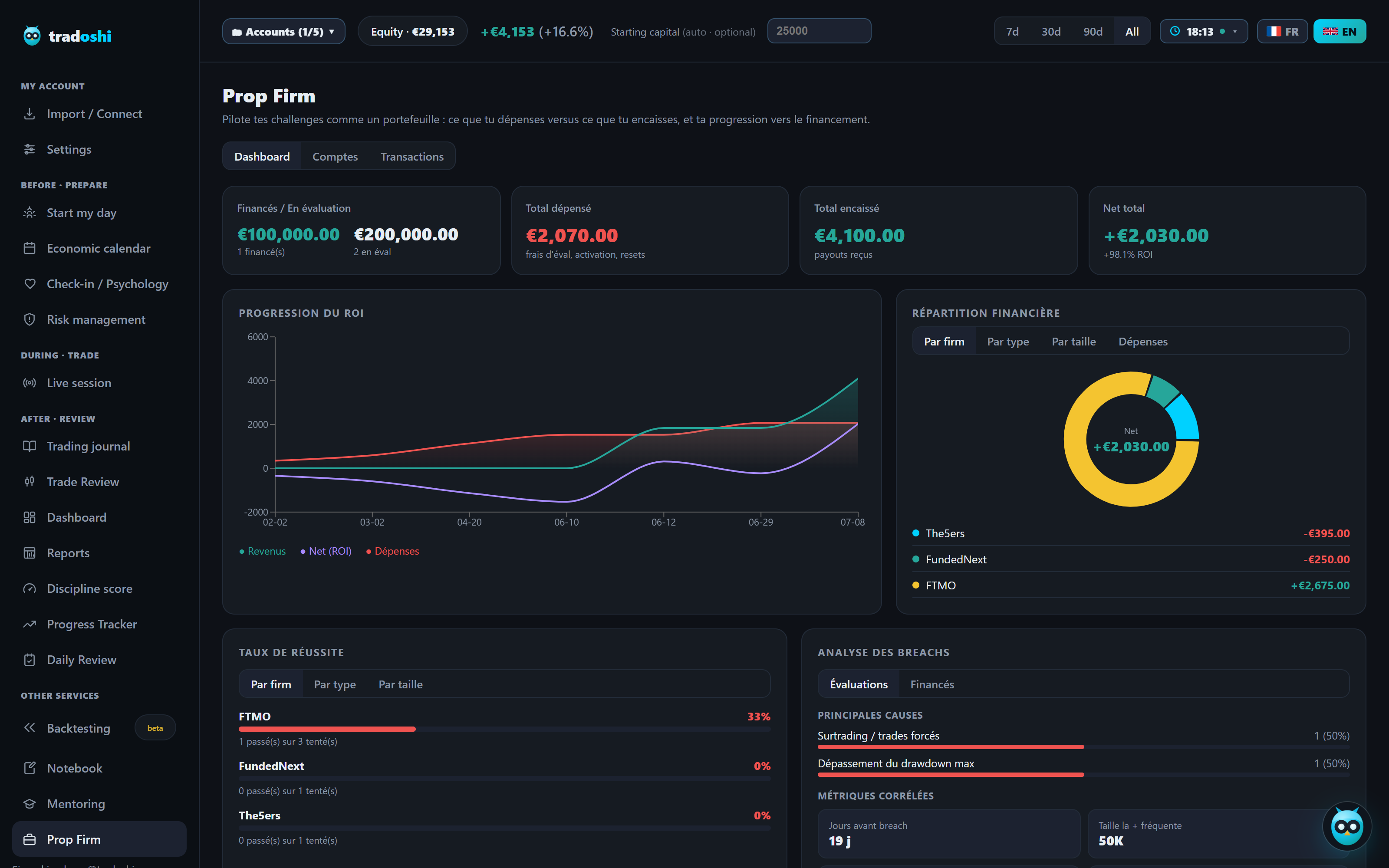
Tradoshi tracks your prop firm accounts in real time with the Path to Consistency module: each of the firm's rules (profit target, max drawdown, daily limit) is tracked against your real performance, so you always know exactly where you stand relative to your challenge's or funded account's requirements.
- Path to Consistency: automatic or manual tracking of your progress toward the firm's target.
- Multi-account: several prop firm accounts tracked simultaneously, each with its own rules.
- Drawdown types handled: static, end-of-day (EOD), or trailing depending on the firm.
- Approaching-limit alerts so you can act before, not after, a rule breach.
Getting funded, managing the account, and the drawdown that decides
Getting funded always follows the same sequence: a paid evaluation, a profit target, loss limits, then a funded account if the first two conditions hold. Passing depends less on performance than on survival, and the method, cutting size and aiming at respecting the limits rather than at the target, is detailed in our guide on passing a prop firm challenge.
Managing a funded account takes a different discipline from running a personal account: the rules are not yours, and a technical breach costs the account even on a winning trade. Reading the rulebook once, in full, saves months, and our guide on choosing your prop firm says what to look for in it.
The trailing drawdown is the first clause to read in a rulebook, before even the profit split. Its intraday version, which recalculates on the session peak, unrealized gains included, is far harsher than the end-of-day one: the same sequence of trades passes under one and fails under the other.
Frequently asked questions
What exactly is a prop firm?
A company that lets you trade an account on its capital, in exchange for a share of the gains you generate, provided you follow its risk rules. At FTMO and at Topstep, according to their pages, that account is a demo account and your share is a reward computed on a simulated result.
What's the typical path with a prop firm?
An evaluation phase (challenge) where you must hit a profit target without breaching loss limits, sometimes followed by a verification phase, then access to a funded account where profit sharing kicks in. Some firms add a scaling plan that increases funded capital with consistency.
Do I own the capital once funded?
No. You own a contractual right to a share of the gains, as long as you follow the rules, and at the firms we read those gains are simulated: FTMO writes that all accounts it provides to its clients are demo accounts with fictitious funds. No capital is placed on a market in your name.
How much does a prop firm evaluation cost?
The price is read on each firm's pricing page, and it changes. At Topstep, according to its help page read in October 2026, the monthly subscription runs from $49 to $199 depending on account size on the standard path, a reset costs the subscription price and activating a funded account $149: two months, two resets and the activation on a $50,000 account add up to $345. At FTMO, the initial 2-Step fee is refunded with the first reward withdrawal, according to its page.
How many candidates pass an evaluation?
The only published statistic among the firms we read is Topstep's for 2025: 16.8% of Trading Combines initiated were completed. The other pages we read publish no rate, and none publishes the share of failures due to each rule. Payout conditions and the other published figures are compared in our guide on choosing your prop firm.
Does an evaluation have a time limit?
Not on the pages we read. FTMO's trading objectives page writes 'No time limit', and at Topstep the evaluation is a monthly subscription that runs as long as it lasts, according to its pricing page. What presses is not a calendar, it is the running cost and the minimum days to validate.
Why does a prop firm account need a different journal?
Because the rules are no longer yours but the firm's, non-negotiable, and even a small breach can end the account. You need to track your remaining drawdown margin, daily limit and profit target in real time, not just your personal risk preferences.
How does Tradoshi help with a prop firm account?
Through the Path to Consistency module, which automatically or manually tracks your progress toward the firm's target, handles several accounts and drawdown types (static, EOD, trailing), and alerts you as you approach a limit so you can act before a breach.
Is prop firm trading right for every trader?
Not necessarily. It suits traders whose main constraint is lack of capital rather than lack of skill, and who can trade while respecting strict, non-negotiable external rules. A trader who needs total flexibility over their risk may find the challenge format more constraining than a personal account.
Can I run a prop firm account alongside a personal trading account?
Yes, and it's actually a common practice. The two follow different logics: the personal account allows total flexibility over risk, the prop firm account gives access to larger capital in exchange for strictly following external rules. Tracking both separately, with their own evaluation criteria, avoids mixing two incompatible risk management logics.
What happens if I break a rule by mistake, without intending to?
The pages we read make no distinction based on intent. At Topstep, the help page on the Maximum Loss Limit writes that the account is liquidated as soon as the limit is hit and that the firm makes no exceptions; at FTMO, equity below the threshold is a violation of the objective. That's one more reason to track your margin in real time rather than relying on your vigilance alone.