 By Benjamin Roure L'Hermitte
Position size is the single most important decision on every trade, and paradoxically the one most traders make on feel. Get it right and no loss can knock you out of the game. Get it wrong and you turn a perfectly normal losing streak into a blown account.
- Size is derived from risk, not the other way around: you first decide how much you're willing to lose.
- One formula links your capital, your risk percentage and your stop distance.
- Fixed percentage risk protects your capital in bad streaks and grows it in good ones.
- Size must vary on every trade based on stop distance, never stay one lot 'out of habit'.
How many lots? How many units? That's the question you answer, consciously or not, on every entry. Answered out of habit ('I always take 1 lot') or on emotion ('I feel good about this one, load up'), it leads to the same place: incoherent exposure that eventually drains the account.
Yet computing the right position size isn't complicated. It's one formula, three inputs, and one rule of discipline. This guide explains the logic, the exact formula, how to apply it on every market, and why it's the number-one safeguard against risk of ruin.
Why position size decides everything
Two traders take the exact same trade, at the same price, with the same stop. The first risks 1% of capital, the second risks 10%. The trade loses. The first lost 1% and can string together ten losses without danger. The second lost 10% and one bad streak is enough to ruin them. Same trade, same analysis, opposite fates: the only difference is position size.
That's why position size isn't a technical detail, it's the heart of survival. Your edge, your strategy, your analysis are worthless if a handful of trades can wipe out your account. Position size is what keeps you in the game long enough for your edge to express itself.
The exact formula
The principle is counterintuitive for a beginner: you don't start from size to derive risk, you start from risk to derive size. You first decide how much you're willing to lose on this trade, then compute the size that matches.
The universal formula is: position size = (capital × risk percentage) / (stop distance in points × point value). Take an example. Capital of 10,000, risk of 1% (i.e. 100), stop 20 pips away on a pair where the pip is worth 10 per lot. Risk per lot = 20 × 10 = 200. Size = 100 / 200 = 0.5 lot. If your stop were 40 pips away, your size would drop to 0.25 lot to risk the same 100.
The stop used in this calculation is one of two orders to place before entry, the other being the profit target: setting both is covered in the guide to take profit and stop loss.
The win rate each ratio demands, and the gap between the planned ratio and the realized one, are explained in the guide to the risk/reward ratio.
| Input | Role | Example |
|---|---|---|
| Capital | The base for the risk calculation | 10,000 |
| Risk % | What you're willing to lose | 1% = 100 |
| Stop distance | Where your thesis is invalidated | 20 pips |
| Point value | What 1 pip is worth per unit | 10 / lot |
| Size (result) | What you compute | 0.5 lot |
Size varies, risk stays constant
This is the point most traders miss. Your position size should never default to the same value from one trade to the next. It changes every time, because your stop distance changes. A tight setup with a 10-pip stop allows a big size; a wide setup with a 60-pip stop forces a small one. What stays identical is the amount risked in money, not the number of lots.
Taking 'always 1 lot' means risking three times more on the wide-stop trade than on the tight-stop one, for no reason. You inject huge, uncontrolled variance into your results. Keeping risk constant smooths your curve and makes your losses predictable.
Where that stop belongs so that it truly marks the scenario's invalidation, and why its distance is never chosen for comfort, is covered in the guide on where to place a stop loss.
What risk percentage should you choose?
A common guideline is to risk between 0.5% and 1% of capital per trade. It is a trader's convention, not a regulator's rule or a measured statistic: Van Tharp's trading concepts present it on a 100,000 portfolio where you decide to risk only 1% on a trading idea, 1,000, and call position sizing the part of your trading system that tells you 'how much'. It feels tiny when you're starting out and dreaming of doubling your account, but that's exactly what protects you in rough patches. At 1% per trade, you'd have to lose 20 times in a row to lose 'only' 18% of capital. At 5%, the same streak puts you at -64%, a hole almost nobody climbs out of.
| Risk per trade | After 10 losses in a row | Verdict |
|---|---|---|
| 0.5% | -4.9% | Barely a scratch |
| 1% | -9.6% | Healthy, recommended |
| 2% | -18.3% | Aggressive but manageable |
| 5% | -40% | Dangerous |
| 10% | -65% | Suicidal |
The table shows why high numbers are a trap: the loss doesn't decrease linearly, it compounds against you. And climbing out of a big drawdown takes a disproportionate effort (losing 50% requires gaining 100% just to break even).
Where the percentages come from: the 1% rule, the 2% rule and the Kelly criterion
Those percentages don't come out of a study: they are conventions of prudence. The one published formula that says how much to bet is the Kelly criterion. In J. L. Kelly's 1956 paper, A New Interpretation of Information Rate, a gambler who knows his edge bets the fraction of his capital that maximizes the exponential rate of growth of that capital. Applied to trading, the calculation requires knowing your win rate and your win/loss ratio precisely, which nobody knows in advance.
That is why the Kelly fraction gets divided in practice. In his chapter on the Kelly criterion in blackjack, sports betting and the stock market, Edward Thorp writes that overbetting is much more severely penalized than underbetting, and that 'fractional Kelly' is prudent to the extent the calculations reflect uncertainties. The fixed percentage you pick (0.5%, 1% or 2% of capital) is a heavily reduced version of that idea: a constant fraction, small enough to survive a wrong estimate of your edge.
What that fraction does to the probability of losing everything is the subject of the guide to risk of ruin.
Adapting the calculation to each market
The formula is universal, but the point value changes with the instrument. On forex, it depends on the pair and lot size. On indices and CFDs, it depends on the contract. On stocks it's simpler: your risk per share = distance between entry and stop, and your size = total risk / risk per share. The key is always to bring the calculation back to the same question: how much do I lose in money if the stop is hit?
On forex, a standard lot is 100,000 currency units, a mini lot 10,000 and a micro lot 1,000: those are the definitions given by IG's page on forex lot sizes, a broker source, regulated by the FCA, not a regulator's text. The pip itself is defined in the NFA's brochure on retail forex trading as the smallest unit of a currency price, and its example, euros bought at 1.2178 and sold at 1.2188 on a 100,000-euro transaction, makes 100: ten pips, so 10 per pip for a standard lot on a pair quoted in dollars. Here is the same 100 of risk on four markets.
- Forex: 30-pip stop on EUR/USD, 10 per pip per standard lot. Size = 100 / (30 × 10) = 0.33 lot, or 33 micro lots.
- Futures: on the Micro E-mini S&P 500 (MES), CME's filing with the CFTC for the launch of the Micro E-mini contracts sets the contract at $5 per index point and the minimum increment at 0.25 index points, equal to $1.25 per contract. With an 8-point stop, one contract risks 8 × 5 = 40: 100 / 40 = 2.5, rounded down to 2 contracts, 80 at risk. A contract can't be split in two, and this is the market where rounding down weighs the most.
- Stocks: risk per share is the difference between entry price and stop. Entry at 42.50, stop at 41.20: 1.30 per share. Size = 100 / 1.30 = 76 shares, rounded down, 98.80 at risk on a 3,230 position.
- Crypto: same logic as a stock, with fractions allowed. Bitcoin bought at 60,000, stop at 58,800: 1,200 of risk per bitcoin. Size = 100 / 1,200 = 0.0833 bitcoin, a 5,000 position. The round number is no accident: 1,200 is 2% of 60,000, and 100 divided by 2% is 5,000.
In all four cases, size is a consequence of risk and stop distance, never a starting point. When rounding down leaves the real risk below budget, that's normal: you never round up.
A position size calculator saves time and avoids rounding errors that, compounded, drift your real risk. But understanding the logic remains essential: a tool that gives you a number you can't verify is a dangerous tool.
The mistakes that wreck the calculation
- Choosing size before the stop: you end up sticking your stop at a distance that 'fits' your size, instead of placing it where it belongs.
- Risking a variable percentage based on confidence: a 'sure trade' doesn't exist; the market doesn't know your confidence level.
- Forgetting fees and spread: they eat into your real risk, especially on small stops.
- Recomputing risk on the starting capital: your percentage should be based on current capital, which rises and falls.
- Doubling size after a loss: the classic martingale, the fastest way to lose everything.
Position size and psychology
A good position size doesn't only protect your capital, it also protects your ability to trade properly. A position too big relative to your account creates an emotional load that degrades every decision: you watch price anxiously, cut your gains too early for fear of giving them back, hold your losses hoping they'll come back, no longer dare to breathe. The amount at stake occupies your mind so much that you no longer trade the market, you trade your fear. Cutting gains early and holding losses has a name, the disposition effect: in Terrance Odean's study, Are Investors Reluctant to Realize Their Losses?, the trading records of 10,000 accounts at a large US discount brokerage, from 1987 to 1993, show investors realizing their gains more readily than their losses. That sample is stock investors, not leveraged traders, and the study doesn't measure position size: the link with size is an observation, not a measurement.
Conversely, a size calibrated to a modest risk (0.5 to 1%) makes the trade emotionally bearable. A loss at that level doesn't hurt, so it doesn't trigger the destructive reflexes. You can execute your plan with the necessary detachment, precisely because the outcome of this isolated trade isn't of vital importance. Position size is thus the first lever of your emotional discipline: calibrating it well means giving yourself the means to stay rational.
Fixed size or fixed risk
There are two main ways to size: fixed size (always the same number of lots) and fixed risk (always the same percentage of capital risked). Fixed size is simple but dangerous: it makes you risk very different amounts depending on your stop distance, with no logic. A tight stop and a wide stop with the same number of lots represent totally different risks, which injects uncontrolled variance into your results.
Fixed risk is far superior, because it keeps constant the only thing that matters: the amount you lose if the stop is hit. The size in lots varies on every trade to respect that risk, but the impact on your capital stays identical. That constancy smooths your curve and makes your losses predictable. Adopting fixed risk over fixed size is one of the most profitable changes a trader can make, yet one of the most neglected.
Adjusting size by conviction: trap or tool
A question comes up often: should you increase your size on the trades where you're more confident? The safe answer is no, firmly. Confidence is an emotion, not data: it's often inversely correlated with reality, because you feel most sure precisely when you're overconfident after a good streak. Varying your size by feeling injects over-risk at exactly the wrong moment.
There's a disciplined version of this idea, reserved for advanced traders: modulating size by the objective, measured quality of the setup, not by feeling. If your data proves a certain type of setup has a clearly superior expectancy, you can allocate it a slightly higher risk, within strict, cold-decided limits. But until you have that numbered proof, keep a fixed risk: it's the safest default, and it will rarely fail you.
A complete example, from setup to trade
Let's walk through a concrete case from start to finish. Imagine a trader with 8,000 in capital who spots a setup on EUR/USD. The entry price is 1.0850, and the analysis places the logical stop at 1.0820, a distance of 30 pips. On this account, the pip is worth 10 per standard lot. The trader applies their 1% rule: they accept to lose 80. Risk per lot is 30 × 10 = 300, so the size is computed as: 80 / 300 = 0.27 lot, rounded to 0.25 or 0.3 depending on what the broker allows. Nothing in this calculation depends on the trader's mood that day or their conviction about the trade: the same formula, applied rigorously, always gives the same answer.
The next day, that same trader spots another setup, this time with a stop only 12 pips away because the setup is tighter. The calculation starts fresh: risk per lot = 12 × 10 = 120, size = 80 / 120 = 0.67 lot. Two trades, two very different sizes, one single amount risked. That mechanical repetition, trade after trade, is what separates a trader who manages risk from one who improvises.
Leverage and sizing: don't confuse margin with risk
A confusion beginners on CFDs or futures run into is mixing up the position size computed from risk with the margin required to open it. Leverage determines how much margin your broker locks up for a given position, 1 divided by the leverage, so 3.33% of the position at 30:1 and 0.2% at 1:500, but it changes nothing in the risk formula: whether you use 1:30 or 1:500 leverage, your real risk stays the same amount of money, set by your stop distance and your lot size.
The trap comes when a trader, seeing they have plenty of free margin thanks to high leverage, is tempted to open a bigger size than the one computed by their risk rule, simply because they 'can afford it' in margin terms. Available leverage isn't a permission slip to take more risk, it's just a financing mechanism for the position. Always keep two separate calculations in mind: the margin needed to open (a broker constraint) and the real risk if the stop is hit (your only real limit).
Take the 0.5 lot of the first example, 50,000 euros on EUR/USD at 1.0850, a 54,250 position. At 30:1 the margin locked up is about 1,808; at 1:500 it is about 109. In both cases, if the 20-pip stop is hit, the loss is 100. For a retail client that leverage isn't free either: ESMA's statement of 27 March 2018 capped the leverage of CFDs sold to retail clients in the European Union, from 30:1 on major currency pairs to 2:1 on cryptocurrencies, and requires providers to close out positions when the account's funds fall to 50% of the minimum required margin.
Where those margin requirements come from, and the leverage limits regulators set by product, is covered in the guide on what leverage is in trading.
Sizing on a prop firm account: an extra constraint
On a prop firm account, the size calculation must factor in something an independent trader doesn't have: the daily loss limit and maximum drawdown imposed by the program's rules. Risking 1% of your capital on a trade means little if the account's rule eliminates you at -5% cumulative loss for the day, across several open trades. In that context, position size must account not only for the risk of that isolated trade, but for the room you have left against your daily limit.
Lowering your risk percentage per trade below your usual habit, to 0.3 or 0.5% for example, leaves you room in case of a losing streak on the same day. A prop firm account that blows because of overly generous sizing isn't a market accident, it's an avoidable calculation error made upstream.
Measuring it automatically with Tradoshi
Computing size before the trade is one thing; checking afterward that you actually risked what you thought is another. Tradoshi reads your stop from your orders and computes the percentage of capital truly risked on each closed trade. You see whether you're holding your rule or quietly drifting, trade after trade.
- Real risk per trade: the percentage of capital engaged is computed from your stop, no manual entry.
- Over-risk detection: trades where you risked far more than your rule stand out immediately.
- Big picture: your average risk per trade tells you whether your management is consistent or erratic.
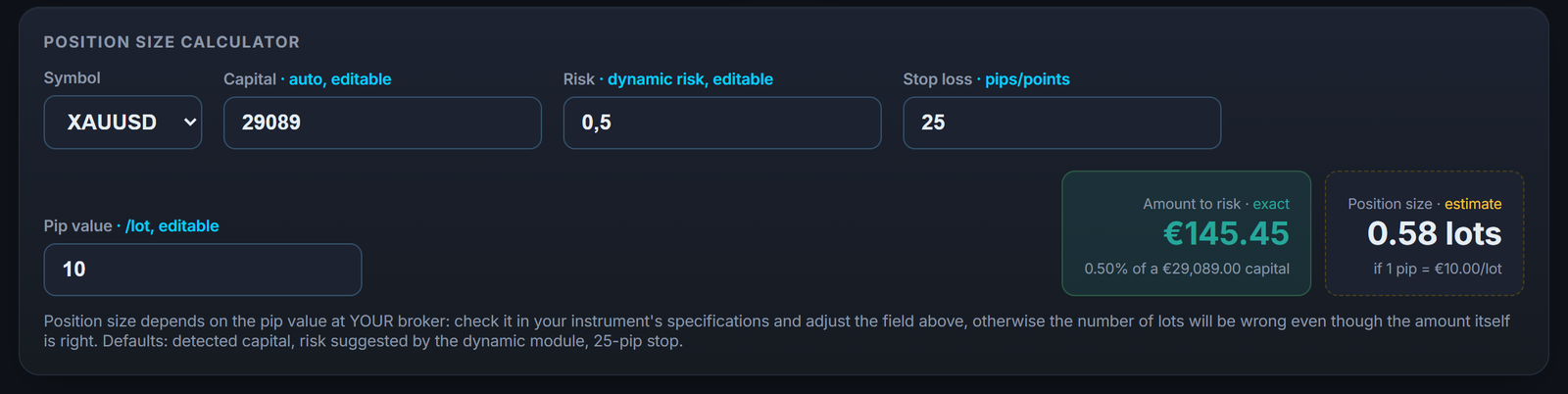
- Built-in calculator: the correct size is computed before the trade, from your real connected capital.
Frequently asked questions
How do I calculate position size?
Size = (capital × risk percentage) / (stop distance × your instrument's point value). You first decide how much you're willing to lose (say 1% of capital), then derive the size that matches your stop distance. Size changes on every trade, the amount risked stays constant.
How much should I risk per trade?
A common guideline is 0.5% to 1% of capital per trade: a convention of prudence, not a statistic. The arithmetic backs it: ten losses in a row cost 4.9% of capital at 0.5% per trade, 9.6% at 1%, 18.3% at 2% and 40% at 5%. The higher the percentage, the longer the climb back: after a 50% loss you need a 100% gain to get back to even.
Why should my position size change on every trade?
Because your stop distance changes on every setup. To risk the same amount in money, you must take a smaller size when your stop is far and a larger one when it's close. Keeping the same size always means risking very different amounts for no reason.
Do I need a position size calculator?
It's a useful time-saver and avoids rounding errors, but the essential thing is understanding the formula. A calculator that spits out a number you can't verify may hide a setup error. Understand the logic first, automate second.
How do I calculate risk on stocks rather than forex?
On stocks it's more direct: your risk per share = entry price − stop price. Your size (number of shares) = total accepted risk / risk per share. Forex just adds the notion of pip value and lot size, but the logic is identical.
Do spread and fees change the calculation?
Yes, especially on tight stops. The spread widens your real loss beyond the displayed distance, and commissions add on top. For an honest calculation, factor the spread into your stop distance and take fees out of your risk budget, otherwise you risk a bit more than planned on every trade.
Which capital should I base my risk percentage on?
On your current capital, not your starting capital. If your account has grown, your 1% represents more money; if it's down, it represents less. Basing the calculation on current capital naturally shrinks your size when you lose and grows it when you win, which is exactly the behavior you want.
Does leverage change the position size I should calculate?
Not directly. Leverage determines the margin needed to open the position, not the real risk, which depends only on your stop distance and your risk percentage. Never confuse available margin with permission to take a bigger size than the one computed by your risk rule.
How should I adapt position size on a prop firm account?
By accounting for the program's daily loss limit and maximum drawdown, not just the risk of that isolated trade. Lowering your risk per trade, to 0.3 or 0.5% for example, keeps room in case of a losing streak within the same day.