 By Benjamin Roure L'Hermitte

A trading checklist is a short list of checks, each answered yes or no, that every trade must pass before it is taken. Surgeons and airline pilots, whose mistakes cost lives, rely on checklists, and in both professions the effect has been measured or written into regulation, not just assumed. For traders, no published study has measured it, as far as we know; what finance research has measured is the effect of a rule set in advance on one specific bias. This guide says what a checklist can do, what it doesn't guarantee, and how to build one that holds.
- A checklist forces consistency: every trade goes through the same checks, whatever your state.
- It puts a check between impulse and action: you follow a list instead of improvising under pressure.
- It makes 'no' easy: if a criterion is missing, you skip the trade, no debate.
- Short and binary: each point is answered yes or no, in seconds.
- What's been measured comes from elsewhere: surgery, intensive care and aviation, not trading; in finance, sell orders set in advance reduced one specific bias, in the lab.
In US commercial aviation, the checklist isn't left to the pilot's discretion: federal rule 14 CFR 121.315 requires each carrier to provide a cockpit check procedure, designed so that a crew member will not need to rely on memory, which the flight crew must follow. Experience exempts no one, because what you forget under pressure has nothing to do with what you know. Trading puts no lives at stake, but a few seconds of inattention can erase weeks of work.
Entering on feel, telling yourself 'this looks good', means replacing a check with an impression. A checklist does the opposite: it puts each trade through a series of objective questions it has to pass. This guide explains what research has measured about checklists and about rules set in advance, how to build an effective one, and how it helps you automate your good decisions so emotion no longer has the last word.
Why a checklist works
A checklist works for a simple reason: it doesn't ask you to remember or judge, it asks you to tick. That's the logic the aviation rule quoted above spells out: the procedure must be designed so the crew doesn't need to rely on memory. It doesn't assume you're incompetent; it assumes that, rushed or emotional, you skip steps you know by heart, and only notice afterwards. What that yields when measured, surgery has documented and trading hasn't: that's the next section.
By turning a complex decision into a series of simple questions, the checklist makes your behavior less dependent on your mood. Whether you're calm or wanting to win it back, the same trade goes through the same filters. That's exactly what you want in trading: consistent execution that doesn't vary with your inner state of the moment.
What research has measured, and on whom
The most cited evidence comes from surgery. In the study by Haynes and colleagues, published in the New England Journal of Medicine in 2009, eight hospitals in eight cities (Toronto, New Delhi, Amman, Auckland, Manila, Ifakara, London and Seattle) introduced the 19-item surgical safety checklist of the WHO programme. Across 3,733 patients operated on before and 3,955 after, in noncardiac surgery, the death rate went from 1.5% to 0.8% and the complication rate from 11.0% to 7.0%. It's a before-and-after study in volunteer hospitals, not a randomized trial, and it concerns patients, not traders.
Before it, the study by Pronovost and colleagues, in the same journal in 2006, had followed 103 intensive care units in Michigan after a standardized intervention against catheter-related infections, over 375,757 catheter-days: the median rate went from 2.7 infections per 1,000 catheter-days to zero three months later, and the drop held over eighteen months. Again, precise actions, repeated identically, on a hospital ward.
The picture has a flip side, and it deserves a read. When Ontario encouraged the general adoption of surgical safety checklists, the study by Urbach and colleagues, published in 2014 in the same journal, did not find the effect: across 101 hospitals, 109,341 procedures before and 106,370 after, adjusted mortality went from 0.71% to 0.65% and complications from 3.86% to 3.82%, differences the authors judge not significant. They conclude that mandatory adoption, in routine practice, was not associated with a measurable reduction. They don't settle the cause, and neither does this article; what it keeps is that a list doesn't work by merely existing.
On the aviation side, the National Air and Space Museum traces the pilot's checklist back to the crash of the Boeing Model 299 at Wright Field, Ohio, on October 30, 1935: an aircraft more complex than anything flown until then, whose loss revealed that you could no longer keep everything in your head. Nearly a century later, the federal rule quoted at the start says the same thing in regulatory language.
And for traders? As far as we know, no published study measures the effect of a checklist on the results of retail traders. Transferring surgery's numbers to trading would be an abuse: the population, the task and the risk have nothing in common, and nobody knows whether a drop from 1.5% to 0.8% somewhere translates into anything on an account. The closest thing in finance concerns rules set in advance.
The experiment by Fischbacher, Hoffmann and Schudy, a 2014 University of Konstanz working paper later published in the Review of Financial Studies, was run in the laboratory: every participant could buy and sell assets by hand, and one group additionally had stop-loss and take-gain orders that sold automatically. According to its abstract, the only part read here, those with access to these orders showed a significantly smaller disposition effect, and the reduction came from an increase in realized losses, with the share of winners sold staying the same. It's a lab experiment, not a measurement on real accounts, and it concerns automatic orders, not a list to tick. It still says something useful: a rule set before you're in a position changes behavior where intention alone doesn't.
The disposition effect itself is well documented. Odean's study, published in the Journal of Finance in 1998, analyzed the records of 10,000 accounts at a large US discount brokerage between 1987 and 1993, retail stock investors: a winning position was more than 50% more likely to be sold on a given day than a losing one, and the winners sold then beat the losers kept by 3.4 points over the following year. These investors weren't day trading, and the measurement holds for them, not for you. It only shows where the bias lives: at the moment of exit, which gives the exit checklist described below its whole point.
It puts a check between impulse and action
The enemy the checklist targets isn't the market, it's impulse. Seeing a fast move and wanting to jump in, feeling a loss and wanting to avenge it, fearing to miss out and forcing an entry: these impulses take control in a fraction of a second. The checklist introduces a delay and a structure between impulse and action. It guarantees nothing: it gives you a moment of verification that impulse never plans for.
You often read that willpower runs out over the day and that rules are needed to spare it. That idea, ego depletion, did not survive replication: the multilab study by Hagger and colleagues, published in 2016 in Perspectives on Psychological Science, reran a standardized protocol in 23 laboratories on 2,141 participants and found an effect close to zero (d = 0.04, with a confidence interval that includes zero). The case for the checklist therefore doesn't rest on a reservoir of willpower draining away, but on a more modest fact: a written question is asked as is, whereas an intention gets renegotiated.
A checklist doesn't make you smarter. It just stops you from being stupid at the worst moment, which is far more useful.
When you have to run your trade through five questions before entering, you can no longer act purely on impulse. Either the trade ticks every box, and then your emotion has no grip since the trade is objectively valid, or one is missing, and the checklist gives you a clear, non-negotiable reason to abstain.
How to build an effective checklist
A good trading checklist is short, precise and binary. Short, because a twenty-point list will never be followed; five to seven criteria suffice. Precise, because a vague criterion filters nothing. Binary, because each point must be answered yes or no in seconds, with no room for interpretation. Here's the structure of a typical pre-entry checklist:
| Criterion | Binary question |
|---|---|
| Context | Is the trade in the direction of my reference trend? |
| Setup | Is my exact entry signal present? |
| Risk | Is my stop placed and my size sized at 1%? |
| Ratio | Does my target offer a ratio of at least 1:2? |
| Time | Am I within an allowed time window? |
| State | Am I calm, and not wanting to win it back? |
The last criterion is the most important and most often forgotten: your own state. A perfect setup taken in a degraded emotional state is a bad trade disguised as a good one. Building a check of your mental state into your checklist is the best way not to trade your emotions instead of the market.
The easy-'no' rule
The checklist's real power is that it makes refusal simple and guilt-free. Without a checklist, saying no to a trade is hard: you doubt, you wonder if you're missing an opportunity, emotion pushes you to enter. With a checklist, refusal becomes mechanical: a criterion is missing, so you skip, period. It's no longer you giving up, it's the list deciding, and that delegation frees you from the pressure.
Nobody has measured that this ability to say no separates profitable traders from the rest, and this article won't claim it. What you can measure, yourself, is the share of your trades that wouldn't have passed your list, and what they cost you. That's the only statistic that matters here, and it's in your journal, not in a study.
From checklist to measurement
A checklist disciplines you before the trade; measuring your trades disciplines you after. The two complement each other perfectly. The checklist filters entry, and measurement tells you whether, in hindsight, you truly respected your criteria or told yourself stories while ticking the boxes a bit fast. Without that verification loop, a checklist can become an empty ritual you follow mechanically.
It's by crossing the two that discipline is truly built: the checklist sets the conditions, and measurement after the fact verifies you honored them. If your off-checklist trades stand out as your worst, you gain the most solid motivation there is to respect it: the numbered proof, on your own trades. And if they don't stand out, your list filters poorly, which is just as good to know.
Entry checklist and exit checklist
We almost always think of the checklist for entering, never for exiting, when the exit is at least as much a source of errors. An exit checklist asks you the right questions at closing time: is my target reached per my plan? Am I cutting out of fear or by my rule? Is my scenario invalidated? Am I holding a loss hoping for a reversal? These questions, asked mechanically, defuse the emotional exits that destroy the ratio.
The exit is also where the best-documented bias among retail investors lives: selling winners too early and keeping losers too long, the disposition effect Odean measured on the accounts described above. An exit checklist forces you to confront your decision with your rules instead of leaving it to your emotion of the moment. A disciplined entry followed by an exit left to chance doesn't make a method: structuring the exit as much as the entry is one of the simplest adjustments to write down, and one of the hardest to hold.
The danger of the checklist becoming an empty ritual
A checklist has a paradoxical enemy: habit. From filling it repeatedly, you risk ticking it mechanically, without really checking, on autopilot. The checklist then becomes an empty ritual that gives you a false sense of rigor while having lost its filtering power. You tick 'yes' on criteria you didn't actually examine, just by reflex, and the safeguard no longer protects anything.
To avoid this, keep your checklist short and demanding, and regularly check, by rereading your trades, whether your answers were honest. If you discover that trades ticked 'compliant' actually violated a criterion, it's the sign you're filling your checklist too fast. A checklist only has value if each box corresponds to a real check, not a reflex. That's also one possible reading of the Ontario study cited above, where a list that became mandatory wasn't followed by a measurable drop; its authors don't settle the cause, and neither does this article. Measuring your trades after the fact is the best way to keep your checklist honest and alive.
Adapting your checklist with experience
A good checklist isn't fixed: it evolves with what your data teaches you. If you discover a certain criterion filters nothing useful, remove it to keep the list light. If you identify a recurring leak (say, your worst trades always happen in a certain context), add a criterion that addresses it. The ideal checklist reflects the lessons of your own history, not a generic list copied elsewhere.
This adaptation must happen cold, based on your past trades, never mid-session to allow a trade the checklist refuses. Revising your checklist between sessions, based on what cost you and what worked, makes it increasingly precise and personal. Over time, it becomes the distillation of everything you've learned about your own way of sabotaging yourself, and therefore the most effective tool for avoiding it.
Mistakes to avoid when building your checklist
Building a checklist seems simple, but certain mistakes keep recurring and cancel out its effectiveness. The first is copying someone else's checklist without adapting it. A checklist found in a book or on a forum reflects its author's strategy and weaknesses, not yours. A criterion essential for a scalper may be useless for a swing trader, and vice versa. Your checklist should come out of your own recurring mistakes, not a generic list.
The second mistake is including subjective criteria that leave too much room for interpretation, like 'the setup looks clean' or 'the context seems favorable'. A vague criterion filters nothing because you can always convince yourself it's met. Each point must be objectively verifiable, with a yes or no that doesn't depend on your mood of the moment.
The third mistake is wanting to include everything, to the point of turning the checklist into a twenty-line slab. A checklist that's too long takes too long to fill in, which pushes you to rush it or abandon it under time pressure, exactly when you need it most. Five criteria truly respected beat twenty ticked in a rush.
A worked example: the checklist that would have prevented an avoidable loss
To make this concrete, imagine a trader who spots a nice setup on an instrument they follow, with a 1:2.5 ratio and a favorable trend context. Excited by the opportunity, they enter without noticing the time falls outside their usual window, right before a major economic release they hadn't checked. The market reacts violently to the release, against their position, and their stop is hit with significant slippage that doubles their expected loss.
Had they followed a five-criterion checklist including the question 'am I within an allowed time window, with no major release imminent?', that trade would have been automatically screened out, without even needing to think about it. The checklist wouldn't have changed anything about their technical read, which was correct, it would simply have blocked the entry because of an external risk factor that the excitement of the moment made them forget.
This example, built to illustrate the mechanism, shows why the checklist protects even good analysis: the problem wasn't the setup, it was the context in which it was taken. An objective checklist catches this kind of blind spot far better than mental vigilance, which relaxes precisely when the opportunity looks great.
One checklist per strategy, not a universal one
If you trade several distinct setups or strategies, a single universal checklist almost always ends up too vague for one and too strict for another. A minimum-ratio criterion relevant to your breakout strategy may make no sense for your reversal strategy, which targets shorter moves with a different ratio. Forcing all your trades through the same grid produces either unjustified refusals or acceptances a poorly calibrated criterion should never have let through.
The solution is to have a short checklist per strategy, each tailored to that setup's specific criteria, rather than a single list meant to cover every case. That takes a bit more design work upfront, but each checklist stays short and relevant, which is the very condition of its effectiveness. The only criterion that should stay common to all your checklists, whatever the strategy, is your emotional state: whatever the setup, a trader who wants to win it back shouldn't take any trade at all.
How Tradoshi complements your checklist
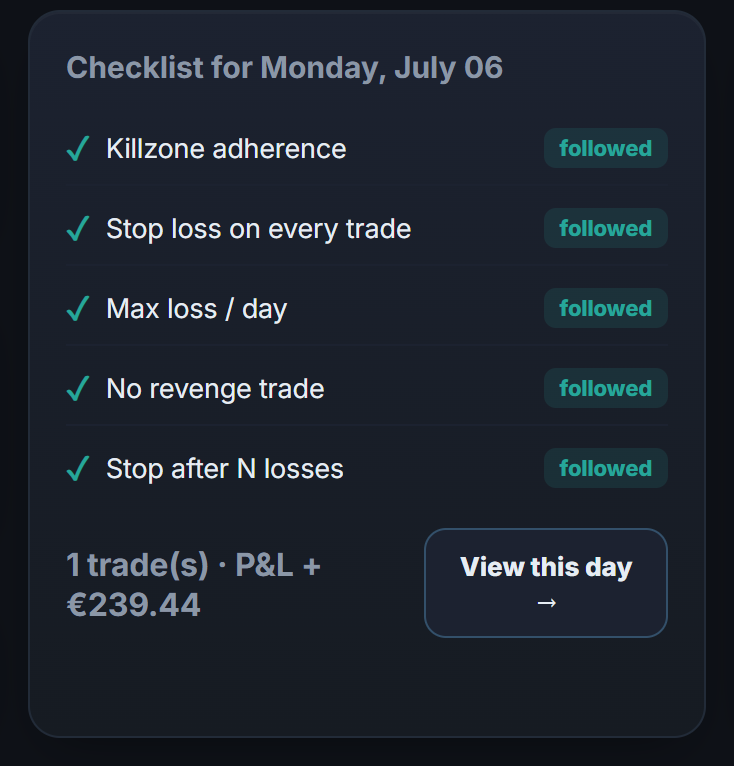
Tradoshi doesn't replace your entry checklist, it extends it by verifying, afterward, whether you respected your key criteria (risk, hours, stop) on your real trades, and showing you what off-rule trades cost.
- Criteria verified: 1% risk, time windows, stop rules automatically checked on every trade.
- Discipline score: a daily grade reflecting your overall adherence to your criteria.
- Emotional check-in: it complements the 'state' criterion of your checklist before the session.
- Numbered proof: your off-rule trades are compared with the others, numbers included.
Plan, playbook and rhythm: the three documents most often missing
A trading plan fits on one page: the markets you follow, the hours, the risk per position, the entry conditions, the exit conditions, and what you do after two losses. A trading plan template is useless until it holds your own numbers, and a sample trading plan already filled in, even an imperfect one, teaches more than an empty grid. The same is true of a playbook, which is nothing more than the collection of your setups, each with its own sheet. The ultimate trading playbook is the one you actually reread.
Frequency deserves to be decided in advance rather than endured. How many trades per week? How many day trades can you make in a week? Those two numbers protect you from a risk a stop cannot see: the losing run, which they stop from existing at all. A trading risk management system is really just those rules written before the session. The perfect trade checklist is the shortest one you will still run at 9.31am.
Risk management techniques in trading come down to three levers: size, distance to stop, and number of simultaneous positions. Everything else follows, and a risk management calculator does not replace the decision to set them. Why is day trading so hard? The answer is boring: those three levers are easy to write down and hard to hold.
Frequently asked questions
What is a trading checklist for?
It runs each trade through the same objective checks, whatever your emotional state, and protects against forgetting, fatigue and haste. For airline pilots, the checklist is required by regulation; in surgery, its effect has been measured; for retail traders, it hasn't been, as far as we know. It puts a check between impulse and entry, and forces consistent execution, independent of your mood of the moment.
What should go in a trading checklist?
Five to seven binary criteria: context (trend direction), the exact setup, risk (stop placed, size at 1%), ratio (at least 1:2), allowed time, and above all your emotional state (are you calm?). Each point must be answered yes or no in seconds, with no room for interpretation.
Should a checklist be long?
No, on the contrary: a long checklist will never be followed. Five to seven criteria suffice. Effectiveness comes from the simplicity and binary nature of each point, not the number. A short list you follow on every trade is infinitely better than an exhaustive one you drop after a week.
How does a checklist reduce emotion?
It introduces a delay and a structure between impulse and action. When you have to run your trade through several questions before entering, you can no longer act purely on impulse. Either the trade ticks every box and is objectively valid, or one is missing and you have a clear, non-negotiable reason to abstain.
Why include my emotional state in the checklist?
Because a perfect setup taken in a degraded state is a bad trade disguised as a good one. The market hasn't changed, but you have: under stress, your execution deteriorates. Adding a check of your mental state ('am I calm or wanting to win it back?') is the best way not to trade your emotions instead of the market.
Is a checklist enough to be disciplined?
It disciplines entry, but it must be complemented by measurement after the fact. Without verification, a checklist can become an empty ritual you tick too fast. By crossing the checklist (before) and measurement of your real trades (after), you see whether you truly respected your criteria, and what your off-rule trades cost you, numbers included.
Can I copy another trader's checklist?
It's not recommended as-is. A checklist found in a book or on a forum reflects its author's strategy and weaknesses, not yours. A criterion essential for a scalper may be useless for a swing trader. Use an existing checklist as a starting point, but adapt it based on your own recurring mistakes.
Do I need a different checklist for each strategy?
Yes, if you trade several distinct setups. A universal checklist almost always ends up too vague for one and too strict for another, because relevant criteria (ratio, context) differ by strategy. Keep a short checklist per strategy, with your emotional state as the only criterion common to all of them.
Does any study prove that a checklist improves a trader's results?
Not as far as we know. The published studies concern surgery (Haynes and colleagues in 2009, eight hospitals, deaths from 1.5% to 0.8%; Urbach and colleagues in 2014, 101 Ontario hospitals, no significant drop) and intensive care (Pronovost and colleagues in 2006, Michigan). In finance, the laboratory experiment by Fischbacher, Hoffmann and Schudy shows that automatic sell orders set in advance reduce the disposition effect. None of this measures a checklist among retail traders.