 By Benjamin Roure L'Hermitte

Playbook trading is about keeping your own library of winning setups, documented in detail. It's the tool that turns isolated successful trades into reproducible know-how. Without a playbook, you reinvent the wheel every session; with one, you instantly recognize your best setups and know exactly how to play them. This guide explains what a playbook is, how to build it, and why it's an accelerator of progress.
- A playbook documents your winning setups in detail: conditions, entry, management, exit.
- It turns isolated successes into reproducible know-how you can replay.
- It's built from your real trades, not theories seen elsewhere.
- It makes your setups measurable: you know which truly pay.
You probably have favorite setups, but in your head, vaguely. You roughly recognize a good configuration, without being able to describe it precisely or say how much it really pays. The result: you play it inconsistently, sometimes well, sometimes badly, and never truly capitalize on what works.
A playbook fixes this by documenting each winning setup as a play sheet: its exact conditions, its entry point, its management and exit, and its real statistics. This guide shows you how to build your playbook from your own trades, and how it becomes one of the most powerful tools for progressing reproducibly, from the structure of a single sheet to the most common mistakes to avoid while building it.
What a playbook is
A playbook, a term borrowed from sports and adapted here to trading, is a collection of your favorite trading configurations, each documented as a detailed play sheet. Each sheet describes a precise setup: in which conditions it appears, how to recognize it, where to enter, how to manage the position, and where to exit. Mike Bellafiore, co-founder of the trading firm SMB, made it the title of a book. In the introduction to The PlayBook, published by its publisher, he describes the exercise: after each session, every trader on his desk archives, in a shared template, the setup that made the most sense to them that day. It's the formalization of your know-how, taken out of your head and put on paper.
The key difference from a simple trading system is that a playbook contains several distinct setups, each adapted to a different market context. Where the system, or the trading plan that describes it, gives the broad general framework, the playbook gathers the concrete, proven situations you already know how to play well. It's your personal toolbox, built not from theories, but from what actually worked for you, trade after trade, session after session.
Why document your setups
Documenting your setups makes them recognizable and replayable. When a setup is described precisely, you know what to look for when it reappears, and what to do, with less hesitation and improvisation. Bellafiore recounts, in the same introduction, meeting a series of very experienced but underperforming traders: none of them had a method to archive their favorite setups, nor could they clearly articulate their best plays. That is a coach's observation, not a measurement. And to our knowledge, no published study measures the effect of a playbook on a trader's performance: the support cited further down comes from work done outside the markets.
A setup that lives in your head is played on instinct, differently each time. The same setup, documented, is played by the same rules. That's reproducibility.
Documenting also brings consistency. An undocumented setup is played variably depending on your mood, which blurs its results and prevents you from knowing whether it's really good. A setup played the same way each time gives comparable trades, and therefore statistics that mean something, provided you have enough of them. Documentation turns a fuzzy intuition into a measurable, improvable asset.
Building your playbook from your trades
The right way to build a playbook isn't to copy setups seen elsewhere, but to start from your own winning trades. By analyzing your successes, you identify the recurring configurations, those where you win most often and biggest. These recurring configurations are the natural candidates for your playbook, on one condition: also count the times the same configuration lost. A sheet built on winners alone describes your good memories, not your real edge.
For each identified setup, you create a dedicated sheet capturing everything that characterizes it: the market context, the signals that trigger it, your typical entry point, your risk management, your exit rule, and what invalidates the idea. A screenshot of a real example is worth a thousand words. The more precise and illustrated the sheet, the easier the setup becomes to recognize and replay. Write these criteria before the next trades, and tag each trade at entry, not once the result is known: in Baruch Fischhoff's paper on hindsight judgment, students who were told the outcome of a story then judged it more likely than those who were not, largely without being aware of it. The experiment is about stories, not trades, but the risk is similar: after the fact, a winner easily looks like your setup. Your playbook thus grows trade after trade, anchored in your reality, rather than in some generic theory that ignores exactly how you trade.
Measure each setup separately
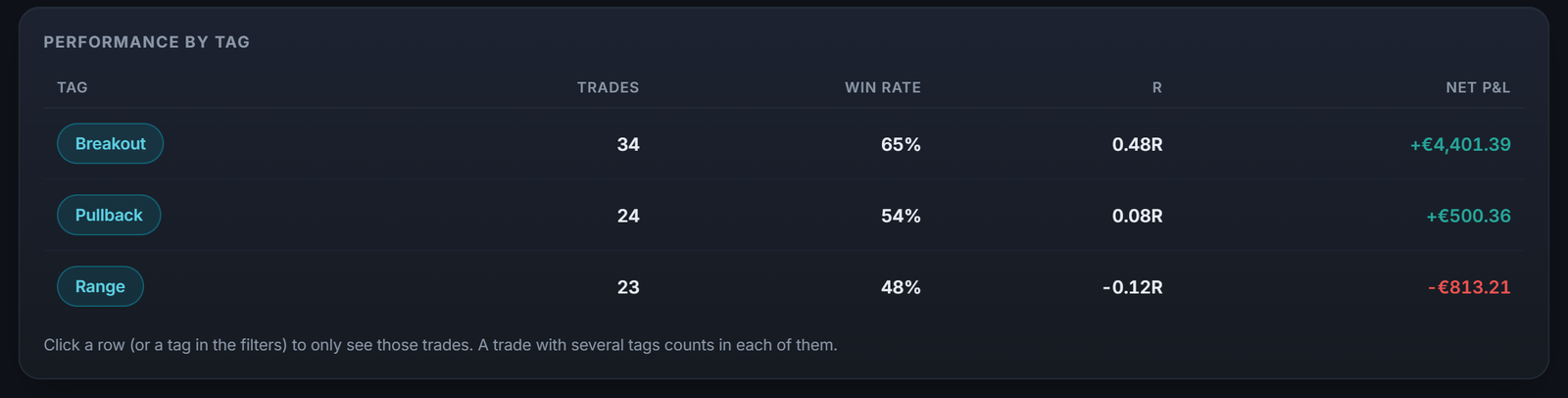
One of the biggest, most underrated benefits of the playbook is letting you measure each setup separately. Instead of an overall performance mixing everything together into one blurry number, you get the statistics of each configuration on its own: its win rate, its profit factor, its average gain. To compare two setups that don't use the same stop, express each result in R: in the Van Tharp Institute's trading concepts, R is the initial risk of the trade, and each gain or loss is written as a multiple of that risk. This segmentation sometimes reveals surprises, like a setup you love but that, with the numbers to prove it, loses you money.
This per-setup measurement turns your playbook into an arbitrage tool. You see which of your setups are truly profitable, which are neutral, and which cost you. The conclusion is direct: play your best setups more, drop the bad ones. It's a simple optimization, and it's impossible without a playbook that isolates each configuration to measure it. One caveat: a setup is neither condemned nor crowned on ten trades, and the sample question is covered further down.
The playbook as a selection filter
Beyond documentation, and this is where it earns its keep on a daily basis, the playbook becomes a selection filter. If a trade matches no sheet in your playbook, it's a strong signal that it probably shouldn't be taken. This simple rule, only trade what's in the playbook, rules out by construction the off-plan trades taken on impulse.
Used this way, the playbook replaces an effort of willpower with a check: is this trade in my playbook? If yes, I play it per the sheet; if no, I pass. The idea has support, but from outside trading. In the meta-analysis by Gollwitzer and Sheeran, which pools 94 independent tests, deciding in advance 'if this situation arises, then I will do that' had a medium-to-large effect (d = 0.65) on goal attainment. And in surgery, the study by Haynes and colleagues, run in eight hospitals, saw the death rate go from 1.5% to 0.8% after a 19-item checklist was introduced. Neither is about traders, and neither promises a result on your account. They only show why a rule written with a cool head holds better than a resolution made in the heat of the moment, even on the days when the urge to trade is strongest.
A living playbook
A good playbook is never frozen in place, it evolves with you as your trading matures. Setups that stop working are removed or revised, new winning setups that emerge are added and documented. This continuous updating keeps your playbook aligned with current market conditions and with your evolution as a trader, preventing it from becoming a museum of obsolete configurations.
This ongoing evolution feeds on your regular review. At each analysis of your trades, you check the performance of your documented setups and spot possible new configurations to formalize. The playbook and the review thus form a virtuous pair: the review feeds the playbook with lessons, the playbook structures the review by giving a clear framework to judge your trades. Together, they make you a trader who truly capitalizes on their own hard-won experience, instead of relearning the same lessons every few months.
Anatomy of a playbook sheet
A good playbook sheet always answers the same questions, in the same order, which makes it fast to check even under pressure during a session. It starts with the market context that must be in place for the setup to be valid: an established trend, a key level, a specific session phase. Many playbooks define that level as a supply or demand zone. It then describes the trigger signal, the visual detail or price move that confirms the setup is forming.
| Sheet section | What it contains |
|---|---|
| Context | Required market conditions |
| Signal | What triggers the setup |
| Entry | Precise entry point |
| Management | Stop, targets, position size |
| Statistics | Win rate, profit factor, average gain |
Next comes the execution part: the precise entry point, the stop placement and its logic, the condition that invalidates the idea, the exit target or targets, and the typical position size for this setup. A good sheet also includes the setup's real statistics (win rate, profit factor, average gain) and, ideally, one or two screenshots of real examples. This identical structure from one sheet to the next makes the playbook checkable in seconds, which matters when an opportunity shows up in real time. The breakdown itself is up to you: Bellafiore files each archived trade under seven headings, from the big picture of the market to the trade review, and makes clear that a playbook's contents belong to each trader.
How many setups should a playbook hold?
The temptation is strong to want a rich playbook, with many setups to cover every possible market situation. That's often a mistake: a trader who starts their playbook with fifteen different setups usually doesn't have enough trades on each to draw reliable statistics, and ends up scattering their attention rather than focusing it where it counts. An effective playbook starts small, with two or three solid setups, before gradually growing.
Quality beats quantity, and it is counted in trades. There is no magic threshold, but there are two benchmarks. The Van Tharp Institute, cited above, asks for at least thirty trades for a first idea of a system's expectancy, and rather a hundred to two hundred for a clear picture. And the confidence interval as presented in the NIST statistics handbook, from the US standards institute, shows what a measured win rate is worth: 60% over 30 trades sits, at 95%, between roughly 42% and 75%, and over 100 trades between 50% and 69%. Three setups each tracked over a hundred trades are therefore worth far more than ten setups with twenty trades each. Adding a setup to the playbook should be an earned decision, made only after observing a clear regularity over a sufficient number of trades, not a reflex the moment a trade happens to work once.
Common mistakes when building a playbook
The first classic mistake is copying setups seen in a course or on social media without ever verifying they actually work in your own trading. A setup that works for someone else, with their risk management, their instrument and their style, doesn't automatically transfer. The playbook should reflect your real edge, measured on your own trades, not a borrowed theory that's never been confronted with your data.
The second mistake is letting the playbook go static: once written, you stop consulting and updating it, and it becomes a relic rather than a living tool. A sheet that no longer reflects the market's current reality or your current results does more harm than good, since it keeps guiding your decisions with outdated information. Reviewing each sheet regularly, in light of the most recent trades, keeps the playbook honest.
A worked example: from isolated trade to documented setup
Let's take a concrete example. A trader notices they've taken twelve trades over the last three months on a level-retest-after-breakout configuration, with nine winners, an average gain of 220 and an average loss of 90. Nine out of twelve is 75%, but on a sample that thin the 95% confidence interval runs from roughly 47% to 91%. That's not yet enough for a definitive playbook entry, but enough to open a provisional sheet and keep specifically tracking this configuration on subsequent trades. The sheet should also cover the case where the retest never comes: according to Thomas Bulkowski's Throwbacks page, a return to the broken level followed 58% of 10,305 upward breakouts recorded since 2000.
Three months later, this same setup shows 34 trades with a 68% win rate and a 3.1 profit factor, numbers above its overall average across all strategies combined. The interval has narrowed, to roughly 51% to 81%, without being tight: this setup then deserves a full sheet in the playbook, with priority over other, less profitable configurations, but not yet certainty, and it keeps being measured. It's this progression, from a noticed isolated trade to a documented and measured sheet, that turns intuition into an advantage you can verify.
Where to start if you don't have a playbook yet
If you don't have a playbook yet, the first step isn't to sit down and invent one from scratch, but to review your trades from the last few months to spot what recurs. Look for trades that resemble each other: same type of context, same kind of signal, same way of managing the position. These repetitions, even informal ones, are the seeds of your first sheets.
Once you've identified two or three candidates, open a provisional sheet for each and start specifically tracking their results on subsequent trades, even if the starting sample is small. Only after accumulating enough trades on a candidate does it deserve a permanent place in your playbook. This process takes time, often several months depending on how often you trade, and that's normal: a solid playbook isn't built in a weekend.
How Tradoshi helps you build your playbook
Tradoshi helps you identify your best setups to document and measure each separately. By breaking down your performance and letting you annotate your trades, it turns your successes into a playbook based on your real data.
- Breakdowns by setup, instrument and time to spot your most profitable configurations.
- Per-setup statistics (win rate, profit factor, average gain) to know which to document first.
- Notebook and screenshots to formalize each sheet from real examples.
- Trade review to analyze your best trades and extract the recurring setups.
Frequently asked questions
What is a trading playbook?
It's your personal library of winning setups, each documented as a detailed play sheet: in which conditions it appears, how to recognize it, where to enter, how to manage, where to exit, and its real statistics. It turns isolated successes into reproducible know-how you can replay with confidence.
How do I build a trading playbook?
By starting from your own winning trades, not setups seen elsewhere. Analyze your successes to identify the recurring configurations where you win most often and biggest, then create a precise sheet for each (context, signals, entry, management, exit), ideally illustrated with a real example. The playbook thus grows trade after trade.
What's the point of documenting setups?
To make them recognizable and replayable the same way each time. A documented setup is spotted instantly and always played optimally, which makes its results reliable and tells you its true value. An undocumented setup is played on instinct, differently each time, which pollutes its statistics.
Does the playbook help with trade selection?
Yes, it's one of its biggest strengths. If a trade matches no sheet in your playbook, it's a strong signal it shouldn't be taken. This rule (only trade what's in the playbook) rules out trades taken on impulse and turns selectivity into a simple objective check, easier to respect.
How do I know which setups are truly profitable?
By measuring each setup separately, which the playbook enables: instead of an overall performance mixing everything, you get the win rate, profit factor and average gain of each configuration. This segmentation often reveals that a setup you love actually loses, letting you play your best ones more and drop the bad ones.
How many setups should a playbook start with?
Start small, with two or three solid setups, rather than trying to cover fifteen from day one. Three setups each tracked over a hundred trades are worth far more than ten half-tested setups. Adding a setup should be an earned decision, made after a clear regularity observed over a sufficient number of trades.
Can you copy a mentor's setups into your playbook?
Not as-is, it's not recommended. A setup that works for someone else, with their risk management, their instrument and their style, doesn't automatically transfer. The playbook should reflect your real edge, measured on your own trades. You can use a course as a starting inspiration, but each setup then needs to be validated and measured on your own data before it truly earns its place.