 By Benjamin Roure L'Hermitte
A trading routine is the same sequence, repeated every day before, during and after the session, so that your decisions depend less on your mood of the moment. Without one, you improvise, and improvisation in trading has another name: indiscipline. This guide says what is established, what isn't, and how to build yours.
- A routine aims at steadier behavior, less dependent on your emotional state of the day.
- It's structured in three phases: before (prepare), during (execute), after (analyze).
- A repeated action becomes automatic in months rather than days: a median of 66 days, from 18 to 254 depending on the person, in Lally's study cited below.
- It's not a constraint, it's a liberation: you no longer reinvent your discipline each day.
Professions where mistakes are costly don't rely on memory. In the United States, federal rule 14 CFR 121.315 requires air carriers to provide a cockpit check procedure designed so that the crew will not need to rely on memory for the items to be checked. In surgery, the study by Haynes and colleagues followed eight hospitals before and then after a 19-item checklist was introduced: across 3,733 then 3,955 patients, the death rate went from 1.5% to 0.8% and the complication rate from 11.0% to 7.0%. Trading is neither aviation nor surgery, and these results don't carry over as they stand. They only show why a written sequence beats a good intention.
A trading routine isn't a straitjacket to stop you thinking, it's the exact opposite: it's what frees you from having to improvise your discipline each day, under pressure, at the worst moment. This pillar guide explains what research says about habits and decisions made in advance, how to structure your day in three phases, and how to measure whether you stick to it.
Why a routine changes everything
The trader's central problem isn't knowing what to do, it's doing it consistently, day after day, whatever their state. And emotional state matters. From July 7 to August 9, 2002, Lo, Repin and Steenbarger followed 80 volunteer day traders, 69 of whom filled out daily mood questionnaires: those whose mood tracked their daily gains and losses most closely had, on average, worse results. The study is small and tests no routine. This guide's bet is that the same sequence of decisions, repeated every day, leaves less room for the mood of the moment.
What supports that bet comes from psychology, not from markets. In the meta-analysis by Gollwitzer and Sheeran, which pools 94 independent tests, deciding in advance 'if this situation arises, then I will do that' had a medium-to-large effect (d = 0.65) on goal attainment, including shielding an ongoing pursuit from unwanted influences and giving up a failing course of action. A trading routine is a series of decisions of that kind, made cold: 'if I hit my loss threshold, I stop.' Without it, each day restarts from zero and everything gets decided in the heat of the moment.
Brett Steenbarger, one of the authors of the day trader study cited above, has also written several coaching books for traders: they feature in our selection of trading psychology books.
The three phases of the trader's day
A complete trading routine covers three distinct moments, each with its function. Many traders think only of the 'during', the moment they trade, and neglect the before and after, which are actually where discipline is truly built.
| Phase | Function | Key actions |
|---|---|---|
| Before · Prepare | Arrive fit to trade | Emotional check, day plan, rule review |
| During · Execute | Apply without deviating | Entry checklist, risk adherence, stop threshold |
| After · Analyze | Learn and correct | Journal, review, discipline measurement |
These three phases form a cycle that closes and reinforces itself: good preparation improves execution, good analysis improves the next day's preparation. Skipping one of the three breaks the cycle. The trader who doesn't prepare arrives cold; the one who doesn't analyze repeats the same mistakes without ever seeing them.
Before: preparing the session
The 'before' phase is where you get in condition. It starts with an honest emotional check: what state do you really arrive in? Naming your state ('I'm tired', 'I want to win back yesterday') lets you spot the days you shouldn't trade. In a brain-imaging study, Lieberman and colleagues observed that putting a word on an emotion, in response to negative images, reduced the amygdala's response; that is a laboratory result, not a measurement taken in front of a chart. Then comes the day plan: the market context, key levels, economic announcements, the setups you await, within the frame set by your trading plan.
Finally, you reactivate your rules: your risk per trade, your stop threshold, your maximum number of trades. The goal of this preparation phase is simple: arrive at the market with a clear intention and your safeguards front of mind, rather than throwing yourself into action cold, reacting to the first move. Allow five to ten minutes: that is a rough figure to adjust, not a measured duration.
During: executing without deviating
The 'during' phase is execution, and that's where the routine must protect you from yourself. Each trade goes through your entry checklist: the same objective checks, whatever your state. Each position respects your computed risk. And at all times, your stop threshold stays active: after a defined number of losses, you stop, no negotiation.
The key to this phase is improvising nothing. Everything that could be decided cold has already been decided during preparation. In the heat of action, you're only executing an existing plan, you reinvent nothing. That absence of improvisation is what leaves less room for revenge trading, overtrading and over-risk, the behaviors that surge precisely when you let emotion take the controls live.
After: analyzing and improving
The 'after' phase is the most neglected yet the one where you truly improve. At the end of your session, you keep your trading journal: what you did, how you felt, whether you respected your plan. You do an honest review, without making excuses or beating yourself up, just observing. And above all, you measure your discipline, which comes down to tracking your trading habits: did you hold your rules, or did you slip, and where?
Without the analysis phase, you don't trade a hundred times, you trade once a hundred times, repeating the same mistakes without ever seeing them.
This review phase closes the cycle and feeds the next day's preparation. The idea has support outside the markets: in their paper on expertise, Ericsson, Krampe and Tesch-Römer write that, without adequate feedback, mere repetition of an activity will not automatically lead to improvement. The journal and the review are that feedback: it's what separates ten years of experience from one year of experience repeated ten times.
The routine turns decisions into automatisms
The expected benefit of routine is automaticity. At first, following it takes conscious effort; by repeating the same action in the same context, it takes less. Lally and colleagues measured it on 96 volunteer students who added one simple action to their day (eating a piece of fruit with lunch, running for 15 minutes before dinner) for 12 weeks. Among the 39 whose progress could be modelled well, automaticity reached its plateau after a median of 66 days, from 18 to 254 days depending on the person. So count in months rather than days, and the study doesn't say what happens with a sequence more complex than a single action.
You often read that willpower is a reserve that drains with effort. The idea is fragile: the replication coordinated by Hagger and Chatzisarantis across 23 laboratories and 2,141 participants measured an effect close to zero (d = 0.04, with a confidence interval that includes zero). The case for a routine doesn't depend on it. An action that has become habitual is done 'without thinking', which is how Lally's study measures automaticity. That is what you expect from a routine on the day you're tired, angry or tempted to force it: that it no longer depends on your determination of the moment.
The routine as a bulwark against emotion
The point of a routine is to put distance between you and your emotions. A decision made within an established routine is less exposed to the impulse of the moment, because it follows an already-drawn path rather than inventing itself in the heat of action. Where improvisation leaves all the room for fear, greed and revenge trading, the routine imposes a stable sequence that doesn't change with your mood.
Hard moments are when you need it most. When you string together losses, when a violent move tempts you, when frustration rises, your routine gives you a rail to hold on to. You don't wonder what to do, you apply what you decided cold. You hand the decision to a pre-established structure rather than to your state of the moment, which is rarely a good judge in those instants. The routine doesn't suppress your emotions, it gives them less grip on your actions.
Adapting your routine to your trading style
There's no universal routine: the right routine depends on your style and your schedule. A scalper trading short, intense sessions needs quick preparation and the ability to disconnect cleanly at the end; a swing trader holding positions for several days needs a more spread-out review and regular monitoring of their open positions. A part-time trader must fit their routine around their job, while a full-time trader can structure their whole day around it.
The point isn't to copy someone else's routine, but to build your own around the three fundamental phases (prepare, execute, analyze), adapting it to your reality. A borrowed routine that doesn't fit your life will be abandoned; a routine tailored to you will become second nature. Experiment, keep what concretely improves your sessions, and don't be afraid to adjust the form as long as the three essential functions are fulfilled. Consistency over time matters more than the exact form.
When the routine cracks
Even the best routine eventually loosens: you skip preparation on a rushed day, neglect the journal after a bad session, trade without an emotional check because you feel confident. These small cracks are normal, but dangerous, because they widen if you don't spot them. The first sign of a trader going off the rails often isn't a big mistake, it's the gradual abandonment of their routine, discreet and rationalized each time.
That's why it's precious to measure your routine adherence as much as your results. When you see in black and white that you skipped your preparation three days in a row, or that your no-journal days are statistically your worst, you can tighten up before the crack becomes a breach. The routine isn't a permanent acquisition, it's a practice to maintain, and watching it is part of the discipline. A mature trader knows that vigilance over their own routine is what stops them from falling back into the chaos it had ordered.
Building your routine progressively, week by week
Trying to install a complete routine overnight, with all three phases and every check, is a good way to abandon it within days. One approach to try is progressive: in week one, you focus on a single element, say the pre-session emotional check. In week two, you add the day plan. In week three, the entry checklist during execution. In week four, the journal at the end of the session.
This split is a method, not a law: nothing establishes that one week per element is the right duration, and in Lally's study cited above, automaticity took from 18 to 254 days. By adding a single element at a time, each new brick rests on a base that is already in place, instead of collapsing under the weight of a routine that's too heavy, installed too fast. After a month, you have a complete routine; it will still take conscious effort for a while. If an element doesn't hold, stay on it one more week before adding the next.
The mistakes that sabotage a budding routine
Two mistakes are worth avoiding when you install a routine. The first is making it too complex from the start: dozens of checkpoints, a journal detailed across fifteen criteria, an exhaustive market plan. The risk with an overloaded routine is skipping it on the first hard day. Better a few points, held every day.
- Trying to install everything in one day instead of progressing in stages.
- Copying another trader's detailed routine without adapting it to your own style.
- Quitting after a single lapse, instead of simply resuming the next day.
- Measuring only results, never adherence to the routine itself.
The second mistake, more insidious, is treating a lapse as a definitive failure. In Lally's study cited above, missing one opportunity did not materially affect the habit formation process. So skipping your preparation one day doesn't break everything if you resume the next day; it's prolonged abandonment that is the problem. A routine doesn't need to be perfect, it needs to be resumed after every slip.
The weekly review: the fourth phase
Beyond the daily before/during/after cycle, you can add a fourth, broader phase: the weekly review. Once a week, for instance on the weekend, you step back over the whole set of your sessions: which setups worked well, which days your discipline cracked, which rules deserve adjusting for the following week.
This weekly review plays a role the daily wrap-up can't play alone: it reveals trends that only appear at the scale of several days, like an error pattern that repeats every Monday after a weekend, or a gradual erosion of discipline toward the end of the week. Without this step back, you stay stuck in the detail of each day without ever seeing the overall trajectory. The weekly review closes the loop at a broader scale and feeds the adjustments the daily cycle alone can't produce.
Holding your routine over time, despite life getting in the way
The biggest threat to a routine isn't a bad market day, it's life spilling over: a short night, a family emergency, a busy stretch at work. A routine that's too rigid, calibrated for ideal conditions, breaks at the first disruption and feels like a failure. A durable routine instead plans for a degraded, minimal version for hard days: even without ten full minutes of preparation, a thirty-second emotional check beats nothing at all.
The goal isn't daily perfection, it's continuity. Better to keep a lightweight version of your routine on complicated days than to apply a perfect routine when everything's fine and drop it the moment life gets complicated. Thinking of your routine as a system with a degraded mode, rather than all-or-nothing, is what makes it sustainable over months and years, not just a good week.
How Tradoshi structures your routine
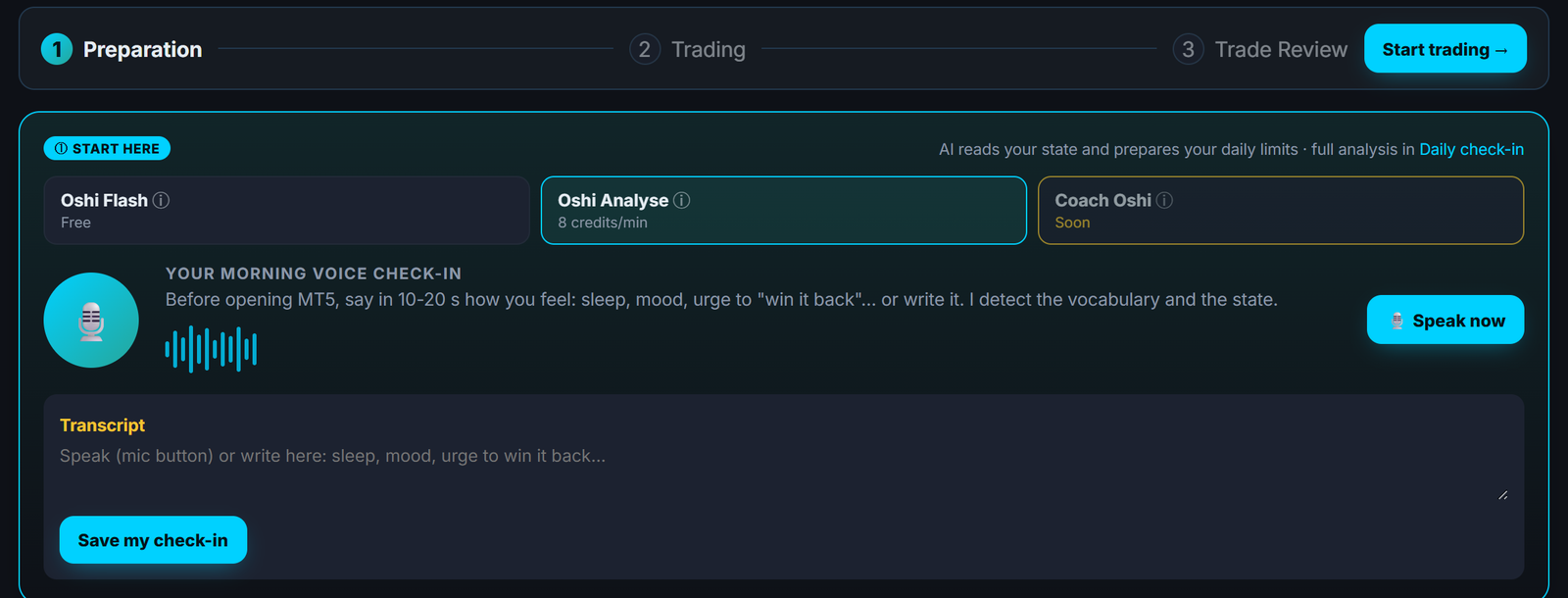
Tradoshi is built around the trader's routine: it structures your three phases and measures, on your real trades, whether you hold your discipline. Your routine stops being an intention and becomes a guided, tracked path, with a score that tells you where you improve and where you crack.
- Before: an emotional check-in and a day plan to prepare each session.
- During: your risk rules, killzones and stop threshold tracked to execute without deviating.
- After: a journal, an analysis and a review to turn each session into learning.
- Discipline score: a daily grade measuring how well you kept your rules on your real trades.
- Progress tracking: your streaks of disciplined days are visible there.
Frequently asked questions
Why do I need a trading routine?
Because mood and results are linked: in a study of 80 day traders, those whose mood tracked their daily gains and losses most closely had, on average, worse results. A routine imposes the same sequence of decisions each day, made cold, to leave less room for the state of the moment. It guarantees no result: it's a method, to be judged on your own trades.
How do I structure a trading routine?
In three phases: before (prepare: emotional check, day plan, rule review), during (execute: entry checklist, risk adherence, stop threshold), and after (analyze: journal, review, discipline measurement). These three phases form a reinforcing cycle: good preparation improves execution, good analysis improves the next day's preparation.
Which phase of the routine is most important?
All three count, but the most neglected is the after: analysis. That's where you truly improve, turning raw experience into learning. Without analysis, you accumulate market hours without progressing and repeat the same mistakes without seeing them. That phase makes the difference between ten years of experience and one year repeated ten times.
Isn't a routine too rigid?
It's the opposite: the routine frees you. It spares you from reinventing your discipline each day, under pressure, at the worst moment. Everything that can be decided cold is decided during preparation, so in action you only execute an existing plan instead of improvising. That absence of improvisation is what leaves less room for revenge trading and over-risk.
How long does a trading routine take?
Allow five to ten minutes for preparation and the same for the review: that is a rough figure to adjust, not a measured duration. Execution happens during the session. What matters is regularity more than duration: a short routine you keep beats an elaborate one you abandon after a week.
How does a routine make my decisions automatic?
Through repetition, and slowly. At first, following your routine takes conscious effort; by repeating the same action in the same context, it takes less. In the study by Lally and colleagues, run on 96 volunteer students who took up one simple daily action, automaticity reached its plateau after a median of 66 days among those whose progress could be modelled, from 18 to 254 days depending on the person. As for the idea of willpower draining like a reserve, a replication run across 23 laboratories measured an effect close to zero.
How do I install a trading routine without abandoning it after a week?
By building it progressively, one element at a time, rather than trying to install everything at once. Start with the emotional check, add the day plan the following week, then the entry checklist, then the journal. It's a method to try, not a guaranteed timeline: if an element doesn't hold yet, stay on it before adding the next.
What should I do on days I don't have time for my full routine?
Run a degraded version rather than skipping everything: even a thirty-second emotional check beats nothing. The goal isn't daily perfection but continuity. In the study by Lally and colleagues on habit formation, missing one opportunity did not materially affect the process; it's prolonged abandonment you need to avoid.