 By Benjamin Roure L'Hermitte

Tracking your trading habits means measuring your behaviors rather than your results: do you respect your rules, prepare your sessions, cut your losses? Your trading performance depends partly on chance, especially in the short term, whereas your habits depend on you. This guide explains what research says about tracking and habit formation, which habits to track, and how to do it concretely.
- P&L mixes your decisions with chance, your habits depend only on you: track habits, not just P&L.
- Monitoring your progress helps you reach a goal: that is what a meta-analysis of 138 studies, outside trading, measures (cited below).
- No study measures the effect of habit tracking on a trader's performance: this guide rests on psychology, not on market evidence.
- A habit settles in over months rather than days: a median of 66 days, from 18 to 254 depending on the person, in Lally's study cited below, where one missed day did not matter.
The most common reflex is to track only one thing: your P&L. It's understandable, but insufficient, because the P&L is a result, largely influenced by short-term randomness, and over which you have no direct grip. Focusing on it means judging what you don't control, at the risk of swinging between euphoria and discouragement depending on results.
What you control are your behaviors: your preparation, your rule adherence, your risk management, your discipline. Tracking these habits rather than the P&L alone shifts your attention to what's truly under your control. What your P&L really measures is worth knowing before you decide to look past it. One honest point before going further: to our knowledge, no published study measures the effect of habit tracking on a trader's performance. What this guide cites comes from psychology and behavioral finance, with the population studied stated each time.
What your habits weigh in your results
Your results don't depend on your habits alone: on one trade, and even on a streak, chance weighs heavily. But research has shown, on stocks, that repeated behaviors leave a measurable trace in accounts. Across 10,000 accounts at a large US discount brokerage, from 1987 to 1993, Terrance Odean's study of the disposition effect finds that the share of winning positions sold reaches 14.8%, against 9.8% for losing positions: these investors sold what was winning more readily than what was losing. Across 66,465 households at a broker of the same kind, from 1991 to 1996, Barber and Odean's study Trading Is Hazardous to Your Wealth measures 11.4% net a year for the households that traded the most, against 18.5% for those that traded the least.
These figures concern individuals invested in US stocks, not day trading, forex or futures, and they don't say that a good habit guarantees a gain. They show that a way of doing things, repeated hundreds of times, ends up readable in an account. That is the point of working on your habits: they are causes you have a hand on, while the outcome of a given trade escapes you. Improving a habit promises no result, but it is the part of your trading you can decide.
Without measurement, all you have is an impression
A habit that isn't tracked stays invisible. You can have the firm intention of respecting your killzones or not overtrading, but without measurement, you have no objective feedback on what you actually do. You live in impression, and the memory you keep of a session is not a record.
Ask yourself whether you respect your rules: you'll answer from memory. Count it on your trades, and you'll have a number. The first value of tracking is to replace one with the other.
What research has measured is the effect of monitoring itself, outside trading. The meta-analysis by Harkin and colleagues, published in 2016 in Psychological Bulletin, pools 138 studies and 19,951 participants randomly allocated to a prompt to monitor their progress or to a control condition: monitoring progress promoted goal attainment (average effect d = 0.40), and more so when the information was physically recorded or made public. This result is about goal monitoring in general, not trading, and promises nothing about your account. Applied to your rule-adherence rate, tracking shows you where you crack, how often, and whether you're improving.
Which habits to track
Not all habits are equal, and it's better to track a few that count than to track too many. The most useful revolve around discipline and risk: respecting your trading hours, the absence of revenge trading, respecting your daily loss limit, stopping after a losing streak, having a stop on every trade.
| Habit to track | What it measures |
|---|---|
| Respecting hours | Trading in your zones, not out of boredom |
| No revenge trade | Not increasing size after a loss |
| Daily loss limit | Stopping before the blow-up |
| Stop on every trade | Risk defined in advance |
| Session preparation | Approaching the market with a plan |
These habits have one thing in common: they're under your direct control and they bear on protecting your capital. They aren't results, but behaviors you can decide to apply each day. By tracking them, you build a dashboard of your discipline that tells you, independent of your gains and losses, whether you did what you had decided. It's behavioral information the P&L alone doesn't give.
Judging your day on what you control
Tracking your habits gives you a reference the P&L doesn't: a way to judge your day on what depended on you. A day can be losing due to chance; if you respected all your rules, it's a well-executed day. Tracking the habit lets you recognize this behavioral success, invisible in a red P&L.
This dissociation between the quality of your discipline and the day's result works both ways. It keeps you from questioning your method after a well-executed losing streak, and from thinking you're good after a poorly executed winning streak. Whether this tracking motivates better than tracking P&L has not been measured in traders: it is a choice of method, consistent with what research says about goal monitoring, not an established fact.
Building a streak
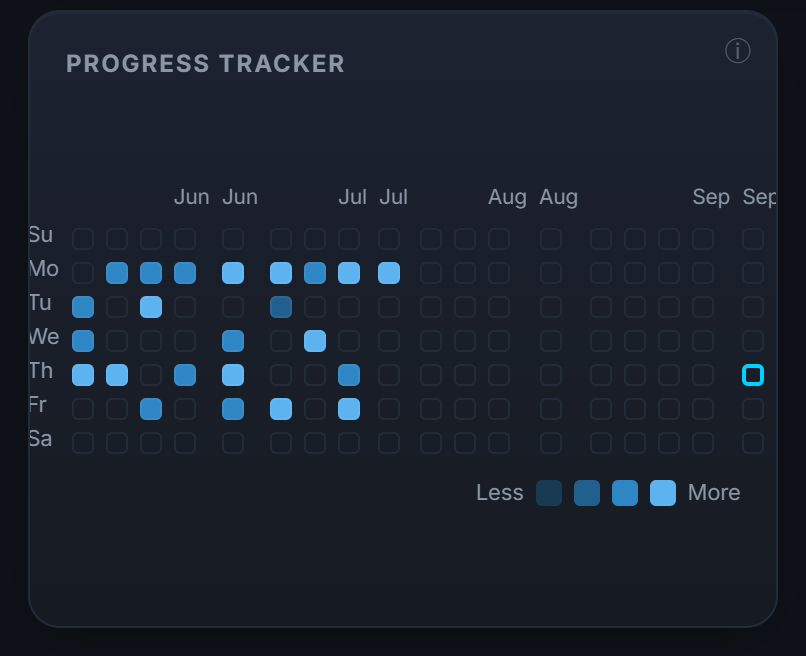
One of the tools of habit tracking is the streak: the number of consecutive days you've respected your rules. Watching it grow creates a daily stake, and the wish not to break it can help you hold your good habits on tough days. It's a simple mechanism, used by many habit-tracking apps; we found no study measuring its effect in traders.
The streak turns discipline, which is abstract and without immediate reward, into a concrete goal. It's no longer 'I must be disciplined in general', but 'I don't want to break my twelve-day streak'. The open question is how long to hold. You often read that a habit forms in 21 days; that is not what was measured. Lally and colleagues followed 96 volunteers, almost all students, who added to their day one simple eating, drinking or activity behavior for 12 weeks. Among the 39 whose progress fitted the model well, automaticity reached its plateau after a median of 66 days, from 18 to 254 days depending on the person. So count in months rather than days, and the study covers a single action, not a trading rule.
Mistakes to avoid when tracking habits
The first mistake is wanting to track everything at once. Jumping into tracking fifteen habits from day one scatters your attention and makes the dashboard unreadable; it's better to track three or four truly priority habits, stabilize them, then progressively add more. A tracking setup that is too heavy from the start is harder to keep up over time.
A second mistake is tracking vanity metrics, habits that are easy to respect but unrelated to your risk, rather than the truly structural habits like risk adherence or the absence of revenge trading. A third, subtler mistake is self-deception: self-reporting a habit as respected when it was only half-followed, which empties the tracking of its value. That's why tracking based on your real trades, rather than on your own declaration, doesn't depend on your good faith of the moment.
A concrete example: tracking a single habit for a month
Take a fictional example, to illustrate the method. A trader decides to track a single habit for a month: never increasing size after a loss. At the start of the month, they respect this rule 60% of the time, a figure that surprises them, since they thought they respected it almost always. By documenting every slip, they notice a pattern: nearly all the breaches happen late in the session.
Armed with this observation, they shorten their sessions and give themselves a rule written in advance: 'if I have just lost, then my size stays the same'. This 'if, then' format has been studied outside trading: in the meta-analysis by Gollwitzer and Sheeran, which pools 94 independent tests, deciding in advance how to respond to a situation had a medium-to-large effect (d = 0.65) on goal attainment. In our example, the adherence rate climbs to 90% by the end of the month. What the example illustrates is not a gain: it is that tracking revealed a pattern invisible to the naked eye, and allowed a targeted correction.
Trading habits and life habits
Trading habits don't live in a vacuum, they sit alongside your life habits. You often read that discipline draws on a reserve of willpower that drains through the day. The idea is fragile: the replication coordinated by Hagger and Chatzisarantis across 23 laboratories and 2,141 participants measured an effect close to zero (d = 0.04, with a confidence interval that includes zero). That a trader who sleeps poorly or skips meals holds their trading rules less well remains plausible, but this guide relies on no measurement made in traders to assert it.
The safest course is therefore to check it on yourself. Note a few basic life habits, like your bedtime or a pause before the market open, alongside your trading habits, and see whether your slips cluster on certain days. If you see a link in your own data, you have a quantified reason to act; if you don't, you've avoided relying on a received idea.
When breaking your streak isn't a big deal
The streak of respected days creates a stake, but it carries a risk: all-or-nothing thinking. After breaking a long streak, it's tempting to abandon tracking altogether, as if a single slip erased all the accumulated progress. That reaction turns a simple hiccup into total abandonment.
A broken streak is one data point among others, not a failure that wipes out everything else. In Lally's study cited above, missing one opportunity did not materially affect the habit formation process. An 85% adherence rate over the year, with a few broken streaks along the way, describes your discipline better than a perfect streak followed by giving up. Resuming the very next day, without making a drama of it, is itself a habit worth cultivating.
From tracking to improvement
Tracking your habits is only the first step; the goal is to improve them. Once you precisely see your adherence rate for each rule, you can target the weakest and work on it first, rather than scattering your efforts. Tracking gives you a clear map of your behavioral strengths and weaknesses, which guides your work efficiently.
This loop, measure, target the weak point, work on it, re-measure, turns the vague resolution to be more disciplined into a concrete, verifiable action plan. Over several months, by attacking your worst habit then the next, you work on your discipline brick by brick, each laid on a measure rather than a good intention. For the overall frame, see how to build a trading routine, and for the document that fixes those rules, what a trading plan contains.
Trading habits on a prop firm account
On a prop firm account, habit tracking takes on particular importance, because the firm's rules (daily loss, maximum drawdown) turn every discipline slip into a direct risk for the account's survival. A trader tracking their rule adherence on a personal account can afford a few slips without immediate consequence; on a funded account, the same slip can cost the entire account.
That's why the highest-priority habits to track under a prop firm are precisely the ones that protect against the firm's limits: respecting the daily loss, stopping after a losing streak, not increasing size under emotion. Tracking them with the same rigor as the firm's own rules means watching what can cost you the account for an avoidable reason. Read your firm's exact rules: they vary from one firm to the next.
How Tradoshi tracks your habits
Tradoshi automatically tracks your trading habits from your real trades, without you having to check anything. The discipline score and progress tracking measure your adherence to each of your rules and your consistency over time.
- Discipline score that measures adherence to each rule (hours, revenge, limit, stops) on your real trades.
- Progress tracking with your streak of respected days and your record, habit-tracker style.
- Adherence rate per rule to target your weak point and work on it first.
- Measured effect of each habit on your performance, to see on your own trades what discipline changes.
Frequently asked questions
Why track habits rather than P&L?
Because the P&L is a result, largely influenced by short-term randomness and out of your direct control, whereas your habits (preparation, rule adherence, risk management) are under your control. Tracking habits shifts your attention to what you truly control. No study measures the effect of this tracking on a trader's performance; outside trading, a meta-analysis of 138 studies shows that monitoring progress helps people reach a goal.
Which trading habits should I track?
A few that count, around discipline and risk: respecting your trading hours, the absence of revenge trading, respecting your daily loss limit, stopping after a losing streak, and having a stop on every trade. All are under your direct control and protect your capital.
How do I know if I really respect my rules?
By measuring them, not trusting your impression. The memory you keep of a session is not a record: count, on your trades, how many times each rule was held. Tracking your adherence rate over time replaces the impression with a number.
What's the point of a streak of respected days?
To turn discipline, abstract and without immediate reward, into a concrete goal. Each day you respect your rules lengthens your streak, each slip resets it. The wish not to break a twelve-day streak can help you hold your good habits on tough days. It's a motivation tool, not a guarantee: its effect in traders has not been measured.
How do I improve my trading habits?
By following a loop: measure your adherence rate for each rule, target the weakest, work on it first, then re-measure. Tracking gives you a clear map of your behavioral strengths and weaknesses. By attacking your worst habit then the next, you work on your discipline brick by brick, on measures rather than intentions.
How many trading habits should I track at once?
Few at first, three or four truly priority ones rather than fifteen scattered habits. A tracking setup that is too heavy from the start is harder to keep up over time. Stabilize a few key habits, then progressively add more once they're well anchored.
What should I do when I break a long streak of respected days?
Resume the very next day, without making a drama of it. A broken streak is just one data point among others. In the study by Lally and colleagues on habit formation, run outside trading, missing one opportunity did not materially affect the process. A high adherence rate over the year, with a few broken streaks, describes your discipline better than a perfect streak followed by giving up.
How long does it take to build a trading habit?
No study measures it for a trading habit. Outside trading, the study by Lally and colleagues followed 96 volunteers who took up one simple daily action: automaticity reached its plateau after a median of 66 days, from 18 to 254 days depending on the person. The 21-day figure you often read is not what that study measured. Count in months rather than days.