 By Benjamin Roure L'Hermitte
A trading journal is where you write down each trade and the reasons behind it, so that the next decision can learn from the last. Yet many journals come down to numbers logged and never used, or stop after two weeks. A truly useful journal doesn't just record your trades: it turns your experience into learning, reveals your destructive patterns, and measures your progress on what matters.
- A useful journal doesn't just record, it reveals patterns and guides your corrections.
- It captures two dimensions: the objective numbers and the subjective emotions.
- Its regularity beats its perfection: a simple journal kept daily beats a perfect one abandoned.
- It's only worth it if reread: rereading is where the lessons are born.
A trade journal is that written record of what you did and why, and keeping one is classic advice. And yet many journals end up useless, for two opposite reasons. Either they're abandoned after a few days, crushed by their own complexity. Or they're kept faithfully but never exploited, reduced to a collection of numbers used for nothing. In both cases, the effort is wasted.
One honest point before going further: to our knowledge, no published study measures the effect of a trading journal on a trader's performance. What exists comes from the psychology of goal monitoring. The meta-analysis by Harkin and colleagues, published in 2016 in Psychological Bulletin, pools 138 studies and 19,951 participants randomly allocated either to an intervention prompting them to monitor their progress or to a control group: monitoring progress promoted goal attainment (average effect d = 0.40), and more so when the information was physically recorded or made public. That result is about goal monitoring in general, not trading, and promises nothing about your account. It only says why writing down what you do beats relying on memory.
A useful journal is something else: a living system that captures the right information, makes it exploitable, and is reread to draw concrete lessons. This pillar guide explains what a journal is really for, what it should contain, how to cross numbers and emotions, and how to keep it sustainably so it becomes the engine of your progress rather than an abandoned chore. If consistency is what you lack, a free trading journal that records your trades straight from your broker removes the step where most traders give up. If you are still hesitating between paid tools, the comparison with JournalPlus breaks down prices and features plan by plan.
What a journal is really for
A journal's deep function isn't to record, it's to make visible. Without a journal, your trades pass and are forgotten, and the patterns running through your trading, those costing you money session after session, stay invisible. The journal keeps a record that, once accumulated and reread, reveals these patterns. It moves you from an experience lived but not understood to an experience analyzed and exploitable.
That's why the journal is the engine of progress. You can only correct what you see, and the journal is what lets you see. It turns 'I think I overtrade' into 'I take on average eight trades on losing days versus three on winning days'. The first is an unusable impression, the second an exploitable fact. The journal is the machine that converts your vague intuitions into actionable data.
That costly patterns hide in account records is something research has shown on stocks. Across 10,000 accounts at a large US discount brokerage, from 1987 to 1993, Terrance Odean's study of the disposition effect finds that the share of winning positions sold reaches 14.8%, against 9.8% for losing positions: investors sell what is up more readily than what is down. Across 66,465 households at a broker of the same kind, from 1991 to 1996, Barber and Odean's study 'Trading Is Hazardous to Your Wealth' measures an annual return of 11.4% for those who trade most, while the market returns 17.9%. These figures concern individual investors in US stocks, not day trading, forex or futures, and the researchers read them in brokerage records, not in journals kept by the investors. They only show that this kind of pattern exists and can be seen in the data. Your journal is there to look for yours.
The two dimensions of a complete journal
A truly useful journal captures two complementary dimensions, and most traders note only one. The first is objective: each trade's data. The second is subjective: your emotional state and reflections. Both are indispensable, because they answer different questions.
| Dimension | What it captures | What it reveals |
|---|---|---|
| Objective (numbers) | Entry, exit, stop, size, result, R | Your performance patterns |
| Subjective (emotion) | Your state, why you acted, your lessons | Your psychological patterns |
| Crossed | Emotion linked to performance | Which states cost you money |
The objective dimension gives you your statistics and reveals what works technically. The subjective dimension reveals why you make bad decisions and in what states. But it's the crossing of the two that's most powerful: when you link your emotion to your performance, you can check on your own trades whether certain states cost you money, for example whether the days you logged as stressed or euphoric are worse than the others. Nothing says in advance that this will be your case: that is precisely what the crossing lets you find out.
What a useful journal should contain
A journal doesn't need to be exhaustive to be useful, but it must contain the right elements. Here's the structure of an effective journal, from the bare minimum to enrichment:
- The bare minimum: the trade's (or session's) result, your emotional state, a lesson.
- The objective data: instrument, entry, exit, stop, size, R, fees.
- The context: the setup taken, market conditions, the time.
- The subjective: why you took this trade, why you managed the exit that way, what you felt.
- The lesson: what does this trade teach you, what to repeat or avoid?
Start with the bare minimum and enrich progressively, once the habit is anchored. Wanting to capture everything from the start is a trap: a too-heavy journal is an abandoned journal. The R in the list is the trade's initial risk: in the Van Tharp Institute's trading concepts, every profit or loss is expressed as a multiple of that risk. The objective data can and should be automated (imported from your broker), because the platform already records it: in MetaTrader 5, for example, the help page on the trading report says an account statement report is generated from the History tab and lists the account's orders and deals. That way you reserve your effort for the truly valuable part, the subjective and the lessons, which only you can write.
The patterns a good journal reveals
The reward of journaling comes at the rereading, when patterns emerge from the accumulation. These are discoveries impossible to see on an isolated trade, that only appear when crossing dozens of trades, and that concretely change how you trade:
| Pattern revealed | Possible correction |
|---|---|
| Bigger losses late in the session | Stop earlier |
| Loss on high-stress days | Don't trade in that state |
| A systematically losing setup | Abandon it |
| Gains cut too early | Work on your exits |
| Over-risk after a loss | Reinforce the stop rule |
A journal you never reread is a useless journal. Value isn't born from the writing, but from the rereading that reveals the patterns.
These patterns are what you can correct: a recurring leak, once identified, becomes a rule to test, with no guarantee of result but with a measure to check it. That's why regular rereading is as important as the keeping itself. A journal is a mirror: it only serves you if you take the time to look into it.
Regularity before perfection
A classic journaling trap is the pursuit of perfection. The scenario is familiar: an elaborate system, one week of keeping it, then abandonment under the load. A perfect abandoned journal is worthless; a simple journal kept daily is gold. Consistency is what produces exploitable patterns, not the exhaustiveness of each entry.
So adopt the rule of regularity before perfection: note little, but every day, including (especially) the bad days, which are the ones you most want to skip. Make the task light enough to never have an excuse to skip it. It's by keeping a minimalist journal for months that you build the database in which, on rereading, your patterns show up, far more than by keeping a perfect journal for a week.
The journal, backbone of your progress
A journal isn't one tool among others, it's the backbone linking all aspects of your trading. It's what feeds your statistics, reveals your psychological patterns, measures your discipline, confronts your strategy with reality and traces your progress over time. Without a journal, all these elements stay disconnected and blurry; with it, they form a coherent system of continuous improvement where each session feeds the next.
That's why the journal is the starting point of almost all serious progress in trading. You can't improve your risk management without measuring your real risk, you can't correct your psychology without capturing your emotions, you can't judge your strategy without comparing planned to realized, and all these measures come from the journal. Investing in a good journal, regularly kept and truly exploited, is probably the best return on effort a trader can make, because it's what makes all other improvements possible.
Rereading your journal: the game-changing act
The most important act of journaling isn't writing, it's rereading. A journal never reread is strictly useless, because the patterns that make its value only emerge on rereading, when you step back over a set of trades. Writing captures information; rereading turns it into a lesson. Many traders faithfully keep their journal but never reread it, depriving themselves of all its benefit, like someone accumulating ingredients but never cooking.
Set up a regular rereading ritual, for example each weekend for the past week and each month for a broader view. During these rereadings, look for recurring patterns, identify a leak to correct, and check that your previous corrections are paying off. This loop (write, reread, correct, verify) is the complete mechanism of progress. Without rereading, the loop is broken and the journal is just a sterile accumulation. The idea has support outside the markets: in their article on expertise, Ericsson, Krampe and Tesch-Römer write that, without adequate feedback, mere repetition of an activity does not automatically lead to improvement. Rereading is that feedback.
Adapting your journal to your level
A good journal evolves with your experience. At first, it should stay minimalist (result, emotion, one lesson) so the habit sets in without discouraging you. As you progress, you can enrich it: adding tracking of specific setups, to the point of turning it into a trading playbook, screenshots, a finer analysis of your execution, tracking of behavioral statistics. The beginner's journal and the experienced trader's don't have the same depth, and that's normal. Once trades pile up, our guide to analyzing your trading performance shows what to draw from them.
The mistake would be wanting an expert's journal when you're starting out, which leads to abandonment, or keeping a minimalist journal when you've progressed, which deprives you of finer information. Let your journal evolve at the pace of your progress, adding depth only when the basic habit is solidly anchored. A journal well calibrated to your level is a journal you actually keep and that actually serves you, whereas a badly calibrated journal, too heavy or too light, ends up either abandoned or useless. The continuous adjustment of the journal to your level is part of keeping it well.
Classic mistakes that make a journal useless
Beyond outright abandonment, certain formal mistakes make a journal ineffective even when kept seriously. The first is only logging winning trades, out of comfort or shame, which strips the journal of half its value: it's often the losing trades that teach the most. The second is logging the facts without ever contextualizing them, without noting why you made the decision, which makes rereading sterile months later.
A third mistake is rewriting history after the fact: you log your trade once the result is known, and your memory, influenced by the outcome, reconstructs a justification that wasn't your real thinking at the moment of deciding. The phenomenon has been described since 1975. In Baruch Fischhoff's article on hindsight judgment, Israeli students read the account of a historical or clinical event; those who were told an outcome then rated it more likely than those who were not, by 10.8 points on average, and were largely unaware that this information had changed their judgment. The experiment is about written accounts, not trades, but it gives the rule its reason: note your reasoning before knowing the result, or right after your decision, never after seeing how the trade turned out. An honest journal captures what you really thought, not what you'd like to have thought.
- Only logging winners: you deprive yourself of the trades that teach the most.
- Writing after the result: your memory rewrites your reasoning in the light of the outcome.
- Too many fields from the start: the load kills the habit before it sets in.
- Never rereading: writing alone produces no lesson.
Paper journal, spreadsheet or app: what to choose
The journal's format matters less than keeping it regularly, but each medium has its advantages and limits. A paper notebook forces reflective writing disconnected from screens, which helps some traders better capture their emotional state, but it computes nothing: all your statistics remain to be done manually. A spreadsheet lets you automatically compute your averages, your R and your win rate, but requires rigorous manual entry of every trade, a load that weighs quickly when trades pile up.
A dedicated trading app combines both advantages: it imports your data automatically from your broker, computes your statistics effortlessly, and leaves you room to note the subjective, your state and your lessons, which remains the most valuable part. The right format is the one that minimizes the friction of objective entry, so your energy focuses entirely on the reflection that can't be automated.
| Format | Advantage | Limit |
|---|---|---|
| Paper notebook | Reflective writing, no screen | No automatic computation |
| Spreadsheet | Computable statistics | Heavy manual entry |
| Dedicated app | Automatic data + computation | Depends on the tool chosen |
A concrete example: the pattern that changes everything
Take a fictional example, with figures made up for illustration: a trader who, over three months, faithfully logs their emotional state before each session and the day's result. At the quarterly rereading, they discover their days logged as 'frustrated' or 'rushed' show an average result of -0.8 R, versus +0.3 R for days logged as 'calm'. Over sixty sessions, their ten 'frustrated' days alone account for almost all of the quarter's net loss.
This discovery, impossible without a consistently kept journal, gives them a concrete, non-negotiable rule: don't trade when their morning state is 'frustrated' or 'rushed'. It's no longer a vague intention to 'manage emotions better', it's a numbered rule, drawn from their own data, that they can apply without arguing with themselves, and that they will keep checking, because ten days remain a small sample. This is exactly the kind of pattern, invisible session by session but obvious over sixty days, the journal exists to reveal.
How Tradoshi makes your journal truly useful
Tradoshi is designed to solve journaling's two failure causes: the entry chore and the lack of exploitation. It automates the data, lets you note what matters, and reveals the patterns for you, so your journal finally becomes the progress engine it should be.
- Automatic data: your trades are imported from your broker, no more tedious entry.
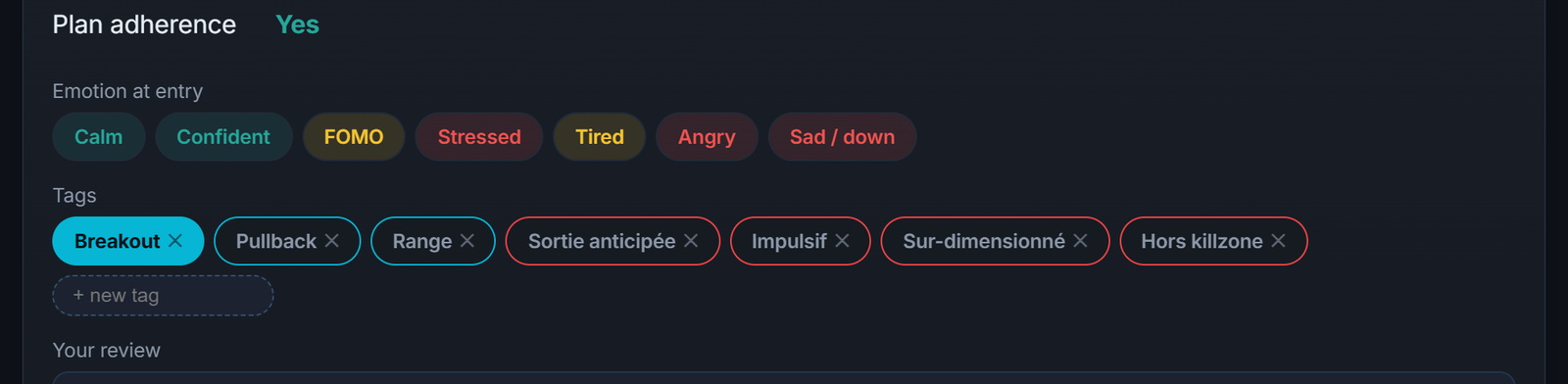
- Notebook and emotion: you note your state and lessons, the subjective dimension that truly matters.
- Computed statistics: expectancy, profit factor, average R and win rate drawn from your real trades.
- Patterns revealed: the app crosses emotion and performance and surfaces your destructive patterns.
- Daily synthesis: each day is summarized to turn experience into learning effortlessly.
Spreadsheet, template, format: where to actually start
A trading journal can perfectly well start in a spreadsheet. An Excel workbook, a Google Sheets file or an old xls file picked up on a forum does the job of the first weeks. What matters is not the tool but the columns: date, instrument, direction, size, entry, exit, stop, reason in, reason out, result, and one line of emotional state. Eleven columns are enough for a serious trade journal, and the free Excel template comes with its formulas already in place.
The format follows what you trade. A forex trade journal template keeps the pips and the pair; a stock trading journal adds the share count and the next earnings date, because a gap on results changes the risk of a position held overnight; an option trading journal keeps the strike, the expiry and the premium, since time decay is part of the result. The columns change, the discipline does not. A sample trading journal filled in over ten trades teaches more than an empty template over a hundred rows.
Result tracking deserves its own column, and a profit and loss calendar makes consistency visible at a glance. Side records belong in the same file rather than in separate ones: payouts and drawdown on a funded account, the open contracts and their expiry for options, or simply a box ticked when you followed your plan.
Keeping a journal comes down to three gestures: write before entering, write after exiting, reread once a week. The third is the easiest one to skip, and the one that makes the other two useful.
Frequently asked questions
What is a trading journal for?
To make visible what experience alone doesn't show: the patterns running through your trading that cost you money session after session. You can only correct what you see, and the journal is what lets you see. It turns your vague intuitions ('I think I overtrade') into exploitable facts ('I take eight trades on losing days versus three on winning days').
What should a useful trading journal contain?
Two dimensions: the objective data (instrument, entry, exit, stop, size, result, R) and the subjective (your emotional state, why you acted, your lessons). Start with the bare minimum (result, emotion, one lesson) and enrich progressively. Automate the objective data and reserve your effort for the subjective, the truly valuable part only you can write.
Why note my emotions in a journal?
Because the numbers alone don't reveal why you make bad decisions. By crossing your emotional state and your performance, you can check whether certain states cost you money, for example whether the days you logged as stressed or euphoric are worse than the others. Without the emotion noted at the time of the trade, that check is impossible.
Why do so many journals end up useless?
For two opposite reasons: either they're abandoned after a few days (crushed by their complexity), or they're kept but never reread or exploited (reduced to a collection of numbers). A useful journal avoids both: it's simple to keep and regularly reread. Value isn't born from the writing but from the rereading that reveals the patterns.
How do I keep a trading journal sustainably?
Apply the rule of regularity before perfection. Note little but every day, including and especially the bad days. Make the task light enough to never have an excuse to skip it: start minimalist (result, emotion, lesson) and enrich once the habit is anchored. A simple journal kept for months beats a perfect one kept for a week.
How often should I reread my journal?
Regularly, because it's in the rereading that lessons are born. A journal never reread is useless: patterns only emerge from crossing many trades, and you must take the time to look at them. Reread after each week or month to spot your recurring patterns, identify a leak to correct, and check that your previous corrections are paying off.
What are the classic mistakes that make a journal useless?
Only logging winning trades (you lose half the value), writing after seeing the result (your memory rewrites your reasoning in the light of the outcome), wanting too many fields from the start (the load kills the habit), and above all never rereading (writing alone produces no lesson). An honest journal captures what you really thought at the moment of deciding.
Should I keep my journal on paper, spreadsheet or app?
The format matters less than regularity, but each has its limits. Paper forces reflective writing but computes nothing. A spreadsheet computes your statistics but requires heavy manual entry. A dedicated app combines both: data imported automatically, computations done for you, and room to note the subjective that truly matters.
How much time should I spend on my trading journal each week?
With automated entry, the real time cost is the weekly review, not day-to-day upkeep: a few minutes to scan your trades, reread your emotional notes, spot a recurring pattern. It's that review time that does the work, not the number of fields filled in.