 By Benjamin Roure L'Hermitte

How much money do day traders make? Most of them lose money: the studies that follow every account in a market find that a large majority of retail day traders end up with a net loss, and that only a small minority earn anything durable. For those who do profit, income depends on capital and actual return, not on a fixed figure. Here is what public statistics and studies say, each with its country, its year and its population, with no invented number.
- No statistic measures 'trader income' as such: there are wages for employed traders and account results for retail traders, each on a specific population.
- Among retail traders, most lose: more than 89% of French clients on CFDs and forex (AMF), 97% of Brazilian day traders followed for more than 300 days.
- Income depends on capital and return, not a fixed amount promised by a course or an influencer.
- Claims of 'X% a month' don't survive compound-interest arithmetic over several years.
- A funded account changes the mechanics: income no longer comes from your own capital but from a profit split, under the firm's rules.
The topic of trading income attracts unverifiable numbers. The image projected on social media and what regulators and researchers actually measure don't tell the same story. This article isn't trying to discourage you, it's trying to replace the fantasy with what has been measured, and with an honest understanding of what actually determines trading income.
You won't find any invented statistic here: every figure points to its source, with the population it measures. You will also find the mechanisms that explain why 'how much does a trader earn' has no single answer, and why anyone who gives you one that's too precise should put you on alert.
The wrong question
Asking 'how much does a trader earn' is like asking 'how much does an entrepreneur earn'. The answer depends entirely on who, with what capital, with what skill, and for how long. A trader starting with 500 euros and a trader managing a 100,000 euro funded account can't be compared with the same number, even if they achieve the exact same percentage return.
This confusion between return (the percentage gain on capital) and income (the euro amount that return represents) is behind most of the misleading numbers floating around. A 5% monthly return can represent 25 euros on a small account or 5,000 euros on a large one: the same skill, the same return, produces a radically different income depending on the capital behind it.
What an employed trader earns, according to public statistics
An employed trader works for a bank, a broker or a fund, and is paid a fixed salary and, often, a variable part. In the United States, the Bureau of Labor Statistics does not publish a wage for traders alone: it places them in a broader occupation, securities, commodities, and financial services sales agents, who sell securities or commodities to clients, advise companies in search of investors, and conduct trades. For that occupation, the median annual wage was $78,660 in May 2025; the lowest 10 percent earned less than $48,040, and the highest 10 percent earned more than $212,880.
In France, we found no public wage statistic that isolates the trader occupation. The amounts that circulate come from recruitment sites or schools, with no verifiable population or method, so we don't repeat them.
At the top of the scale, the European Banking Authority counts each year the people paid EUR 1 million or more in banks and investment firms across the European Union and the European Economic Area. According to its dashboard on high earners, 2024 data, there were 2,554 of them, up from 2,343 in 2023. In credit institutions, 904 of the 2,266 high earners worked in investment banking, the most represented business area. That count does not separate traders from other roles, and it says nothing about an ordinary trader's pay: it measures how many people exceed one million.
Why most traders lose or stagnate
For retail traders, the figures are not wages but account results, and they only hold for the population measured. In France, the AMF's study followed 14,799 clients active on CFDs and forex over four years: more than 89% lost money, with an average result of −€10,887 per client, winners and losers combined, and a median result of −€1,843. In Europe, ESMA, the European markets regulator, noted in 2018 that 74 to 89% of retail accounts lose money on CFDs, depending on the country. Both measure leveraged products, not traders as a whole: the detail is in our article on why 90% of traders lose.
On day trading, two studies follow every account in a market. On the Taiwan Stock Exchange, from 1992 to 2006, about 360,000 individuals day traded stocks in the average year: according to Barber, Lee, Liu and Odean, about 13% earned profits net of fees in the typical year, and fewer than 1%, or 1,000 out of 360,000, were able to do so consistently. In Brazil, the study by Chague, De-Losso and Giovannetti, 'Day Trading for a Living?', follows the 19,646 individuals who began day trading mini-Ibovespa futures between 2013 and 2015. Among the 1,551 who persisted for more than 300 days, 97% lost money; 17 people, or 1.1%, earned more than the Brazilian minimum wage (US$16 per day), and 8, or 0.5%, more than the starting salary of a bank teller (US$54 per day). The individual who earned the most made US$310 per day on average.
Losing doesn't mean the same thing everywhere. Among 66,465 households with accounts at a large US discount broker from 1991 to 1996, Barber and Odean measure a net annual return of 16.4% for the average household invested in stocks, while the market returned 17.9%: it didn't lose money, it did worse than the index. Those that traded the most earned 11.4%. None of these studies measures options or cryptocurrencies, and none of them tells you what you will earn.
What actually determines a profitable trader's income
For the minority of consistently profitable traders, income is calculated by a simple but often ignored equation: available capital multiplied by the actual return over the period. A trader with 10,000 euros and a 20% annual return earns 2,000 euros over the year. A trader with 100,000 euros and the same 20% return earns 20,000 euros. The skill is identical, the income isn't, purely because of starting capital.
| Capital | Annual return | Annual income (illustrative) |
|---|---|---|
| €5,000 | 15% | €750 |
| €25,000 | 15% | €3,750 |
| €100,000 | 15% | €15,000 |
This purely illustrative table shows why an identical return isn't enough to produce a livable income if starting capital is too small. That arithmetic is what makes solutions that let you trade capital larger than your own, like funded accounts, attractive.
Why 'X% a month' almost always sounds wrong
Promises of high, consistent monthly returns, often displayed by courses or influencers, run into a simple arithmetic problem: a compounded return becomes absurd if it is sustained for long. At 10% a month for five years, an account is multiplied by about 304: 1,000 euros would become more than 300,000 euros, and 10,000 euros more than 3 million. When a return of that size is advertised as consistent, the question to ask is simple: where are the statements showing it over several years?
When such a promise comes with no complete statement, three explanations are possible: cherry-picking (showing the best month out of dozens, never the real average), unsustainability (a return achieved once, on an exceptional market, presented as repeatable every month), or lying, when no verifiable result backs the claim. A modest annual return sustained year after year says more about a trader than an isolated exceptional month.
Trading your own capital vs a funded account
The income mechanics change fundamentally depending on whether you trade your own capital or a prop firm funded account. With your own capital, income belongs to you entirely but stays capped by the size of that capital, often modest at the start. With a funded account, you trade capital much larger than your own, but profit is split according to a percentage set by the firm, and under its rules.
This path eliminates neither the risk nor the demand, it shifts the problem: you first need to pass an evaluation, then follow the account's rules. Few firms publish their own figures. Topstep does: according to the statistics Topstep publishes on its program page, read in October 2026, 16.8% of all Trading Combines initiated in 2025 were successfully completed, 51.8% of participants advanced to the Funded Level in at least one of theirs, and 33.3% of participants at the Funded Level received a payout. The page does not give the amount of those payouts, and these figures only hold for that company and that year.
Gross return isn't your net income
A return displayed as a percentage often hides costs that erode the income actually pocketed: spreads, commissions, financing fees on positions held, and slippage on execution. These costs exist regardless of account size, but a fixed fee weighs proportionally heavier on a small account, where it represents a bigger share of the capital deployed. The gap between gross and net has been measured: in Taiwan, the 500 most active day traders earned 13.1 basis points per day before costs on their day trading, and lost 6.8 net of fees, according to the Barber, Lee, Liu and Odean study cited above.
That's one reason the return shown by a strategy on paper, before fees, never tells the whole story. Two traders with the same gross return can end up with very different net incomes depending on trade frequency, position size and their broker's specific fees. Evaluating real performance always requires reasoning net of fees, never on a theoretical gross return that ignores the real cost of getting in and out of the market repeatedly.
Consistency matters as much as the average
An average annual return of 15% can hide two very different realities: a trader progressing steadily, month after month, with moderate swings, and a trader stringing together one exceptional month followed by several catastrophic ones, landing on the same average for the year. The second trajectory is far more fragile, because it exposes you to a higher risk of ruin during the bad stretches, even if the final average looks identical.
That's why the average return isn't enough to assess the quality of a performance: consistency, the size of the maximum losses endured, and the ability to limit bad months matter just as much as the final number. Trading income built on an irregular performance is income you can't anticipate from one month to the next, which makes it hard to fit into a real life budget.
The time before becoming profitable, if it happens
No universal timeframe guarantees profitability in trading, and trusting a precise number ('6 months', '2 years') is the same kind of wishful thinking as monthly return promises. The time needed depends on the quality of learning, the consistency of practice, the ability to draw lessons from mistakes rather than repeat them, and honestly, on a share of factors nobody fully controls.
The studies point the same way: time spent alone guarantees nothing. In the AMF's study, of the 1,881 clients who stayed active every year from 2009 to 2012, 82.5% lost money in the first year and 87.6% over the four years combined, which the AMF describes as the absence of a learning effect. In Brazil, Chague, De-Losso and Giovannetti likewise find no evidence of learning by day trading. Piling up screen hours with no method, no journal and no analysis of your mistakes is therefore not enough: what matters is what that time produces.
How Tradoshi helps you see your reality, not a fantasy
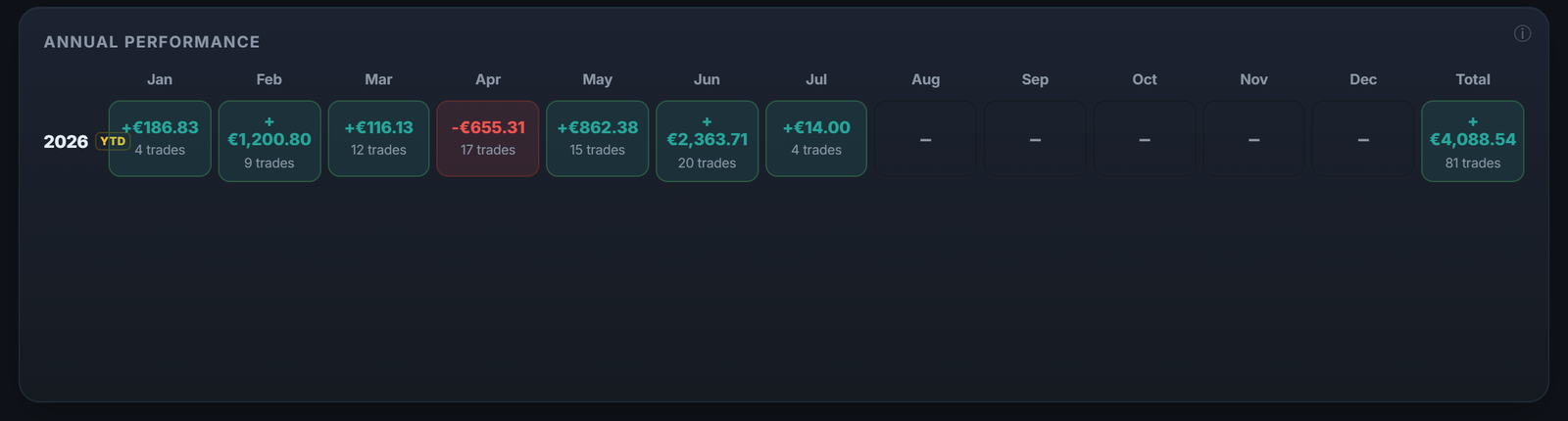
Tradoshi promises no return, because no honest app can. What it does is give you the real numbers of your own performance, so you base your decisions on measured facts rather than comparisons with unverifiable numbers seen on social media. Your actual return, your expectancy, your profit factor become visible, month after month.
- Real statistics: return, expectancy, profit factor and win rate calculated on your real trades, not promises.
- Progress tracking to see your actual trajectory instead of comparing yourself to strangers' screenshots.
- Prop firm module to track your path toward a funded account if you choose that route.
- Detailed journal that distinguishes what comes from your skill from what comes from market variance.
Frequently asked questions
Is it true that most traders lose money?
The available studies measure a majority of losers in the populations they follow: more than 89% of the 14,799 French clients active on CFDs and forex over four years (AMF), and 97% of the Brazilian day traders who persisted for more than 300 days on mini-Ibovespa futures. These measurements cover specific products and markets, not traders as a whole.
How much can you earn trading?
There's no universal number. Income depends on available capital multiplied by the actual return achieved over the period, not a fixed amount. The same 15% return produces very different income depending on whether starting capital is €5,000 or €100,000.
Why are promises of high monthly returns suspicious?
Because a high, constant monthly return, compounded over several years, produces absurd amounts: at 10% a month, an account is multiplied by about 304 in five years. Without a complete statement over time, such a promise may come from cherry-picking, a non-repeatable exceptional result, or a lie.
Does a prop firm funded account guarantee income?
No, it only changes the income mechanics: you trade capital larger than your own but profit is split according to a percentage set by the firm. You first need to pass an evaluation, then follow the account's rules: at Topstep, by its own figures for 2025, 33.3% of participants at the Funded Level received a payout.
How long before becoming profitable in trading?
No universal timeframe guarantees it, and time alone isn't enough: in the AMF's study, clients active four years in a row did not lose less often after four years than after the first. Quality of practice matters more than quantity of time spent.
How do I know if my trading return is good?
By comparing it to your own trajectory over time, not to unverifiable numbers seen on social media. A modest return sustained year after year, measured on your real trades, is more meaningful than one exceptional month, yours or anyone else's.
Do trading fees really affect final income?
Yes, often more than people imagine. Spreads, commissions and slippage weigh proportionally heavier on a small account, where they represent a bigger share of the capital deployed. Two strategies with an identical gross return can produce very different net incomes depending on trade frequency, position size and broker fees.
Is living off trading alone realistic for a beginner?
The available measurements say it is rare: in Brazil, out of 1,551 individuals who day traded mini-Ibovespa futures for more than 300 days, 17 earned more than the minimum wage. And at a given return, a livable income requires enough capital. Aiming for a measured supplemental income on a reasonable capital, rather than an immediate replacement income, is a more realistic expectation until performance consistency is proven over an extended period of time, ideally across different market conditions rather than a single favorable stretch.