 By Benjamin Roure L'Hermitte

How do prop firms work? You pay to trade a simulated account wired to real quotes, while software continuously checks loss and target rules. If you stay within them, you sign a contract and receive an account, also simulated at FTMO and Topstep, on which part of the result turns into a reward paid in real money. This article takes the machine apart piece by piece: what happens to your order, what closes an account, what triggers a payout.
- Three parts run the whole thing: a real quote feed, an automatic rules engine, and a contract that turns a simulated result into a payment.
- Your order doesn't reach the market: FTMO and Topstep both say so, up to the funded account.
- Rules are checked during the session: at Topstep, an open loss is enough to close a position and bring the account down.
- A payout has a hidden cost: on a Topstep 50K, withdrawing $500 can cut your loss buffer to a quarter.
Homepages show a capital figure, a percentage and a button. They rarely tell you what happens in between. And that in-between is where people lose accounts without understanding why: a limit triggered by an unrealized gain, a buffer that shrinks right after a withdrawal, a funded account that is still a simulation.
We use two firms that publish a lot and look nothing alike: FTMO, from the forex and CFD side, and Topstep, a futures specialist. What their pages say holds only for them, and their rules change. For the big picture, see our guide to prop firm trading. For the money flows, see how do prop firms make money.
Two businesses under one name
The term is misleading. In the classic sense, proprietary trading means taking positions with the house's capital. Fed governor Daniel Tarullo, in his January 2012 testimony on the Volcker rule, defines it as a position taken as principal with the intent to resell in the near term. In that version, the company risks its money and the trader is its tool.
The online firm does something else. It provides a service to a customer who pays for it. Belgium's FSMA describes that customer, in its French text, as someone playing on the company's demo account, and FTMO writes in its technical FAQ that its clients place no trades on live markets. This article covers the second business, because that's the one you meet when you search for a prop firm online.
The parts of the machine
To follow the rest, you only need to separate what is real from what isn't. The table follows the path in order, as it comes out of the pages read in November 2026.
| Part | Its job | Real or simulated |
|---|---|---|
| Fees | Open access to the evaluation | Real: you pay in actual currency |
| Quotes | Show market prices | Real: a feed from liquidity providers or the exchange |
| Orders and capital | Replicate execution and balance | Simulated: fictitious funds, no effect on price |
| Rules engine | Compare equity with limits and close if needed | Automatic: the effect on your account is immediate |
| Identity and contract | Move you from customer to trader bound by terms | Real: a legal commitment |
| Reward | Convert a simulated result into a payment | Real: money paid by the firm |
| Live account | The last level, depending on the firm | Real: at Topstep, fees and commissions go through a brokerage account |
What happens to your order when you click
The screen looks like a brokerage account, and the price on it really is the market's. FTMO's technical FAQ says the account uses real quotes from liquidity providers, and that those providers give it no capital, only prices. Your order stops there. On its futures offer, the FAQ on infrastructure says orders don't affect the instrument's price. Topstep, for its part, writes on its program page that its evaluations and funded accounts are realistic simulations of trading under actual market conditions.
Simulated doesn't mean frictionless. The same FTMO FAQ warns of possible execution delays and slippage, plus simulated commissions shown on the platform. At Topstep, the help page on pricing says commissions and fees come off your balance with each fill. For a scalper this matters a lot: it eats into the result the reward is calculated on, even though that money doesn't exist. The platform isn't always your choice either. Topstep writes in its getting-started guide that TopstepX is the only available platform.
The rules engine: why an account dies mid-session
The heart of the system has nothing human about it. FTMO's futures FAQ explains that the platform checks your risk rules in real time and closes positions automatically when one is broken. Topstep details in its page on the Maximum Loss Limit that realized and unrealized losses both count, that the position is closed by a market order, and that no exceptions are made. Slippage may even leave you above the limit: the breach still stands.
The limits themselves can be worked out in advance. On the $100,000 2-Step described by FTMO's trading objectives page, the target is $10,000 then $5,000, the daily loss $5,000 and the maximum loss $10,000, with a fixed floor at $90,000, and at least four trading days per phase. On the 1-Step, the daily loss drops to 3%, the 10% maximum loss trails the end-of-day balance, and, for orders placed since 12 October 2026, your best day must not exceed 50% of total gains. So the calculation method changes everything, and our guides on the trailing drawdown and the daily loss limit cover the details.
The penalty depends on the level you're at. At Topstep, hitting the limit in a Trading Combine liquidates the account for the day, and it can't be funded without a reset, though you can keep practicing. On an Express Funded Account, the account closes for good, unless you qualify for a paid reactivation. The same move doesn't cost the same at every level.
Moving to the funded account: review, identity, contract
Hitting the target doesn't hand you an account that evening. FTMO's FAQ on timing counts a minimum of 8 trading days on the 2-Step and 2 on the 1-Step, then a review of your trades. Its FAQ on the legal relationship adds identity verification, as a natural person, entrepreneur or company, and the signing of terms it calls a legally binding document. That's worth reading rather than skipping, since this text, more than the homepage, sets your rights.
Your status changes too. You aren't an employee: Topstep's tax page classifies all traders as independent contractors, asks for a W-9 from US citizens and a W-8 BEN from non-US citizens living abroad, and reminds the latter to follow their local tax laws. It gives no tax advice. Wherever you live, find out how to declare these sums before your first payout: nobody will do it for you. On the regulatory side, the FSMA writes that these companies have no authorization to provide investment services, and Italy's CONSOB has issued its own warning. You are the customer of a service, and the protection framework isn't necessarily that of a brokerage account: check with your country's regulator.
How a payout gets triggered, and what it costs you
A reward doesn't arrive by itself: you request it, and it follows conditions that vary a lot from firm to firm.
| Point | FTMO (account from a challenge) | Topstep (standard Express Funded Account) |
|---|---|---|
| When to request | From day 14 after the first trade | After 5 winning days of $150 or more |
| Before requesting | All positions and orders closed | Positive net result since the last payout |
| Share paid | Up to 90% of simulated gains | 90/10 |
| Cap or minimum | $20 minimum closed gain, $50 for crypto | $125 minimum; 50% of balance, $2,000 to $5,000 by account |
| Timing | Review in 1 to 2 business days, payment 1 to 2 days after invoice approval | Approval in 1 to 3 business days, then by payment method |
| Transfer fees | No extra commission | $30 for ACH or wire, $0 with Wise or Aeropay |
These lines come from FTMO's FAQ on withdrawals, its how-it-works page, Topstep's payout policy and its account parameters. They hide an effect that rarely gets explained: withdrawing shrinks your loss buffer.
Take a 50K Express Funded Account. According to Topstep's page, its starting limit is -$2,000, it trails the end-of-day balance, and it moves to $0 after the first payout. Suppose a balance that climbed steadily to $1,000: the limit sits at -$1,000, so a $2,000 buffer. You request the maximum, 50% of the balance, so $500. The balance falls to $500, the limit rises to $0, and your buffer goes from $2,000 to $500. Withdrawing $500 cut it to a quarter. The rule is written down. The sums are yours to do before you click.
The live account, a very narrow top floor
Many candidates picture a funded account naturally leading to the market. The numbers say otherwise. Topstep publishes for 2025 that 0.71% of Express Funded Account participants were called up to a Live Funded Account, and that 33.3% of participants at the Funded Level received a payout. The move also changes the cost structure: its page on the live account lists $133 per month per exchange for professional data, one of them covered by Topstep, plus commissions, exchange fees and your platform license, all on you.
At FTMO, growth takes another route. Its scaling plan raises the account size by 25% every four months if you make at least 10% in net simulated gains and have at least two processed rewards, up to $2,000,000. The plan doesn't apply to the instant account. And it stays within the simulation: according to its technical FAQ, FTMO's real trading runs separately, with its own means.
Subscription, one-time payment, instant account: three setups
How things work also depends on how the offer is built. In our prop firm directory, recorded in late October 2026 across more than 270 companies, the one-time payment dominates, and fewer than 30 firms use a subscription on the program we recorded.
| Setup | How it works | What it changes for you |
|---|---|---|
| One-time payment (FTMO 2-Step) | One price per attempt, refunded with the first withdrawal at FTMO | You know the cost up front, and each new try is a new purchase |
| Subscription (Topstep) | A charge every month while the evaluation lasts | Time costs money, and activation may come on top |
| Instant account (FTMO Instant) | No evaluation, a non-refundable entry fee | No test phase, but the maximum loss doesn't reset after a withdrawal |
To compare on the evidence, our prop firm rankings score each company on published criteria. The comparison tool sets the rules side by side, and how to choose a prop firm tells you which clauses to read first.
What these mechanics ask of your tracking
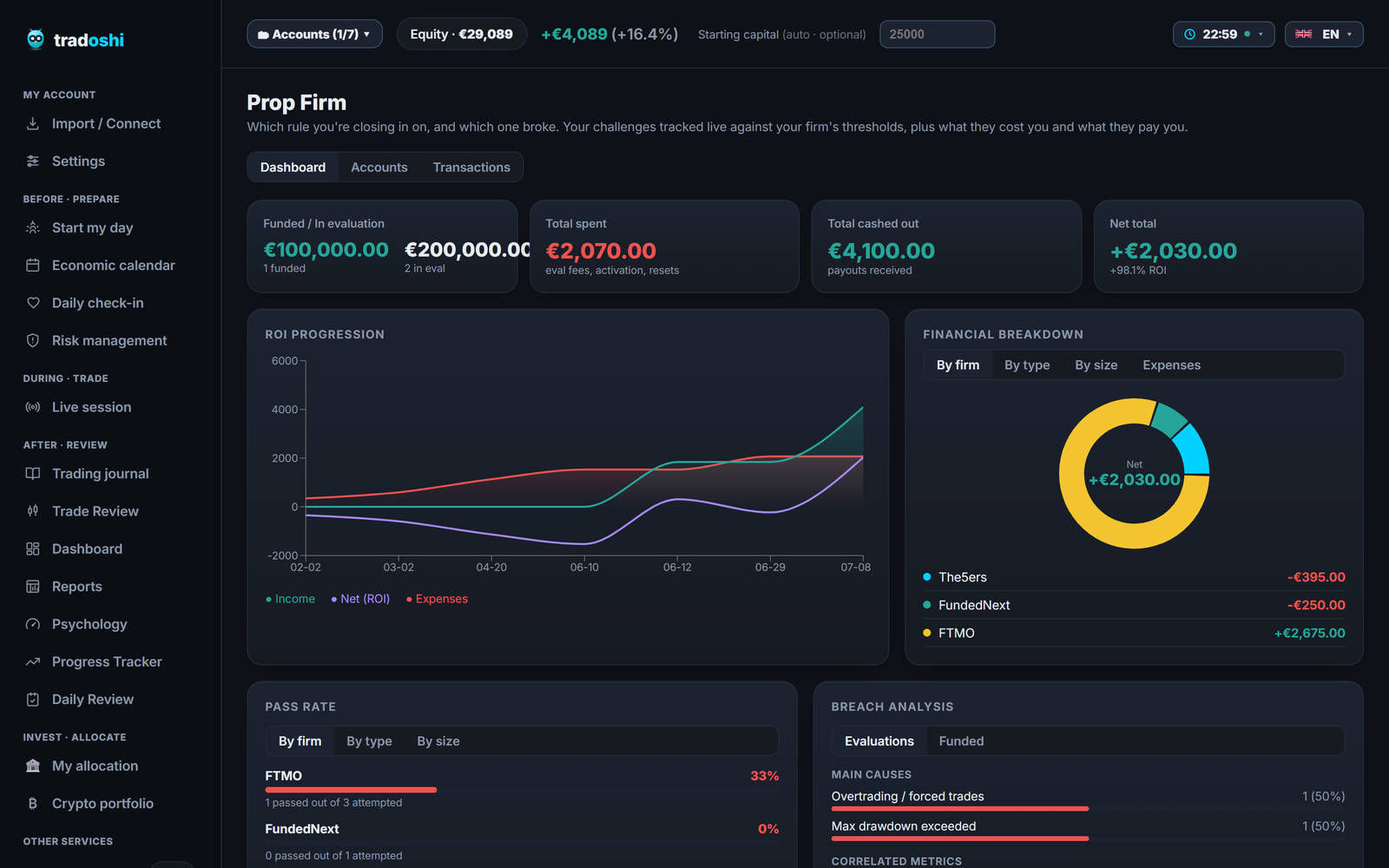
Since software watches your limits continuously, you need a view at least as clear as its own, and a hand-kept sheet goes stale fast once you run two accounts. Tradoshi's Prop Firm screen, from the Pro plan, tracks your challenges against your firm's thresholds, shows which rule you're getting close to, and records what each firm has cost you and paid you. Our method for passing a challenge explains how to size positions against those thresholds.
Frequently asked questions
How do prop firms work, in one sentence?
You pay to trade a simulated account under loss and target rules watched by software; if you keep to them, a contract entitles you to a reward based on your simulated result, up to 90% at FTMO and Topstep.
Do my orders go to the market?
Not on the evaluation or funded accounts at FTMO and Topstep, according to their pages. Prices come from the market, but orders don't reach it. At Topstep, only the Live Funded Account changes that.
How long does it take to get a funded account?
The minimum shown by FTMO is 8 trading days on the 2-Step and 2 on the 1-Step, plus the trade review, identity check and contract. In practice it depends on your trading: neither firm publishes an average on the pages we read.
Am I an employee of the prop firm?
No. Topstep classifies all traders as independent contractors. FTMO treats you as a client bound by its terms, as a natural person, entrepreneur or company. Declaring your payouts for tax depends on your country and is up to you.
When do I get paid?
At FTMO, the request opens 14 days after your first trade, then the review and payment each take 1 to 2 business days. At Topstep, on the standard account, you need five winning days of $150 or more, and each request is capped at 50% of the balance.
Why does my buffer drop after a withdrawal?
Because the withdrawal lowers the balance, and at Topstep the Maximum Loss Limit moves to $0 after the first payout. On a 50K with a $1,000 balance, withdrawing $500 takes the buffer from $2,000 to $500. Other firms have their own rule: at FTMO, the instant account's maximum loss doesn't reset after a withdrawal.
Is a prop firm regulated like a broker?
The pages we read don't present it that way, and Belgium's FSMA writes that these companies have no authorization to provide investment services. The framework depends on the country and the company: check with your country's regulator before paying.