 By Benjamin Roure L'Hermitte

How do prop firms make money? First by selling evaluations, not by taking a cut of gains made in a market. At FTMO and Topstep, the accounts offered up to the funded level are simulated: what comes in is fees, resets and activations, and what goes out is rewards paid in real money. FTMO's 2025 figures give a sense of scale: about $330 collected per order, and roughly 14% of 2024 revenue paid back to traders.
- The main income is fees: evaluation, reset, activation, reactivation, add-ons.
- The 90% split is not revenue: on a simulated account, it is an expense the firm pays from its own funds.
- Repeat customers carry the model: around 80% of FTMO's paid orders in 2025.
- A firm can hurt when traders win: FTMO's net income fell 59% in 2025, with rewards far above its reserve.
The answer you see everywhere fits in one line: the firm lives off failures. It isn't wrong, just incomplete. It can't explain why a company pays hundreds of millions of dollars to its customers, or why its earnings can melt in the very year it sells more than ever. To see clearly, you have to drop the slogans and follow the cash.
This article relies on what firms publish, what the Czech press drew from FTMO's annual report, and the texts of two regulators and a court. It describes a business model; it doesn't say whether any firm is a good buy.
The six revenue lines of a prop firm
Not every firm uses every line, and none of those we read publishes the weight of each. So the table shows what exists, with an example from an official page, not a breakdown.
| Where the money comes from | How it works | Example read in November 2026 |
|---|---|---|
| Evaluation fees | The price of an attempt, paid once or monthly | Topstep: $49, $99 or $199 a month depending on account size |
| Reset | Starting over after a failure without rebuying the whole path | Topstep: the subscription price, so $49 on a 50K account |
| Activation | An entry charge when you receive the funded account | Topstep: $149 per account earned, or a pricier subscription without it |
| Reactivation | Getting a lost funded account back | Topstep: $599 to $829 depending on size |
| Add-ons and services | Data, transfer fees, courses, software | Topstep: order book data at $38 a month, $30 per wire; the FSMA also describes paid courses |
| The firm's own real trading | A separate activity, with its own funds | FTMO states it in its FAQ, without giving an amount |
All these Topstep prices appear on its help page on pricing and in its payout policy. The same help page notes that most fees are non-refundable. FTMO works differently: its FAQ on fees refunds the 2-Step with the first reward withdrawal, but not the 1-Step or the instant account.
Evaluation fees, the real engine of the model
The principle is that of an entry fee: the firm collects at the point of sale, whatever the result. Spotware, the company behind the cTrader platform, puts it plainly in its article on whether prop firms use real money: this model relies on evaluation fees as a primary revenue stream, covering operating costs and payouts. That's an industry supplier talking, not a critic.
The sticker price varies less than you might think. In our prop firm directory, which covers more than 270 companies, the median price of a $100,000 account on a one-time payment, recorded in late October 2026 and excluding discounts, sits around $550 for two steps and $540 for one step, against about $820 for an instant account with no evaluation. About nine firms in ten sell the program we recorded there as a one-time payment, and more than 40 show an activation fee on at least one offer.
The most telling figure comes from FTMO. According to CzechCrunch's analysis of FTMO's annual report, published on 8 September 2026, the company booked CZK 8.81 billion in revenue in 2025 on 1.27 million paid orders. The division is ours: about CZK 6,900 per order, or roughly $330 at the rate the article uses. That's too close to the price of a challenge to be a coincidence, even if not all revenue necessarily comes from orders.
The returning customer, the number nobody leads with
The picture of a beginner who pays once, fails and vanishes doesn't fit the numbers. The same article reports that around 80% of FTMO's paid orders in 2025 came from returning customers, and Finance Magnates reports a similar share of revenue. So a prop firm isn't selling a single test. It is selling something close to a subscription, to customers who buy again after a failure, or after a success to open one more account.
Topstep shows the same pattern. Its program page publishes for 2025 that 16.8% of Trading Combines initiated were completed, while 51.8% of participants reached the Funded Level in at least one of theirs. The simplest explanation for the gap between the per-attempt rate and the per-person rate is that many people try several times. That's our reading: the page doesn't give the average number of attempts.
Run the sums on those prices. At 16.8%, it takes six Trading Combines on average for one completion. At $49 a month on a 50K account, with a single month per attempt plus the $149 activation, that's about $440 of income. One payout request can reach $2,000 on that account. This doesn't measure Topstep's margin, since it doesn't publish its accounts, but it shows why the firm needs its funded traders not to be paid all at once, and why payout conditions matter as much to it as they do to you.
The 90% is not a cut the firm takes
This is the most common misreading. When a broker or a fund keeps 10% of a gain, it receives 10% of money earned in a market. On a simulated account, there is no market gain to split. FTMO's technical FAQ says so: its accounts hold fully fictitious funds, and its liquidity providers supply quotes, not money. Topstep sums up its setup in one line: funded traders keep 90% and the company covers the losses. A fictitious loss costs nobody anything, apart from the account. A reward, on the other hand, gets paid in real currency.
The comparison that holds up best comes from insurance. The firm collects premiums up front, reserves what it expects to owe, then settles claims: here, the traders who meet the conditions. Its health depends on what insurers call the loss ratio, what it pays out against what it took in. The analogy is ours, but FTMO's accounts use exactly that vocabulary: a reserve, and an overrun.
| FTMO, from its annual report as summarized by CzechCrunch | Amount |
|---|---|
| 2024 revenue | CZK 6.73 billion |
| 2025 revenue | CZK 8.81 billion, about 31% more |
| Reserve for rewards at end of 2024 | CZK 523 million |
| Actual rewards tied to 2024 sales | about CZK 955 million, 82% above the reserve |
| Those rewards as a share of 2024 revenue (our calculation) | about 14% |
| Social media advertising in 2025 | CZK 735.8 million, 8.4% of revenue |
| 2025 net income | CZK 782 million, down 59% |
| Net margin | 8.9% in 2025, 28% in 2024, over 55% in 2021 |
That 14% holds for one company and one year, and it needs careful reading: we didn't read the report itself, only what the press drew from it, and nothing says another firm sits at the same level. It still corrects two common ideas. The firm doesn't keep everything it collects, since the article mentions more than $650 million paid to traders over ten years. Nor does it pay back 90% of its income: the 90% applies to the simulated result of the accounts that meet the conditions, not to revenue.
When traders win too much: FTMO's 2025
The idea of a firm that wins every time doesn't survive that year. FTMO set a sales record and posted its lowest profit since 2020. According to CzechCrunch, traders earned more than expected on the platform, and the company had to raise its reserve to CZK 1 billion, a CZK 479 million difference booked as a cost. The article sees that as the main cause of the decline. Lupa.cz also stresses the acquisition of the broker OANDA and its financing, and advertising and currency losses weighed too. Co-founder Marek Vašíček calls it the toughest test for modern prop trading in years, citing US tariff shocks and demand for safe-haven assets. One lesson to draw: a firm's cash position, and not just its promise, decides whether you get paid.
So where does the real market come in?
It exists, but not where the word 'funded' suggests. FTMO writes in its FAQ on trading according to a real market that it may use data from client accounts to trade on its own live accounts, and its technical FAQ adds that this trading, done with its own means, runs as a separate process with no impact on clients. The warning from Belgium's FSMA, dated 7 March 2024, describes something similar in its French text: the company may copy some demo trades onto a real platform, and the customer may then receive a commission, on conditions the company alone sets.
Spotware separates three setups: simulated accounts paid from revenue, a hybrid model where the firm selectively copies consistent traders, and real accounts kept for a handful. Topstep shows the third tier: according to its page, 0.71% of participants trading an Express Funded Account were called up to a Live Funded Account in 2025. Beyond that, what each firm does on its side with your results isn't on its pages. It's a question to ask them, and the answer is worth keeping.
What regulators and courts have said
The FSMA uses the strongest language. After describing paid tests, often retaken several times and never passed by many, it writes in French that the prop trading company thereby makes money at their expense. It adds that these companies have no authorization to provide investment services. The press release from Italy's CONSOB, dated 8 July 2024, reports complaints from users about the difficulty of the tests and the failure to share gains, as complaints rather than established facts. Both texts target a type of offer and name no company.
The best-known court case settled nothing on the substance. In the US, the CFTC sued Traders Global Group, parent of My Forex Funds, in August 2023 for alleged fraud. According to Today's General Counsel, it argued among other things that customers believed they were trading live while transactions took place in demo environments. The New Jersey court's order of 13 May 2025 dismissed the complaint with prejudice and sanctioned the regulator. The analysis by the law firm Willkie reports that the dismissal rests on the CFTC's conduct in the proceedings. So the allegations were never tried, one way or the other.
What this changes before you pay
- Work out your real entry price: evaluation, likely resets, activation, add-ons. The headline price says very little on a monthly subscription.
- Check what gets refunded: at FTMO, the 2-Step is refunded with the first withdrawal, the 1-Step isn't.
- Read the payout conditions before the percentage: winning days, caps, minimum amount, and the loss limits, starting with the trailing drawdown.
- Look for what the firm publishes about itself: pass rates, share of traders paid, track record. Few companies do, and that is information in itself.
- Compare on a written basis: our prop firm rankings score each company on published criteria, and the comparison tool puts rules and prices side by side.
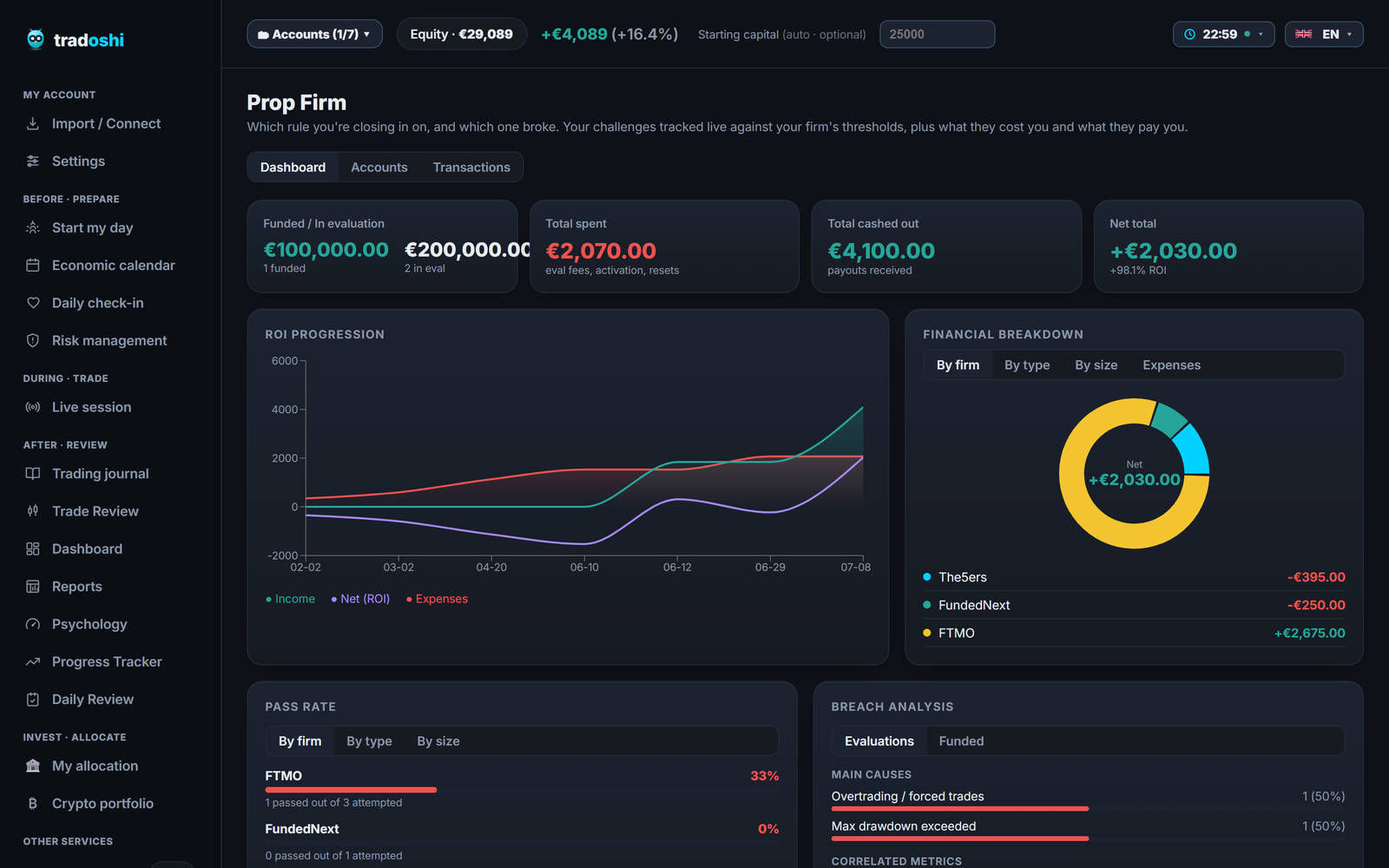
The simplest way not to fool yourself is to keep your own books. Plenty of traders know the size of their last payout and have no idea what they've spent on attempts. In Tradoshi, the Prop Firm screen, from the Pro plan, adds up evaluation, activation and reset fees on one side, payouts received on the other, and gives a net figure per firm. Our page for prop firm traders shows the rest of the tracking.
Three reads from here: how do prop firms work for the mechanics of the path, our guide to prop firm trading for the full picture, and how to choose a prop firm for the clauses to check. If you decide to try, how to pass a prop firm challenge covers the method, and how much day traders make puts the amounts in perspective.
Frequently asked questions
Do prop firms make money when you fail?
They keep the fees you paid, unless a refund clause applies, and a failure can trigger another purchase. But that line is too short: they collect the same fees when you pass, and successful traders often buy again as well. Around 80% of FTMO's orders in 2025 came from returning customers.
Does a prop firm want you to fail?
Nobody can answer that for a company from the outside. What can be established is that each reward is a real cost on a simulated account, and that returning customers weigh heavily in sales. So a firm needs both paid traders, for its reputation, and a loss ratio it can absorb. CONSOB reports user complaints about the difficulty of tests, without establishing them.
Where does the reward money come from?
At a firm whose accounts are simulated, it comes out of its cash, so mainly from what it has collected. Spotware writes that evaluation fees cover costs and payouts in this model. FTMO also runs separate real trading, without publishing the amount.
What share of revenue does a prop firm pay to traders?
We could only work this out for FTMO: about CZK 955 million in rewards tied to 2024 sales, on CZK 6.73 billion of revenue, so about 14%, according to the annual report as summarized by CzechCrunch. That figure doesn't hold for another year or another company.
Do prop firms actually trade the markets?
Some do, separately from your account. FTMO writes that it trades on its own live accounts, in a separate process. Topstep offers a Live Funded Account, reached by 0.71% of Express Funded Account participants in 2025. For other firms, you have to ask each one.
Is the prop firm model legal?
It depends on the country and how the offer is presented, and we don't give legal opinions. Belgium's FSMA writes that these companies have no authorization to provide investment services, and it warns against them. In the US, the CFTC's case against the My Forex Funds group ended in May 2025 with a dismissal tied to the regulator's conduct, without a ruling on the substance.