 By Benjamin Roure L'Hermitte

What is a prop trader? It's someone who trades a trading firm's capital rather than clients' money, and whose result belongs first to that firm. On a desk it is a job, with a hiring process, a base salary and a bonus, and never a client on the phone. Online, the same title often means a retail trader who has paid for an evaluation and trades a simulated account for a share of simulated gains. That difference is no fine point: the first person has been hired, the second is a customer.
- A prop trader serves no client: they take positions, they don't execute someone else's orders.
- Status changes everything: employee of a firm, independent on their own account, or customer of an online prop firm.
- Pay has no public median: only isolated data points, such as a posted $300,000 base at Jane Street in New York, and 33.3% of Funded Level participants paid out at Topstep.
- Bias survives the job: in Chicago, professionals took more risk in the afternoon after a losing morning.
The title looks good in a bio, and that's precisely the problem: it doesn't say whether the person was hired by a trading firm, is committing their own savings, or paid a monthly subscription last week. All three can write 'prop trader' without quite lying.
So here is what the term covers on the human side: what the day looks like, what they earn, how you become one, and what research has measured about how they react. If you are after the meaning of the activity and its legal framework instead, read what is prop trading.
Three people carry this title
To know who you are dealing with, look at the capital, what can be lost, and how the person gets paid. The table below sums up these three situations, and the pages and studies describing them are cited further down.
| Employee of a trading firm | Local, on an exchange | Customer of an online prop firm | |
|---|---|---|---|
| The capital | The firm's | Their own | Simulated at FTMO, and at Topstep up to the Express Funded Account, according to their pages |
| What they can lose | Their bonus and their seat | Their money | Their fees and access to the account |
| Their pay | A base and a bonus | The result of their positions | A share of the simulated result, up to 90% at FTMO |
| The way in | A hiring process | A trading account in their own name | A paid evaluation |
The local deserves a word, because they get forgotten. The study by Coval and Shumway in the Journal of Finance calls the Chicago Board of Trade traders it follows proprietary traders, and the summary of that study in the CFA Digest specifies that these are local traders dealing on personal accounts. So the term has never meant only 'employee of a big firm'.
The day: screens, models, no clients
The most concrete portrait we have read comes from a physiology study. Coates and Herbert, in PNAS in 2008, followed 17 traders on a London floor of about 260 people. They sit in front of a bank of live price screens, with a news feed and a risk management system. Their largest exposure is to German markets, mainly interest rate futures. Their trade sizes run from £100,000 to £500,000,000 nominal depending on experience, and most close their positions by the end of the day. A useful caveat: the study never uses the word proprietary and doesn't say who funds the positions, but it does describe income calculated after profit sharing with the firm.
At the most technology-driven firms, the portrait shifts. Optiver writes that its traders 'set prices, manage exposure and work close to research and engineering'. Jane Street's quantitative trader job posting mentions proprietary models and over a million trades on busy days. Nobody clicks a million times: at that scale, the trader designs, monitors and corrects far more than they press a button.
What both portraits share is the absence of a client. No portfolio to present, no mandate to honor, no end-of-quarter meeting. The less pleasant side: when the day goes badly, there is nobody to explain it to, only a number.
How much does a prop trader make?
We found no public pay statistic specific to this job. Anyone quoting you an average for 'the prop trader' got it from a sample they should be able to name. Here is what can actually be read, and these are isolated points:
- A posted base: that same Jane Street posting said 'Base salary is $300,000' in November 2026 for a New York role, plus an annual discretionary bonus. One firm, one city, one job, and very likely not the general case.
- A range on one floor: in Coates and Herbert, annual income runs from £12,000 to over £5,000,000, across 17 people, seven of them in their first year. That spread says more than any average.
- A payout rate: Topstep reports for 2025 that 33.3% of participants at the Funded Level received a payout, with no amount given here.
- A sharing ceiling: FTMO writes 'up to 90% of your simulated profits' on its 2-Step model. That is a percentage, not an income.
The real difference shows up before the first trade. The employee receives something, the prop firm customer pays something. Topstep's pricing page listed in November 2026, for the $50,000 account on the standard path, a $49 monthly subscription and a $149 activation fee: three months of evaluation and one activation come to 3 × 49 + 149 = $296, before tax and without a reset, ahead of any possible payout. To place these amounts against trading income more broadly, read how much day traders make.
How you become a prop trader
Through hiring
The most telling sentence comes from Jane Street: 'Prior knowledge of finance or economics is not expected or required'. The same posting looks for people 'who have a strong quantitative mind'. In other words, what gets filtered is not your knowledge of candlesticks but how you reason about probability. A firm with its own models would rather teach markets to a mathematician than the reverse. That doesn't hold everywhere, but it changes how you prepare.
In the US, a regulatory step comes on top. FINRA Regulatory Notice 15-45 created, effective January 4, 2016, the Securities Trader category, which covers people engaged in proprietary trading. Getting it means passing the Series 57 exam: 50 items, 1 hour 45 minutes, $105, plus the SIE exam. The detail that matters: candidates must be sponsored by a member firm. You can't sign up on your own to declare yourself a prop trader. Elsewhere, rules vary and need checking country by country.
Through an online evaluation
Here there is no interview, just a result and some limits. FTMO's trading objectives page asks on the 2-Step for a 10% simulated gain and then 5% in verification, over at least four trading days, without losing more than 5% in a day or 10% overall. Once through, the firm writes, you keep trading simulated capital, and its how-it-works page describes no job, salary or employment link. Belgium's FSMA warns, in its French text, that these courses often get paid for several times over and that there is a chance consumers never pass them.
There is nothing illegitimate about this route as long as it goes by its real name. The steps are in our guide to prop firm trading, the method in our article on passing a challenge, what to read in a rulebook in our article on choosing a prop firm, and firms can be compared on our list of prop firms and our prop firm rankings.
What trips up a prop trader, even a professional one
Coval and Shumway worked on over 5 million T-bond futures transactions in 1998. Their finding fits in one sentence: these traders are highly loss-averse and regularly take on above-average afternoon risk to recover morning losses. The CFA Digest summary gives the figure: the chance of taking above-average risk was 31.2% after a losing morning, against 27% after a winning one. More trades, larger trades, more inventory.
Just over four points of difference doesn't look like much. Except these are people doing this for a living, on their own money, and the effect shows up in their prices: those set after a bad morning reverse faster than the others. The market reads them. The mechanism has a more familiar name and its own article: revenge trading.
Coates and Herbert add a physiological angle, to be taken carefully. Of their 17 traders, 14 did better on days when morning testosterone was high, and cortisol closely tracked Bund implied volatility. But the study covers only eight business days, in a calm period, and the authors themselves write that the low volatility makes it difficult to assess the size of the effects. Take away just this: your body takes part in the trading day, it doesn't watch from the bench.
You can rerun the Chicago test on your own history in a few minutes. Split each day in two at mid-session. For days with a red morning, then for the others, note the number of afternoon trades and their average size. If the two columns differ clearly, you have found something more useful than an average of professionals: your own reaction. It is a measurement, not a market recommendation.
Prop trader, day trader, fund manager: where the line falls
These labels answer different questions. Day trader describes a horizon: you close positions within the day, whether or not the money is yours. Prop trader describes the capital and the absence of a client: a prop trader can hold for several days, and Coates and Herbert's traders were allowed to, even though most didn't. Fund manager describes a mandate: people entrust you with money and you report back. Funded trader, finally, is the commercial vocabulary of online prop firms, and it is worth what the account behind it is worth: at FTMO, and at Topstep up to the Express Funded Account, read 'simulated' alongside it.
What Tradoshi tracks on a prop firm account
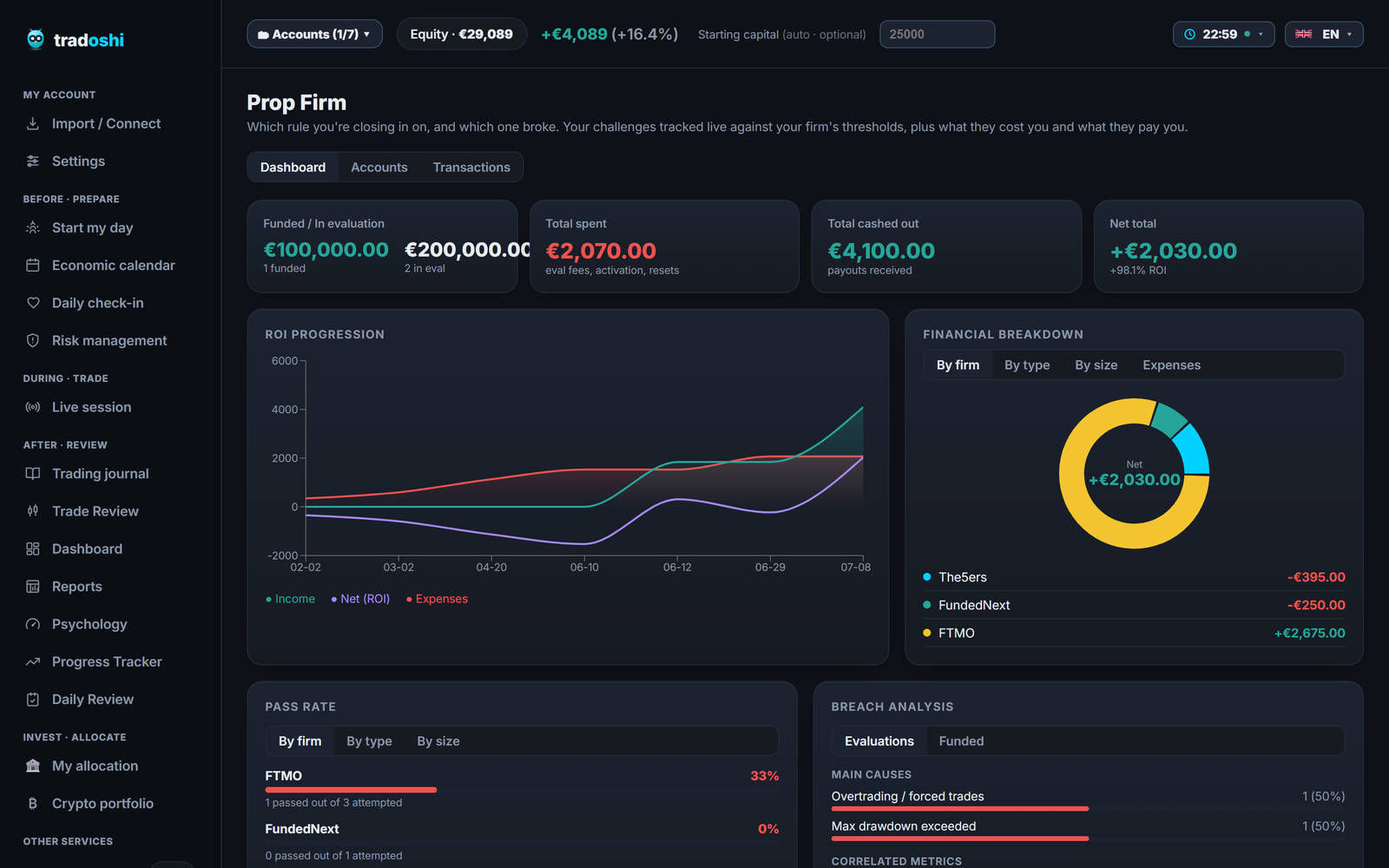
An employee has a risk department looking at their numbers. A trader on an evaluation has nobody. Tradoshi's Prop Firm screen takes on part of that role: it starts from your firm's rules, checks them against your closed trades to show which one you are getting close to, and sets your fees against your payouts. The discipline score looks at something else: whether you kept to your time slots, your stops after losses and your daily limit, and whether your size went up right after a loss, the very behavior Coval and Shumway measured in Chicago.
Frequently asked questions
Is a prop trader an employee?
It depends who you mean. At a trading firm that hires, yes, with a base and a bonus on the postings we read. An online prop firm customer is not, according to the pages we read: FTMO describes a reward on a simulated result, with no job or salary. A local on an exchange works for themselves.
What's the difference between a prop trader and a funded trader?
Funded trader is the term online prop firms use: the person has passed an evaluation and trades an account, simulated at FTMO, and at Topstep up to the Express Funded Account, according to their pages. Prop trader is the original term for the profession, someone trading a firm's capital or their own. Today, the two often get mixed up.
Do you need a degree to become a prop trader?
The pages we read don't call for a finance degree. Jane Street's posting says prior knowledge of finance or economics is neither expected nor required, and looks for a strongly quantitative mind. In the US, Securities Trader registration goes through the Series 57 and SIE exams. Online, entry comes down to the evaluation.
Does a prop trader risk their own money?
An employee commits the firm's capital: they risk their bonus and their seat. A local commits their own money. An online prop firm customer risks their evaluation fees and access to the account, the account result being simulated according to FTMO's and Topstep's pages.
How much does a prop trader make?
No public statistic covers the profession. One example: Jane Street listed a $300,000 base in New York in November 2026, plus a discretionary bonus. At the other end, Topstep writes that 33.3% of Funded Level participants received a payout in 2025. Neither is a promise or an average.
How is a prop trader different from a market maker?
Market making is a specialty: under MiFID II, a market maker holds itself out on a continuous basis as willing to buy and sell against its own capital at prices it sets. Many prop traders work for market makers such as Optiver, but a firm can also take positions without quoting continuously.
Can you be a prop trader from home?
Online, yes: that's how prop firms work, but you are a customer and the account is simulated at FTMO and Topstep. For a job at a firm, that is up to the employer. The postings we read name a city, such as New York at Jane Street, and we found no general rule.