KOSPI halted after the Nasdaq 100's worst session since 2020
The Nasdaq 100 suffered its worst session since March 2020 on 5 November 2026, and the semiconductor sell-off forced a trading halt in South Korea the next morning. For index traders, prop firm traders and leveraged crypto traders, the episode highlights the risk of price gaps and fast liquidations.
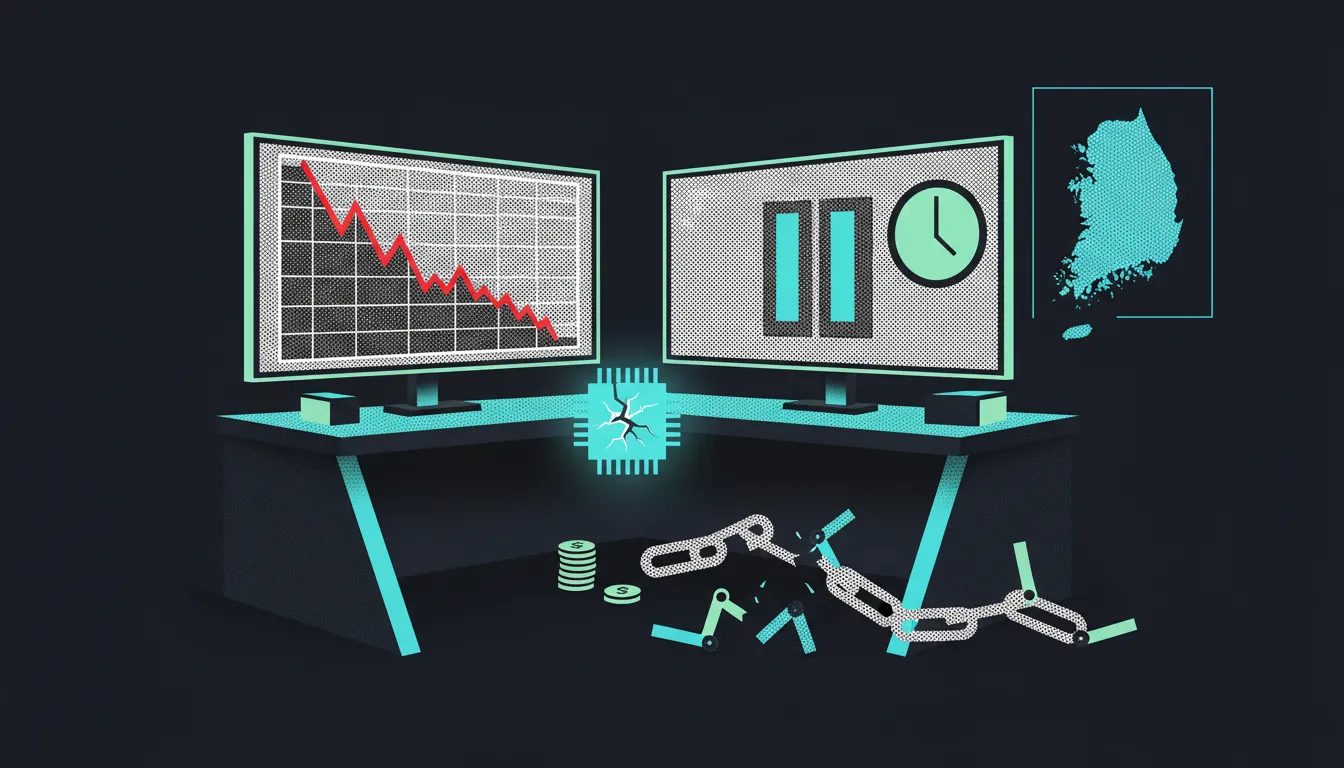
On 6 November 2026 at 9:03 a.m. Seoul time (00:03 GMT), the Korea Exchange triggered a level 1 circuit breaker on the KOSPI, South Korea's benchmark index, which was then down more than 8%, according to The Asia Business Daily and the Seoul Economic Daily. All trading was suspended for 20 minutes. The halt followed the 5 November session on Wall Street, which closed at 4 p.m. New York time, during which the Nasdaq 100 posted its steepest decline since March 2020, according to investingLive and 24/7 Wall St.
Nasdaq 100 posts its worst session since March 2020
On 5 November, the Nasdaq 100 shed 1,807.36 points, or 6.36%, to close at 26,629.81, according to investingLive. 24/7 Wall St. dates the last drop of that size to 16 March 2020. The rest of the US market followed: the Nasdaq Composite fell 5.52% to 24,315, the Dow Jones lost 1,833 points (-3.44%) and the S&P 500 dropped about 4.35% to finish around 7,354. For these indices, CNN and Business Model Analyst describe the session as the worst since April 2025.
Chipmakers bore the brunt of the selling. The Philadelphia Semiconductor Index (SOX) slid more than 12%, while Nvidia lost around 9.3% to roughly $181.6, according to investingLive, Finbold and CNN.
Media outlets link the move to fears that the construction of artificial intelligence data centers could slow down or face tighter oversight after the Democrats won both the House and the Senate in the midterm elections. Existing doubts over AI capital spending reportedly amplified those concerns. This remains a market interpretation: The Kobeissi Letter, quoted by Cointelegraph, sees the decline as more technical than fundamental.
Seoul shuts its market for twenty minutes at the open
On 6 November, the KOSPI opened at 5,263.26, down 2.24% (-120.54 points) from the previous close. Three minutes later, the decline exceeded 8% and the index dropped below 5,000 points intraday, with the exact low varying from one outlet to another. According to The Asia Business Daily, the level 1 circuit breaker is triggered when the KOSPI stays at least 8% below the previous close for one minute; it then suspends the entire market for 20 minutes.
On the KOSDAQ, which fell more than 6%, a so-called 'sidecar' was activated on the sell side, restricting programme sell orders for five minutes, according to The Asia Business Daily and Invezz. Samsung Electronics and SK Hynix led the decline, the former losing about 10% intraday and the latter as much as 12 to 13%. Once trading resumed, the KOSPI pared its losses and closed down about 6%, around 5,059.7, back above the 5,000 mark, according to TradingKey and Cointelegraph.
Seoul relaxes margin rules as crypto liquidations top $1 billion
On 6 November, the South Korean government announced that brokers would be exempt, for three months starting Monday 9 November, from maintaining the 140% collateral ratio required on margin loans, the Seoul Economic Daily and Cointelegraph report. The stated aim is to limit forced selling. According to the Seoul Economic Daily, it is the first such measure since July 2022.
Crypto markets also took the hit. More than $1 billion in leveraged positions, overwhelmingly longs, were liquidated over 24 hours between 5 and 6 November; reported figures range from $1.1 billion to $1.26 billion depending on when the data was taken. Bitcoin fell about 6% on 5 November to around $75,700, erasing its post-election gains, and was holding above $75,000 on 6 November, according to CoinDesk and Cointelegraph. Investors were also awaiting the US jobs report for October, released on Friday 6 November.
What it means for traders
For traders of Nasdaq 100 CFDs (listed as US100 or NAS100 depending on the platform), the range of the 5 November session was far wider than usual. Any changes to margins, leverage or trading hours on US and Korean index CFDs have not been specified by brokers or prop firms at this stage; affected clients would benefit from checking the conditions currently applied to their accounts.
For KOSPI-linked products (CFDs, KOSPI 200 futures, ETFs), the halt illustrates a specific risk: for twenty minutes, the underlying is no longer quoted. When trading resumes, a price gap can appear and stop orders may be filled well away from their level.
In prop firm accounts, such a gap, whether at the Seoul or Tokyo open or when US futures reopen, could breach the daily loss limit or the maximum drawdown in one move. The account rules worth rereading cover how unrealised losses are counted, when the daily limit resets and how positions held overnight or over the weekend are treated.
The Korean relief measure concerns margin loans from local brokers. It does not change the conditions applied by foreign CFD brokers.
On crypto perpetual futures, the 5 and 6 November liquidations underline the weight of leverage, liquidation prices and funding rates, at a time when bitcoin has fallen in step with the Nasdaq. The jobs report, landing in an already volatile market, could come with wider spreads on indices, the dollar and crypto. Finally, logging in a trading journal the gaps suffered, the slippage and any orders left unfilled during the Seoul halt would help support an execution dispute if needed, or a review of position sizing.
Sources
- Nasdaq 100 suffers worst day since 2020, investingLive (ex-ForexLive)
- Tech Stocks Just Had Their Worst Day Since 2020, 24/7 Wall St.
- Massive tech sell-off wipes $2.5 trillion from the stock market, CNN
- Nasdaq Just Had Its Worst Day in 19 Months Over AI Data Centers, Business Model Analyst
- Nvidia stock wipes $447 billion in a day as Nasdaq-100 suffers worst drop since 2020, Finbold
- KOSPI Triggers Circuit Breaker After Falling 8%, The Asia Business Daily (Asiae)
- Korea Eases Margin Call Rules as KOSPI Clings to 5,000, Seoul Economic Daily
- Why did South Korea halt KOSPI trading after an 8% crash?, Invezz
- Kospi Closes Strongly Above 5,000 Mark After Circuit Breaker as SK Hynix Plunges Over 10%, TradingKey
- Bitcoin holds $75K as AI regulation fears see KOSPI halted after 8% crash, Cointelegraph
- Bitcoin steadies after AI-led selloff as eyes turn to latest U.S. jobs figures, CoinDesk
- Bitcoin (BTC) Price: $1.1 Billion in Liquidations Follow Drop to $75,700, Blockonomi
- Bitcoin erases post-election gains as Wall Street selloff hits $1B in liquidations, Crypto Briefing
- Best Crypto to Buy Now: Bitcoin Slips to $76K as $1.26 Billion in Longs Gets Liquidated, Blockchain Reporter
This article is published for information purposes. It is neither investment advice nor a recommendation to buy or sell any financial instrument. Verification method and corrections policy: The newsroom.
More news
- US Treasury hits Prince Group scam network with third wave of sanctions5 November 2026
- Spotware launches cAntifraud fraud network for brokers and prop firms4 November 2026
- CFTC opens US exchanges to perpetual futures on individual stocks4 November 2026
- CFTC: Texas man and his firm ordered to pay over $13 million for fraud3 November 2026
Account sync, statistics and discipline tracking. Free plan, no card required.