 By Benjamin Roure L'Hermitte

How to become a professional trader? No study measures how long it takes: the ones that follow every account on a market show that most individuals who day trade lose money, and that years of practice are not enough on their own. This guide describes six stages many traders report on the way from beginner to profitable trader, from beginner's luck to the work of discipline, separating what has been measured from what is narrative. Knowing this path doesn't make it shorter, but it tells you where to look to see where you really stand.
- The path is told in stages: a useful way to read your own progress, not a measured law.
- No timeline is guaranteed: in the studies that follow day traders, practicing longer is not enough to become a winner.
- The tipping point is about psychology and discipline, not a better strategy.
- Measuring your progress lets you judge your work on something other than the account balance.
We often imagine the profitable trader as someone who found the right strategy, the right secret, and took off. The reality is far more down-to-earth: becoming profitable is a long journey, where the real work isn't finding a magic method but changing the way you operate. And few get there: on the Taiwan Stock Exchange, from 1992 to 2006, about 360,000 individuals day traded stocks each year, and according to Barber, Lee, Liu and Odean, about 13% made money net of fees in a typical year and fewer than 1% did so consistently. That figure holds for that market and that period; the other measurements are in our article on why 90% of traders lose.
Knowing this path in advance has real value: it tells you where you stand, what may await you, and that your struggles are not yours alone. This guide describes the real stages from beginner to profitable trader, the traps of each, and why, once the method is sound, the work is about execution and discipline rather than yet another strategy. If you haven't placed your first real trade yet, start with our tips on how to start trading and with the Academy track on trading basics.
Stage 1: beginner's luck
Some traders start by winning. A few easy trades, an intuition that pays off, and confidence shoots up. That's beginner's luck, and it's a trap, because it makes you attribute to your talent what partly comes from chance and favorable market conditions. In Gervais and Odean's model, 'Learning to Be Overconfident', a trader who does not yet know their own ability takes too much credit for their successes, and their overconfidence grows in the early stages of their career: it is a theoretical model, not a measurement. And in the real-money experiments of Thaler and Johnson, run with Cornell University students, a prior gain increases risk taking. You conclude trading is easy, increase your size, and lay the foundations of the fall that may follow.
The danger of this stage is that it installs unearned confidence and bad habits. Since everything works, you feel no need to manage your risk, keep a journal, discipline yourself. You learn the worst possible lesson: that trading on feel pays. That lesson will be billed to you dearly at the next stage.
Stage 2: the first real drawdown
Sooner or later, a losing streak arrives. There is nothing abnormal about it, but it is devastating for a trader who wasn't prepared. Without risk management or discipline, that streak hurts: the account melts, confidence collapses, and panic sets in. It's the first real test, and the data show that many stop early. In Brazil, of the 19,646 individuals who began day trading the mini-Ibovespa futures contract between 2013 and 2015, 1,111 day traded for a single day and 9,978 for 2 to 50 days, according to the study by Chague, De-Losso and Giovannetti, 'Day Trading for a Living?'. The study does not say why they stopped; concluding that 'trading doesn't work' after a single streak is in any case a conclusion drawn from too few trades.
The first drawdown isn't the end of your trading journey. It's the start of your real learning, if you don't run.
Those who get through this stage do so by understanding one thing: the problem wasn't the market, it was the absence of risk management. The first drawdown is the moment you realize that winning a few trades isn't enough, that you need a method and discipline. Two concrete markers: maximum drawdown, which measures the largest fall of your account from a peak, and a position size calculator, which gives you the size matching the risk you accept per trade. It's painful, but it's the real starting point of the path to profitability.
Stage 3: the quest for the perfect strategy
After the first drawdown, the temptation is to seek the solution in the wrong place: a better strategy. The trader starts collecting methods, indicators, courses, convinced the key is finding the right system. They jump from strategy to strategy, abandon each at the first drawdown, and never build any exploitable data.
| Stage | Belief | Reality |
|---|---|---|
| Beginner's luck | Trading is easy | Chance played its part |
| First drawdown | Trading doesn't work | Risk management was missing |
| Strategy quest | I need a better system | The losses were never measured |
| Awareness | The problem is me | The real start of progress |
This stage can last a long time. The trader goes in circles, because they change method without ever measuring which of their losses come from the strategy and which come from their execution. Until they have sorted that out on their own trades, they keep collecting beginnings without ever knowing whether they hold an edge.
Stage 4: the psychological awareness
The turning point comes when the trader stops looking outside and looks at what they do themselves. They realize part of their losses doesn't come from their strategy, but from what they do when money is at stake: revenge trading, over-risk, decisions under emotion. That reflex has been measured in professionals: in Coval and Shumway's study published in the Journal of Finance, Chicago Board of Trade proprietary traders with morning losses were about 16 percent more likely to take above-average risk in the afternoon than those with morning gains. It's an uncomfortable awareness, because it shifts responsibility from the strategy to oneself, but it's where the useful work begins.
From that moment, the work changes nature. It's no longer about finding the right method, but about becoming able to execute a correct method with discipline. The trader starts keeping a journal, measuring their discipline, setting safeguards. They finally understand that trading is work on oneself as much as on the market, and it's that mindset shift that opens the door to profitability.
Stage 5: discipline and consistency
Once the awareness is made, comes the long, unspectacular work of building discipline. The trader learns to follow their plan, hold their rules, manage their emotions, measure their progress. Writing that tracking down has a measured effect: in the meta-analysis by Harkin and colleagues, published in 2016 in Psychological Bulletin, across 138 studies and nearly 20,000 participants, monitoring progress helped people reach their goal, more so when the information was physically recorded. These are not studies of traders. The work is not glorious: it's repetitive, patient, even boring. But it's what turns a trader who knows what to do into a trader who actually does it.
Discipline is built through repetition, day after day. As it sets in, controlled days become the norm and disasters become rare. It does not guarantee a winning account: discipline protects an edge, it doesn't create one. But without it, a real edge never shows in the numbers, and it is consistency, not the grand gesture, that lets you verify it.
Stage 6: lasting profitability
Lasting profitability isn't a spectacular arrival point, it's the quiet culmination of all this work. The profitable trader hasn't found a secret: they have a decent edge, solid risk management, proven discipline, and they execute all of it consistently. Nothing magical, just the patiently built mastery of what they control. And it remains rare: in the Taiwan study cited above, fewer than 1% of day traders won consistently.
The most important message of this path is that time alone doesn't do the work. In Brazil, in the study by Chague, De-Losso and Giovannetti, the share of winners falls as the number of days traded rises, down to 3% among the 1,551 individuals who went beyond 300 days, and the authors find no evidence of learning. In France, the AMF's study of CFDs and Forex followed 1,881 clients who were active every year from 2009 to 2012: 87.56% lost over the four years, against 89.4% for all 14,799 clients, and the AMF writes that experience 'does not seem to be acquired easily'. On Finnish individual investors followed for nine years, Seru, Shumway and Stoffman find that some get better with experience, but that a substantial part of the learning consists of stopping after realizing that one's ability is poor. None of these studies says how long it takes to become profitable. Measuring your progress is what lets you know whether you're truly advancing, before it shows in your account.
Why most quit before the end
On the Taiwan Stock Exchange, more than 75% of day traders quit within two years, and losers quit more often than winners, according to the study by Barber, Lee, Liu, Odean and Zhang on day traders on the Taiwan Stock Exchange from 1992 to 2006. Quitting is therefore not always a mistake: for some of them, it is the conclusion drawn from an experience that cost money. The study does not say what decides each person. The reasons traders report are the first big drawdown that makes you conclude 'it doesn't work', financial exhaustion from blowing accounts, the weariness of not seeing results despite the effort, or the discouraging comparison with spectacular gains seen on social media. On that last point, the CFTC, the US futures regulator, notes that for every post about 'taking it to the moon', there are many more posts about individuals losing some or all of their money.
Knowing these quit points in advance helps you go through them with open eyes: you can prepare for the first drawdown instead of suffering it. But persevering is not a virtue in itself. In the same study, previously unprofitable day traders with at least 50 days of experience have a 95.3% probability of day trading again in the next twelve months, nearly the same as those who were profitable (96.4%): many persist despite an extensive experience of losses. So the useful question is not 'am I holding on?' but 'are my numbers improving?'. Continuing, cutting back or stopping is decided on a measurement, not on hope.
The role of capital in the path
An often underestimated factor of the path is managing your learning capital. Burning too much money too fast while learning means ending up short of capital before acquiring the necessary skills. The right approach is to preserve your capital while learning: trade small, even practice on a demo account for the basics, to stay in the game long enough to get through all the stages. Our paper trading guide explains how to use that demo account without picking up bad habits.
The idea is to separate the cost of learning from the trading capital itself. Losing money while learning is normal, but these losses should be calibrated as training fees, not as capital you plan to grow immediately. A trader who approaches their beginnings preserving their capital and risking very little gives themselves time to learn without ruining themselves, while one who bets big from the start risks being financially eliminated before even having the chance to progress. Surviving financially during learning is a condition of the path.
Capital also matters at the finish: for the same return, what a trader earns depends on the size of the account. The measured figures, for employed and retail traders, are in our article on how much day traders make.
Profitability isn't a finish line
We imagine profitability as a definitive arrival point, a state you reach once and for all. It isn't. Trading is a craft requiring permanent upkeep: markets evolve, an edge can erode, and your own discipline can loosen. A profitable trader who stops working on themselves and their system can end up losing again. Profitability is a state to maintain, not a summit to conquer once.
This reality is liberating rather than discouraging: it means the path never truly ends, and that each stage crossed made you sturdier for what's next. The lasting profitable trader is the one who keeps learning, measuring, adjusting, indefinitely, with the humility to know nothing is acquired. This mindset of continuous progress, rather than reached destination, is what gives you a chance of staying profitable over years rather than being so for a time and then relapsing. The path doesn't stop at profitability, it continues through it.
How many trades does it take to judge a system?
A question comes up often at the strategy-quest stage: after how many trades can you say a system works or doesn't? The answer disappoints impatient beginners: far more than they hope. Ten or twenty trades are not enough to decide, because chance weighs heavily on such a small number. On a system that wins one time in two, five losses in a row starting from any given trade have a one-in-32 chance of happening: over a long series, it happens without the system having changed. Interpreting it as the system's failure is the classic mistake of this stage.
There is no number of trades that holds for every system: it depends on the win rate and on how spread out the gains and losses are, and the uncertainty on your expectancy only shrinks slowly as the sample grows. That's one reason jumping from strategy to strategy is so destructive: every premature abandonment resets the counter to zero, and the trader never builds the sample size needed to properly judge anything. Staying on one system long enough, with rigorous execution, is a necessary condition for eventually being able to say whether it works.
Recognizing the signs you're approaching the tipping point
The tip toward profitability doesn't happen all at once, it's announced by discreet signs before the account even reflects it. The first sign is a drop in the emotional intensity of trades: losses stop triggering panic or anger, they become neutral events you log and learn from. The second is the gradual disappearance of off-plan trades: fewer and fewer impulsive entries, more and more trades that follow the checklist exactly.
The third sign, often the most telling, is a shift in your relationship to the daily result: the trader worries less about today's P&L and more about whether they executed their plan correctly. This shift of attention, from result to process, is not proof of profitability to come. It is, however, what goal-setting research recommends when the skill is still missing: according to Seijts and Latham's article published in 2005 in the Academy of Management Executive, when what is required is first the acquisition of knowledge and skills, a learning goal draws attention away from the end result and toward the discovery of effective strategies. That work is about the workplace, not about traders. Spotting these signs in yourself tells you the way you work is changing; only your account, over a sufficient sample, will say whether it pays.
The trap of theoretical over-learning
One last trap especially lies in wait for analytical traders or those from an academic background: spending a disproportionate amount of time reading, taking courses and watching analyses, at the expense of time spent actually executing trades and learning from them. Theory has its place, but it never replaces the direct experience of seeing your own money on the line and observing your own emotional reaction under real conditions.
This trap is comfortable because it feels like progress (you learn, you read, you feel competent) without ever facing the real discomfort of live trading, where the psychological tipping point actually happens. A trader who's read twenty books on trading but never journaled their last hundred trades knows far less about themselves than a trader who's read a single book but rigorously analyzed their own practice. Theory prepares you, but it is your own measured practice that tells you about yourself.
How Tradoshi supports you on the path
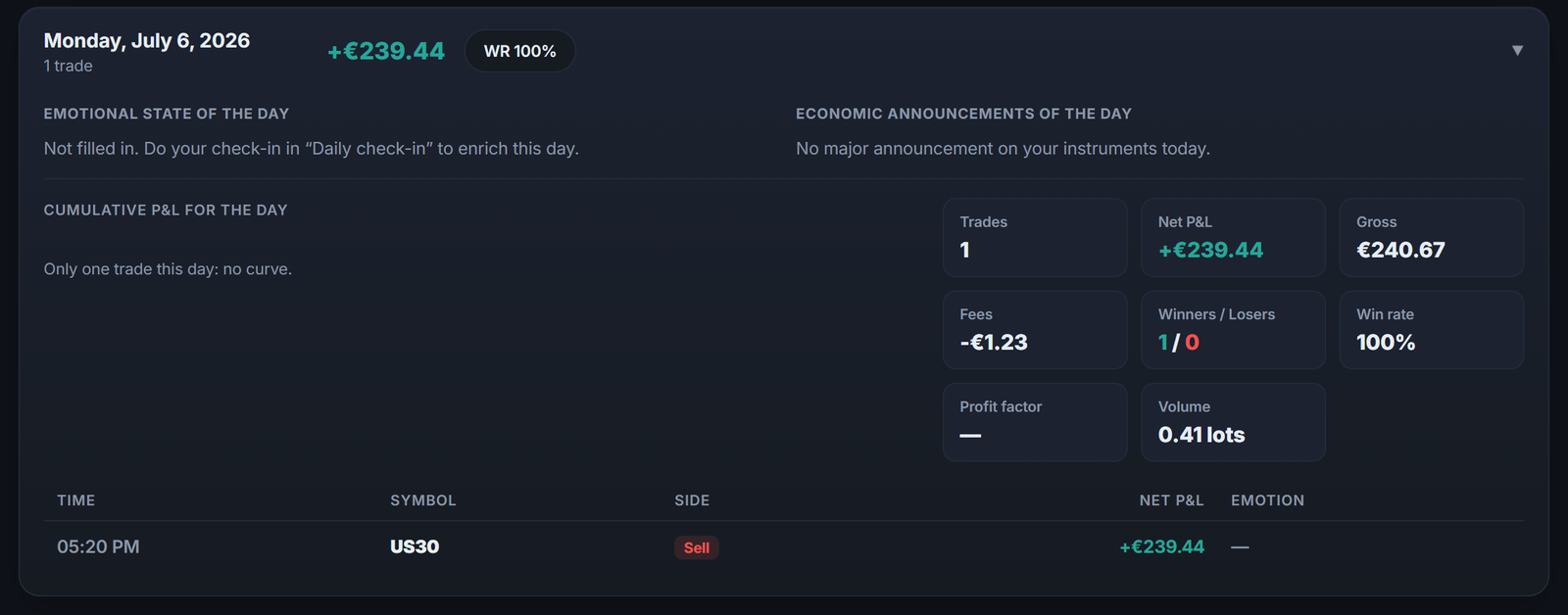
Tradoshi measures your discipline and edge to place you on this path and show you you're progressing, even when profitability isn't there yet.
- Discipline score: it measures your progress on the skill that decides the tipping point.
- Expectancy and average R: they tell you whether your edge is real, regardless of your last trades.
- Progress tracking: your streaks of disciplined days show you you're truly advancing.
- Emotion → performance: it helps you reach the psychological awareness, the decisive stage.
Frequently asked questions
How long does it take to become a profitable trader?
No study gives a duration. The ones that follow day traders mostly show that time alone is not enough: in Brazil, among the individuals who day traded the mini-Ibovespa contract for more than 300 days, 97% lost money, and the authors find no evidence of learning. The path is told in stages (beginner's luck, first drawdown, strategy quest, psychological awareness, discipline, profitability), but what counts is what you do with your practice, measurement and risk management included, not how long it lasts.
What are the stages from beginner to profitable trader?
Six predictable stages: beginner's luck (easy gains wrongly attributed to talent), the first real drawdown (where many quit), the quest for the perfect strategy (seeking the solution in the wrong place), the psychological awareness (the problem is me), building discipline, and finally lasting profitability as the quiet culmination of all this work.
Why is beginner's luck a trap?
Because it makes you attribute to your talent what comes from chance and favorable conditions. It installs unearned confidence and bad habits: since everything works, you feel no need to manage your risk or discipline yourself. You learn the worst possible lesson, that trading on feel pays, and that lesson will be billed dearly at the first drawdown.
Should I change strategy when I'm not profitable?
Not before you have measured. Changing method at every losing streak prevents you from knowing whether the problem comes from the strategy or from your execution. First look, on your own trades, at what share of your losses comes from off-plan trades or from too much risk. If your execution is clean over a sufficient sample and the expectancy stays negative, then the strategy is the issue.
What really tips you toward profitability?
Psychology and discipline, not a better strategy. The decisive turning point comes when you stop seeking the solution outside and realize your losses come from what you do when money is at stake (revenge, over-risk, decisions under emotion). From there, the work becomes building the discipline to execute a correct method, which opens the door to lasting profitability.
How do I know if I'm really progressing?
By measuring your discipline and edge, not just your account. Profitability arrives late in the path, but you can see well before that your discipline is improving and your edge is real. A rising discipline score, streaks of controlled days and a positive expectancy show you you're advancing, even when it doesn't yet show in your capital curve. That's what gives you the perseverance to continue.
How many trades does it take to know if my system works?
There is no number that holds for every system: it depends on the win rate and on how spread out the gains and losses are. Ten or twenty trades are not enough to decide: on a system that wins one time in two, five losses in a row starting from any given trade have a one-in-32 chance of happening. Jumping from strategy to strategy resets the sample to zero and prevents you from judging anything.
How do I know I'm getting closer to profitability?
Three signs to watch for in yourself: losses that trigger less panic or anger, fewer and fewer off-plan trades, and attention moving from the day's result to correctly executing the plan. They are not proof of profitability to come: only your numbers, over a sufficient sample, can say that.