 By Benjamin Roure L'Hermitte

Two million pounds. That is what Barings' account 88888 in Singapore was hiding at the end of 1992. End of 1993: twenty-three million. End of 1994: two hundred and eight. On 27 February 1995: eight hundred and twenty-seven, about 1.3 billion dollars at the time. All that while, the man who ran the account, Nick Leeson, was telling London he was making money. On the evening of Sunday 26 February 1995, Britain's oldest merchant bank, founded in 1762, could no longer trade.
- Nick Leeson, 27 when the big losses came, ran Barings' subsidiary on the Singapore exchange. He hid losses that reached £827 million in an error account numbered 88888.
- Meanwhile, he reported profits. From 1 January to 24 February 1995, London saw £18.6 million in profits. The hidden account lost £619 million from 1 January to 27 February.
- The Kobe earthquake was not the cause. By the end of 1994, £208 million was already gone. Most of the rest came from the contracts he bought afterwards, trying to win it back.
- The lesson for you: a loss you hide does not go away, it grows. Trading without lying to yourself starts with a record you cannot edit yourself.
Nick Leeson is often described as a genius gone mad, or as the victim of an earthquake. The documents show something else: a young man who knew the machinery of control, who hid a first loss, then another, and who increased his stake every time the hole got deeper. This portrait relies on the Bank of England report of 18 July 1995 and on the newspapers of the time. Amounts are in pounds sterling of the day, and anything that rests only on Leeson's own account is flagged.
Who is Nick Leeson?
Nicholas William Leeson was born on 25 February 1967 in Watford, north of London. The son of a plasterer, he grew up in public housing and failed his school-leaving mathematics exam. At eighteen he joined Coutts, a private London bank, as a junior clerk. He then moved to Morgan Stanley and, in July 1989, to Barings, each time in futures and options settlements.
That detail matters for what follows. Settlements is the back office: checking that every trade is recorded, settled and paid. Leeson did not come from trading, he came from control, and he knew where the books were checked. In 1991 he even oversaw part of an internal inquiry into an employee who had suppressed a late margin report. In early 1992, Barings asked the British regulator to license him. The regulator found that he had failed to disclose a court judgment for a small unpaid debt, and the application was dropped. Leeson was never licensed to trade in London.
Barings, a bank founded in 1762
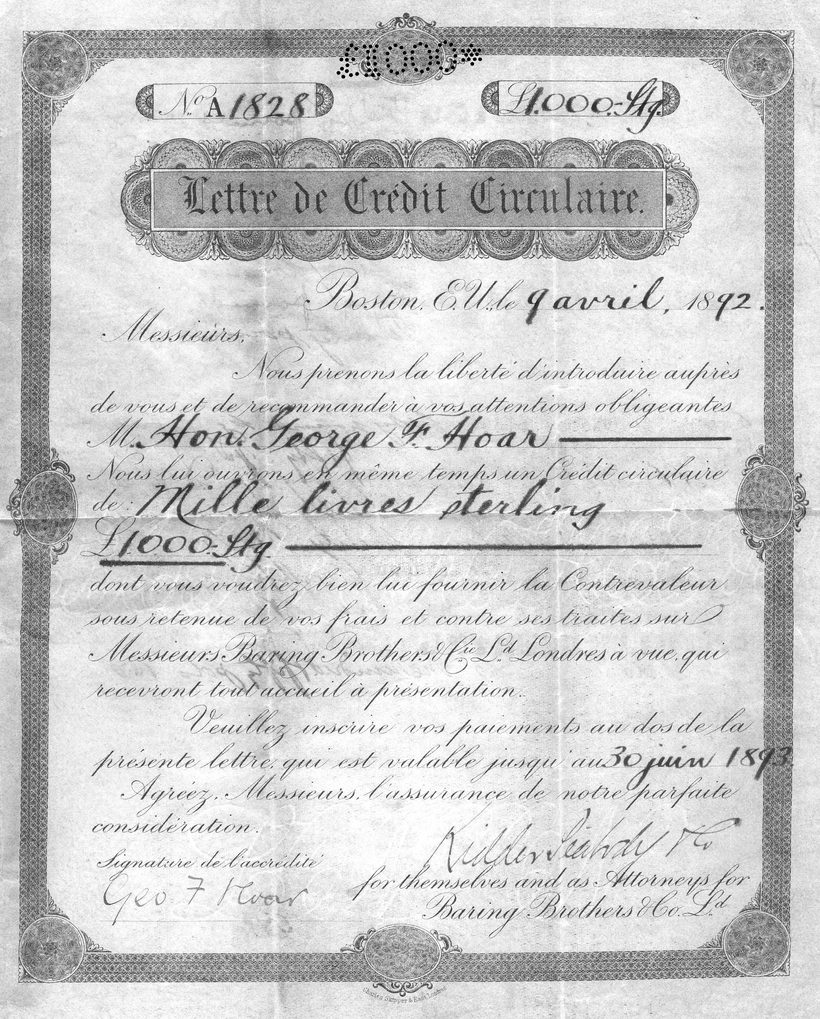
Barings was founded in London in 1762 by the sons of an immigrant from Bremen. It helped finance the Louisiana Purchase by the United States and Britain's wars against Napoleon, and the Duc de Richelieu is credited with calling the Baring family the "sixth great power of Europe". In 1995 it employed about 4,000 people. It was neither the oldest bank in the world nor the Queen's bank, as you often read, but Britain's oldest merchant bank. The royal family's bank is Coutts, where Leeson had started out.
Singapore, 1992: one man at both ends of the chain
In March 1992, aged 25, Leeson arrived in Singapore to run the back office of Baring Futures, the subsidiary trading on SIMEX. That exchange listed the same products as the Japanese exchanges, including the futures contract on the Nikkei 225 index, which made arbitrage between the two countries possible. A fax dated 24 March stated that he would also run the trading floor operation. The next day, the bank's regional director warned in writing of a structure "which will subsequently prove disastrous", with which the bank could end up "losing either a lot of money or client goodwill or probably both". From the start, the same man would place the orders and control how they were recorded.
In early July 1992, account 88888 was opened. It was set up as a client account and described as an error account, the place where small execution mistakes are parked. Around 8 July, according to a systems consultant to the subsidiary, Leeson asked him to remove the account from every daily report sent to London except one, the margin file. The Bank of England report concluded that he appears to have intended to use it for unauthorized activity from the outset. Leeson refused to cooperate with the inquiry, and his lawyers called its conclusions inaccurate, without saying on which points.
His own version has never changed. He says he chose the 8 because it is lucky in Chinese culture, and that he first used the account on 17 July 1992 to cover a young trader's mistake of about £20,000, rather than have her fired. No independent source confirms this account, and the instruction given to the consultant came nine days before it. By 30 September a false confirmation of the account was already being produced for the auditors. In late 1992 Leeson passed the SIMEX exams, began trading on the floor himself and became general manager of the subsidiary.
Account 88888: 2, 23, 208 million
The official report traces the growth of the hidden losses: £2 million at the end of 1992, £23 million at the end of 1993, £208 million at the end of 1994. To keep anyone from seeing them, an accounting entry brought the account back to zero at almost every month end from February 1993 to January 1995, and was reversed the next day. On the day anyone looked, the account showed zero. The month-end bank reconciliation was signed by Leeson himself.
Meanwhile, London saw profits. Baring Futures reported arbitrage profits presented as riskless, and in 1994 the unit booking them earned more than the whole banking side of the group. In September 1994, at the annual SIMEX dinner, the subsidiary was named "Number One Volume House", the firm that had traded the largest volume.
| Period | What London saw | What account 88888 was hiding |
|---|---|---|
| Every month end, February 1993 to January 1995 | An error account at zero | The loss, back the next day |
| The year 1994 | At least £28.5 million in arbitrage revenue | £185 million in losses over the year |
| 1 January to 24 February 1995 | £18.6 million in reported profits | £619 million lost from 1 January to 27 February |
Success bought silence. Before the inquiry, witnesses spoke of a "star trader" nobody wanted to see roughed up. One summed up the mood: "for God's sake don't interfere". Another admitted that everyone found those profits very puzzling, and that they accepted them anyway. Leeson benefited too: his bonus went from £35,746 for 1992 to £130,000 for 1993, and £450,000 was proposed for 1994, never paid. The report could not conclude that money was his main motive.
Written rules that nobody enforced
The most troubling part is that the rules existed. Leeson was allowed neither to hold open positions overnight nor to sell options for the bank's own account. He did both for more than two years. In October 1994, an internal audit found "a significant general risk that the controls could be overridden by the General Manager", because he ran both the front office and the back office. It recommended taking the back office away from him. The recommendation was never implemented.
Nor was account 88888 invisible. The back office in Singapore booked trades to it every day, SIMEX had flagged it, and it appeared in a file sent to London every day, which nobody read.
His real strategy: selling volatility
What was in the account? From the end of 1992, Leeson sold options on the Nikkei, mostly as straddles: a call and a put sold at the same strike price. As long as the index stayed calm, he pocketed the premiums. If it moved sharply, in either direction, the loss accelerated. The option Greeks exist to measure that exposure. Leeson did not hedge it, apparently had neither a pricing model nor a risk system, and the report calls his products "very simple": it was not their complexity that sank Barings.
In essence, he had bet that the Nikkei index would stay calm, around 19,000 points. At the end of 1994, to plug the hole, he brought the account back to zero with a fictitious premium of about £50 million, attributed to a New York firm that later said it had never known anything about the deal.
January 1995: Kobe, then the doubling
On Tuesday 17 January 1995, at 5:46 a.m., an earthquake struck the Kobe region of Japan, killing more than 6,400 people. Japanese markets fell away: exactly the kind of sudden move that hurts an option seller. Leeson did not cut. On Friday the 20th, within a few hours, he bought 10,814 Nikkei contracts. On Monday the 23rd, the index fell 1,055 points, or 5.6%. He closed out during the day, lost £34 million, then started again: 27,158 contracts by the end of the week. On 26 January, the asset and liability committee in London had him told not to increase his positions any further. The instruction was ignored.
On Monday 30 January, the market rose 700 points. That day Leeson had wiped out his futures losses since Kobe: he could have got out, at least of that part. He kept buying. On 1 February he misreported his positions to SIMEX, which released $115 million in margin. On the 2nd he produced a falsified payment slip to make the auditors believe the year-end receivable had been paid. The header on the confirmation showed it had been sent from the fax at home. Those two acts are the ones he would be convicted for.
On 6 February, the cumulative loss reached £253 million. Over the next sixteen days, the report says, Leeson doubled his long position, to more than 60,000 contracts. At the same time he was short Japanese government bond futures, which were rising: he was losing on both sides. To pay the margin calls, London and Tokyo sent money with no independent check, and funding to the subsidiary reached £742 million on 24 February, more than twice the group's reported capital. Leeson was still reporting profits. In early February, one manager marveled: "That guy is a turbo arbitrageur!"
23 February 1995: the escape
In mid-February, a settlements employee sent from London found that Singapore's funding requests matched nothing and that billions of yen were missing. Leeson, reported ill, did not come into the office on 20 and 21 February. On the evening of the 22nd, when the employee finally told him the money was missing, he answered: "Yes, I agree with you."
On Thursday 23 February, the Nikkei fell again. Every 100-point drop cost him £20 million, and the day cost him £65 million. Account 88888 then held the equivalent of 49% of the open interest in the March Nikkei contract on SIMEX. That is not "half the Japanese market", as you sometimes read, but it is nearly half of a contract in the hands of a single account. Around 4 p.m., Leeson left the office and never came back. That evening he left for Kuala Lumpur with his wife. The next day he faxed his resignation to two executives in Singapore, with his "sincere apologies for the predicament" he had left them in. The "I'm sorry" note he supposedly left on his desk rests on no solid source. On Saturday the 25th, he turned 28 on the run.
Over the weekend, the Bank of England searched for a rescue. The British banks were ready to recapitalize, provided the losses on the contracts still open could be capped, which proved impossible. On the evening of Sunday 26 February, Barings went into administration. The next day the loss was put at £827 million. In the House of Commons, Chancellor of the Exchequer Kenneth Clarke described an incident "centred on one rogue trader in Singapore". On 5 March, ING bought the bank for a symbolic one pound, taking on the debts and putting in £660 million. Leeson was arrested on 2 March in Frankfurt, off a flight that had left from Borneo.
The trial, prison, and after
The Bank of England report, published on 18 July 1995, found unauthorized and concealed trading and a failure of controls that the bank's chairman had called "absolute". "We agree", the inquiry wrote. In October, the Singapore report blamed management. The two reports contradicted each other on what management knew, and no executive was ever criminally prosecuted. Leeson is the only person who was convicted.
Germany granted his extradition. He dropped his appeal and went back to Singapore in November. On 1 December 1995 he pleaded guilty to two counts of cheating out of eleven, and the next day he was sentenced to six and a half years: six years for the falsified slip meant for the auditors, six months for deceiving SIMEX. He has always maintained that he did not steal any money. He was diagnosed with colon cancer in prison in 1998. He walked out on 3 July 1999, at the end of the standard one-third remission, after four years and four months in custody. In the years that followed, he took a psychology degree, ran the Irish football club Galway United and gave talks on risk.
What he says about himself
The report describes the acts. For the inner mechanism you have to listen to Leeson, keeping in mind that this is his word, after the fact. In September 1995, from his Frankfurt prison, he told the BBC: "I was frightened of quantifying the amount", and "stupid as it may sound, none of this is really real money". In 2005 he concluded that it was not pride that kept him from owning up, but "actually my status in Barings", because everyone around him had bought into his success. In 2016: "I saw asking for help and advice as a sign of weakness", and "it was pure survival".
Not every day is a down day. So it adds to your belief that you can do it. Unfortunately, I lost more than I won. (Nick Leeson, interview with David Frost, BBC, September 1995, as reported by the Associated Press)
Five lessons for trading without lying to yourself
You are not managing £800 million. But the mechanism that sank Barings fits inside a retail account. Account 88888 is trading without lying to yourself, turned inside out: lying to others, then to yourself, and sizing up so you never have to look at the number.
1. A hidden loss never closes
Leeson did not start with £827 million, but with an account removed from the reports, then a false confirmation, then an entry at every month end. Each cover-up required another. For a retail trader, account 88888 takes other forms: the trade you do not log because it "doesn't count", the loss deleted from the spreadsheet because it was "an exception". A loss you do not look at keeps growing, just without a witness.
2. Doubling up to win it back makes the next position bigger
After Kobe, every loss made the next position bigger: 10,814 contracts, then 27,158, then more than 60,000. That is the logic of revenge trading taken all the way. Doubling your size does nothing to the odds of the next trade, it only changes what that trade costs if it fails. And your risk of ruin climbs all the faster when your size grows after each loss.
3. The day you get back to zero is the most dangerous one
On 30 January 1995, Leeson was back to zero on his futures. The next day he was buying again. Getting back to breakeven does not reassure you, it makes you feel you were right to hold on and pushes you to play bigger. If a disastrous day ends at zero, close the platform. Decide in advance what you will do on that day.
4. A record you can edit yourself is no longer a record
The 1994 audit sums up the flaw: the same man could initiate a trade, then make sure it was recorded the way he wanted. A retail trader is in exactly that position, his own front office and his own back office. The defense is to take control out of your own hands: a daily loss limit set before the session, written risk management rules, and a trade history you do not get to pick. That is the point of a trading journal like the Tradoshi Trading Journal, which pulls in your trades from your broker or your statement: losses get in even on the days you would rather not see them.
5. A gain that looks too good is an alarm
In 1994, an activity presented as riskless was earning more than the whole banking side of the group, and nobody really asked how. Selling volatility means stringing together small gains and keeping one single day to lose it all. If your equity curve rises too smoothly with a strategy you believe is safe, look for what you sold to get it. The portrait of Jesse Livermore already showed it: the moment you feel strongest is when you are closest to breaking your own rules.
Frequently asked questions
Who is Nick Leeson?
Nick Leeson, born in 1967 in Watford, is the former general manager of Baring Futures, the Singapore subsidiary of Barings bank. From 1992 to 1995 he hid losses of £827 million in account 88888, which caused the bank's collapse in February 1995. He was sentenced to six and a half years in prison after pleading guilty to two counts of cheating.
How much did Nick Leeson lose?
£827 million at 27 February 1995, about 1.3 billion dollars at the time, according to the Bank of England report. After the positions were closed out, the final cost reached £927 million.
What was account 88888?
An account at Baring Futures opened in early July 1992, set up as a client account and described as an error account. Leeson parked his losses there and had it removed from the daily reports sent to London.
Why did Barings Bank collapse?
The hidden losses, £827 million, far exceeded the bank's equity of £354 million at the end of 1994, and nobody could cap the losses on the contracts still open. The official report concluded that it was Leeson's ability to act without authority and without detection that brought the bank down.
Did the Kobe earthquake sink Barings?
No. By the end of 1994, before the earthquake, £208 million had already been lost. Most of the later losses came from the contracts Leeson bought afterwards, trying to win his losses back.
How long was Nick Leeson in prison?
Four years and four months, from his arrest on 2 March 1995 to his release on 3 July 1999. His six-and-a-half-year sentence was cut by a third under the standard remission, not on health grounds: that request had been refused.
Official reports and period press
- Bank of England, Report of the Board of Banking Supervision Inquiry into the Circumstances of the Collapse of Barings, HC 673, 18 July 1995. Source of the amounts, the dates and the statements of Barings managers.
- Hansard, House of Commons, debates of 27 February 1995 and 18 July 1995.
- Report of the Singapore inspectors, 17 October 1995, known through the press: UPI, 17 October 1995.
- Los Angeles Times, 7 March 1995 (resignation letter) and 2 December 1995 (sentence).
- Associated Press, 11 September 1995, on the BBC interview. Later interviews: The Irish Times, 23 August 2005, Ivey Business School, 26 July 2016.
- Illustration: 1892 letter of credit, public domain, via Wikimedia Commons.