 By Benjamin Roure L'Hermitte

Forex, or the foreign exchange market, is where currencies are traded against each other, twenty-four hours a day, five days a week: the Bank for International Settlements measured $9.6 trillion of trading per day in April 2025. Understanding what forex trading is matters because major pairs are accessible with little capital and the market almost never closes on weekdays. This guide explains simply how a quote works, how sessions are structured, what regulators impose on leverage, and what sets this market apart from others.
- Forex is currency exchange in pairs: you buy one currency by selling another.
- The market runs 24 hours a day on weekdays because trading centres in Asia, Europe and America take turns: London and New York alone account for more than half of all trading.
- Spread and pip are the basic units for reading a quote and computing transaction cost.
- Leverage amplifies everything, gains and losses alike: regulators cap it for retail clients, at 30:1 on major pairs in the European Union.
Unlike a stock or a commodity, a currency only has value relative to another one. That's what makes forex a bit confusing at first: you never trade a single asset, you always trade a ratio between two currencies. Understanding this basic mechanism changes the way you read any quote, and it's the first thing to absorb before getting started.
This guide starts from the simplest possible definition and builds up progressively: what a currency pair is, how to read a price, who participates in this market, how sessions work, and why leverage fundamentally changes the risk profile compared to other markets.
What forex is
The word forex comes from the contraction of 'foreign exchange'. This market exists because every country has its own currency, and international trade, tourism, and cross-border investment constantly require converting one currency into another. A European company buying goods from the US has to convert euros into dollars, a traveler abroad has to exchange their currency, and these flows, multiplied across thousands of participants, form the basis of the currency market. Their size is measured: according to the 2025 Triennial Survey of the Bank for International Settlements, trading averaged $9.6 trillion per day in April 2025 across all instruments, 28% more than in April 2022, and spot trading, the immediate purchase or sale of one currency against another, accounted for only 31% of it.
Forex has no single physical location, unlike a stock exchange. It's a decentralized, over-the-counter market: the BIS 2022 survey characterises FX markets globally as OTC markets, and the National Futures Association's brochure on retail forex, from the self-regulatory organization of the US futures industry, notes that it has no central trading location or exchange, that most trading goes through electronic networks, and that it operates 24 hours a day. That structure explains why the market stays open continuously on weekdays: when one centre closes somewhere on the planet, another is already open elsewhere, and retail brokers present the trading week as running from the Asian open on Monday morning to the New York close on Friday evening.
How a currency pair works
In forex, you never trade a single currency: you always trade a pair, made up of a base currency and a quote currency. The EUR/USD pair, for example, expresses how many dollars it takes to buy one euro. If EUR/USD quotes at 1.0850, that means one euro is worth 1.0850 dollars. Buying this pair means betting the euro will strengthen against the dollar; selling it means betting the opposite.
Pairs fall into three broad families, a brokers' convention rather than an official ranking. Majors pair the US dollar with another major currency (EUR/USD, GBP/USD, USD/JPY) and concentrate most of the world's volume: in the BIS 2025 survey, the dollar is on one side of 89.2% of all trades, the euro of 28.9% and the yen of 16.8%. Minors, or crosses, don't contain the dollar (EUR/GBP, EUR/JPY) and remain liquid, somewhat less than majors. Exotics pair a major currency with that of an emerging economy (USD/TRY, USD/ZAR): they trade far less, with wider spreads and a thinner book, which our article on liquidity in trading details.
Reading a quote: pip, spread and bid/ask
Every forex quote actually shows two prices: the bid, the price at which you can sell, and the ask, the price at which you can buy. The difference between the two is called the spread, and it's the implicit cost of every transaction: the NFA brochure explains that banks and dealers make money by selling a currency for more than they paid for it, and that a retail dealer can charge a mark-up by widening the spread it gets from a bank. The more a pair trades, the tighter its spread tends to be: on EUR/USD and USD/JPY, Ito and Hashimoto (NBER, 2006) measure, on EBS transactions from 1999 to 2001, a bid-ask spread that narrows as the number of deals rises. A less traded, exotic pair therefore usually shows a noticeably wider spread.
The pip is the unit for measuring price movements in forex: the NFA defines it as the smallest unit of trading in a foreign currency price, generally the fourth decimal of a quote, and the second for pairs including the yen. If EUR/USD moves from 1.0850 to 1.0855, the price has moved 5 pips. This shared vocabulary lets traders talk about the size of a move or a stop independent of the displayed price, and it's the basis for calculating position size and risk in your account currency. The pipette, the value of a pip per lot and what separates the pip from a point and a tick are in our glossary entry on the pip.
| Term | Definition | Example |
|---|---|---|
| Base currency | First currency in the pair | EUR in EUR/USD |
| Quote currency | Second currency in the pair | USD in EUR/USD |
| Spread | Gap between bid and ask | 1.0850 / 1.0852 = 2 pips |
| Pip | Standard unit of movement | 1.0850 → 1.0855 = 5 pips |
| Standard lot | Forex volume unit | 100,000 units of the base currency |
The four major sessions
Forex runs continuously because financial centres take turns around the globe. Traders' usage splits the day into four sessions, Sydney, Tokyo, London and New York, but their weight is anything but equal: the BIS 2025 survey places approximately 38% of trading in the United Kingdom and 19% in the United States, ahead of Singapore (11.8%) and Hong Kong (7%). What that gives hour by hour is measured: on EBS transactions in USD/JPY and EUR/USD from 1999 to 2001, Ito and Hashimoto find three activity peaks in the day, at the Tokyo opening, in the London morning and during the overlap of the London afternoon with the New York morning, and three troughs, at the Tokyo lunch hour, the London lunch hour, and late in the US day. The spread is narrowest during the London/New York overlap, and widest from mid-afternoon to the evening in New York, when activity is at its lowest. That is the reason to log the session of each trade in a forex trading journal.
Understanding this time structure helps decide when to trade, especially for a beginner looking for more predictable conditions. The same study measures a home-market effect: USD/JPY trades relatively more during Tokyo hours, EUR/USD during London hours, and the euro market is particularly deep in the London morning, and deeper still during the overlap with New York. Trading a pair in the hours when it trades little means accepting a wider spread and a thinner book, two conditions unfavorable to a plan built around normal conditions. As for the 'best time to trade', none of these measurements names it: they say where the activity is, not where your edge is.
Who trades forex
Forex is above all a market of banks and institutions. The NFA brochure describes its first tier, the interbank market, where banks, insurance companies, large corporations and other large financial institutions manage the risks tied to currency fluctuations, a market only available to those who trade in large quantities. Central banks intervene there to manage their reserves or weigh on their currency, commercial banks handle the flows tied to international trade, and funds speculate on interest rate differentials and macroeconomic trends between countries.
Retail traders reach this market through a second tier: the NFA explains that a secondary over-the-counter market has developed, where the customer trades directly with a dealer that is its counterparty and determines the execution price, without the interbank market's prices but with many of its characteristics. At the scale of a market trading $9.6 trillion a day, a retail order moves nothing: it adapts to the moves generated by much heavier players. That's one reason following the economic calendar and central bank decisions stays central in forex.
Leverage, a central ingredient of forex
Forex stands out for the availability of high leverage, which lets you control a position much larger than the capital actually deposited. A leverage of 30:1 means 1,000 euros of margin lets you control a 30,000 euro position. That's what makes a move of a few tenths of a percent meaningful for a small account, in both directions: the NFA brochure takes the example of 100:1 leverage, where a 1% move against you is enough to lose the entire deposit.
That leverage isn't free. For retail clients in the European Union, ESMA's measures on CFDs, announced in March 2018, cap leverage at 30:1 on major currency pairs and 20:1 on the others, require positions to be closed out when the funds in the account fall to 50% of the required margin, and guarantee that a retail client cannot lose more than the funds in the account. In the United States, Section 12 of the NFA's Financial Requirements sets the retail forex security deposit at 2% of the notional value on ten currencies, including the euro, the yen, the British pound and the Swiss franc, which is 50:1 leverage, and at 5% on the others, which is 20:1. The limits product by product, how a margin call works and what it changes for your size are in our article on leverage in trading.
But leverage is a double-edged sword that must be respected absolutely. It amplifies gains exactly as it amplifies losses, and a position oversized relative to capital can turn a normal price move into a severe loss. Leverage creates no edge on its own: it simply scales up whatever happens, for better or worse. That's why a rigorous position size calculation, independent of the maximum leverage offered by the broker, is essential from your very first trades.
Leverage doesn't make a bad trade better: it just makes its consequences faster, in either direction.
How forex differs from other markets
Compared to stocks or commodities, forex has specifics that change how you approach it. First, there's no daily 'close' in the sense a stock trader knows it: the market stays open continuously all week, which imposes a different discipline around trading hours and sleep management for a retail trader. Second, forex is structurally more sensitive to macroeconomic data (interest rates, inflation, employment) than to company-specific news, since a currency reflects the economic health of an entire country.
Finally, the continuous quoting of major pairs spares them, during the week, the gaps a stock can show between two sessions, except at the Monday reopening, and nothing prevents a price jump on a surprise announcement. That liquidity is an advantage for execution, but it doesn't excuse you from managing risk with the same rigor as on any other market: the ease of accessing forex should never be confused with an ease of extracting a regular profit from it.
Common mistakes beginners make in forex
The first mistake is sizing your position from the leverage offered rather than from your risk. A 1,000 euro account with 500:1 leverage, a level no retail client gets from a broker subject to the European or US caps, can technically open a 500,000 euro position, and a move of a few dozen pips is then enough to wipe out all the capital. Regulators have measured what these products do to accounts: the AMF study published in 2014 (in French) counts more than 89% of losing clients among 14,799 French clients active on CFDs and forex over four years, between 2009 and 2013 depending on the broker, with an average loss of 10,887 euros, and observes that the loss grows with the average order size, leverage included, and with the number of orders. ESMA, for its part, notes that 74 to 89% of retail accounts lose money on CFDs in the EU countries analysed by national authorities. Available leverage isn't a recommendation to use it in full: it's a maximum ceiling, and the position size actually suited to you depends only on your stop's distance and the percentage of capital you accept to risk, never on the maximum leverage displayed.
The second classic mistake is ignoring the economic calendar and getting caught off guard by a major release, like US employment figures or a central bank rate decision, which can move a pair sharply. The third is wanting to trade too many pairs at once from the start, spreading your attention thin, rather than focusing on one or two major pairs to learn their usual behavior, active hours and typical reactions to news. Depth on one pair beats breadth across ten. The full path, from the vocabulary to a first order, is in our forex trading lessons for beginners.
How Tradoshi helps you with forex
Whether you're starting on EUR/USD or expanding into minor pairs, Tradoshi centralizes your forex trades in a journal that automatically computes your risk in pips and percentage of capital, without you reaching for a calculator on every position.
- Risk per trade tracked day by day, with sizing that tightens after a loss.
- And our position size calculator, free and without signing up: capital, risk in %, stop loss, it returns your lot size.
- Automatic sync with your MT4/MT5 account, read-only.
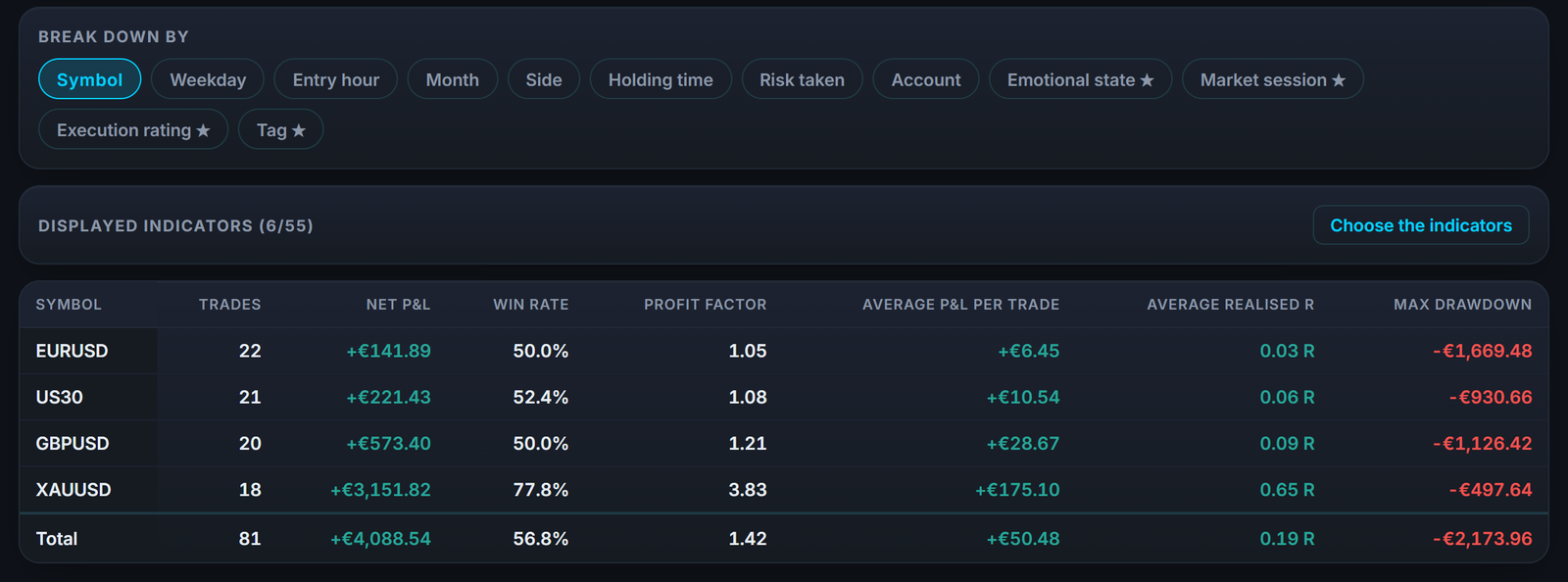
- Per-pair statistics to see where your edge is real across majors, minors or exotics.
- Built-in economic calendar to anticipate releases that move your pairs.
Frequently asked questions
What is forex in trading?
Forex, or the foreign exchange market, is where currencies trade against each other, continuously all week, over the counter between banks, brokers and electronic platforms. Unlike a stock, a currency only has value relative to another one: you always trade a pair, like EUR/USD, never a single currency.
What's the difference between a major, minor and exotic pair?
Major pairs pair the US dollar with another major currency (EUR/USD, GBP/USD) and concentrate most of the volume with the tightest spreads. Minors don't contain the dollar (EUR/GBP). Exotics pair a major currency with that of an emerging economy (USD/TRY), with wider spreads and more irregular liquidity.
What are spread and pip?
The spread is the gap between the buy price (ask) and the sell price (bid) of a pair, an implicit cost of every transaction. The pip is the standard unit for measuring a price move, generally the fourth decimal of a quote. Both concepts are the basis for computing a trade's cost and risk.
Why is forex open 24 hours a day?
Because financial centres take turns around the globe: when one session closes somewhere, another is open elsewhere, and the market has no central exchange setting opening hours. The two largest centres, the United Kingdom and the United States, account for approximately 38% and 19% of trading according to the BIS 2025 survey, and their overlapping hours are the most active of the day.
Who actually trades forex?
First the banks and large institutions, on the interbank market the NFA describes as only available to those who trade in large quantities, along with central banks and funds. Retail traders reach it through an over-the-counter retail market, where the dealer is the counterparty and determines the execution price, with no ability to move the market.
Why is leverage so prevalent in forex?
Because it lets you control a position much larger than the deposited capital, which makes a small move in the quote meaningful for a small account, in both directions: at 100:1 leverage, the NFA's example, a 1% move is enough to lose the deposit. It amplifies gains and losses alike, which requires a rigorous position size calculation.
What leverage can a retail trader use on forex?
In the European Union, ESMA's measures cap CFD leverage at 30:1 on major currency pairs and 20:1 on the others for retail clients. In the United States, the NFA requires a security deposit of 2% of the notional value on ten major currencies, which is 50:1, and 5% on the others, which is 20:1. A 500:1 leverage falls under a different framework, outside those protections.