 By Benjamin Roure L'Hermitte
A program that buys and sells for you, no shaking hands, no hesitation, no checking the news feed before pulling the trigger. That is the pitch behind algo trading. Between the pitch and reality sits messy data, misleading backtests and a fair amount of disappointment. Let's look at it properly.
- Algo trading automates order execution through rules coded in advance, with no manual click at the moment of entry.
- Several families exist: large order execution, systematic quant strategies, high frequency trading, market making, statistical arbitrage.
- Backtesting sits at the center of the process, but a pretty equity curve on historical data guarantees nothing live: slippage, latency and overfitting distort results constantly.
- Getting started requires real coding basics (mostly Python), reliable API access, and a monitoring discipline just as strict as manual trading demands.
What algo trading actually means
Forget the image of a magic robot predicting the market. In its simplest form, algo trading is a set of computer instructions deciding when to buy, when to sell, and how much, based on objective criteria: a price level broken, a moving average crossover, unusual volume, a specific time of day. The program executes. It does not think twice, does not second-guess itself, does not change its mind because it slept badly.
Here is the nuance people skip: automation is not automatically smart. An algo can be as dumb as a single line saying if price crosses above this moving average, buy. And that's fine. The strength of algo trading doesn't come from complexity, it comes from executing the exact same rule a thousand times without fatigue and without bias. A human trader who applies his own strategy perfectly, trade after trade, for months on end? Rare. A machine does it by design.
What really separates algo trading from manual trading assisted by alerts is the absence of a human click at execution. You can have an indicator flagging an opportunity while you place the order yourself, that's discretionary trading with tools, not algo trading. The moment the machine sends the order to the broker without manual approval, you're into the real subject. It is also how European law defines it: under the MiFID II directive (Article 4), algorithmic trading is trading where a computer algorithm automatically determines order parameters, such as whether to initiate the order, its timing, price or quantity, with limited or no human intervention.
The main families of algorithmic strategies
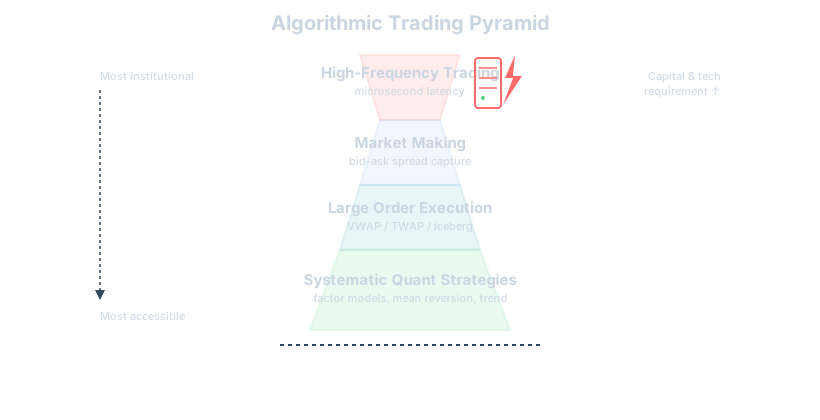
The term algo trading covers very different realities depending on who uses it. A fund that needs to liquidate a ten million dollar position without moving the market has nothing to do with a retail trader automating a moving average crossover on forex. Yet both are doing algo trading. Here are the main families, from most accessible to most institutional.
Large order execution (VWAP, TWAP, iceberg)
When an institution needs to buy or sell a huge quantity of an asset, doing it all at once would blow the price against them. Execution algos slice the order into small pieces spread over time. VWAP (volume weighted average price) aims to execute proportionally to real market volume. TWAP (time weighted average price) splits the order across regular time intervals. The iceberg order only shows a small fraction of the total size on the order book, hiding the rest so other participants don't notice. This kind of algo isn't trying to predict anything, just to get in or out at the best possible average price.
Systematic quant strategies
This is the category that speaks most to retail traders wanting to get in. A systematic quant strategy applies rules based on data: technical signals, fundamental data, correlations between assets. It gets backtested on historical prices, then deployed. The underlying logic often stays close to what a discretionary trader does with, say, moving averages for entries and exits, except the rule is coded and fires automatically, without the trader glued to a screen all day.
High frequency trading (HFT)
Here the scale changes completely. The MiFID II directive characterises high frequency trading by three traits: infrastructure built to minimise latency (co-location, proximity hosting), orders initiated without human intervention, and high intraday message rates (orders, quotes, cancellations). HFT runs on execution speeds measured in microseconds, with servers physically parked next to exchanges to shave off milliseconds of latency. Positions last seconds, sometimes less. This is a game of infrastructure and capital far more than strategy in the classic sense. A retail trader with a laptop and fiber internet simply has no access to this playground, and understanding that early saves a lot of wasted fantasy.
Market making and statistical arbitrage
A market maker places simultaneous buy and sell orders around the current price, capturing the spread between the two. It supplies liquidity to the market and gets paid on volume rather than direction. Statistical arbitrage exploits temporary price gaps between two normally correlated assets, betting on that gap reverting to normal. Both approaches demand extremely fast execution and tight risk control, since per-trade margins are tiny and only become meaningful at scale.
Why automate: the real advantages
The first argument you hear everywhere is removing emotion. That's partly true. An algo won't double its position size after a loss trying to get even, a classic behavior behind revenge trading that wrecks so many accounts. It also won't jump into an entry out of fear of missing the move, the reflex known as FOMO that pushes traders in too late and too big. The rule gets applied exactly as written, trade after trade.
The second advantage, often underrated, is execution speed and precision. A human spotting an opportunity needs several seconds to analyze, decide, click. A program reacts in a fraction of a second. On fast markets that gap literally changes the entry price you get. Not a minor detail on low-margin strategies where every tick matters.
The third advantage, maybe the strongest one, is testing an idea before risking real money on it. Backtesting lets you simulate a strategy against years of historical data and see, with zero risk, whether it would have been profitable. That's a luxury a purely discretionary trader doesn't really have, he can only test his method by living it, trade by trade, in the present. A quant can replay ten years of market history in a few minutes.
Finally, an algo can watch a number of markets and setups no human could track manually. A program can scan a hundred currency pairs or a thousand stocks continuously, while a discretionary trader reasonably focuses on a handful of assets at once. That opens diversification opportunities that would be impossible otherwise.
The risks people don't warn you about enough
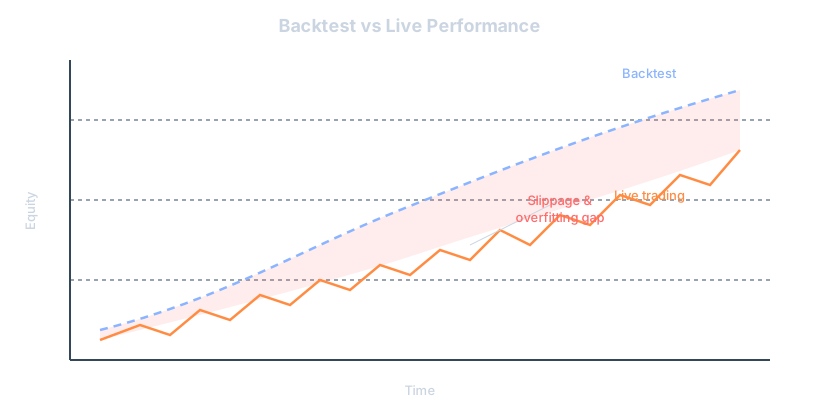
Here's the other side of the coin, and it's where most beginners get burned. Trap number one is overfitting. You tweak your strategy against historical data until you get a gorgeous equity curve, straight up and to the right. The problem: you haven't found a robust strategy, you've found a formula that fits perfectly to past noise. It will collapse on data it has never seen. Mathematicians have shown how easy that is: in the article 'Pseudo-Mathematics and Financial Charlatanism' in the Notices of the AMS, Bailey, Borwein, López de Prado and Zhu explain that it is relatively simple to overfit a strategy so that it performs well on the very history used to build it. This is the most common mistake among beginners hacking together their first Python algo.
Second risk is the gap between backtest and live, sometimes called modeling slippage. Your backtest usually assumes perfect execution at the displayed price. In reality there's spread, latency, partial fills, and sometimes a broker flat out refusing your price during volatility spikes. A strategy showing 15% annual return in backtest can easily land at breakeven, or worse, once it meets real market friction.
Third risk, and it's sneaky: a false sense of safety. Because it's 'automated', some traders stop watching their algo, assuming it just runs itself without attention. A code bug, an API that crashes, corrupted market data, a market regime the strategy never encountered in backtest: any of these can turn a profitable algo into a loss machine within hours, often before anyone notices. The best-known case is the US broker Knight Capital: on August 1, 2012, incorrectly deployed code sent more than 4 million orders in 45 minutes while trying to fill just 212 customer orders, and the loss exceeded $460 million, according to the SEC press release on Knight Capital. Automation removes emotion from execution, it does not remove the need for supervision.
There's also the dumbest but most common risk of all: coding a strategy without ever thinking through its risk management. Plenty of algo trading beginners spend weeks polishing entry logic and five minutes on position sizing. Result: a technically brilliant algo that can still wreck an account because nothing caps the maximum loss. European law actually requires it from professionals: trading thresholds and limits, safeguards against sending erroneous orders, systems that are tested and monitored (Article 17 of the same directive). The basics of money management still apply, whether a human or a machine presses the button.
Skills and tools you actually need to start
Python is the most common starting language for retail algo trading, and a large chunk of professional quant research runs on it too. Libraries like pandas for data handling, numpy for computation, and dedicated backtesting frameworks make entering the field relatively approachable compared to C++, which still rules latency-sensitive environments like HFT shops. You don't need to master pointers and memory management to build a decent swing strategy on daily candles. You do need to understand loops, functions, and how to structure a dataset without turning it into spaghetti.
Beyond code, you need reliable market data and a broker API that actually lets you automate. Many retail brokers offer an API for MT4, MT5 or cTrader, and crypto exchanges generally expose their own. The catch: free or cheap historical data is often riddled with gaps, bad ticks, and survivorship bias (stocks that got delisted simply vanish from the dataset, quietly inflating backtested returns). Paying for clean data isn't glamorous but it's often the difference between a strategy that means something and one that's an illusion built on garbage inputs.
Then there's infrastructure. A simple swing strategy checking prices once a day can run on a laptop with a scheduled script. A strategy holding positions intraday needs a server running continuously, because your laptop going to sleep at the wrong moment can leave a position unmanaged. This is also where concepts like displacement in trading become interesting to formalize into rules, since a sudden directional move is exactly the kind of pattern code can be trained to react to faster than a human eye.
Backtesting properly, not just impressively
A backtest answers one question: how would this exact rule set have performed on this exact historical data? That's it. It doesn't answer whether the strategy will work tomorrow. The first mistake beginners make is testing on too short a window, say six months of a strong trend, and concluding they've found gold. Markets go through ranges, trends, panics and dead zones. A strategy needs to survive all of them, or at least you need to know in advance which regime it's built for.
Walk-forward testing fixes part of the overfitting problem. Instead of optimizing parameters on the full dataset at once, you optimize on a chunk, test on the next unseen chunk, then roll forward. If performance holds up across multiple out-of-sample periods, you have something closer to a real edge. If it only shines on the exact period you tuned it on, you've built a curve-fit, not a strategy.
Transaction costs deserve their own paragraph because beginners forget them constantly. Spread, commission, slippage: these eat into every single trade, and a strategy generating hundreds of tiny trades a day can look fantastic gross and turn negative net once realistic costs are applied. Always backtest with costs baked in, even rough estimates, rather than bolting them on as an afterthought once you're excited about the results. The full method is in our guide on how to backtest a trading strategy.
Algo trading and discretionary trading aren't enemies
There's a weird tribalism online where algo traders look down on discretionary traders and vice versa. Pointless. Plenty of profitable approaches sit in between: a trader reads market structure manually using concepts like auction market theory to understand where value is being built, then uses a small script purely to automate execution once their own conditions are met. That's not full algo trading in the institutional sense, but it borrows the discipline part without requiring you to become a quant developer.
Even fully discretionary traders can borrow the mindset. Writing your setup as a strict checklist, almost like pseudocode, forces a clarity that vague mental rules never give you. If you can't describe your entry condition precisely enough that a computer could theoretically check it, there's a decent chance the rule is fuzzier than you think, and that fuzziness is usually where losses sneak in. The same trade-off runs through the comparison between manual and automated backtesting.
Tracking performance once your algo is live
Here's the part algo traders underestimate: once the code is running, the real work of monitoring begins. Win rate and profit factor don't mean much as single numbers, you need to track them over rolling windows to catch a strategy quietly degrading. The debate around win rate versus profit factor applies just as much to a coded strategy as to a manual one, because a high win rate algo can still bleed money if its average loss dwarfs its average win.
Drawdown monitoring matters even more with automation, precisely because nobody is watching every trade in real time. You want hard circuit breakers: a daily loss limit that pauses the algo automatically, a maximum consecutive losing trades threshold that triggers a review. Without that, a strategy that broke due to a market regime shift can keep firing losing trades for days before a human notices the account bleeding out.
And yes, keeping records still matters, maybe even more than for a discretionary trader, because when something goes wrong you need to reconstruct exactly what the algo did and why. This is where a disciplined habit like keeping a useful trading journal pays off, even for automated systems: logging every trade, every parameter change, every time you manually overrode the algo. That last part matters a lot, because the moment you start manually intervening on an automated strategy, you're quietly turning it into a hybrid system, and you need to know that's what's happening.
How Tradoshi helps you
Tradoshi isn't a coding platform and it won't write your strategy for you, but once your algo (or your semi-automated setup) starts generating trades, you need somewhere honest to see what's actually happening. The journal pulls trades in automatically from MT4, MT5, cTrader and crypto exchanges, or via CSV import, so you're not manually re-typing fills from an algo that might execute dozens of times a day.
From there, the statistics engine gives you win rate, profit factor, expectancy, drawdown, R-multiple and the Oshi Score, which matters a lot when you're trying to tell whether your live results are drifting from your backtest or just going through normal variance. The risk management tools, including the position size calculator and customizable risk rules, help enforce the exact caps your strategy's logic should already respect, as a second layer of protection against a bug or a bad parameter. And if you do intervene manually on an automated system from time to time, Trade Review lets you label that override, add notes, and check plan adherence afterward, so your journal reflects reality instead of a false image of a fully hands-off algo.
Common beginner mistakes worth naming
Chasing complexity too early tops the list. New algo traders often want to combine five indicators, three timeframes and a machine learning layer before they've even proven a single simple rule has any edge. Start stupidly simple. A single moving average crossover, properly tested across years and multiple instruments, teaches you more about the realities of execution and costs than a complex model that nobody, including its author, fully understands six months later.
Ignoring position sizing is another classic. An algo can have a perfectly reasonable win rate and still blow an account if the position size logic scales up aggressively after wins, a mechanical cousin of the same impulse behind overtrading in discretionary accounts. The machine doesn't feel greedy, but if you coded greed into the sizing rule, it will execute that greed flawlessly.
Last one: treating a demo or prop firm evaluation account exactly like a live account without adjusting for the fact that rules differ. If you're testing an algo under a funded program, the daily loss limits and consistency rules of that program need to be coded into your risk logic directly, not just kept in mind. Anyone who has gone through choosing a prop firm knows the fine print around drawdown rules can disqualify an otherwise sound strategy overnight if it isn't respected mechanically.
Is algo trading right for you
Honest answer: it depends on what you actually enjoy doing, not just what sounds impressive at a dinner party. If you like reading charts, feeling market rhythm, reacting to structure as it forms, full automation might frustrate you more than it helps, since it removes exactly the part you find engaging. If you enjoy research, testing, iterating on logic, and you're comfortable with the idea of trusting a system you built rather than your gut in the moment, algo trading fits naturally.
A realistic starting point for most retail traders isn't full automation anyway. It's partial: automate the boring, error-prone part (order execution, position sizing, trailing stops) while keeping judgment for context and discretion where a human still has an edge, like interpreting market concepts from the ICT framework around liquidity and structure that are harder to codify cleanly. That hybrid path tends to be where most individual traders actually land after a year or two of experimenting with both extremes.
Frequently asked questions
Do I need to know how to code to start algo trading?
Yes, at least basic programming. Python is the most common starting language because of its readable syntax and strong data libraries. You don't need to be a software engineer, but you do need to understand loops, conditions and how to structure data.
Is algo trading more profitable than manual trading?
Not inherently. Automation removes emotional execution errors and adds speed, but a bad strategy automated is still a bad strategy, just executed faster and more consistently into losses.
Can I do algo trading with a small account?
Yes for systematic quant strategies on retail platforms. High frequency trading and market making require infrastructure and capital out of reach for individuals, so those stay institutional territory.
What is overfitting in algo trading?
It's tuning a strategy so precisely to historical data that it captures random noise instead of a real pattern. It looks excellent in backtest and usually fails on new, unseen data.
Which markets work best for algo trading beginners?
Liquid markets with low spreads and reliable data tend to be easiest to start with, since execution costs and data quality issues are smaller. Major forex pairs and large cap stocks are common starting points.
Do I need a VPS or server to run an algo?
For intraday strategies, generally yes, since the algo needs to run continuously without interruption. For strategies checking prices once a day, a scheduled script on a personal computer can work, though it's less reliable.
How is algo trading different from high frequency trading?
HFT is a subset of algo trading focused on extreme speed, microsecond execution and infrastructure proximity to exchanges. Most retail algo trading operates on much slower timeframes with no need for that infrastructure.
Should I keep manually overriding my algo once it's live?
Occasional overrides happen, but frequent manual intervention defeats the purpose of automation and turns your system into a hybrid. If you do override, log it so you understand its real impact on performance.
What's the biggest mistake beginners make in algo trading?
Trusting a flattering backtest without accounting for overfitting, transaction costs and slippage. The gap between simulated and live performance is often the single biggest source of disappointment.
Can algo trading and discretionary trading be combined?
Absolutely, and many experienced traders do exactly that: discretionary market reading for context, automated execution for consistency and speed on the mechanical parts of the trade.